
A manager changes an employee's schedule after that employee raises a safety concern. On paper, it looks operational. In practice, it may look punitive. That gap between business intent and legal exposure is where many employers get into trouble.
If you're asking what is an adverse employment action, you're usually not dealing with theory. You're trying to decide whether a termination, transfer, write-up, schedule change, or performance step could trigger a claim. For owners, COOs, and HR leaders, that question matters most in gray-area decisions where the action feels routine but the timing, context, or impact says otherwise.
An adverse employment action is a negative employer action that harms an employee's job status, working conditions, or future prospects. Some examples are obvious. Termination, demotion, and pay reduction usually get immediate attention. The harder cases involve changes that seem smaller but still affect the employee in a meaningful way.
That's why this concept belongs in everyday management decisions, not just legal review. A supervisor may think a schedule change, training denial, or transfer is a normal business adjustment. An employee may see the same decision as punishment for speaking up.
Retaliation is the risk area that shows up again and again. In FY 2021, retaliation charges represented 56.0% of all 61,331 charges filed with the EEOC, making it the most frequently alleged basis of discrimination and a major employer risk, according to EEOC charge statistics summarized here.
That matters because many retaliation claims don't start with a dramatic event. They start with a sequence. An employee complains, participates in an investigation, reports a concern, or supports another employee. Then something changes at work.
Practical rule: If an employee has engaged in protected activity, treat any negative employment decision that follows as a high-review event.
Protected activity can include actions such as:
The mistake I see most often is assuming only major actions create legal exposure. They don't. The issue is whether the action can be framed as harmful and connected to protected activity.
For executive teams, the practical takeaway is simple. Before acting, ask two questions. Did this employee recently do something legally protected, and would this action look punitive if a third party reviewed the timeline?
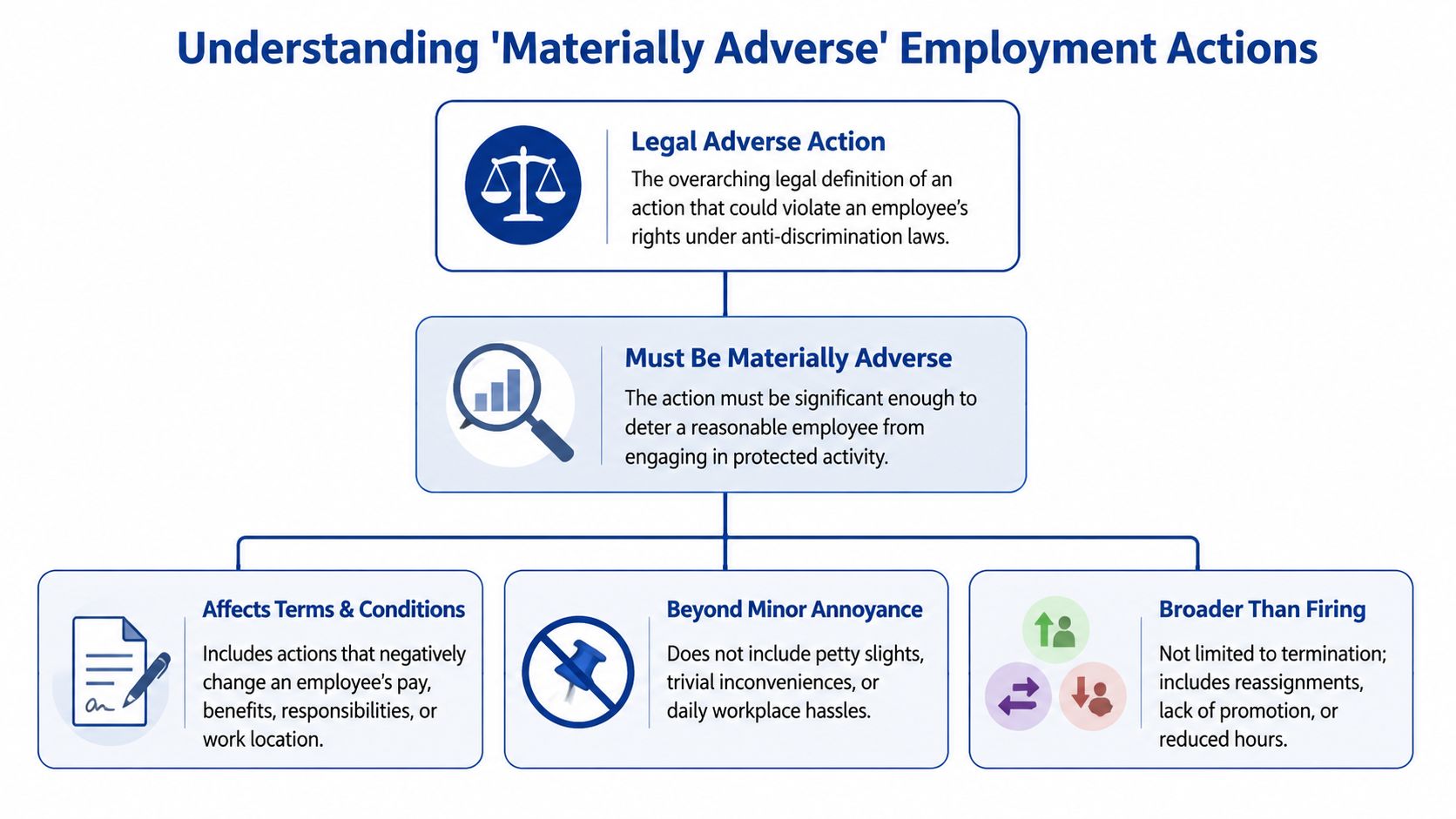
The legal test is broader than many managers expect. Courts don't look only at firing, demotion, or compensation cuts. They ask whether the employer's action would matter to a reasonable employee in that situation.
Under that standard, the question is whether the action might dissuade a worker from making or supporting a discrimination charge. The Supreme Court has also expanded the concept beyond “ultimate employment decisions” to include actions causing “some harm” to employment terms or conditions, as explained in this discussion of the reasonable employee standard and some-harm test.
Many leaders frequently stumble in this area. Not every unpleasant event at work is legally actionable. Courts generally look for something materially adverse, not just annoying, frustrating, or awkward.
A useful way to think about it is this:
The challenge is that “meaningful” depends on context. A lateral transfer may look neutral on an org chart. It may not feel neutral to the employee who loses flexibility, visibility, or a career path because of it.
Timing often gives a routine decision legal significance. If an employee raises a complaint on Monday and gets transferred on Friday, you now have a causation problem even if the transfer was already under discussion. If your file doesn't show that clearly, your business reason may not hold up well later.
That's especially important in at-will environments. Employers often assume at-will status gives wide discretion, but it doesn't erase retaliation or discrimination risk. If your team operates under employment at-will principles, you still need documentation that shows the decision was legitimate, consistent, and not tied to protected activity.
The best defense usually isn't the business reason alone. It's the business reason, documented before the dispute started.
Once an employee shows three things by a preponderance of the evidence, the case becomes more serious:
At that point, the burden shifts to the employer to show the same action would have happened anyway. That's why the legal standard matters operationally. If your managers don't understand materiality, they'll create exposure long before counsel sees the file.
Some actions are so direct that there's little debate about whether they can qualify. The primary question in those cases is usually motive, timing, and documentation, not whether the action itself is serious enough.

These actions change the employee's employment reality in a visible way. They affect compensation, status, opportunity, or continued employment. That's why they should never move through your process casually.
If your managers are using corrective action before one of these decisions, it helps to separate coaching from discipline and discipline from termination planning. A clear framework for disciplinary action reduces the chance that managers improvise language or apply standards unevenly.
If a decision alters pay, title, authority, hours, or advancement, don't treat it as routine. Treat it as reviewable.
The biggest exposure usually isn't the obvious firing. It's the decision a manager thought was safe because it wasn't technically a termination, demotion, or pay cut. These are the cases where employers say, “We didn't do anything that serious,” and plaintiffs say, “You changed my job right after I complained.”
A key challenge for SMBs is the ambiguous “some harm” standard. Courts don't apply it uniformly. As noted in this analysis of different circuit approaches to adverse employment action, the Ninth Circuit uses a broader reasonable employee standard, while the Fifth Circuit applies a narrower ultimate-employment-decisions approach. For multi-state employers, the same manager action can look much riskier in one jurisdiction than another.
Common examples include:
The same action can fall into different legal territory depending on context. That's why a binary checklist isn't enough. You need a practical decision frame.
| Action | Why It's Risky | Mitigation Tactic |
|---|---|---|
| Lateral transfer | May reduce status, visibility, or work quality even without pay loss | Document the business reason, compare duties before and after, and assess whether the employee is losing meaningful opportunities |
| Schedule change | Can impose a substantial burden on family obligations, commute, or earning potential | Show objective operational need, review timing carefully, and test alternatives before implementation |
| Mandatory counseling | May look corrective or stigmatizing if imposed after a complaint | Clarify purpose in writing, apply consistently, and avoid language that sounds punitive |
| Administrative leave | Often feels disciplinary even when described as neutral | Explain the reason, define expectations, and keep the process consistent across similar cases |
| Denial of training | Can affect advancement and credentials | Tie the decision to objective criteria and document who else was approved or denied |
| Negative reference | Can impair future employment prospects | Centralize reference practices and avoid ad hoc manager commentary |
Before approving a gray-area action, ask:
If a leader can't answer those questions clearly, the action isn't ready. It needs more support, better timing, or a different approach.
Documentation is where good intentions either become defensible or fall apart. Courts evaluate context, and that means your records need to show what happened, why it happened, and why the action was legitimate. As explained in CACI guidance on adverse employment action, an action must be “both detrimental and substantial,” affecting the “terms, conditions, or privileges” of employment. Employers need precise documentation to show minor actions weren't material and major decisions were driven by business reasons rather than retaliation.

Strong documentation is specific, dated, and tied to observable facts. It doesn't rely on labels like “bad attitude” or “not a team player” unless the file explains the actual behavior. It also doesn't suddenly appear only after the employee complains.
Use records that show:
Weak documentation usually has one of three problems.
Manager note: If your documentation reads like you're trying to win a fight, it probably won't help you win a case.
A few habits make a large difference:
Scheduling decisions deserve special attention because they're often treated as routine when they're anything but. If your operation relies heavily on shift changes, coverage adjustments, or manager discretion, it helps to review practical ways to avoid costly scheduling mistakes before those issues become both operational and legal problems.
In more complex cases, some businesses use outside advisors to pressure-test decisions before implementation. Firms specializing in this area work with leadership teams on documentation standards, investigations, and defensibility review when a people decision carries increased legal risk.
A defensible workplace usually isn't built through legal language alone. It's built through manager discipline, fair process, and consistency under pressure. When leaders understand the materiality threshold, they stop treating gray-area actions as harmless just because they aren't terminations.
Fair practice doesn't mean avoiding hard decisions. It means making those decisions with a record that shows legitimate reasons, comparable treatment, and thoughtful timing. Employees notice that. So do agencies, judges, and juries.
The strongest organizations do a few things well:
What is an adverse employment action, in practical terms? It's any employer move that materially harms an employee's work situation enough to create legal risk, especially when it follows protected activity. Once leaders start using that lens, they make better calls.
Fairness and defensibility usually travel together. When they don't, the documentation often reveals why.
For multi-state and regulated employers, the hard part isn't knowing that termination is risky. The hard part is assessing the schedule change, the counseling referral, the lateral transfer, or the discipline step that sits in the middle. Those are the moments that deserve the most judgment.
If your team is weighing a sensitive employment decision, reviewing a retaliation concern, or trying to build more defensible HR practices across locations, Paradigm International Inc. can help you assess the risk before the decision becomes a dispute.