A business owner usually asks what is an at will employment state when a termination decision is already on the table. An employee isn't meeting expectations, a manager wants to move quickly, and someone in leadership assumes the company can end employment because the state is “at will.” That assumption is often incomplete.
At-will employment gives employers flexibility, but it doesn't give them cover for sloppy process, inconsistent treatment, or poorly written documents. For multi-state businesses, the bigger issue isn't the definition. It's the gap between what leaders think at-will allows and what state exceptions, federal law, and internal records support.
At-will employment means the employment relationship can generally end at any time, by either the employer or the employee, for any legal reason or for no reason. In practical terms, that means an employer usually doesn't need to prove “just cause” before ending employment, and an employee usually doesn't have to stay.
That is the default rule across the country, but with one important exception. All 50 U.S. states and Washington, D.C., operate under at-will employment as the default doctrine, with Montana standing as the sole exception since its 1987 Wrongful Discharge from Employment Act established a just-cause requirement for terminations after a probationary period, according to World Population Review’s summary of at-will employment states.

The doctrine gives room to make business decisions without having to maintain an employee indefinitely. If a role changes, performance stays weak, or the organization needs different capabilities, at-will employment usually gives the employer a path to act.
But the word “legal” does most of the work in that definition. An employer can terminate for a legal reason, not an illegal one. That distinction is where many problems start.
A clean way to think about it is this:
Practical rule: If your documents or managers suggest job security, progressive discipline guarantees, or termination only for cause, you may weaken the at-will presumption yourself.
Many leaders hear “at will” and translate it to “we can terminate anyone whenever we want.” That's too broad. The better translation is “we can usually end employment without proving cause, unless a law, a contract, a policy, or our own conduct creates a limit.”
That distinction matters even more if you're comparing at-will vs contract employment. A true contract relationship typically defines duration, termination terms, or cause standards expressly. At-will employment starts from the opposite presumption, but it can still be narrowed by what the employer says and does.
Businesses use at-will status effectively when they treat it as a legal framework that needs support. They issue clear offer letters, maintain handbooks with careful disclaimers, train managers not to make promises, and document performance issues before a termination becomes urgent.
What doesn't work is relying on the label alone. If the file is thin, the discipline process was inconsistent, or a supervisor told the employee “you'll always have a place here if you work hard,” the company may have created avoidable risk before the termination meeting ever happens.
The clean legal definition of at-will starts to blur when state exceptions come into play. At this point, the at-will illusion shows up most clearly. A company believes it has broad discretion, but the actual dispute turns on something narrower, like a handbook sentence, a retaliation theory, or a supervisor’s promise.
For multi-state employers, this isn't a fringe issue. A key angle for multi-state operators is the complexity of state-specific exceptions. For instance, 38 states recognize public policy exceptions, 36 imply contractual limits via employee handbooks, and 11 enforce good faith duties. Data from Thomson Reuters highlights how wrongful termination suits have risen 15% in multi-state firms per 2024 BLS litigation trends, as summarized by Paycor’s review of employment at-will laws by state.

An employer usually can't terminate someone for reasons that violate a state's public policy. The classic examples involve firing an employee for doing something the law protects or for refusing to do something the law forbids.
A business owner might see this in situations like these:
The practical mistake is timing. Leaders often focus on whether they were frustrated with performance, but a court or agency may focus on what protected activity happened right before the discharge.
This is one of the most common ways employers accidentally weaken at-will status. No one signs a formal employment contract, yet company documents or manager statements still create an argument that the employee could only be terminated under certain conditions.
Common risk points include:
This is why handbook review matters. If your policies read like promises rather than guidelines, your company may be giving away flexibility without realizing it. For employers trying to understand how these disputes are evaluated in real litigation, resources discussing the average wrongful termination settlement in California can help frame why documentation and wording matter long before a claim is filed.
A handbook should guide conduct and process. It shouldn't quietly rewrite the employment relationship.
If you're already seeing tension between policy language and a pending termination, it's worth reviewing common employer mistakes in wrongful termination decisions.
Some states recognize a duty that limits terminations made in bad faith. This is narrower than many people assume, but it matters in the right fact pattern.
A familiar example is compensation. Suppose an employee is about to receive an earned commission, bonus, or payout, and the employer terminates them primarily to avoid paying it. In states that recognize a good faith exception, that motive can become the center of the dispute.
The key issue isn't whether the company had an at-will policy. It's whether the company used that policy in a way a court sees as opportunistic or unfair.
A termination challenge often doesn't attack at-will employment itself. It attacks the exception. That means business owners need to ask better questions before acting:
Those questions are usually more important than whether your state is generally at will.
The phrase what is an at will employment state sounds simple, but state application isn't uniform. Some states preserve a stronger at-will presumption in day-to-day practice. Others recognize more pathways for employees to challenge a discharge.
For a growing business, the issue isn't just where the company is headquartered. It's where the employee works, where the handbook applies, where the manager sits, and which state-specific rules shape the dispute if the relationship ends.
State systems show a meaningful range in how much of the workforce is subject to broad at-will treatment. State government workforces illustrate at-will's practical impacts, with broad at-will states like Texas at 100% of workforce at-will and Kansas at 58% exhibiting turnover rates 2 to 5 times higher than the federal government, compared to limited at-will states like Washington at 6%, according to The Partnership for Public Service analysis on what the federal government can learn from states.
That doesn't mean private employers can use those figures as a direct operating rule. It does show that “at will” exists on a spectrum in practice, and that the employment environment can affect retention, stability, and workforce behavior.
Even in a strongly at-will state, employers can't terminate for unlawful discrimination, unlawful retaliation, or other prohibited reasons under federal law. That means an at-will policy doesn't override obligations tied to race, sex, disability, age, religion, national origin, or protected complaints and leave rights.
Many leadership teams misread risk. They evaluate the local at-will doctrine and overlook the federal overlay. In actual disputes, the claim often isn't “you lacked cause.” It's “you acted for an unlawful reason” or “your stated reason was a pretext.”
The safest question before a termination isn't “Are we in an at-will state?” It's “If this decision is challenged, what lawful reason will our records prove?”
| State | Public Policy Exception | Implied Contract Exception | Good Faith & Fair Dealing Covenant |
|---|---|---|---|
| Montana | Limited by just-cause framework after probationary period | May arise depending on documents and conduct | Greater caution required because at-will is not the default after probation |
| Texas | Recognized in a narrower at-will environment | Risk depends on employer language and practices | Generally treated more favorably to employer discretion |
| California | Broadly important in practice | Frequently litigated when handbooks or statements suggest job security | Commonly treated as a meaningful risk area |
| Washington | Public policy issues matter | Employer documents can still create exposure | Requires careful state-specific review |
| Florida | At-will framework is generally employer-friendly | Disclaimers still matter to preserve flexibility | Employers still need disciplined process |
The table isn't a substitute for legal advice. It is a reminder that one national policy rarely solves every state issue by itself.
Companies handle this well when they separate what can be standardized from what must be localized. Core expectations, documentation standards, and manager training can be company-wide. Handbook supplements, final pay practices, protected activity review, and termination checklists often need state-level adjustments.
What doesn't work is copying one state’s approach across the whole workforce and assuming the phrase “employment is at will” will fix the mismatch.
The legal doctrine matters less than the operational consequences that follow from it. Most business owners don't lose sleep over the phrase “at-will employment.” They lose sleep over the complaint letter, the agency charge, the demand for records, the internal disruption, and the question of whether leadership handled the termination in a way that can be defended.
That is the at-will illusion. Leaders think the doctrine reduces risk on its own. In reality, it often shifts the burden to execution.
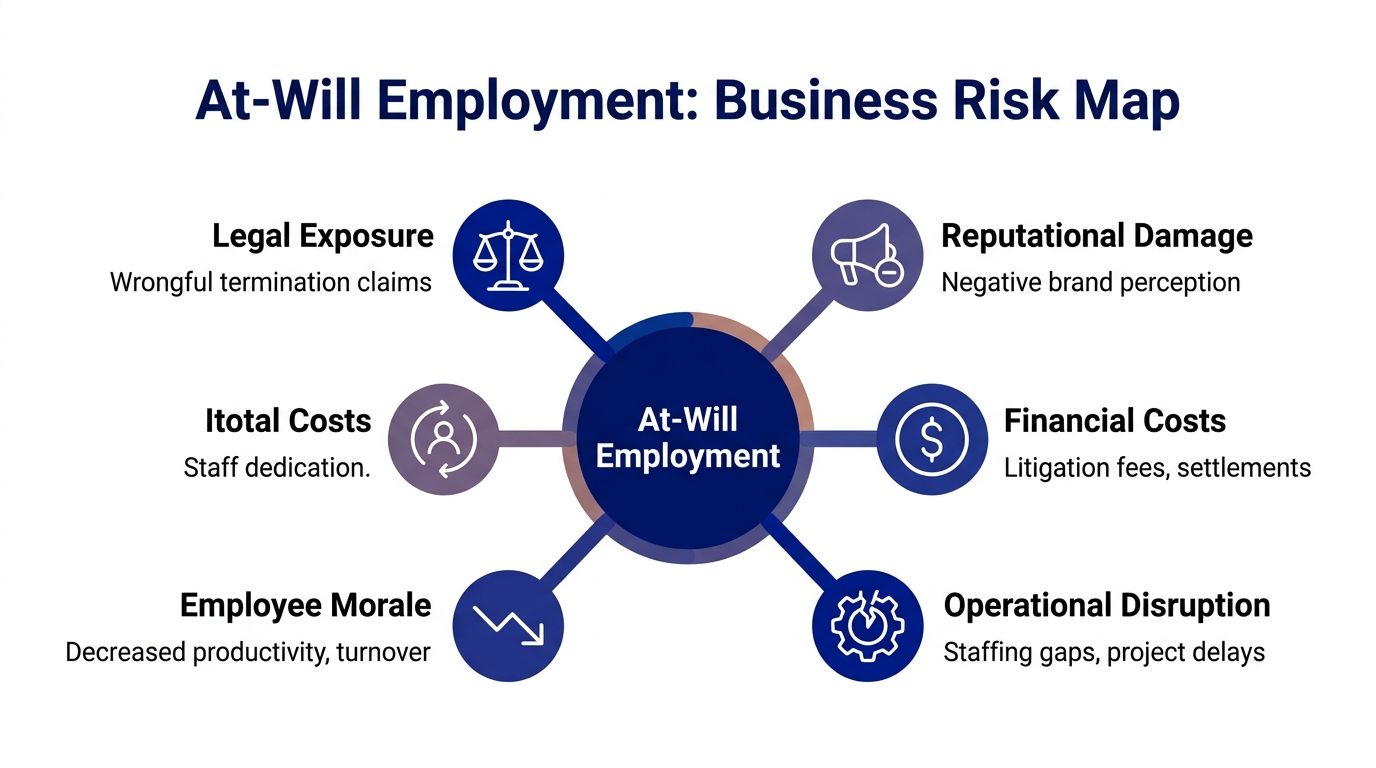
A weak termination process creates several problems at once.
A frequent pattern is that the file tells a different story than the termination meeting. Leadership says the issue was sustained performance failure. The file shows strong reviews, limited coaching notes, and no clear final warning. At that point, the problem isn't the legal concept. It's the mismatch.
At-will status can support flexibility, but it doesn't repair bad facts. If the company ignored its own policy, treated similar employees differently, rushed the decision after a complaint, or allowed a manager to make careless comments, the dispute becomes harder to defend.
This is especially true in multi-state environments. The same termination that looks straightforward to one executive may trigger a very different risk review once someone checks state exceptions, timing, leave history, compensation issues, or prior complaints.
A termination should be easy to explain in one sentence and easy to support with records. If you can do the first but not the second, risk is already rising.
Most employment disputes aren't created at the moment of separation. They are built over months of inconsistent feedback, missing notes, untrained managers, and policy language that sounds firmer than leadership intended.
The business impact usually unfolds in stages:
That's the point where at-will starts feeling less like protection and more like a false sense of security.
A risk-aware leader doesn't ask only whether termination is permissible. They ask whether it is defensible. That means the stated reason is documented, policy application is consistent, timing has been reviewed, and the people involved can explain the decision without contradiction.
This is also where an advisory model becomes useful. Firms specializing in HR advisory services support leadership teams during high-risk moments by helping structure documentation, evaluate termination exposure, and keep decisions aligned across managers and states.
The best use of at-will employment is disciplined, not aggressive. Employers preserve flexibility when their documents are clear, their managers are trained, and their records show a fair, consistent process. Employers lose flexibility when they rely on assumptions.
One of the most practical safeguards is the at-will disclaimer itself. Implementing at-will disclaimers in offer letters and handbooks stating that employment may be terminated at any time by either party, with or without cause or notice can reduce termination litigation risk by 70-80% compared to just-cause regimes when not undermined by implied contracts, and in states like Florida proactive disclaimers have been shown to reduce termination disputes by 40%, as reflected in Wikipedia’s summary of at-will employment.

An at-will disclaimer should be easy to find and hard to misread. It belongs in the offer letter, the handbook, and the employee acknowledgment.
A straightforward example is the language already widely used in this area: employment may be terminated at any time by either party, with or without cause or notice. That language only helps if the rest of your documents don't contradict it.
Watch for policy language that creates accidental promises, including:
For employers revisiting handbook structure, a state-by-state review of employee handbook requirements by state is often a better starting point than a generic template.
A defensible file usually develops over time. It doesn't appear the day a manager decides they are done.
Use a simple operating standard:
Decision test: Before termination, ask whether an outside reviewer could understand the reason for the decision using only the documents in the file.
Many at-will problems begin with supervisor behavior, not legal complexity. A manager promises job security, skips documentation, reacts emotionally after a complaint, or treats one employee differently from another.
Manager training should focus on common pressure points:
This is also where well-written policy architecture matters. Guidance on the power of well-defined workplace policies is useful because policy strength isn't just about coverage. It's about whether managers can apply those rules consistently under pressure.
A short checklist often prevents expensive mistakes. It doesn't need to be complex, but it does need to be used every time.
What works is a system. Clear disclaimers. Careful handbook language. Trained managers. Consistent documentation. A pause for review before high-risk terminations.
What doesn't work is depending on one sentence in the handbook while every other document and manager behavior points the other way.
Some termination decisions should not stay inside a routine manager workflow. They need formal review before action is taken because the risk isn't only legal. It's strategic, operational, and reputational.
The most common red flags are easy to recognize:
This isn't an admission that the decision is wrong. It's a recognition that high-stakes employment actions deserve a higher standard of review. Businesses usually regret the consultation they skipped, not the one they made.
If you're dealing with a termination, handbook language, manager conduct issue, or multi-state employment question, Paradigm International Inc. can help leadership teams evaluate risk, tighten documentation, and approach high-stakes people decisions with a more defensible process.