Navigating federal compliance can feel like a maze, but understanding your obligations is the first step toward clarity. For many business leaders, the term "EEO-1 Report" is a familiar one. This isn't just another piece of administrative paperwork; it's a mandatory annual data survey required by the U.S. Equal Employment Opportunity Commission (EEOC). The report gathers demographic workforce data from private employers and federal contractors, helping the government enforce civil rights laws and ensure equal opportunity in the workplace.
The EEO-1 Report is an annual census of your company's workforce. Mandated under Title VII of the Civil Rights Act of 1964, it provides a demographic snapshot of your employees. Its core purpose is to collect data that helps the EEOC identify and address potential workplace discrimination by looking at who you employ and in what roles.
This report is a critical tool for both federal oversight and internal risk management. The government aggregates this data to analyze national employment trends and enforce anti-discrimination laws. For federal contractors, timely and accurate EEO-1 filing is often a direct condition of maintaining government contracts, making it a non-negotiable compliance task.
Understanding the EEO-1 Report begins with its basic building blocks. The report is structured around a few key data points that every covered employer must provide.
The data collected through the EEO-1 report is confidential, but it plays a significant role in how the EEOC and the Office of Federal Contract Compliance Programs (OFCCP) conduct investigations and enforce employment law.
The EEO-1 report translates your internal HR data into a standardized format, demonstrating compliance with federal equal opportunity regulations. Smart leadership teams view this not just as an obligation but as an opportunity to review their own practices and strengthen their commitment to a fair and equitable workplace. Navigating these requirements can be complex, but you don't have to manage it alone. If you need guidance on your EEO-1 strategy, contact our team to discuss how we can help.
Determining your EEO-1 filing obligation is the first critical step. The answer almost always comes down to two factors: your total number of employees and whether you work with the federal government. Getting this right is key to staying compliant and preparing long before the annual filing window opens.
The EEO-1 report is a mandatory annual data collection. It applies to private employers with 100 or more employees, as well as federal contractors with 50 or more employees and at least $50,000 in federal contracts. These are firm legal requirements, and failing to comply can lead to serious consequences.
The filing criteria are broken down into two main categories. If your business falls into either of these groups during the designated “workforce snapshot period,” you are required to file.
This decision tree offers a quick visual to help you determine where your business stands.
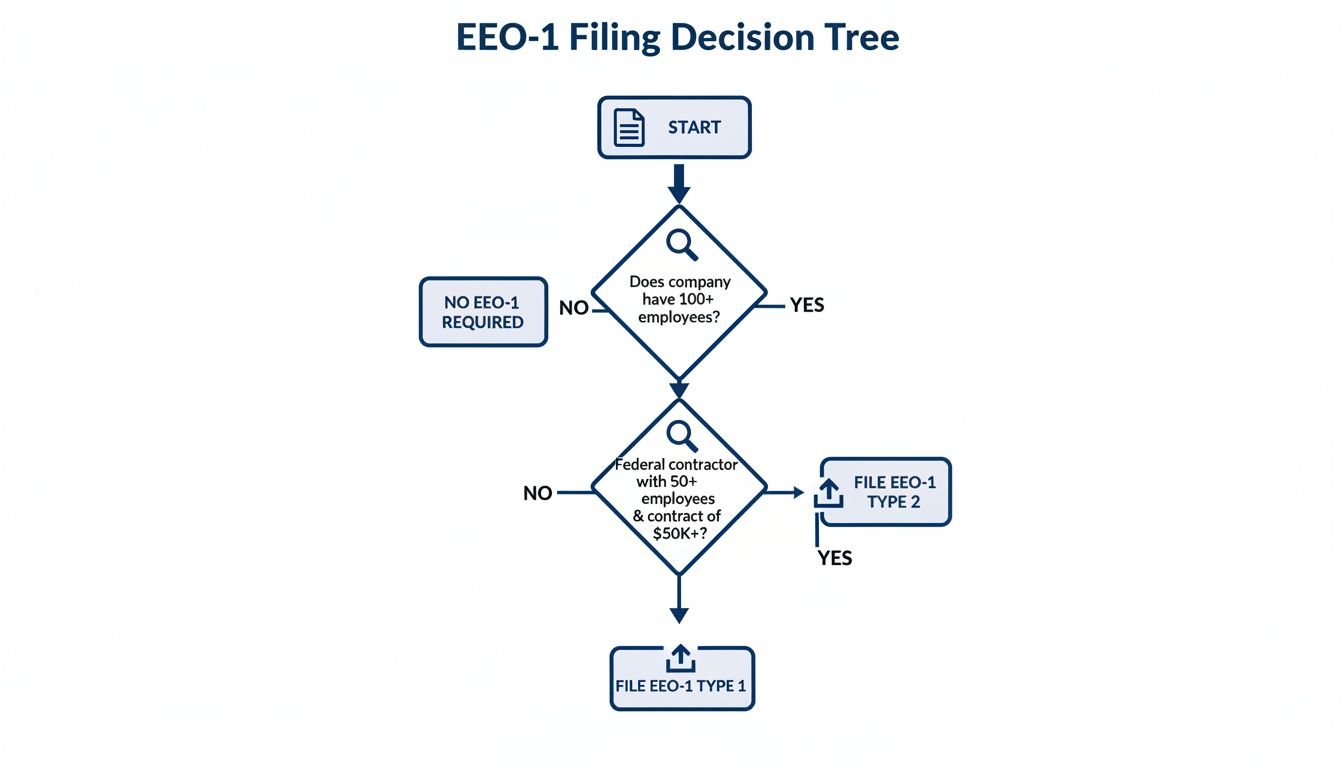
As you can see, your filing obligation depends on whether you meet the employee count for private employers or the specific criteria for federal contractors.
The process becomes more complex if your company operates from more than one physical location. In this case, you are considered a multi-establishment employer and have additional reporting duties. You cannot submit a single, consolidated report for the entire company.
You must file a separate EEO-1 report for your company headquarters, another report for each establishment with 50 or more employees, and a consolidated report summarizing data for all locations.
Knowing who needs to file is a cornerstone of good employment compliance. A Florida business compliance lawyer specializing in employment compliance can offer detailed guidance for complex situations. You must properly identify each worksite and its employee count to ensure your multi-establishment filing is accurate. For more on this, explore our guide on small business HR compliance essentials.

Once you confirm your business must file an EEO-1 report, the next step is gathering the right information. While the process is straightforward, it demands precision. You will need to pull specific employee data from your HR and payroll systems and fit it into the EEOC's standardized framework.
At its core, the report asks two simple questions: who are your employees, and what jobs do they perform? This data gives the EEOC a clear snapshot of your workforce makeup, which forms the basis for federal analysis of employment patterns nationwide.
The good news is that you do not have to track your employee count for the entire year. Instead, the EEOC requires you to select a single pay period between October 1 and December 31 of the reporting year. This timeframe is known as the “workforce snapshot period.” Your employee count on any given day during that chosen pay period is what you will use for the report.
The first layer of data is about demographics. The EEOC requires employers to categorize every employee using a specific set of classifications. The agency strongly encourages relying on employee self-identification to gather this information.
In addition to race and ethnicity, employee data must also be sorted by gender. Currently, the EEOC uses the binary options of male and female for this purpose.
It’s critical to have a reliable method for collecting and storing this self-identified data. A clean and organized HRIS or payroll system is your best tool for ensuring the information is accurate and ready for reporting.
The second layer of data involves classifying each employee into one of 10 specific job categories. This is a crucial step, as these categories are not based on your internal job titles. Instead, they are based on the EEOC's official classifications, which reflect responsibility and skill level. Proper categorization is not just for compliance; it's also a powerful tool for internal analysis. You can learn more about how to leverage human resources analytics to find deeper insights.
The table below breaks down the 10 official EEO-1 job categories. Correctly mapping your internal roles to these classifications is one of the most important steps in preparing an accurate report.
These job categories cover everything from the executive suite to frontline workers. Getting this mapping right is non-negotiable for a smooth filing process. If you need support building a defensible HR compliance framework, our team is here to help. Reach out to discuss your needs and see how we can provide clarity and guidance.
Successfully submitting your EEO-1 report comes down to understanding the annual filing cycle and having a clear process. The EEOC runs everything through a dedicated online portal. By staying ahead of key dates and knowing what to expect, you can turn a stressful compliance task into a routine administrative function.
The annual filing cycle can shift from year to year, so monitoring the EEOC’s website for official announcements is essential. Typically, the data collection portal opens in the spring, with a firm filing deadline announced shortly after. This window is your official timeframe to gather, format, and submit your workforce data.
The process follows a logical path from registration to submission. Sticking to these steps ensures nothing is missed, which is especially helpful for multi-establishment employers managing data from various locations.
The EEOC’s portal and requirements have evolved over time. For example, the 2019 collection of Component 2 pay data required a separate submission with a tight deadline, impacting an estimated 60 million workers. This highlights how quickly reporting requirements can change. You can find more insights about past reporting shifts and their impact on equitymethods.com.
Your compliance duties do not end after you hit "submit." The EEOC requires you to retain copies of your EEO-1 reports. This is a legal requirement designed to ensure you can produce documentation if questions arise.
You are required to keep a copy of your submitted EEO-1 report for at least one year. However, many legal experts recommend retaining these records for three to five years, as they can become critical evidence in audits or litigation.
Proper documentation is the cornerstone of any defensible HR strategy. Beyond the EEO-1, there are many other records you must maintain. To learn more, check out our guide on essential employment records retention requirements. If you need help building a structured approach to your compliance obligations, contact our team to learn how we can help.
It is easy to view the EEO-1 report as just another administrative deadline. However, failing to file, submitting late, or providing inaccurate data is a serious oversight. This can expose your organization to significant legal and financial risks, impacting your operations, bottom line, and reputation.
The most direct penalty comes from the EEOC itself. If you fail to file, the commission can obtain a court order compelling you to submit the data. This process is expensive and time-consuming, but more importantly, it puts your company on the EEOC's radar, inviting closer scrutiny of your employment practices.
For any business working with the federal government, the risks are even greater. Non-compliance can lead to debarment, a penalty that terminates your existing federal contracts and bans you from securing new ones. For a business that relies on government revenue, this can be a crippling blow.
The potential fallout is severe:
For federal contractors, EEO-1 compliance isn't just a reporting task—it's a non-negotiable condition of doing business with the U.S. government. A single missed filing can put your entire portfolio of government contracts on the line.
Perhaps the biggest risk is how EEO-1 data can be used against you in court. The report is a statistical snapshot of your workforce, and in the hands of a plaintiff's attorney, it can become powerful evidence in a discrimination or pay equity lawsuit. Both private lawyers and government agencies use these reports to identify patterns that might suggest systemic issues within a company.
Your EEO-1 report can become a central piece of evidence, providing the statistical basis in many EEOC discrimination cases. You can get more insight into how this data fits into the bigger picture by reading up on EEOC complaint processes on tullylegal.com. This is why accurate reporting is a core part of proactive risk management. If you need help building a compliance framework that protects your business, contact our team.

Moving beyond basic EEO-1 compliance is about building a process that can withstand scrutiny. A defensible strategy turns reporting from a reactive chore into a proactive risk management tool. This means your data is not just accurate but also consistently categorized and thoroughly documented, protecting your organization long after submission.
The foundation of a strong strategy is clean, reliable data. Inaccurate or inconsistent information creates a significant vulnerability, potentially attracting unwanted attention from federal agencies. A defensible approach begins months before the filing window opens with a firm commitment to data integrity.
Waiting until the filing deadline is near to check your data is a recipe for disaster. Instead, make internal audits a routine part of your HR calendar. A preemptive review gives you the space to identify and correct issues without the pressure of a ticking clock.
Your audit should focus on two critical areas:
A common pitfall is letting internal job titles dictate EEO-1 categories. A "lead engineer" and a "senior engineer" might have different titles, but they likely both belong in the "Professionals" category. Regular audits ensure classifications are based on function, not just title.
Your EEO-1 report is a powerful internal analytics tool. After filing, use the data to analyze workforce trends and identify opportunities for improvement. This practice demonstrates a good-faith effort to use the information for its intended purpose: promoting equal opportunity.
For example, you can benchmark your diversity metrics against industry averages or track your own progress year-over-year. This turns a compliance task into a valuable asset for strategic workforce planning and strengthens your diversity initiatives. It also aligns well with the goals of a formal Affirmative Action Plan, connecting different compliance efforts into one cohesive strategy.
Finally, a defensible strategy is a well-documented one. Keep detailed records of your methodology for mapping job titles and how you handle situations where employees decline to self-identify. This documentation becomes your first line of defense if your report is ever questioned during an audit. By taking these steps, you shift from simply filing a report to building a structured, defensible compliance function that truly protects the business.
Even with official guidance, navigating the EEO-1 report can bring up tricky, real-world questions. Business leaders and HR teams often encounter the same points of confusion, especially when dealing with a modern, dynamic workforce. Let's clear up some of the most common ones.
One of the first hurdles is figuring out if you even need to file. This often comes down to a fluctuating employee count, and the key is the “workforce snapshot period.” This is a single pay period your company chooses between October 1 and December 31 of the reporting year. If you had 100 or more employees on your payroll during that selected pay period, you must file for that year. Growing businesses should watch their headcount closely during the last quarter.
The EEOC’s preference is clear: employees should self-identify their race, ethnicity, and gender. But what happens when they do not? If an employee declines to self-identify, you are permitted to use existing employment records or visual observation to complete the report. The critical part is documenting how you made those determinations. While the current EEO-1 report uses binary gender categories (male/female), an employee's self-identification should always be your primary source of information.
With remote and hybrid work now common, knowing where to count these employees is essential. Every employee, including those who work fully remotely, must be included in your EEO-1 report. A remote employee should be assigned to the establishment they report to. If there is no specific physical office they are tied to, you should include them in the report for your company headquarters or the location of their direct manager.
Building robust and defensible HR practices is crucial for navigating today's complex employment landscape. To ensure your compliance strategy is sound, Paradigm International Inc. provides expert guidance to protect your organization. Contact our team to learn how we can help you manage risk effectively.