


A manager calls you after a difficult meeting with a senior employee. Performance has slipped, expectations were never written down clearly, and now the employee is disputing bonus eligibility, remote work terms, and who owns a client relationship. In another version of the same story, a former employee leaves and starts soliciting customers, only for leadership to discover the non-compete language they copied from an old template may not hold up where that person lives.
That is usually when business owners ask the right question, a little later than they wanted to. What is an employment contract, really? Not in the abstract, but in operational terms. What does it do when a hire goes sideways, a termination gets challenged, or a company expands into a second or third state?
A practical answer starts with this: an employment contract is not routine paperwork. It is one of the core documents that sets expectations, allocates risk, and gives the business something defensible to point to when decisions are tested. If you are trying to pressure-test language before sending it to counsel, even a structured drafting tool like a free AI contract generator can help you identify missing sections and questions to resolve before the document reaches signature.
An employment contract is a legally binding agreement between employer and employee that defines the terms of the working relationship. That definition is accurate, but it is incomplete.
In practice, the contract does several jobs at once. It tells the employee what the role is. It tells managers what they promised. It creates a record of the business terms that matter when memory, leadership, or circumstances change.
The strongest contracts do not try to sound impressive. They do something more useful. They reduce ambiguity around pay, duties, benefits, confidentiality, and exit terms so the company is not forced to reconstruct intent during a dispute.
For small and mid-sized businesses, that matters more than many leaders expect. You may not need a heavily negotiated executive agreement for every hire. You do need documentation that is clear enough to support consistent decisions and narrow enough to survive scrutiny.
Many leaders think the purpose of an employment contract is to “make it official.” That understates its value. Its true purpose is to create a clear, enforceable record of the employment relationship before conflict appears.
A business can operate for a while on implied understandings. Someone joins, accepts the salary discussed in meetings, starts work, and everyone assumes the rest will sort itself out. That works until a disagreement exposes the gaps.
Standard definitions of employment contracts often overlook the inherent power imbalance in implied and at-will arrangements, which courts may recognize but can be difficult to enforce, as noted in analysis from the Economic Policy Institute on the flawed legal freedom of contract framework: https://www.epi.org/unequalpower/publications/legal-freedom-of-contract-framework-is-flawed
That is one reason written contracts matter. They do not eliminate all disputes, but they reduce the number of disputes driven by vague promises, informal practices, and inconsistent manager communication.
Good contracts help the business operate consistently. They give HR, finance, and front-line managers the same reference point for questions like:
When those issues are left to emails and conversations, leaders often discover that each stakeholder heard something different.
A contract earns its value when the relationship is under pressure, not when everyone agrees.
In most states, employers start from an at-will framework. That does not mean the company should leave terms loose. It means the default rule exists unless the contract modifies it, limits it, or creates conflicting promises through poor drafting.
Many growing businesses get into trouble at that point. They use at-will language in one paragraph, then add detailed “for cause” language elsewhere without thinking through how those provisions interact. They promise discretionary bonuses verbally but describe them casually in writing. They borrow language from another state that does not fit their workforce.
If you want a practical primer on that distinction, an overview of at-will vs. contract employment is worth reviewing: https://paradigmie.com/post/at-will-vs-contract-employment
A useful contract is specific where it needs to be specific, and restrained where flexibility matters.
What usually works:
What usually fails:
An employment contract is not there to make the company look formal. It is there to reduce preventable exposure and support disciplined decision-making.
Not every hire needs the same agreement. The right structure depends on the role, the business objective, and the amount of risk the company is taking on.
In the United States, the permanent employee contract is the most prevalent form of employment, making up approximately 60% of the workforce, with full-time variants typically requiring 35 to 40 hours per week, while temporary and contract staffing declined by nearly one million workers in 2023, according to AIHR’s overview of employment contract types: https://www.aihr.com/blog/types-of-employment-contracts/
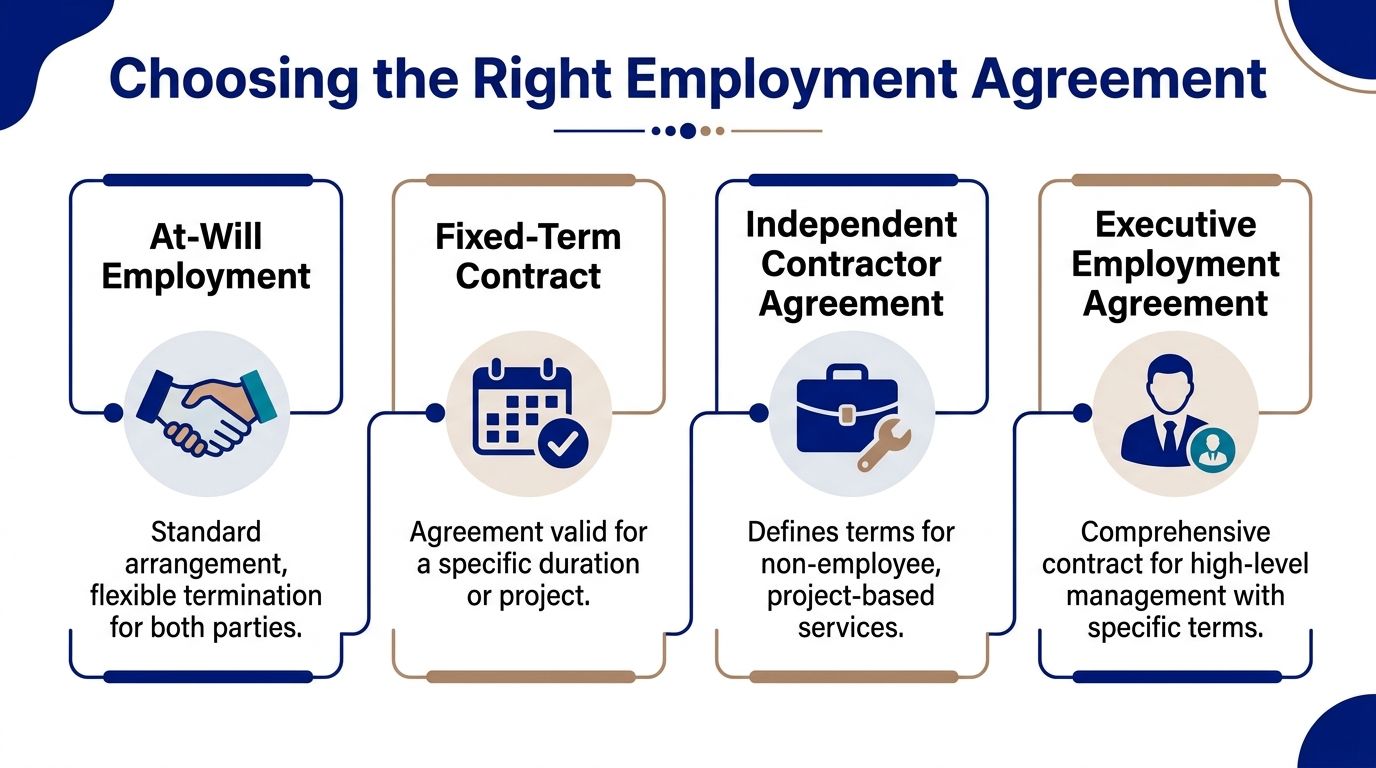
This is the standard employment arrangement for many businesses. It is often the right fit when the company needs hiring flexibility and the role does not justify a negotiated fixed commitment.
At-will agreements work best when the employer still documents the basics carefully. That includes the title, compensation, exempt or nonexempt status where applicable, reporting relationship, and any confidentiality or proprietary information obligations.
The advantage is flexibility. The trade-off is that sloppy drafting can create mixed signals about termination rights, performance standards, or severance expectations.
A fixed-term contract is built for a defined period or a defined project. These work well when the business needs a role for a limited duration, wants certainty around an assignment, or is hiring into a time-bound initiative.
This structure can be useful, but it changes the risk profile. Once you specify a term, the business should think carefully about renewal mechanics, early termination rights, performance triggers, and what happens if the project changes scope.
A fixed-term agreement is often chosen for predictability. The mistake is treating it like a standard offer letter with a date added at the top.
Here, many businesses create avoidable exposure. An independent contractor agreement is not merely a cheaper employment contract with different wording. It is for a non-employee relationship, and the facts on the ground must support that classification.
When companies use contractor language for someone who functions like an employee, they invite problems around wages, benefits, tax treatment, and control over the work. The document matters, but the working relationship matters more.
Use this structure only when the service arrangement fits a contractor model. If the company directs the work like an employee relationship, integrates the person into day-to-day operations, and treats them like staff, the contract label will not save the business.
Executive agreements are different because the stakes are different. These contracts usually address compensation in more detail, include stronger confidentiality and intellectual property language, define incentive terms more carefully, and often address severance, post-employment obligations, or transition expectations.
These are not the place for vague promises. If the business is hiring a CEO, COO, physician leader, or senior revenue executive, the agreement should reflect the business risk tied to that role.
The most common drafting error is using a broad, executive-sounding document that creates obligations leadership has not operationally planned to honor.
| Agreement type | Best use case | Main advantage | Main risk |
|---|---|---|---|
| At-will | Standard employee roles | Flexibility | Inconsistent drafting can weaken defensibility |
| Fixed-term | Project or time-bound role | Defined commitment | Early exit and renewal disputes |
| Independent contractor | Genuine non-employee services | Structural flexibility | Misclassification exposure |
| Executive agreement | Senior leadership roles | Clear high-stakes terms | Overly complex promises or bad severance design |
A related issue often gets overlooked at the start of hiring. The document that introduces the employment relationship may not be the full contract, but it can still create expectations. An overview of letters of employment is useful for separating offer-stage communication from the final agreement: https://paradigmie.com/post/what-is-a-letter-of-employment
The best agreement type is not the one with the most clauses. It is the one that matches the actual relationship the business intends to create.
A defensible contract is built clause by clause. Most disputes do not arise because a company forgot to add legal jargon. They arise because the agreement failed to say something important in a clear way.
A thorough contract must clearly delineate job information, compensation, benefits, protective agreements like NDAs, and termination clauses, and the need for documented, explicit terms is reinforced by the 2024 Department of Labor rule on worker classification, as summarized here: https://davisbusinesslaw.com/key-points-when-crafting-an-employment-contract/

Start with the basics, but do not stop at a title. “Director,” “Manager,” or “Administrator” tells you very little if a dispute later turns on scope of authority, exempt status, or performance expectations.
A stronger clause identifies:
The balance matters. If you define duties loosely, the company has little to point to in a performance discussion. If you define them rigidly, every business change can look like a contract breach.
This is one of the first places I would review in any contract dispute. Not because pay is the only issue, but because unclear compensation language causes problems.
Use plain terms. State the base salary or wage rate, the payment frequency, and whether any bonus, commission, or equity component is discretionary or formula-based.
Avoid soft phrases that sound harmless during recruiting, such as “expected bonus” or “standard incentive,” unless the document also explains the conditions. If bonus eligibility depends on active employment, board approval, performance metrics, or anniversary dates, say so.
Many contracts mention benefits casually. That creates trouble when plans change, when someone transfers states, or when leave rules differ by location.
A better approach is to confirm eligibility for company benefit plans and cross-reference governing plan documents or policies where appropriate. The contract should also address paid time off, sick leave, holidays, and any special leave arrangements that are part of the deal.
For senior hires, if there is a negotiated benefit that differs from normal policy, document it. Side promises are difficult to administer and even harder to defend.
This clause shapes the company’s risk during one of the most sensitive phases of employment. It should reflect whether the arrangement is at-will or fixed-term, and it should avoid accidental contradictions.
Good termination language usually addresses:
If severance is offered in some situations, the contract should say when, on what conditions, and whether a release is required. “We will work something out” is not a policy.
For many SMBs, the most valuable parts of the business are intangible. Client data, pricing strategy, process design, proprietary workflows, referral sources, and internal know-how all deserve attention in the agreement.
The contract should identify confidential information broadly enough to protect legitimate business interests, but not broad that the language looks careless or punitive. It should also address ownership of work product, inventions, materials, and company records created within the scope of employment relevant to the role.
This is especially important in healthcare, professional services, and knowledge-based businesses where the person leaving may carry a great deal of operational knowledge.
Some companies overlook procedural clauses because they feel secondary. They are not. A contract should make it easier to administer the relationship, not harder.
Depending on the business and jurisdiction, practical clauses may include:
If a manager cannot explain a clause consistently, the company will struggle to enforce it consistently.
A strong employment contract is not the longest version. It is the version that tells the truth about the deal, supports day-to-day management, and holds up when a decision is challenged.
Some contract language looks protective but creates more risk than it removes. Restrictive covenants are the clearest example.
Restrictive covenants like non-competes require strict compliance to be enforceable. SHRM’s 2024 data notes that 78% of compliant employers use industry-specific formats, and a valid non-compete must be reasonable in its limits, typically 6 to 24 months in duration, while the FTC’s 2024 rule has increased pressure on employers to avoid unenforceable restrictions, as summarized here: https://www.aihr.com/blog/employment-contract/

A common mistake is drafting a non-compete that tries to solve every possible business concern at once. Broad geography, long duration, and vague definitions of competition may feel safer to the employer. In reality, they often invite challenge.
The better approach is narrower and role-based. If the business wants to protect client relationships, confidential information, and key employees, it should consider which restriction matches which risk.
A court is more likely to take a targeted provision seriously than a clause that appears designed to block ordinary mobility.
Leaders often assume a contract is “legally reviewed” because it came from a prior employer, a downloaded form, or a package used years ago. That assumption causes trouble.
What fails in practice:
Templates are not the problem by themselves. Unexamined templates are.
Another drafting mistake is using strong-sounding language that no one can administer. “Immediate forfeiture of all compensation” or “company may deduct losses” can create legal issues if the clause is inconsistent with wage payment rules or basic fairness requirements.
The same applies to for-cause definitions. If “cause” includes everything from gross misconduct to “failure to meet expectations,” the company may think it has broad discretion. In a dispute, that breadth can look arbitrary.
Ask hard questions before the contract goes out:
A clause that is aggressive to enforce is not protective. It is a drafting liability.
The businesses that handle restrictive terms well are usually the ones that draft less dramatically and think more.
A signed contract is only the start. The harder issue is what happens when the business tries to enforce it across different facts, managers, and states.
For multi-state businesses, an employment contract must specify the governing law and jurisdiction. Failure to do so can lead to disputes being resolved under the employee’s preferred jurisdiction, potentially increasing litigation costs by up to 30%, and misclassification or ambiguous termination language can create additional exposure, as summarized here: https://workmotion.com/employment-contracts/

When a company hires across states, a standard form can break down. Final pay rules, leave requirements, restrictive covenant standards, and termination doctrines can differ in material ways.
A governing law clause helps define which state’s law applies. A jurisdiction clause helps determine where disputes will be heard. Without those provisions, the company may lose control over where a disagreement unfolds and what legal framework applies.
That matters most when the business assumes its home-state template governs everyone, but its workforce no longer sits in one place.
Leaders often ask whether a contract clause is enforceable as if that question can be answered in the abstract. It depends on both the drafting and the conduct that followed.
A business is in a better position to enforce a contract when it can show:
If the company ignores its own contract for months or years, then tries to enforce one clause after a dispute, that weakens the overall posture.
The practical answer is not to write an entirely new contract from scratch for every hire. It is to control the process.
A workable model often includes:
| Need | Practical response |
|---|---|
| Core consistency | Maintain a base contract form for each role category |
| State variation | Add state-specific supplements or approved alternatives |
| Approval control | Limit who can revise or promise off-template terms |
| Audit trail | Track versions, signatures, and later amendments |
At this juncture, contract administration connects directly to separation practices. If the company is negotiating an exit, a resource on employment separation agreements can help clarify how the original contract and the separation document should work together rather than conflict: https://paradigmie.com/post/employment-separation-agreement-template
Enforcement usually turns on two things. What the contract says, and whether the company behaved as though those words mattered.
The operational lesson is simple. Multi-state compliance is not a legal footnote. It is a drafting, workflow, and approval problem that needs structure.
Business leaders do not need to become employment lawyers to review a contract intelligently. They do need a disciplined checklist.
Use this list when reviewing a new agreement or auditing an existing one:
A contract should also be reviewed as part of a broader workflow, not as a one-time event. If your team is tightening internal process, this guide to contract management best practices is a useful operational reference for version control, approvals, and post-signature administration.
Some contracts can be handled with a solid template and disciplined internal review. Others should trigger immediate legal or advisory review before the offer goes out.
Those higher-risk situations include:
The key shift for leadership teams is cultural. Contract review is not administrative cleanup. It is a core business control.
When a company treats employment agreements as strategic documents, managers make better promises, HR documents more carefully, and difficult decisions become easier to defend. That is the practical answer to what is an employment contract. It is the written framework that turns employment from an improvised relationship into a managed one.
If your leadership team is dealing with contract risk, multi-state growth, sensitive terminations, or inconsistent documentation standards, this company can help you build a more defensible approach. Learn more about how this firm supports SMBs facing high-stakes people decisions at this company.


