
Understanding what is considered full time hours in California can feel complex for business owners and HR leaders. Unlike other states, California doesn't have a single law that defines "full-time" for every purpose. Instead, the state uses different hour thresholds for different rules, such as overtime and benefits. This guide will provide clear, actionable insights to help you navigate these requirements, maintain compliance, and protect your business.

Many employers look for one clear number to define a full-time employee, but in California, no such number exists. While your company is free to set its own definition for internal policies, that standard must coexist with separate state and federal legal thresholds. For example, a 30-hour workweek might qualify an employee for health benefits under one law, while a 40-hour week triggers overtime pay under another.
Think of it as navigating different legal requirements for different aspects of employment. Your responsibility as an employer is to understand which hourly standard applies to each specific compliance area, from payroll to benefits administration. This approach is key to avoiding costly legal missteps.
Despite the lack of a single statewide definition, the 40-hour workweek is the most important benchmark in California employment law. This standard, widely recognized by the Department of Industrial Relations, serves as the foundation for two critical compliance areas.
Because the 40-hour week is deeply embedded in wage and hour laws, it is the most reliable default standard for California employers. Adopting it as your company's baseline for full-time status helps create consistency between your internal policies and state regulations.
This complexity is not unique to California. Regulatory approaches to defining "full-time" vary significantly from one country to another. A look at a guide on how many hours is full time in the UK reveals just how differently jurisdictions can approach the same question.
For business leaders in California, the key takeaway is that compliance isn't about finding one answer. It is about understanding which rule applies to which situation. By recognizing the distinct roles of the 40-hour state benchmark, the 30-hour federal ACA rule, and your own internal policies, you can build a clear and defensible HR framework.

One of the biggest compliance challenges for California employers is the difference between state norms and federal law. While California's wage and hour laws point to a 40-hour workweek as the practical standard, the federal Affordable Care Act (ACA) introduces its own definition. This creates a complex environment where an employee’s status can change depending on which regulation you are applying.
Under the ACA, a full-time employee is anyone who works, on average, at least 30 hours per week or 130 hours per month. This is a legal mandate for Applicable Large Employers (ALEs), which are businesses with 50 or more full-time equivalent employees. If you are an ALE, you are required to offer affordable, minimum-value health coverage to these employees.
This is where many businesses run into trouble. An employee working 35 hours a week might be considered "part-time" under your company policy, but they are "full-time" under the ACA. Overlooking this distinction because your handbook defines them as part-time can lead to substantial IRS penalties.
The core conflict is clear: an employee in California working between 30 and 39 hours a week may exist in a gray area for state-level practices, but they are firmly defined as full-time under federal benefits law. This requires a dual-track approach to workforce management.
To manage compliance effectively, you must understand how these two systems operate side-by-side. Each standard serves a different purpose and carries different consequences if ignored. This is especially true for overtime, where state rules are paramount, and for benefits, where federal law often takes precedence.
This table helps illustrate how these definitions apply in different contexts.
This comparison makes it clear that you cannot use a single definition for all purposes. For example, managing payroll for overtime requires strict adherence to California’s daily and weekly standards, which we explore in our guide to California meal and rest break laws. At the same time, you must use the ACA's 30-hour rule to administer your health benefits program if you're an ALE.

While your company handbook may define "full-time" for benefits, California’s wage and hour laws have their own rules. The concept of full-time work is directly connected to two of the highest-stakes compliance areas for employers: overtime pay and employee classification. Getting this connection wrong can lead to significant financial liability.
The key number here is 40 hours. While California is known for its daily overtime rules, the 40-hour workweek is the foundation for the state's most critical salary calculations. It is the mathematical basis for determining if a salaried employee is legally exempt from overtime.
In California, classifying an employee as exempt requires them to pass both a strict "duties test" and a "salary basis test." It is the salary test where the 40-hour workweek becomes a non-negotiable factor. State law requires an exempt employee's annual salary to be at least twice the state minimum wage for full-time work.
For this calculation, the law defines "full-time" as 40 hours per week for 52 weeks a year, which totals 2,080 hours. This formula creates a firm salary floor. If you pay a salaried employee less than this state-mandated minimum, their exempt status is automatically invalid, and they are owed overtime for all hours worked beyond state limits. You can learn more about the other half of this equation in our guide on the duties test for exempt employees.
An employee's exempt status is not determined by their job title or a flat salary. It is a strict legal standard based on specific job duties and a minimum salary calculated from a 40-hour workweek, making it a frequent point of failure for unwary employers.
Let's walk through how easily this can go wrong. Imagine a small business hires a "Store Manager," giving them a salary that seems fair but doesn't meet the state's formula.
In this case, the business is liable for five hours of overtime every week, plus potential penalties for missed meal breaks, interest, and attorney's fees. Staying on top of regulatory updates is essential, as changes to the overtime salary threshold can affect these calculations.
Knowing California’s employment laws is only half the battle. The next step is to translate that knowledge into a clear, defensible policy for your employee handbook. A documented policy turns legal theory into everyday rules for your team, setting expectations, creating consistency, and building a powerful shield against potential legal claims.
Without a documented policy, your business is exposed. Decisions about benefits can appear arbitrary or discriminatory, opening the door to costly disputes. A well-written policy provides a consistent framework, proving that your decisions are based on fair, objective standards.
Your policy must explicitly define what "full-time" means at your company. Since California law does not provide a single number, it is up to you to create a clear definition for administering internal benefits and setting work expectations. Common thresholds that employers set are 32, 35, or 40 hours per week.
Once you have defined full-time, connect that status directly to specific benefits. This linkage eliminates gray areas and ensures everyone understands what their classification means for them. Be specific and list which perks are tied to full-time status.
Your policy should clearly address key benefits such as:
A strong policy acts as a contract of expectations. It should state directly: "Full-time employees are those regularly scheduled to work a minimum of 40 hours per week and are eligible for health, dental, and retirement benefits." This direct language leaves no room for misunderstanding.
Getting the language right is crucial. Your policy should be straightforward enough for any employee to understand. While you should always have your final handbook reviewed by legal counsel, this template provides a solid starting point.
Example Policy Section:
"Employment Classification
At [Company Name], we classify employees as either full-time or part-time. This classification helps determine eligibility for certain company-sponsored benefits.
Full-Time Employees: Employees who are regularly scheduled to work a minimum of 40 hours per week are classified as full-time. Full-time employees are eligible for the complete benefits package offered by the company, including medical, dental, and vision insurance, as well as paid time off and 401(k) plan participation, subject to individual plan terms.
Part-Time Employees: Employees regularly scheduled to work fewer than 40 hours per week are classified as part-time. Part-time employees are eligible for all legally required benefits, such as paid sick leave and workers' compensation, but are not eligible for the company's group health insurance or certain other voluntary benefits."
This clear distinction helps manage expectations and ensures you apply your benefits programs consistently. If you need help developing HR policies that protect your business, feel free to reach out to us.
Accurately tracking employee hours has become more critical than ever, especially for businesses with variable-hour, remote, or hybrid teams. A reliable, modern system is essential to ensure every minute is logged correctly, which is vital for complying with California’s strict wage and hour laws.
Precise hour tracking is also essential for managing federal benefits obligations under the Affordable Care Act (ACA). The ACA has specific rules for employees whose hours fluctuate, making it difficult to determine their full-time status. This is where a key ACA provision, the look-back measurement method, becomes an invaluable tool for employers.
The look-back measurement method offers a "safe harbor" for employers with variable-hour employees. Instead of guessing an employee’s status, you use a defined historical period to calculate their average hours. This method provides a clear, compliant way to manage benefits for a non-traditional workforce and reduces the risk of ACA penalties.
Here is a simple breakdown of how it works:
During the stability period, an employee’s full-time status for benefits purposes is locked in, even if their weekly hours drop below 30. This rule provides certainty and protects employers from penalties, as long as a qualifying offer of health coverage is made.
For example, a restaurant with fluctuating seasonal demand can use a 12-month look-back period to determine who qualifies for health benefits for the entire following year. This systematic approach removes guesswork and ensures you treat all variable-hour employees consistently and in line with federal law.
Implementing this method requires meticulous record-keeping. You must have a robust time and attendance system that accurately tracks every hour worked. For business leaders, mastering the look-back method is a critical risk management strategy for determining what is considered full time hours in California for benefits eligibility.
Managing variable-hour employees involves many moving parts. If you need support creating a compliant timekeeping and benefits administration strategy, you can visit us at Paradigmie.com/contact.
For businesses operating across state lines, California often represents the peak of compliance complexity. Applying a one-size-fits-all HR policy built for a less-regulated state is a recipe for disaster. A policy that works well in Texas, for example, could create immediate liability the moment you hire a remote employee in California.
This is especially true when defining full-time hours. If your company is based in a state without daily overtime and you hire in California, you are instantly at risk of violating state law. The second that new hire works over eight hours in a single day, your company is on the hook for unpaid wages and penalties.
The most effective strategy is to create a core handbook for company-wide policies, supported by a California-specific addendum. This separate document should outline all rules that apply only to your California employees, from daily overtime to meal break requirements. This approach helps formalize your strategy for managing remote worker compliance.
A "one-policy-fits-all" approach is a critical error for multi-state employers. California compliance isn't optional; it demands a proactive, tailored strategy to prevent the kind of costly and avoidable legal battles that can harm a growing business.
Manually tracking different rules for employees in different states is inefficient and prone to human error. Modern Human Resource Information System (HRIS) platforms can be configured to manage state-specific employment laws automatically.
These systems can become your compliance engine, helping you by:
By implementing a state-aware HRIS, you embed compliance directly into your daily operations. This automates crucial processes and creates a digital paper trail, which is invaluable for defending against potential wage and hour claims.
This flowchart shows the basic process for tracking variable hours, a key task for managing ACA compliance across multiple states.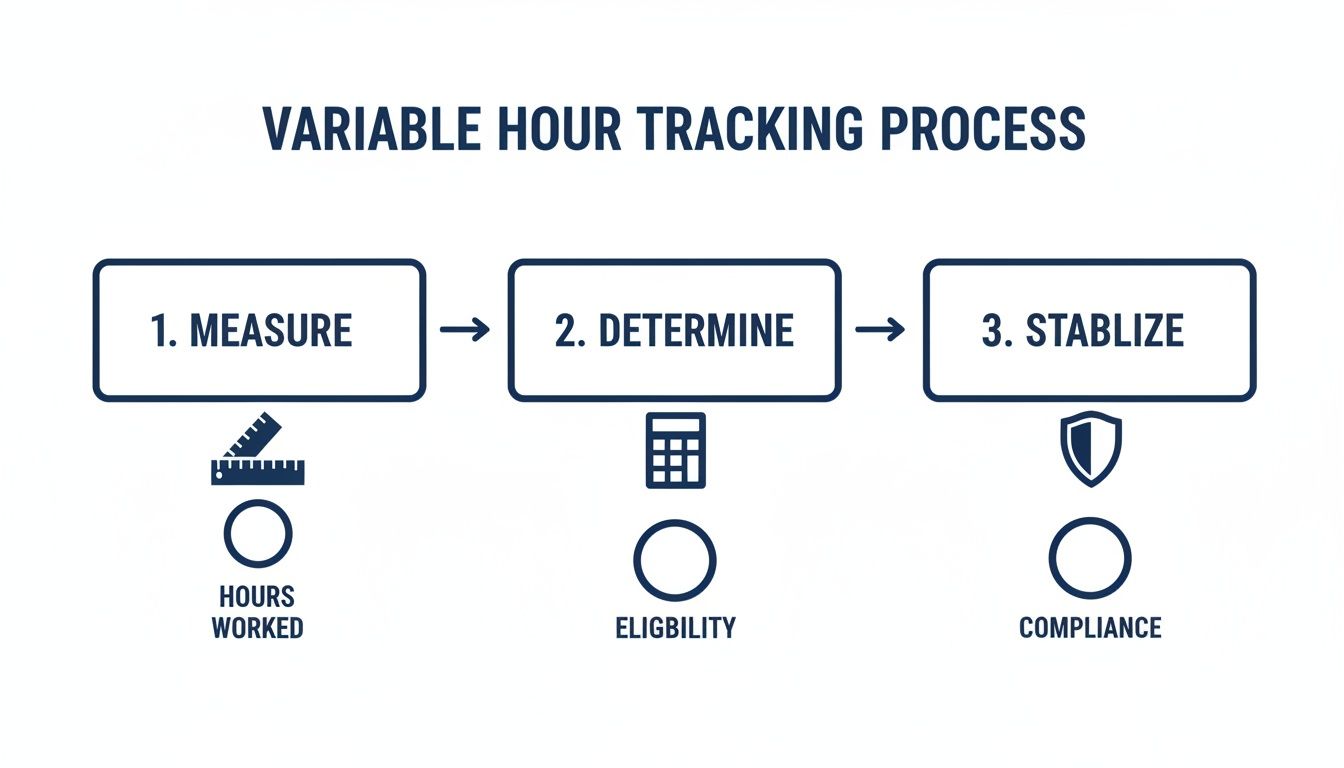
The process gives you a structured way to measure hours, determine benefits eligibility, and stabilize an employee's status, creating predictability for both the business and your team. The takeaway for any multi-state employer is that California is different, and ignoring its specific rules is not a risk worth taking.
Running a business in California often leads to recurring questions about employment law. The overlap between state practices, federal rules, and internal policies can create confusion. Here are direct answers to the most common questions about what counts as full-time in California.
Can I classify an employee who works 35 hours per week as part-time?
Yes, for your internal policies, you can set your full-time threshold at 40 hours, making a 35-hour employee "part-time." However, this does not change your obligations under federal law. If you are an Applicable Large Employer (ALE), the ACA views any employee averaging 30 or more hours per week as full-time, which means you must offer them health coverage.
What are the risks of misclassifying an employee's full-time ACA status?
The risks are almost entirely financial and can be substantial. Misclassifying an employee’s ACA status can trigger significant IRS penalties for failing to offer affordable, minimum-value health coverage. The cost can quickly add up to thousands of dollars per employee, per year.
The IRS strictly enforces the Employer Mandate. Even an honest mistake in tracking hours or determining an employee’s status can lead to an audit and costly penalties, making accurate monitoring a critical compliance task.
Do full-time exempt employees in California get overtime?
No, a correctly classified exempt employee in California is not eligible for overtime pay. The key is "correctly classified." For an exemption to be valid, the employee must pass both a strict duties test and the salary basis test. This salary test requires them to earn at least twice the state minimum wage for full-time work, calculated based on a 40-hour workweek.
How does California paid sick leave apply to part-time vs. full-time staff?
California's paid sick leave law applies to nearly all employees, regardless of whether they are full-time or part-time. As long as an employee works for you for at least 30 days within a year in California, they are entitled to accrue and use paid sick leave. You must apply your chosen accrual method consistently for all eligible employees.
Navigating the complexities of California employment law requires precision and a proactive approach. Understanding the different definitions of "full-time" is a critical step in building a compliant and defensible HR framework.
If you are looking for expert guidance on your specific compliance challenges, there is more to learn. At Paradigm International Inc., we act as a strategic partner to help you manage risk effectively. To continue the conversation and ensure your practices are sound, contact us to start a conversation.