


When a key employee resigns, it’s natural to assume the departure is voluntary. But what if it isn’t? Imagine an employee quits after a sudden pay cut, a demotion, or a toxic work environment that became unbearable. This scenario is known as constructive dismissal, where an employee feels they have no choice but to leave, even without being formally fired. For business owners and HR leaders, understanding this concept is critical to avoiding significant legal risk.
Constructive dismissal occurs when an employer's actions, or lack thereof, create a work environment so intolerable that a reasonable person would feel forced to resign. In these situations, the law treats the employee's resignation as an involuntary termination. This means the employee may be entitled to the same legal remedies as if they were wrongfully fired, turning a seemingly simple resignation into a complex legal problem.
This is a critical distinction for employers. A resignation letter does not automatically protect your business from a lawsuit. Courts will look beyond the surface to examine the employer's conduct that led to the departure. The core issue is whether the employer fundamentally breached the employment contract.
Constructive dismissal is essentially a breach of the employment contract. This breach can be explicit, like unilaterally cutting an employee's pay, or implicit, like failing to provide a safe and respectful work environment.
Several common scenarios can lead to a constructive dismissal claim. Recognizing these warning signs is the first step in mitigating risk that many businesses overlook.
These actions fundamentally alter the employment agreement, making it difficult for an employee to continue working. Understanding this is vital, as certain actions can create liability even in states with at-will employment.
For an employee's resignation to be treated as a constructive dismissal, they must prove several key elements. It's important to note that the burden of proof rests on the employee, not the employer. General unhappiness or workplace stress is not enough; the focus is on the employer's specific actions.
The changes imposed must be substantial enough to be considered a fundamental breach of the employment agreement—not just minor inconveniences.
The flowchart below breaks down the basic questions to ask when an employee resigns unexpectedly.
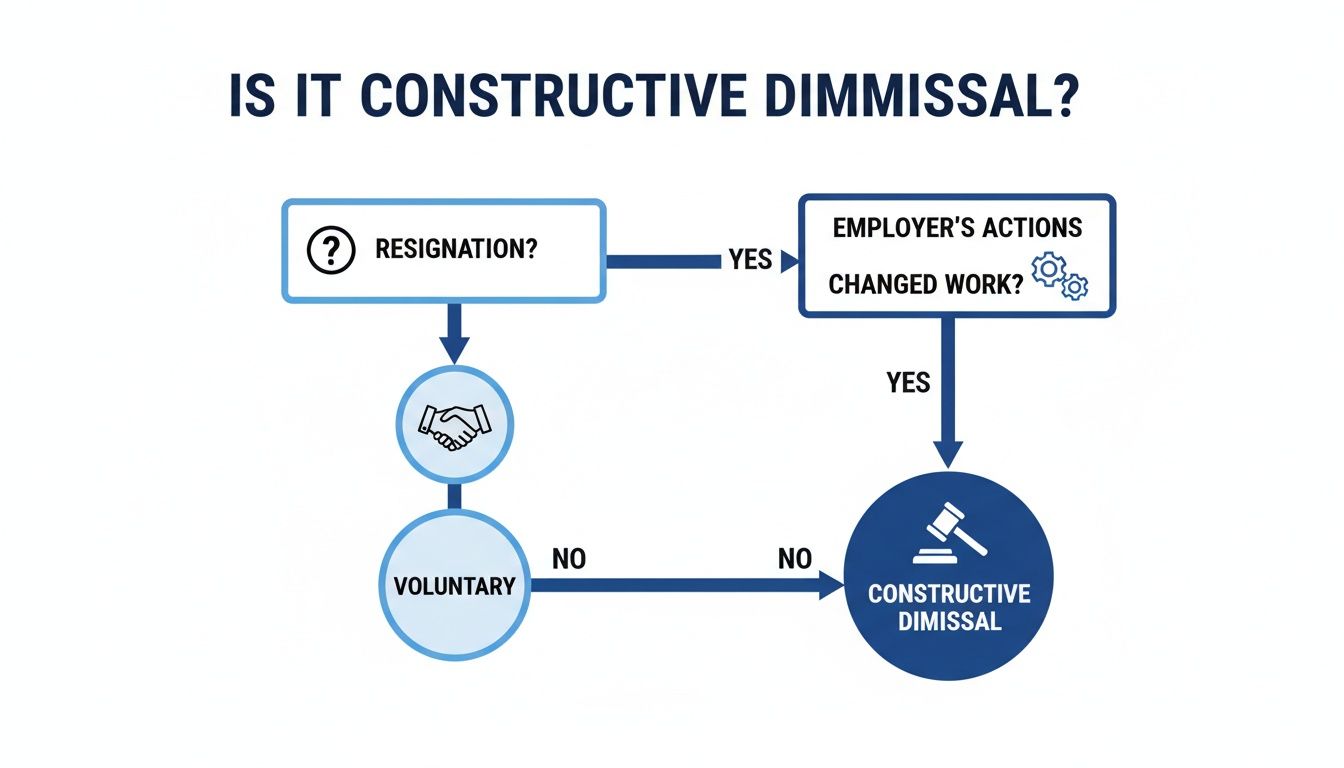
As you can see, a resignation only escalates into a potential constructive dismissal claim if it was triggered by major, employer-driven changes to the job.
For a claim to succeed, an employee must demonstrate that their situation meets a specific legal standard. Understanding these components is the first step toward building a strong defense and mitigating risk.
| Element | Description for Employers |
|---|---|
| A Fundamental Breach | The employer made a serious, one-sided change to a core part of the job. This could be an explicit term like pay or an implied term like the duty to provide a workplace free from harassment. Minor operational changes do not meet this standard. |
| An Intolerable Environment | The employer’s actions created working conditions so difficult that a reasonable person would feel compelled to leave. The focus is on what is "objectively" intolerable, not just the employee's personal feelings. |
| A Prompt Resignation | The employee resigned within a reasonable timeframe after the breach occurred. If an employee waits too long, they risk being seen as having accepted the new conditions, which weakens their claim. |
| Causation | The employee must show their resignation was a direct result of the employer's breach. They must connect the dots and show they left because of the intolerable changes, not for another unrelated reason. |
A single, severe incident—like an unjustified demotion—can be enough to trigger a claim. More often, it is the result of a "last straw" event following a series of negative actions that make the job unbearable. While it shares some similarities, constructive dismissal has its own legal tests that set it apart from a standard wrongful termination case.
Constructive dismissal claims often develop slowly. While a single, dramatic event can ignite a legal issue, it is more commonly a series of unresolved problems that poison the work environment. For business owners and HR leaders, spotting these warning signs early is a critical form of risk prevention.
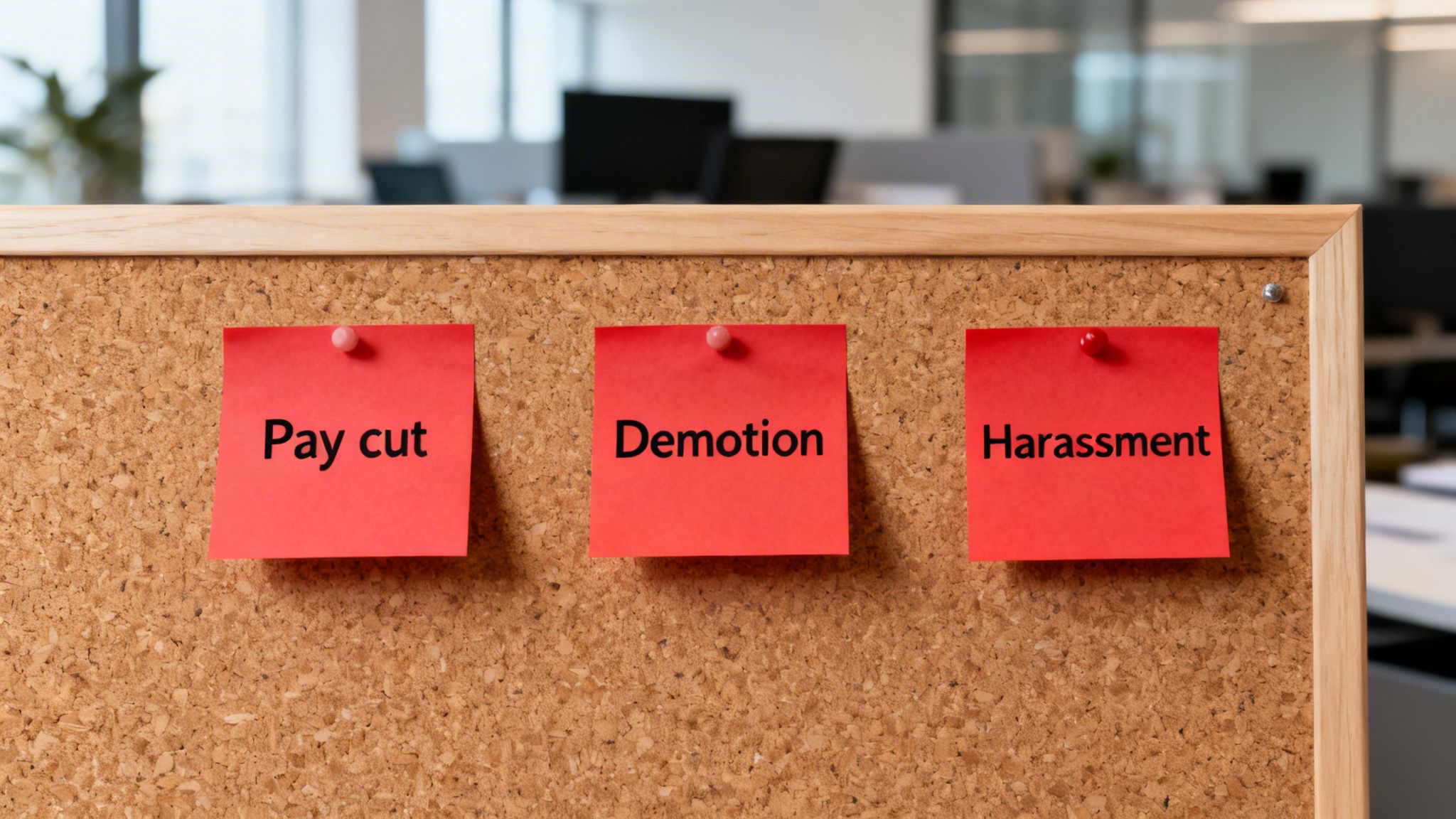
These triggers are more than just unfortunate workplace moments; they can be seen as a fundamental breach of the employment contract. Identifying them allows you to intervene before a situation escalates into a resignation and a potential lawsuit.
One of the most direct paths to a constructive dismissal claim is when an employer makes a unilateral and substantial change to an employee's core job terms. These are not minor tweaks but moves that fundamentally alter the original employment agreement.
Key examples include:
Every employer has an implied duty to provide a safe and tolerable workplace. This includes psychological safety, not just physical safety. A consistent failure in this area is a frequent driver of claims, often stemming from inaction rather than direct action. This is where many complex employee relations issues arise.
An employer's legal duty is not just to avoid creating a hostile environment, but to take active steps to prevent and fix one when it emerges. Ignoring a problem is often seen as condoning it.
Key red flags in this category include:
If you are seeing these signs in your organization, it is time to act carefully. Understanding your obligations is the first step, but taking decisive and defensible action is what truly protects your business. We can help you build a clear strategy for complex employee situations. To learn more, get in touch with us.
Ignoring the warning signs of constructive dismissal can have consequences that ripple through your entire business, creating financial and operational threats. Thinking about risk management proactively is key to protecting your company's stability and bottom line. Let's break down the real costs you could be facing.
A claim's first impact is always financial. These direct costs are tangible and can escalate quickly.
These financial risks are not theoretical. In the UK, employment tribunals handle these cases with rigor, and statistics for 2023/24 show a 13% rise in claims. This signals a growing willingness from employees to challenge what they perceive as poor employer conduct.
While the median award for unfair dismissal—which often overlaps with constructive dismissal—was £6,746, the average climbed to £13,749. The single highest award hit £179,124. In related discrimination cases, one award reached a staggering £995,128, highlighting the severe financial exposure businesses face. You can explore the full employment tribunal award statistics to see the trends for yourself.
While direct financial penalties are daunting, it is often the indirect costs that cause the most long-term damage. These consequences are harder to measure but can erode your company from the inside out.
The most expensive problems in business rarely show up on a financial statement. Reputational harm and lost productivity can silently undermine growth and stability.
Here are the hidden costs you cannot afford to ignore:
The cumulative effect of these issues makes it clear: the price of mishandling a potential constructive dismissal is simply too high. Preventing claims is not just about avoiding legal trouble; it is about protecting your company's financial health, team focus, and long-term reputation. If you need help assessing your current risks, reach out to our advisory team.
Knowing what constructive dismissal is and spotting red flags is one thing; preventing it is another. The best defense is a proactive one: building a fair, predictable, and legally sound workplace. This approach protects both your employees and your organization by ensuring a claim never has a reason to surface.

This strategy hinges on clear processes, transparent communication, and consistent follow-through. For businesses without a large HR team, these practices are the foundation of responsible growth and a powerful defense against claims that working conditions became intolerable.
From a legal standpoint, if it was not documented, it did not happen. Inconsistent or nonexistent documentation is a major weakness for an employer defending a constructive dismissal claim. Good documentation creates a factual, time-stamped record that is difficult to dispute.
Your goal is to build a clear paper trail for every significant employment action.
This paperwork serves as objective proof that you managed performance and conduct fairly. It directly counters any narrative that an employee was singled out or treated unfairly, which is often at the heart of a constructive dismissal argument.
Ignoring an employee's complaint about harassment or discrimination is one of the fastest ways to create an intolerable work environment. When you fail to act, you breach your duty to provide a safe workplace. A prompt, impartial, and well-documented investigation is the most effective way to fulfill that duty.
An investigation is not just about finding a resolution; it is about showing your employees that their concerns are taken seriously. The process itself sends a powerful message that you are committed to maintaining a respectful workplace.
Even if an investigation finds a complaint to be without merit, the act of investigating demonstrates your commitment to a fair process. That alone can dismantle an employee’s claim they were “forced” to quit because the company ignored their pleas for help.
Many constructive dismissal claims are triggered by major organizational changes, like a demotion or a shift in job duties. While business needs sometimes require these moves, how you communicate them is critical. Surprising an employee with a major negative change is a recipe for a legal fight.
Before making significant changes to an employee's role, follow these steps:
This transparent approach shows respect and professionalism. It helps frame the change as a business decision, not a personal attack, making it much harder for an employee to argue they were targeted. Effective employee retention strategies also help ensure employees do not feel compelled to leave in the first place. If you need guidance on ensuring your actions are defensible, contact us today.
It is easy to think of constructive dismissal as the result of a single, dramatic event. But often, the most dangerous breaches are not loud at all; they are silent failures to act. When leaders turn a blind eye to a toxic situation, it is an active decision that can create enormous legal and financial liability.
To see how damaging inaction can be, we can look at a landmark international case. It perfectly illustrates how a series of ignored complaints—not one big blow-up—can create a textbook constructive dismissal claim. The court made it clear that the slow burn of unresolved grievances is what ultimately makes staying on the job impossible.
In the March 2025 South African Labour Court case, Makombe v Cape Conference of the Seventh-day Adventists, this scenario played out. After a new posting, Pastor Makombe faced hostility and online abuse from her congregants. She complained repeatedly, and her employer made verbal promises to intervene, but nothing happened. The toxic environment was allowed to fester for months until she felt she had no choice but to resign.
The court’s ruling was decisive: this was constructive dismissal. The church had breached its duty of care through its failure to act and was ordered to pay 12 months' compensation plus her legal costs. You can find more details on how neglect creates liability in the Makombe case to see the court's full reasoning.
Analyzing the employer's errors in this case provides a powerful playbook of what not to do. These mistakes are common in businesses that lack solid HR processes, where containable problems spiral into costly legal battles.
The employer's critical errors included:
The core takeaway is that an employer's duty is not just to avoid causing harm, but to actively protect employees from it. Ignoring repeated complaints about a toxic environment is a direct failure of that duty.
For any business leader, this case is a wake-up call. It confirms that "letting it play out" is not a defensible strategy when an employee’s well-being is at risk. Intervening is not just good management; it is a legal necessity. If you are concerned about handling employee complaints, connecting with us can provide the strategic guidance you need.
For any business owner or HR leader, one of the most important skills is knowing when to call for backup. While strong internal processes can prevent many problems, some situations are too high-stakes to handle alone. Trying to "wing it" can lead to costly and avoidable mistakes.
Recognizing these critical moments is key to protecting your business from serious legal, financial, and reputational damage. Getting expert advice at the right time is a strategic move to ensure every decision you make is solid and defensible.
Certain events should be an immediate red flag, signaling that it’s time to bring in external HR or legal support. These are not "wait and see" moments, as the potential for a misstep is simply too high.
You should get an expert on the line when you are:
In these situations, you need more than an HR administrator; you need a strategic partner who can help you see around corners and build a defensible case. An advisor helps you move with precision, ensuring your documentation is airtight and your actions align with legal requirements. When navigating these complexities, you might also require support from experienced legal assistants to manage your case.
In high-stakes employment matters, the goal isn't just to be right; it's to be defensible. Expert guidance helps ensure that every step you take can be clearly justified and documented, protecting your organization from preventable exposure.
Navigating complex employment matters requires precision and foresight. At Paradigm, we act as a strategic partner for leadership teams facing high-stakes people issues. If you need guidance on building a defensible approach to protect your business, we can help.
You can learn more by reaching out to us at https://paradigmie.com/contact.

