
As a business owner or HR leader, you've likely spent countless hours ensuring your workplace policies are fair. But what if a seemingly neutral rule—like a fitness test or a degree requirement—unintentionally harms a specific group of people? This is the core of disparate impact discrimination, a subtle but significant legal risk where the outcome of a policy matters far more than its intent. Understanding this concept is crucial for protecting your organization and building a truly equitable workplace.
Disparate impact occurs when a workplace rule, practice, or policy that appears impartial on its face has a disproportionately negative effect on people in a protected class. These classes include race, color, religion, sex, or national origin, among others. Unlike intentional bias, the employer’s motive is irrelevant. It’s all about the outcome. This is a critical distinction for business leaders, as these risks can arise from well-meaning decisions.
Think of it like this: a company requires all warehouse staff to lift 75 pounds as a standard hiring requirement. The goal is to ensure safety and capability. However, this policy could disproportionately screen out female applicants. Even without any intent to discriminate, the practice creates a disparate impact based on gender. The key is whether the policy is truly necessary for the job.
The core principle of disparate impact is that a policy is not judged by its intent, but by its effect. A business practice that is fair in form but discriminatory in operation may still be unlawful under Title VII of the Civil Rights Act.
So, how do you spot these hidden risks? Start by examining your "gatekeeper" policies—the rules that control who gets hired, promoted, or receives certain opportunities. These are the areas where unintentional bias often emerges.
Common examples that can create significant risk include:
Recognizing these potential pitfalls is the first step toward building a more equitable and legally sound organization. Proactively auditing these practices can shield your business from high-stakes liability. If you are concerned about your current practices, a confidential conversation can provide immediate clarity. You can learn more by contacting us today.
To protect your business from a disparate impact claim, you must understand the legal framework. This area of law is not about proving malicious intent; it is about measurable outcomes. The legal standards established over decades provide a clear roadmap for what is permissible.
The concept was solidified in the landmark 1971 Supreme Court case, Griggs v. Duke Power Company. The company required a high school diploma for certain jobs, a policy that appeared neutral. However, the data showed that at the time, only 12% of Black men in North Carolina had diplomas, compared to 34% of white men. This seemingly fair rule created a significant, illegal barrier. You can read the full background on disparate impact discrimination to see how this case reshaped employment law.
The Court's ruling made it clear: under Title VII of the Civil Rights Act, employers cannot use policies that disproportionately harm protected groups unless they can prove the policy is a "business necessity"—even if no discrimination was ever intended.
To give employers a practical way to spot potential issues, the Equal Employment Opportunity Commission (EEOC) introduced the "four-fifths" or "80% rule." This is not a rigid law but a widely used guideline to flag statistical imbalances that may require closer review.
The 80% rule states that a selection rate for any race, sex, or ethnic group which is less than four-fifths (or 80%) of the rate for the group with the highest rate will generally be regarded as evidence of adverse impact.
Here’s how it works in a simple hiring scenario:
This decision tree illustrates how a fair-looking policy can still lead to unintentional harm.
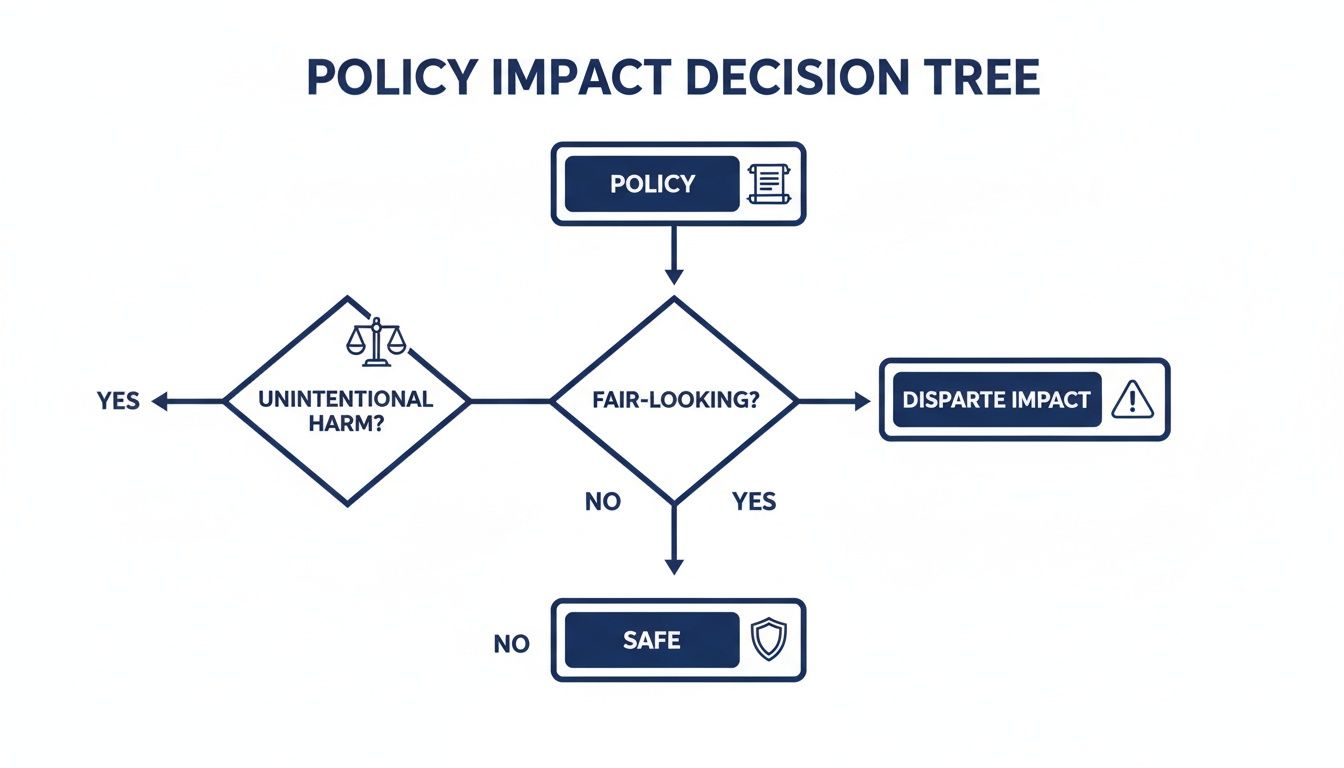
As the visual shows, the key question is not whether a policy seems fair, but whether its actual results create an imbalance that disproportionately affects a protected group.
When a potential issue is flagged and a claim moves forward, courts follow a three-step "burden-shifting" framework. Understanding this process is essential for building a legally defensible hiring and promotion system.
This legal structure forces leaders to think critically about every policy. The focus must always be on the direct connection between your requirements and the actual demands of the role. If you are unsure how your policies measure up, expert guidance is a smart move. To start a conversation, please contact our team.
Moving from legal theory to the real world, it’s clear that many standard HR practices can unintentionally create disparate impact risks. Policies that seem perfectly fair on the surface—designed with the best of intentions—can carry hidden liability. It’s critical for business leaders to recognize these common red flags in their own organizations before they escalate into serious legal problems.
A policy can appear completely objective yet still systematically filter out qualified people from protected groups. The key is to scrutinize any practice that acts as a "gatekeeper" for hiring, promotions, or pay. Understanding where these risks lie is the first step toward building a more defensible and equitable workplace.
Before diving into specific examples, it's crucial to understand the difference between the two primary forms of employment discrimination. Disparate impact is about the outcome of a policy, not the intent behind it. Disparate treatment, on the other hand, is about intentional discrimination. This table breaks down the key distinctions.
Understanding this distinction is fundamental. With disparate impact, a company can face legal action even if it never intended to discriminate. The focus is entirely on whether a neutral-seeming practice creates a statistically significant disadvantage for a protected group.
One of the most frequently challenged policies involves physical ability tests. For instance, a company might require every warehouse applicant to lift a 75-pound box, believing this ensures all new hires can handle the most demanding tasks. While it sounds logical, a requirement like this can disproportionately screen out female applicants or older candidates.
If the core, day-to-day functions of the job don't consistently require lifting that exact weight, the test could be challenged. The critical question is whether the test truly measures the essential functions of the role. If it doesn’t, it creates a significant risk of a disparate impact claim, even though the goal was simply to ensure capability and safety.
Inflexible degree or experience requirements are another common pitfall. Mandating a bachelor's degree for a role where years of hands-on experience would be a perfectly suitable—or even better—qualification can create an unnecessary barrier. This kind of policy can disproportionately screen out candidates from certain racial or socioeconomic backgrounds who had less access to higher education but possess all the necessary skills.
A policy isn't a "business necessity" just because it's convenient or traditional. It must be directly and demonstrably linked to an individual's ability to succeed in the specific role they are applying for.
This is exactly why writing clear, accurate, and compliant job descriptions is so crucial for risk management. When your requirements align precisely with the job's true demands, your defense against a potential claim becomes much stronger. You can check out our guide on how to write compliant job descriptions to ensure your hiring foundation is solid.
Blanket policies that exclude any applicant with a criminal record are a major source of disparate impact litigation. Due to systemic factors in the U.S. justice system, these policies often have a disproportionately negative effect on certain minority groups, particularly Black and Hispanic men. The EEOC has issued specific guidance on this, cautioning employers against using arrest records at all in hiring decisions.
For conviction records, a compliant approach requires a more individualized assessment:
A conviction for financial fraud from a decade ago might be relevant for a CFO role but is likely irrelevant for a landscaping position. To truly decode the legal standard for disparate impact, it's essential to understand related legal terminology such as theories of Adverse Impact.
Perhaps one of the most scrutinized practices today is the use of pre-employment credit checks. A neutral policy requiring candidates to have "good credit" can create a substantial disparate impact. Federal Reserve data has shown that minority candidates are often disqualified at much higher rates than white candidates due to historic and systemic inequities in lending.
A prime example is the EEOC's case against Kaplan Higher Education. The company’s credit check policy rejected 56% of African American applicants compared to just 9% of white applicants, without clear evidence linking credit history to job performance. The case resulted in a $2.45 million settlement, underscoring the severe financial risk. As more states move to ban or restrict these checks, multi-state employers face a complex web of rules where violations carry steep penalties.
Ultimately, each of these policies—from fitness tests to credit checks—highlights the same core principle. A practice must be more than just neutral on its face; it must be genuinely necessary for the job. By proactively examining and questioning these common gatekeepers, you can move your organization from a position of risk to one of strength and fairness.
The best defense is a proactive one. Auditing your HR processes for disparate impact risks empowers you to find and fix potential issues before they escalate into costly legal battles. This is not about assigning blame; it is about making your organization stronger by ensuring your practices are fair, legally defensible, and genuinely effective.
A proactive audit involves a structured review of your policies, data, and decision-making processes. By examining each step of the employee lifecycle—from recruitment and screening to promotions—you can uncover hidden barriers. This approach shifts you from a reactive, firefighting mode to a strategic one, allowing you to build a more resilient organization.

First, take inventory of all your "gatekeeper" policies. These are the seemingly neutral rules and requirements that decide who gets hired, promoted, or filtered out. Think of any practice that acts as a checkpoint in your talent pipeline.
Common gatekeeper policies to put under the microscope include:
Once you have identified your policies, gather the data to see what is actually happening. Your goal is to run a statistical analysis to check for imbalances, often using the 80% rule as your guide. You will need to collect applicant and employee data broken down by protected characteristics like race, gender, and age.
Key Takeaway: Data analysis isn't about finding blame; it's about uncovering patterns. Without objective data, you're just operating on assumptions, and that’s a huge business risk.
The data for this analysis often comes from your HRIS, ATS, and voluntary self-identification forms. If your company already submits federal compliance documents, you may have a head start. Learning more about what is an EEO-1 report can provide a solid starting point for your data collection efforts.
If your data analysis flags a policy that is creating a statistical disparity, the third stage is to put it to the test. Here, you must ask a tough question: Is this policy a true "business necessity" and directly related to essential job functions?
A requirement is not a business necessity just because it is "nice to have" or because "we've always done it that way." You need to draw a clear, defensible line from the requirement to successful performance in the role. For example, requiring a valid driver's license for a traveling sales representative is a clear business necessity. Requiring one for an office-based accountant is likely not.
This final stage applies when a policy fails the business necessity test. Your team must then brainstorm and document less discriminatory alternatives that can still achieve the same business goal. This step is crucial because it demonstrates a good-faith effort to build a fair process.
For instance, if a written test for a mechanic role shows a disparate impact, could a hands-on skills assessment be a more effective and equitable alternative? If a bachelor's degree requirement is screening out skilled candidates, could you accept a portfolio of work instead? Documenting this exploration is a vital part of building a defensible HR process.
Following this four-stage audit allows you to systematically reduce your exposure to disparate impact claims. It transforms compliance from a reactive headache into a strategic advantage.
Identifying a potential risk is the first step. What you do next is what truly protects your organization. Creating a legally defensible and well-documented process is not just about compliance; it is about building a foundation of fairness that strengthens your business. This means moving beyond assumptions and proving that your methods are valid, necessary, and equitable.
A huge part of this defense comes down to validation studies. These are formal, data-driven methods used to prove that a specific selection tool—like a skills test or physical assessment—actually predicts on-the-job success. They provide the objective evidence you need to justify a practice if it creates a statistical imbalance.

When a policy is challenged for creating disparate impact, the burden of proof shifts to you, the employer, to prove it is a "business necessity." A validation study is your strongest tool for meeting that burden. It is designed to answer one critical question: does this test actually measure what we think it measures?
There are several types of validation studies, but they all aim to connect a test score to real-world job performance. For instance, a "content validation" study ensures that a test for a programmer involves tasks they would perform daily. A "criterion-related" study looks for a correlation between test scores and performance metrics, like sales figures.
A classic example involves pre-employment strength tests. A company might require all warehouse applicants to lift 50 pounds. While seemingly neutral, this could disproportionately screen out women. If women pass at a rate less than 80% of men, it flags a potential disparate impact. In one real case, the EEOC sued a company over a strength test that disqualified 92% of female applicants but only 7% of males.
Any strong legal defense rests on a simple principle: "If it wasn’t documented, it didn’t happen." Meticulous documentation is your best shield in an investigation and the cornerstone of a defensible process. Your documentation should be a living record of your decision-making, showing that your team has acted thoughtfully and with clear purpose.
This record-keeping should include a few key things:
Building this complete record is a core part of any effective risk management strategy. You can use an HR audit checklist to ensure you are covering all your bases.
A thoughtful, well-documented process proves that your requirements are tied to genuine business needs, not just tradition or convenience. This transforms your HR function from a potential liability into a strategic asset.
Ultimately, building a defensible system is about being intentional. It forces you to validate your methods and document your reasoning at every step. While it demands upfront effort, this structured approach is what separates prepared organizations from those left vulnerable.
Navigating the complexities of disparate impact is about more than just avoiding lawsuits—it is about building a stronger, more resilient organization. If there is one thing to take away, it is that disparate impact discrimination is a question of outcomes, not intent. Even your most fair-minded policies can create significant legal exposure if they unintentionally create barriers for a protected group.
For a growing business, this is a real-world operational challenge. Ignoring these principles is a direct threat to your financial stability and reputation. Every seemingly neutral policy must be scrutinized to prove it is a true business necessity. By viewing compliance not as a burden but as a strategic advantage, you can enhance fairness, widen your talent pool, and strengthen your company’s foundation.
This mindset shifts your organization from a reactive stance to a proactive one. It fosters an environment where merit and skill are the true measures of success, reducing the risk of a policy having an unintended, disproportionate effect. Ultimately, a defensible process is one that is fair by design. Understanding your risks is the first step toward mitigating them.
If these challenges resonate with you and your leadership team, getting expert guidance can be a powerful next step. To learn more about how to protect your business while building a more equitable workplace, we invite you to schedule a confidential consultation with our team.
As a business leader, you’re likely wondering how these legal ideas apply to the real world of running your company. This section tackles the most common questions we hear, offering straightforward answers to help you get your immediate compliance efforts on the right track.
This is the single most important distinction in employment discrimination law. Think of it this way: disparate treatment is about intention, while disparate impact is all about outcome.
Yes, absolutely. As the employer, you are ultimately responsible for your hiring process, even if you outsource parts of it. If a vendor’s background check, skills assessment, or algorithm creates a disparate impact, your company can be held liable.
You simply can’t delegate your legal responsibility for fair hiring. It’s on you to thoroughly vet every vendor and make sure their tools are validated, compliant, and aren't quietly creating legal risks for your business.
This isn’t a one-and-done task. Proactive analysis is your best defense. As a best practice, you should run an internal audit on your hiring and promotion numbers at least annually.
You should also run an analysis anytime you:
Yes, some industries receive more scrutiny because their standard hiring practices often act as "gatekeepers." If your business relies heavily on specific tests or requirements, you must be extra careful to validate them.
Industries that are often under the microscope include:
While these practices can be perfectly legal and defensible, the burden is on you to prove they are a true business necessity and essential for performing the job.
Navigating these complexities is essential for protecting your business and building a fair workplace. Paradigm International Inc. specializes in helping leadership teams implement defensible HR practices. To start a confidential conversation about your specific needs, please contact our team.