


In the United States, the relationship between an employer and an employee is typically governed by a long-standing legal principle known as the employment-at-will doctrine. This concept forms the default setting for employment in nearly every state, offering a framework built on flexibility for both parties. Understanding its rules—and its exceptions—is essential for making sound HR decisions and protecting your business.
At its core, the doctrine is straightforward: an employee can leave a job at any time for any reason, and an employer can terminate an employee at any time for any reason, as long as the reason is not illegal. This two-way street allows businesses to adapt their workforce to changing needs. However, the freedom to terminate is not absolute, and navigating the legal boundaries is critical for any leader.

The at-will doctrine grants employers and employees the freedom to end the working relationship without notice or cause. This flexibility allows businesses to scale their teams up or down in response to market demands, avoiding the constraints of long-term commitments. It streamlines the process of parting ways when the fit is no longer right.
However, this flexibility comes with important limitations. The phrase "for any reason" is protected by legal guardrails that every business owner and HR leader must understand. It is crucial to distinguish between a termination that is merely unfair and one that is unlawful.
For example, terminating an employee for a minor, subjective reason might feel unfair but is generally permissible under the at-will doctrine. In contrast, terminating someone because of their age, race, or for reporting a safety violation is illegal and exposes your business to significant legal risk.
The at-will principle assumes the employment relationship is voluntary and has no fixed duration. This default arrangement can be modified by a formal employment contract that specifies a term of employment or outlines the exact conditions for termination. You can explore a detailed breakdown of the differences between at-will vs. contract employment in our guide. The key takeaway is simple: without a formal agreement stating otherwise, at-will is the standard.
The doctrine's simplicity is its greatest strength and its most significant risk. It empowers swift organizational change but requires leaders to act with a clear understanding of legal boundaries to avoid wrongful termination claims.
This balance between flexibility and risk is why mastering the at-will doctrine is so important. It serves as the foundation for building HR practices that withstand scrutiny and for making well-documented employment decisions. Understanding these nuances helps you sidestep preventable and costly legal challenges down the road.
While the employment-at-will doctrine provides considerable flexibility, it is not a blank check. Courts and legislatures have established important exceptions to protect employees from wrongful termination. These guardrails act as critical checks on an employer's authority, ensuring the freedom to terminate is not absolute. For business owners and HR leaders, understanding these exceptions is a core component of risk management.

These exceptions generally fall into three categories: the public policy exception, the implied contract exception, and the covenant of good faith and fair dealing. Each addresses a different type of potential employer overreach. Knowing where these lines are drawn can be the difference between a compliant separation and a costly legal battle.
The most widely recognized limit on at-will employment is the public policy exception. This principle prevents an employer from firing someone for reasons that violate a clear societal principle or the public good. It is a legal backstop that protects employees who act in the public's interest, even if it conflicts with their employer's directives.
This exception shields employees who are terminated for performing a legally protected action or for refusing to do something illegal. While specifics vary by state, it generally covers a few key scenarios:
For instance, if a manager directs a driver to ignore federal safety regulations and the driver is fired for refusing, that employee would likely have a strong case for wrongful termination.
Although at-will employment means there is no formal contract, an implied contract exception can arise when an employer's words, actions, or written policies create a reasonable expectation of job security. This is one of the easiest ways for a business to accidentally undermine its at-will status. This is not a signed document but a promise inferred from the employment relationship.
These "contracts" can be created through well-intentioned but careless communication.
An implied contract can morph the at-will relationship into one where termination is only allowed for "just cause." This raises the bar for letting someone go and exposes the business to much greater legal risk if the termination isn't handled perfectly.
Here are common ways an implied contract is created:
To avoid this, it is vital that your employee handbook includes a clear, prominent disclaimer stating that employment is at-will and that the handbook does not create a contract.
The third and least common exception is the covenant of good faith and fair dealing. Recognized by only a minority of states, this principle holds that every employment relationship includes an unwritten promise that both parties will treat each other fairly. A termination violates this covenant if it is done maliciously or timed to prevent an employee from receiving earned benefits.
This exception is much narrower than the other two. It focuses on whether the employer acted in bad faith to financially harm the employee, not on the general fairness of the termination reason.
For example, terminating a top salesperson the day before a large commission payment is due could be seen as a bad-faith action intended to avoid the payout. Similarly, an employer who fabricates a reason for termination to prevent an employee’s stock options from vesting might also be in violation.
This patchwork of state laws makes compliance complex, and there's a growing public movement for stronger employee protections. You can learn more about how cities are working to end at-will employment.
Understanding these legal guardrails is the first step toward making defensible termination decisions. Knowing where the boundaries lie is essential for protecting your business from potential risks.
If you are concerned about navigating these exceptions, our team can help. Contact us to learn how we can strengthen your HR compliance framework.
If your business operates in multiple states, a one-size-fits-all HR policy can lead to serious legal trouble. While the employment-at-will doctrine is the default in 49 states, its application is far from uniform. Each state interprets the common-law exceptions differently, creating a complex compliance landscape that requires state-specific policies.
An action that is a defensible termination in one state could become a wrongful termination lawsuit in another. This reality makes it critical for multi-state employers to understand the subtle but significant variations in at-will employment nationwide. Without this awareness, you risk navigating complex legal terrain without a proper map.
The level of employee protection varies widely across the country. States like California broadly interpret exceptions to at-will employment, making their courts more receptive to claims of implied contracts and public policy violations. This gives employees a stronger foundation to challenge terminations they believe are unfair.
On the other end of the spectrum are states like Georgia, which maintain a more traditional, employer-friendly stance. Here, the at-will doctrine is applied more strictly, and the standard for an employee to successfully sue for wrongful termination is significantly higher. This contrast highlights why a termination process that is compliant in one location could be legally risky in another.
Understanding your state’s specific legal climate isn't just a best practice; it's a fundamental part of risk management. Every termination decision has to be viewed through the lens of local and state law, not just federal guidelines.
These differences directly impact how you write policies and train managers. The U.S. at-will standard is already an outlier compared to the "just cause" norms in most other countries. For multi-state employers, that risk multiplies. A significant 38 states now recognize implied contracts through company policies, and 43 states prohibit terminations that violate public policy. You can learn more about these global and domestic employment law variations on GoGlobal.com.
Montana is the only state in the U.S. that has opted out of the at-will standard entirely. Once an employee completes a probationary period, an employer must have "just cause" to terminate them.
This changes the entire dynamic. "Just cause" requires a legitimate, business-related reason for the termination, such as documented poor performance, serious misconduct, or a genuine operational restructuring. This standard demands a much higher level of documentation and a more structured approach to progressive discipline.
Montana’s unique framework is a powerful reminder of how dramatically employment law can shift between states. It reinforces why you need:
Understanding these state-by-state requirements is a crucial first step for any business with a multi-state presence. This patchwork of laws means that diligence is your best defense against preventable legal challenges.
Applying the employment-at-will doctrine correctly requires a clear and consistent process. A well-documented approach is not just about legal compliance; it is about creating a record that proves each separation was fair, objective, and based on legitimate business needs. This record becomes your strongest defense if a termination is ever challenged.
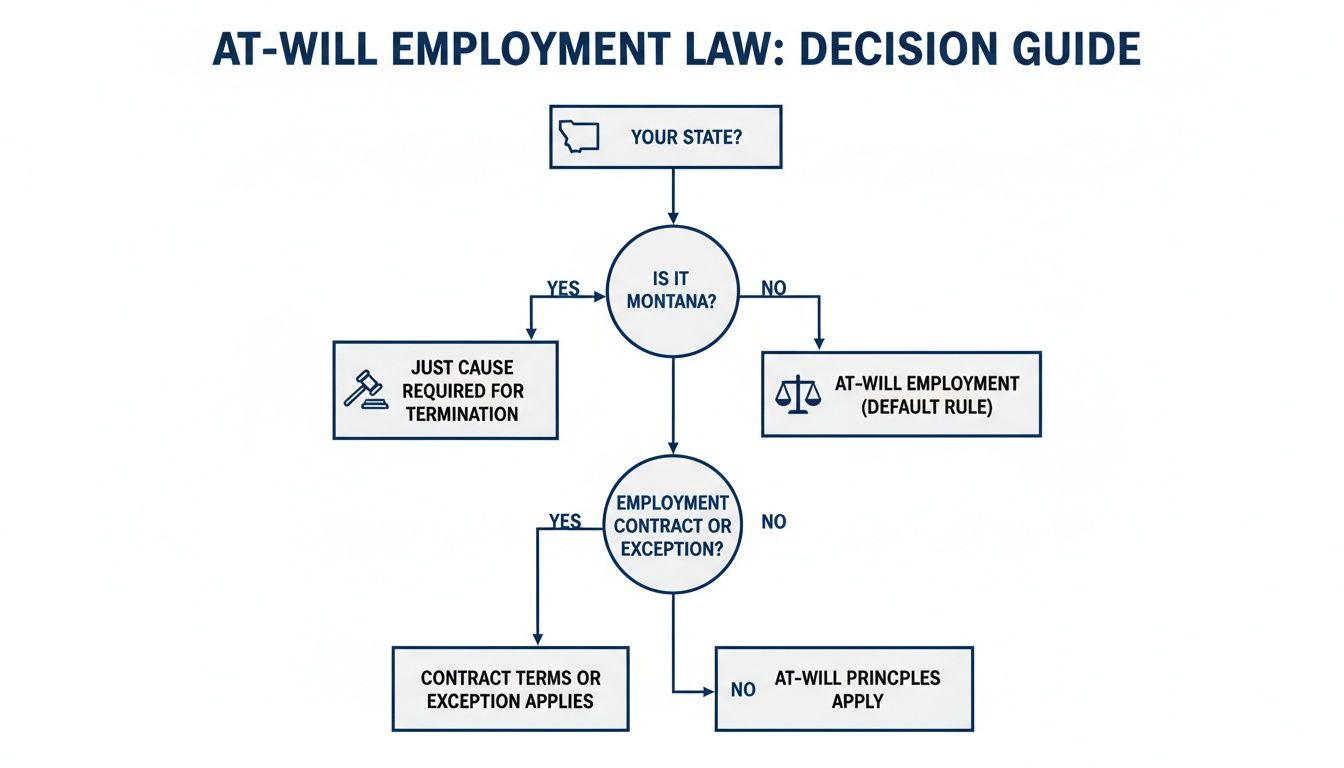
The flowchart illustrates the legal landscape: Montana follows a “just cause” model, while the other 49 states begin with an at-will presumption but layer on exceptions for public policy and implied contracts.
Good documentation demonstrates that your decision was based on performance issues or policy violations, not bias. Keep your records:
When misconduct allegations arise, a rushed conclusion can backfire. Treat investigations like fact-finding missions: gather evidence, interview all parties, and then make a determination based on the facts.
Best practices include:
The termination meeting is a critical moment. A structured approach helps managers remain calm and clear, reducing the risk of off-the-cuff remarks that could create legal exposure.
Key meeting steps include:
Your employee handbook can unintentionally create an employment contract if not worded carefully. A clear at-will disclaimer—placed prominently—reminds employees that the employment relationship can be ended at any time by either party. Without this statement, a progressive discipline policy could be interpreted by a court as a promise of job security.
Understanding the nuances of wrongful termination from an employer's perspective is fundamental. A framework built on consistent documentation, impartial investigations, and clear policy language allows you to make difficult decisions confidently and defensibly.
Navigating the world of employment-at-will is about proactive risk management, not reactive damage control. While the doctrine offers flexibility, it is not an impenetrable shield. The most resilient organizations build their HR frameworks on three pillars: consistency, thorough documentation, and clear policies. This approach transforms HR from an administrative function into a strategic asset.
A well-structured compliance strategy not only helps avoid lawsuits but also builds a foundation of fairness that strengthens the entire organization. It supports sustainable and responsible growth by ensuring that employment decisions are objective and equitable.
Your strongest legal defense is built through fair processes and clear communication in your daily operations. Every termination, performance review, and policy update must be handled with unwavering consistency. Technology can assist in this effort; for example, many companies are implementing HR chatbots to provide instant, uniform answers to common employee questions.
A resilient strategy includes a few key components:
Ultimately, a strong compliance framework is about creating a predictable and equitable environment. When employees understand the rules and see them applied fairly, the risk of disputes plummets, allowing leadership to focus on growing the business instead of playing defense.
In today's complex legal landscape, this proactive approach is a business necessity. Navigating these laws can feel overwhelming, but building a solid foundation now will protect your organization for years to come.
If you need a trusted partner to help you make defensible HR decisions and reduce your compliance risk, our team at Paradigm is here to help. Contact us to learn more about our advisory services.
The theory of at-will employment is one thing, but applying it correctly is where business leaders often have questions. Here are answers to some of the most common inquiries to help you put these concepts into practice and protect your organization.
No, and this is the most critical distinction. While the at-will doctrine provides broad discretion, you cannot terminate an employee for an illegal reason. This includes terminations that violate federal, state, or local anti-discrimination laws based on race, gender, religion, age, or disability. You also cannot fire someone for reasons that fall under a recognized exception, such as retaliating against a whistleblower.
Yes, this is a common risk. If your handbook uses language that implies job security or lists specific reasons for termination as the only grounds for dismissal, a court could interpret it as an implied contract. This could negate an employee’s at-will status. To prevent this, include a clear at-will disclaimer stating that the handbook does not create a contract.
From a risk management perspective, yes. While you may not be legally required to provide a reason in a pure at-will scenario, offering a truthful, consistent, and well-documented business reason is a powerful best practice. Not giving a reason can appear suspicious and may lead a former employee to assume the termination was for an illegal reason, potentially resulting in a lawsuit.
In a true at-will relationship, you are generally not required to offer severance unless it is part of a formal employment agreement or company policy. However, many employers use severance strategically. By offering a severance package, you can ask the departing employee to sign a release of claims, an agreement not to sue the company. This is a valuable tool for mitigating the risk of future legal battles.
Understanding what is employment at will doctrine is the foundation of a sound HR framework. If you need assistance making compliant HR decisions and reducing risk, the team at Paradigm is here to provide expert guidance. For more information on how we can support your business, consider contacting us.


