
Understanding and managing holiday pay is a critical function for any business leader. It's more than just a line item in your payroll budget; it's a strategic tool that impacts everything from employee morale to your ability to attract top talent. A well-defined holiday pay policy signals that you value your team's well-being and fosters a positive company culture.
Simply put, holiday pay is the compensation an employee receives for a company-observed holiday. This can mean a paid day off when the business is closed or premium pay for employees who are required to work on that day. While the concept seems simple, its implementation requires careful thought to ensure fairness, compliance, and strategic alignment with your business goals.

It is crucial for business leaders to recognize one key fact. Under the federal Fair Labor Standards Act (FLSA), private employers in the United States are not required to offer paid holidays. This means any holiday pay policy you implement is a strategic choice, not a legal mandate. This perspective transforms holiday pay from a compliance task into a competitive advantage.
By crafting a clear and thoughtful holiday pay program, you can directly influence employee morale, retention, and how your company is perceived in the job market. It becomes a tangible signal that you value your team’s well-being and their life outside of work. A well-structured policy is a foundational piece of your total rewards strategy, demonstrating your commitment to being an employer of choice.
A strong policy needs to address several key components to be effective. It is not enough to simply give people a day off; you must structure and communicate the benefit clearly to your team. Without a formal policy, you risk creating confusion, perceived unfairness, and administrative headaches.
Your policy should clearly define:
The approach to holiday compensation also varies significantly across industries. Sectors like retail or healthcare often rely on premium pay to ensure operational continuity. Data shows that while only 19% of U.S. employers pay regular rates for holiday work, 28% offer premium pay. This makes it a key retention tool in competitive fields. You can discover more insights about these leave management trends to better position your benefits package.
A generous and well-defined policy can boost morale, reduce turnover, and help attract top-tier talent. It reframes the conversation from "Do we have to do this?" to "How can this benefit our people and our business?" If you need guidance on building a strategic holiday pay policy, our team is here to help.
One of the most common points of confusion for business owners is the distinction between paid holidays and a general Paid Time Off (PTO) bank. While both provide employees with paid leave, they serve different purposes and have unique strategic implications. Understanding this difference is key to designing a leave program that fits your operational needs and company culture.
Think of paid holidays as fixed dates on the company calendar—like Thanksgiving or Christmas—where the business typically closes and eligible employees receive pay. It is a collective, company-wide benefit that occurs on specific days designated by leadership. This creates predictability for scheduling, production, and client communication.
In contrast, Paid Time Off (PTO) is a flexible bank of hours or days given to an individual employee. This bank usually combines traditional vacation, sick, and personal days into one account. Employees can then use their PTO for various personal needs, provided they follow company approval and scheduling policies.
The real distinction lies in control and flexibility. With paid holidays, the employer sets the schedule, creating a shared pause for the entire organization. This is a significant advantage for businesses that need predictable shutdowns for factory maintenance, annual inventory, or ensuring teams get a break without disrupting workflows.
PTO, on the other hand, gives control to the employee. It offers the flexibility many modern workers expect, allowing them to take time off for personal appointments, family events, or a long weekend. This sense of autonomy can be a powerful tool for attracting and retaining great talent in a competitive market. The choice reflects your company's operational philosophy: fixed holidays emphasize structure, while PTO banks prioritize individual flexibility.
Many companies find that a hybrid model offers the best of both worlds. This approach combines a set list of company-paid holidays with a separate PTO bank for employees to use at their discretion. This structure provides the predictability of fixed holidays while still offering the flexibility that employees value.
When deciding on your approach, consider these questions:
Ultimately, your goal is to create a leave policy that is clear, fair, and competitive. Whether you choose fixed holidays, a PTO bank, or a hybrid model, the most important step is documenting the specifics in your employee handbook.
Calculating holiday pay should not be a complex task, but errors can lead to payroll headaches, employee disputes, and compliance issues. The key is understanding that the calculation depends on the employee's classification and your company's policy. A consistent and transparent process empowers you to handle payroll with confidence.
For hourly (non-exempt) staff, there are two main scenarios: paying them for a day off or paying them a premium rate to work on the holiday. Your employee handbook must clearly state your company's approach and the exact rate of pay.
This visual guide shows how paid holidays fit into your company's broader leave structure.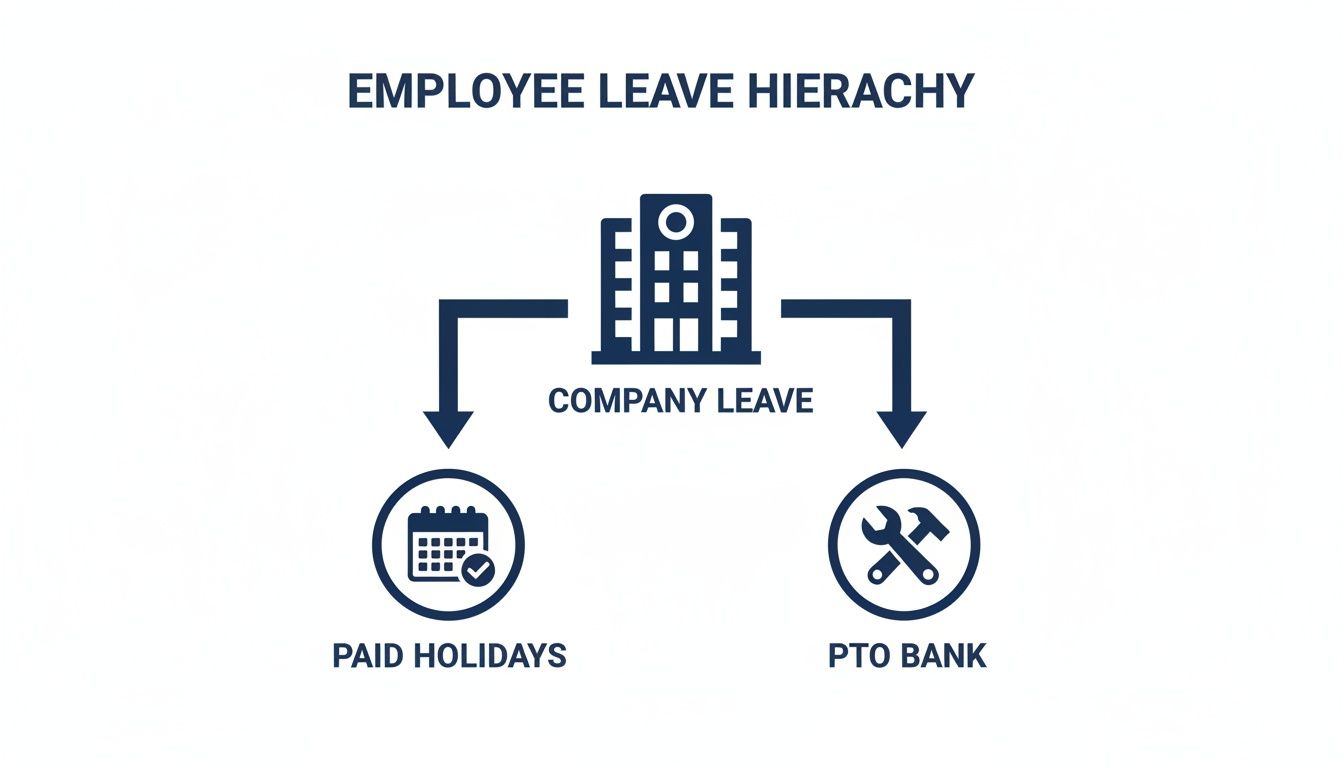
As you can see, even though paid holidays and PTO are both forms of company-provided leave, they're typically managed as separate buckets with their own rules.
Holiday pay for salaried exempt employees is much simpler. Their salary is intended to cover them for the entire week, regardless of the hours or days worked. If you close the office for a holiday, you cannot deduct their pay. Under the FLSA, if an exempt employee performs any work during a workweek, they must receive their full weekly salary.
If a salaried exempt employee works on a holiday, they are generally not entitled to extra pay unless your company policy specifically provides for it. You can learn more about these critical pay rules by exploring our guide on exempt vs. nonexempt employees.
To make things easier, here’s a quick-reference table that breaks down the calculation methods for different employee types.
This cheat sheet is a great starting point, but always cross-reference it with your company's written policies to ensure consistent application.
Part-time employees and overtime during holiday weeks can add complexity. A common method for part-time employees is to pro-rate their holiday pay. For example, an employee working 20 hours per week (50% of a 40-hour week) would receive four hours of holiday pay for an 8-hour holiday.
For overtime, it is important to note that pay for an unworked holiday does not count toward the hours worked when calculating weekly overtime according to the FLSA. Getting holiday pay right is one piece of the puzzle in running payroll for your small business correctly. Your ability to calculate pay accurately depends on the clear rules you establish in your policy.
Expanding your business across state lines introduces new HR complexities. For leaders managing teams in multiple states, holiday pay compliance can be challenging. While federal law does not require paid holidays, a few states have specific rules. The key is to build a strategic framework that simplifies administration and ensures equitable treatment for all employees.
You must recognize that holiday pay regulations vary by state. A policy that is compliant in Texas could create issues in Massachusetts. Some states have laws, sometimes called "blue laws," that dictate how certain businesses must pay employees on specific holidays.
These states create legal obligations that exceed the federal baseline. If your company has employees in these locations, your payroll practices must be adjusted to remain compliant.
Managing multiple, state-specific holiday pay policies is an administrative challenge that increases the risk of errors and can create feelings of unfairness. A better approach is to create a single, unified company-wide policy. Best practice is to design your policy around the requirements of your most stringent state of operation.
By setting your company-wide policy to the highest legal standard you must meet, you simplify administration and eliminate the risk of non-compliance. This proactive approach ensures fairness and makes your policy easier to manage as you grow. This strategy streamlines your payroll process and fosters a sense of unity. Creating this consistency is a cornerstone of a solid multi-state handbook, and you can learn more from our guide on employee handbook requirements by state.
State employment laws are not static; they change. A policy that is compliant today may be outdated next year. Periodic legal reviews are an essential risk management practice for any multi-state employer. The complexity of U.S. laws is notable when compared globally, where rules vary dramatically. For instance, the U.S. has no federal mandate for paid holidays, unlike countries such as Luxembourg. You can discover more about how paid time off varies worldwide for a broader perspective.
Set a calendar reminder to review your holiday pay policy at least annually with legal counsel specializing in employment law. This simple step ensures you stay ahead of legislative changes and can make adjustments before they become problems.
A clear holiday pay policy is your best defense against employee misunderstandings, inconsistent application, and potential legal claims. Drafting a comprehensive and legally sound policy provides the structure needed to manage expectations and protect your business. It serves as the single source of truth, giving managers and employees a clear understanding of what to expect.

When you build your policy, certain elements are non-negotiable. Each clause should be written with clarity, leaving no room for interpretation. You are creating a blueprint for how your company handles every aspect of holiday compensation.
Your policy must spell out these core components:
Detailing these points creates a consistent framework that can be applied fairly to everyone. This is a fundamental piece of any strong paid time off policy and your overall benefits program.
The language you choose matters. Vague wording creates loopholes and invites disagreements. Your policy should use direct, simple language that is easy for everyone to understand. A clause requiring employees to work their last scheduled day before and first scheduled day after a holiday to be eligible for pay is a critical tool for preventing abuse and protecting operations.
Every section of your policy serves a specific purpose in minimizing risk and ensuring fairness.
A well-documented holiday pay policy is a strategic tool. It promotes fairness, reduces administrative burden, and demonstrates a commitment to professional management.
Even with the best intentions, a small administrative slip-up with holiday pay can lead to larger problems. These errors can damage morale, create perceptions of unfairness, and even result in costly legal issues. Understanding the most common pitfalls is the first step toward building a fair and defensible policy.
One of the riskiest mistakes is applying holiday pay rules differently to different employees. This often happens when one manager makes an exception for an employee, while another manager adheres strictly to the handbook. This inconsistency can lead to claims of favoritism or discrimination.
Solution: The only solution is absolute consistency. Your employee handbook must be the single source of truth, and its rules must be applied uniformly. Regular training for managers on how to interpret and apply company policies is essential.
Part-time employees are a frequent source of holiday pay confusion. A common error is not paying a part-time employee for a holiday because they were not scheduled to work that day. This can create a sense of inequity, especially if holidays consistently fall on their regular day off.
Solution: Address part-time holiday pay directly in your policy. A fair approach is to offer pro-rated holiday pay based on the employee's average hours worked. For example, an employee who works 20 hours a week would receive four hours of pay for an eight-hour company holiday.
Misclassification is a serious compliance risk with major financial consequences. This can involve incorrectly labeling a non-exempt employee as exempt to avoid overtime or miscalculating an employee's "regular rate of pay" for overtime purposes during a holiday week.
Solution: Conduct regular audits of your employee classifications with guidance from HR or legal counsel to ensure alignment with the FLSA. For overtime calculations, double-check that all required compensation is included in the regular rate. When in doubt, seeking expert advice is always a smart investment.
Even with a strong policy, real-world situations can test the fine print of your employee handbook. As a business owner or HR leader, you will face questions that require clear, confident answers. This section addresses some of the most common scenarios.
Generally, no. Most companies tie holiday pay eligibility to active employment status on the holiday itself. Your policy should state that an employee's final day of work must be after the holiday to receive holiday pay. A defensible approach is to require employees to work their last scheduled shift before and first scheduled shift after the holiday to qualify.
A good policy must address this scenario. You can either pay the employee for those holiday hours in addition to their regular pay or grant them another paid day off, often called a "floating holiday." While salaried exempt employees' pay should not change, addressing this for hourly staff is crucial for maintaining morale and fairness.
You are not legally required to offer the same benefits to every employee, but your policy must clearly define eligibility based on objective criteria like employment status (full-time vs. part-time) or length of service. The key is to apply these rules consistently to all similarly situated employees to avoid claims of discrimination.
This is a complex area of the FLSA. Generally, discretionary premium pay for working a holiday does not count toward the "regular rate of pay" for calculating overtime, but only if the premium is at least 1.5 times the normal rate. Because these rules are intricate, we always recommend consulting with legal counsel to ensure your calculations are fully compliant.
Navigating holiday pay is one of many complex HR challenges business leaders face. Paradigm is here to help you build and maintain sound, defensible HR practices.
If you're looking for a partner to guide you through these decisions, we invite you to learn more about our advisory services. Contact us to learn more.