When an employee needs to step away from work for a serious health issue, you're dealing with more than just a few sick days. This situation is known as medical leave—a protected absence governed by a complex web of federal, state, and even local laws. For business owners and HR leaders, understanding what is medical leave and how it differs from other time off is the first step toward building a compliant process that protects both your business and your people.
Mishandling a medical leave request can quickly spiral into legal and financial trouble, especially for businesses operating in multiple states. However, getting it right builds employee trust and ensures you’re prepared for one of the most common and complex HR challenges you will face. This guide provides the clear, actionable insights you need to navigate medical leave with confidence.

Medical leave is a legally protected period of time away from work for an employee's own serious health condition or to care for a family member with one. Unlike a standard sick day, which is usually brief and covered by company policy, medical leave is typically longer and triggers specific legal duties for you as the employer. The key differentiator is the presence of a "serious health condition," a term specifically defined by federal law.
This distinction is what separates a routine absence from a legally protected one, and it's where many employers make their first mistake. Understanding this difference is critical to categorizing leave requests correctly from the start and avoiding compliance risks.
One of the most common points of confusion is the difference between job protection and wage replacement. These are two separate concepts that do not always go together. An employee might be eligible for one but not the other, or both, depending on the applicable laws.
Think of it like this:
An employee might have job protection without pay (like unpaid FMLA), or get paid without explicit job protection (under some disability plans). It is essential to know the difference between a general leave of absence and a legally mandated one. To dig deeper, you can learn more about leave of absence vs FMLA in our detailed article.
To help clarify the moving parts, this table breaks down the most common types of leave related to employee health. Each one serves a different purpose and comes with its own set of rules.
These leave types often overlap, creating what's known as the "Bermuda Triangle" of employment law. An employee might be on FMLA leave while receiving STD benefits, and their absence could also be considered a reasonable accommodation under the ADA. This is why a solid understanding of each component is so important.
Navigating the complexities of medical leave requires a clear, defensible process. If you need support in developing compliant policies or handling difficult leave situations, our team can provide the expert guidance you need. To learn more about how we partner with businesses like yours, please consider reaching out to us.
When an employee needs time off for a medical issue, your response is typically framed by two major federal laws: the Family and Medical Leave Act (FMLA) and the Americans with Disabilities Act (ADA). They serve different purposes but often work in tandem, creating a web of obligations for employers. Understanding how they function—both on their own and together—is the first step toward managing leave correctly.
The FMLA is the law that provides eligible employees with job-protected, unpaid leave for specific medical and family reasons. It's a cornerstone of employee rights, but it does not cover every business or every worker. This is where most employers get their first real introduction to the legal side of medical leave.
For the FMLA to apply, both the company and the employee must meet certain criteria. An employer is covered if they have 50 or more employees for at least 20 workweeks in the current or previous year. Those employees must also work within a 75-mile radius of their worksite.
An employee is eligible only if they meet three specific milestones:
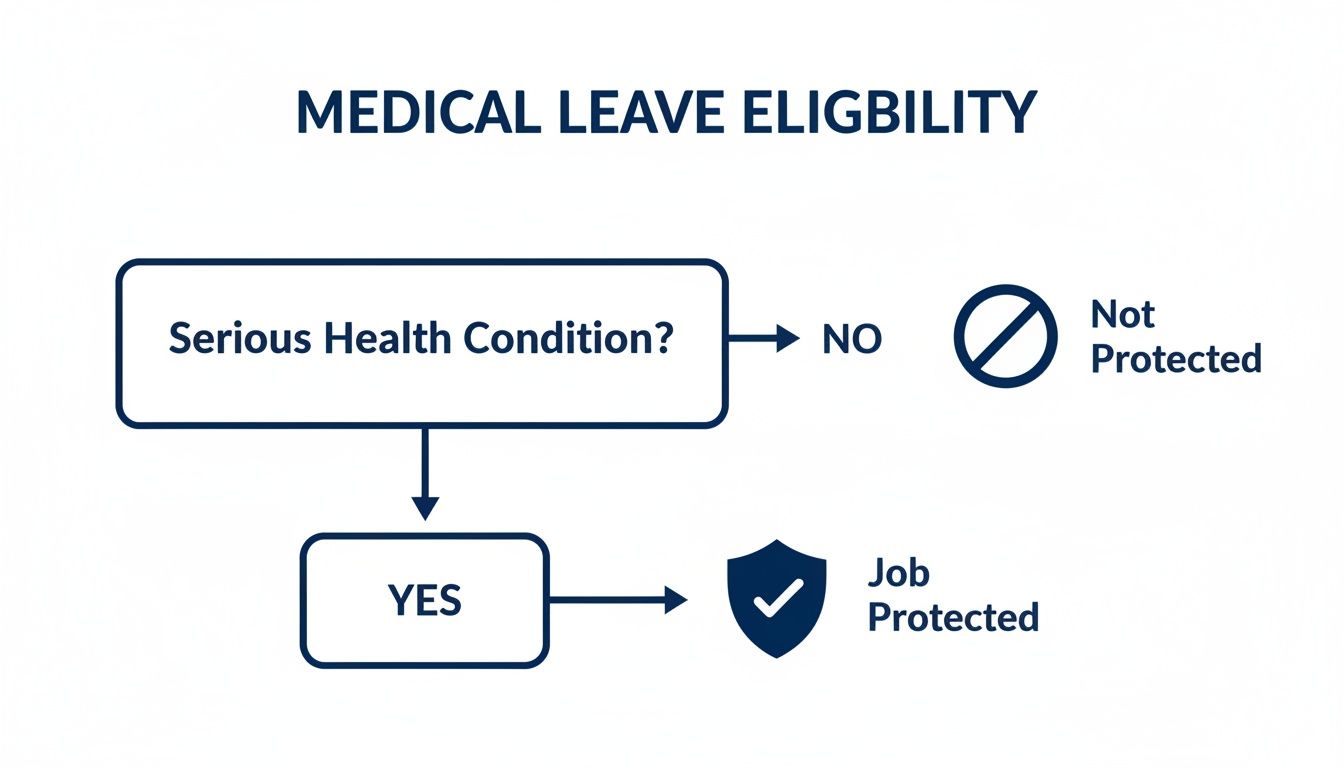
If everyone meets the criteria, the FMLA grants up to 12 weeks of unpaid, job-protected leave within a 12-month period. Most companies use a "rolling" 12-month period, which looks backward from the date an employee requests leave to determine how much time they have remaining. For a deeper look at these rules, you can check out our FMLA eligibility checklist for employers.
The ADA approaches the issue from a different angle. It applies to employers with 15 or more employees and is designed to prevent discrimination against individuals with disabilities. Instead of a fixed amount of leave, the ADA requires you to provide reasonable accommodations to help a qualified employee perform their job, as long as it does not create an "undue hardship" for the business.
A key insight here is that a leave of absence can be a form of reasonable accommodation. This means even if your business is too small for FMLA or an employee has exhausted all their FMLA time, you might still have to provide additional unpaid leave under the ADA. This obligation is managed through a collaborative dialogue known as the interactive process.
The interactive process is a structured conversation between you and your employee to identify a reasonable accommodation. The moment an employee requests a change at work because of a medical condition, your legal duty to engage in this process begins.
Here are the basic steps:
Managing these federal rules is a significant administrative task. Recent data shows that 53% of all leaves offered by U.S. businesses are for medical reasons, and 50% of administrators spend four to six hours on every single request. When you consider that much of this work is done manually, the risk of costly mistakes becomes clear.
If you have employees in more than one state, federal laws like FMLA and the ADA are just the starting point. A growing number of states have introduced their own medical and paid family leave (PFL) laws, creating a complicated and overlapping map of regulations. Staying on top of this patchwork is a necessity for protecting your business from compliance risks.
These state-level mandates often provide more generous protections than their federal counterparts. They may cover smaller employers, offer longer leave periods, or provide partial wage replacement through state-run insurance programs. This means an employee who is not eligible for FMLA might still be entitled to protected, paid time off under their state’s law.
Understanding the differences between federal and state requirements is crucial, as an employee's rights can change based on where they work. Your policies must be flexible enough to account for these local variations.
Key areas where state laws often expand on federal rules include:
This creates a complex environment where you must determine which law—federal, state, or local—provides the greatest benefit to the employee and apply that standard. Our guide to employee handbook requirements by state offers more detail on managing these jurisdictional differences.
To give you a clearer picture of this variability, the table below highlights how key provisions differ across a few prominent state-mandated paid leave programs. This is a quick snapshot of what you need to manage as a multi-state employer.
As these examples show, there is no one-size-fits-all approach. Each program has its own contribution rates, benefit calculations, and administrative requirements that demand localized knowledge. Access to paid leave remains a patchwork in the United States, which is one of the few advanced economies without a federal mandate. You can learn more about how the U.S. compares globally from these paid sick leave findings.
If navigating the complexities of multi-state leave laws feels overwhelming, our experts can help you build a compliant framework. To ensure your policies are up to date and your practices are sound, consider contacting us today.
A solid medical leave process is your best defense against compliance issues and legal risk. It all comes down to clear communication and consistent documentation. Without them, you are navigating a maze of legal requirements without a map. Getting this right turns confusing rules into a structured system that protects both your employees and your business.
The process begins the moment an employee notifies you they might need a leave. Every document, from their initial request to the final fitness-for-duty certification, serves a purpose. Knowing what you can—and cannot—ask for is key to staying compliant while respecting employee privacy.
Think of your documentation as a complete, consistent record of the entire leave process. If your decisions are ever questioned, this paper trail becomes your primary defense. It demonstrates that you followed a fair and standardized process at every step.
Here are the key documents you'll need:
Remember, all medical documents must be stored in a separate, secure file, not in the employee’s regular personnel file. This is a strict confidentiality requirement under both the ADA and FMLA. For a diverse workforce, consider how to manage situations requiring medical leave document translation to ensure compliance and clear communication.
Your employee handbook is your most important tool for communicating your leave process. A well-written policy sets clear expectations, standardizes how leave is handled, and prevents inconsistent decisions. An ambiguous or poorly drafted policy is a significant liability, creating confusion and increasing legal exposure.
Your policy must detail:
Building a structured process around these documents and policy points takes the guesswork out of medical leave and creates a powerful defense against potential claims.
For any business with a distributed workforce, managing medical leave is more than a compliance task—it's a critical part of maintaining operational stability. As your team spreads across state lines, a one-size-fits-all approach to leave is not just ineffective; it's a significant liability. What works in one state may fall dangerously short of legal requirements in another.
The complexity multiplies when you factor in how dramatically leave laws and employee expectations can vary from one region to another. This directly impacts workforce planning, budgeting, and your company's legal exposure. Understanding these differences is the first step toward building a truly defensible system.
Beyond legal mandates, even cultural norms around taking sick time can create operational hurdles, especially for companies with an international footprint. For example, a recent report highlights stark global disparities in medical leave usage, which can present forecasting challenges for a growing business.
The 2025 sick leave report found that workers in some countries take significantly more sick days per year than in others. For a US-based company with international teams, this variance presents a real operational risk. Failing to account for local norms and higher usage rates can lead to unplanned productivity gaps and financial strain, underscoring the need for tailored leave policies.
An effective strategy for multi-state employers is to develop a "core and flex" policy. This involves creating a foundational leave policy that outlines your company's general principles, then building state-specific addendums that adapt to local requirements. This approach ensures your company-wide philosophy remains consistent while you adhere to local laws.
Your core policy should cover elements you control company-wide, such as:
The state-specific addendums must then detail the unique provisions of each location, including eligibility rules, leave duration, and any paid benefits required by that state's law.
One of the greatest dangers in multi-state leave management is applying policies inconsistently. When managers in different locations handle similar leave requests in different ways, it opens the door for claims of discrimination and unfair treatment. A manager in one state might deny a request that a manager in another state is legally required to approve.
Inconsistent handling of leave requests is a leading cause of employment litigation. Training your managers to recognize a potential leave request and escalate it to HR uniformly is not just a best practice—it's a critical risk mitigation strategy. This approach turns a major compliance headache into a structured and defensible process.
Navigating the web of multi-state employment rules is a significant challenge. If you need expert guidance to build a compliant leave management framework, we can help. Contact our team to ensure your policies are sound and your practices are defensible.
Even with the best policies in place, the day-to-day reality of managing medical leave can present challenging scenarios. This section tackles the most frequent questions we hear from business owners and HR leaders, providing clear answers to help you handle these moments with confidence.
While you can, it is often not a practical strategy. Demanding a doctor's note for a single-day absence can create administrative burdens and negatively impact employee morale. A more effective approach is to reserve this requirement for absences of three or more consecutive days or when you observe a clear pattern of absenteeism. If the leave might qualify under FMLA, you must follow the official medical certification process.
Intermittent leave is FMLA-protected time off taken in smaller blocks for a single, ongoing health condition, such as regular medical appointments. Tracking this type of leave is a major challenge for many employers. You are required to track it using the smallest time increment your payroll system uses, such as 15-minute intervals. You cannot require an employee to take more FMLA time than is medically necessary.
This is a critical risk area. Firing an employee the moment their FMLA leave ends can lead to a disability discrimination claim under the Americans with Disabilities Act (ADA). Before making any decision, you have a duty to engage in the interactive process to determine if providing additional unpaid leave could serve as a reasonable accommodation. You must evaluate whether an additional, defined period of leave is feasible for your business or if it would cause an "undue hardship."
The laws that apply are those of the state where the employee actually performs their work, not where your company is headquartered. This is a crucial detail for businesses with a distributed workforce. You are responsible for complying with the specific medical and paid leave requirements for every state where you have an employee. This is a primary reason why multi-state employers need an adaptable, well-documented compliance framework.
Managing the complexities of medical leave requires a strong foundation and expert guidance, especially when high-stakes situations arise. If you need support building a compliant framework for your business, we can help you navigate these challenges and maintain defensible HR practices.
To learn more about how we can support your team, feel free to get in touch with our team.