
Workplace harassment can take many forms, but quid pro quo harassment is one of the most direct and damaging. In simple terms, this illegal behavior creates a "this for that" exchange where a job benefit, like a promotion or even keeping one's job, is conditioned on an employee submitting to unwelcome sexual advances. For any leader dedicated to building a safe, compliant, and respectful workplace, understanding this specific type of harassment is a critical first step.
At its core, quid pro quo harassment is about an imbalance of power. It occurs when someone in authority—a manager, supervisor, or executive—uses their position to demand sexual favors or coerce a subordinate. This behavior is not just poor management; it is a clear violation of federal law with severe consequences for any business.
Quid pro quo, a Latin phrase meaning "this for that," is a form of sexual harassment where job benefits are offered in exchange for an employee's submission to unwelcome advances. The reverse is also true, where a supervisor might threaten negative consequences for refusal. This illegal practice is a direct violation of Title VII of the Civil Rights Act of 1964. You can find more details on what is legally considered quid pro quo harassment over at alancohenlaw.com.
To properly identify quid pro quo harassment, it helps to break it down into its core components. Legally, three conditions generally need to be met for an incident to be classified this way:
This type of harassment hinges on the exchange. It links a tangible employment action directly to how an employee responds to sexual demands. The exchange can be a promise of a reward for compliance or a threat of punishment for refusal. Understanding these elements is essential for developing effective prevention strategies. If you need guidance on strengthening your company’s HR framework, connect with our team at Paradigm.
To protect your business from the consequences of quid pro quo harassment, you must first understand its legal definition. This is not about becoming a lawyer, but about grasping the core components that courts and agencies like the Equal Employment Opportunity Commission (EEOC) look for.
The foundation for these regulations is Title VII of the Civil Rights Act of 1964. This federal law makes it illegal for employers to discriminate based on sex, among other protected classes. Quid pro quo harassment is a direct violation of an employee's right to a workplace free from coercion.
For a situation to legally qualify as quid pro quo harassment, a complaint generally needs to prove three specific things. Knowing these elements can help you spot high-risk behavior before it escalates into a legal issue.
The term “tangible employment action” is the cornerstone of a quid pro quo case. It refers to a significant, official change in someone’s employment status, not just a negative interaction. These are official company acts that cause direct economic harm or fundamentally alter the job.
Examples of tangible employment actions include:
The presence of a tangible employment action often triggers strict liability for the company. When a supervisor’s harassment leads to an official company decision, the business itself is typically held directly responsible for the damage.
One of the most critical distinctions for leaders to understand is that quid pro quo harassment differs from a hostile work environment. A hostile work environment claim usually requires a pattern of behavior that is "severe or pervasive" enough to make the workplace abusive.
This is not the case with quid pro quo. A single incident can be enough to file a valid claim. If a manager fires an employee for refusing a date, that single act is sufficient. The severity of the consequence—the tangible employment action—replaces the need to show a pattern of behavior. This is what makes quid pro quo claims so dangerous for employers. If you need help turning these legal standards into practical policies and training for your team, reach out to Paradigm for guidance.
Understanding the definition of quid pro quo harassment is one thing, but identifying it in daily operations is another challenge. This type of harassment is not always a blatant proposition; it often appears as subtle, coercive suggestions.
For any leader or HR professional, the ability to recognize these behaviors is the first line of defense. At its core, quid pro quo is an abuse of authority where a supervisor creates a “this for that” ultimatum. An employee is made to feel that their job or career advancement depends on complying with an inappropriate demand, creating significant legal risk.
While every situation is unique, quid pro quo harassment often follows common patterns. The consistent theme is a person in power linking a job benefit to unwelcome conduct, either explicitly or implicitly.
Here are a few real-world examples:
As these scenarios show, quid pro quo does not require an explicit demand. Implied pressure and subtle retaliation are just as illegal and damaging. Our guide on how to handle workplace harassment offers additional steps and insights.
A common point of confusion for leaders is the difference between quid pro quo harassment and a hostile work environment. Both are illegal under Title VII, but they have different legal standards. Understanding this distinction is vital for conducting a proper investigation.
Quid pro quo is a specific, transactional demand from someone in power. A hostile work environment, on the other hand, is created by unwelcome conduct so severe or pervasive that it makes the workplace feel intimidating or abusive.
The critical takeaway is that quid pro quo harassment is tied to a supervisor's power to make official employment decisions. A coworker telling offensive jokes may create a hostile environment, but only a manager can threaten termination for refusing a date. Recognizing these differences helps you classify complaints correctly and launch the right type of investigation.
When a quid pro quo harassment claim arises, understanding your company’s liability is critical. If a supervisor’s harassment leads to a tangible employment action—such as firing, demoting, or denying a promotion—the situation becomes very serious. The law views this as a direct failure by the company to prevent an abuse of power.
In these cases, a legal concept called strict liability often applies. This means your company can be held automatically responsible for the supervisor's actions, regardless of whether you knew about the harassment. The reasoning is that the supervisor used company-granted authority to make a harmful decision, making their actions the company's actions.
The fallout from mishandling such a complaint can be devastating. Beyond costly legal settlements, the damage to your company's reputation can be lasting. A public harassment scandal can harm employee morale, tarnish your brand, and make it difficult to attract talent.
When the harasser is a supervisor, the employer is typically held vicariously liable for their conduct. This legal doctrine holds the company responsible because it placed the supervisor in a position of power. For quid pro quo claims involving a tangible employment action, this liability is usually absolute.
However, if a supervisor's harassment does not result in a tangible employment action, the situation is more nuanced and may be treated as a hostile work environment claim. In these cases, your company may have a defense if you can prove two things:
This is why a well-communicated anti-harassment policy and reporting system is your best defense. This diagram illustrates the critical differences between quid pro quo and a hostile work environment, which directly impacts how liability is determined.
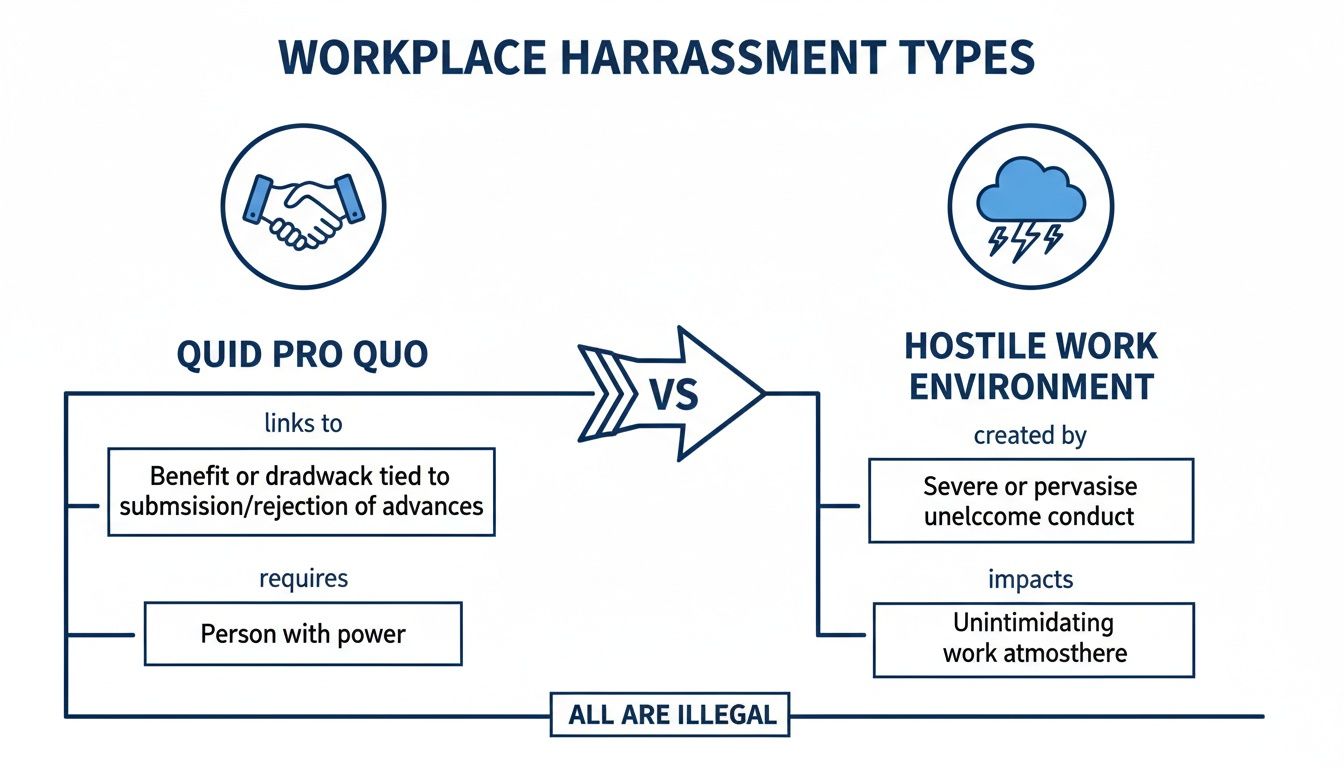
The key takeaway is that quid pro quo is a direct abuse of supervisory authority tied to a real job consequence, while a hostile environment is about the overall workplace atmosphere.
The moment a harassment complaint is filed, the clock starts ticking. A prompt, impartial, and thoroughly documented investigation is the core of a legally defensible position. For a deeper look, see our guide on investigating workplace harassment.
Your investigation must focus on uncovering facts, not protecting a person or outcome. Here are the key steps:
A solid investigation resolves the immediate problem and creates a record demonstrating your company took its legal duties seriously. This documentation is invaluable if the issue ever escalates.

The most effective way to manage the risk of quid pro quo harassment is to prevent it from happening. A proactive approach sends a clear message that such behavior will not be tolerated, fostering a culture of respect and safety. This requires implementing a framework designed to stop harassment before it starts.
This framework involves more than just a policy in a handbook. It means embedding prevention into daily operations through clear policies, meaningful training, and accessible reporting channels that employees trust. These elements work together to form a strong defense against liability.
Your anti-harassment policy is the cornerstone of your prevention strategy. It must be clear, comprehensive, and easy for everyone to understand. The document should explicitly define quid pro quo harassment and state that it is illegal and grounds for termination.
A strong policy also serves as a practical guide, outlining professional conduct expectations and detailing the consequences for violations. This ethical foundation, often captured by understanding What Is a Code of Conduct, is essential for fostering a respectful workplace.
To be effective, your policy must include:
Since quid pro quo harassment is an abuse of power, training your managers and supervisors is your most critical preventive measure. Generic, check-the-box training is insufficient. Your leaders need specific, scenario-based instruction that helps them understand their unique responsibilities.
Effective manager training should equip supervisors with the real-world skills to recognize subtle coercion, respond appropriately to complaints, and model respectful behavior. This empowers your leaders to cultivate a safe and productive team environment. You can explore a deeper dive into this subject by reading about workplace harassment training for managers.
Your manager training program should focus on:
An anti-harassment policy is only as good as its supporting reporting system. If employees do not know how to report an issue or fear retaliation, your policy is ineffective. Creating multiple, accessible, and trusted channels for reporting encourages employees to come forward.
These channels must be clearly communicated to every employee during onboarding and reinforced through regular training. The goal is to make reporting as straightforward and safe as possible.
Consider implementing a multi-faceted reporting system:
If your business operates in multiple states, you face a more complex landscape for anti-harassment compliance. Federal law sets a baseline, but many states and even cities have more demanding laws. This patchwork of regulations requires careful attention.
What keeps you compliant in one state may be insufficient in another. For example, states like California, New York, and Illinois have specific mandates on anti-harassment training content and frequency that exceed federal recommendations.
Successfully navigating this landscape requires a proactive, location-specific compliance strategy. Federal law (Title VII) generally applies to employers with 15 or more employees, but many states lower that threshold, some applying their rules to businesses with just one employee.
Key areas where state laws often exceed federal standards include:
A one-size-fits-all anti-harassment policy is a significant risk for any multi-state employer. Your policies must meet the requirements of the most stringent location in which you operate.
To manage these varied obligations, build an adaptable compliance framework. Start by mapping out all applicable state and local laws for every location where you have employees, including remote workers.
Next, audit your current policies against the toughest standards you face. It is often simpler and safer to adopt the strictest state’s requirements company-wide. This streamlines administration and ensures a consistently high standard across your organization.
Finally, seek expert advice. Work with legal or HR advisors specializing in multi-state employment law to stay ahead of legislative changes and build a program that protects your people and your business. If you need help creating a strategy that addresses these multi-state challenges, contact Paradigm for expert guidance.
Understanding the nuances of harassment is just as important as knowing the clear-cut rules. While the concept of "this for that" seems simple, real-world situations can be complicated. Here are some of the most common questions from leaders and HR professionals.
Generally, the answer is no. For a situation to be quid pro quo, the harasser must have the authority to grant or deny a job benefit. This dynamic almost always involves a supervisor and a subordinate, not two peers. Harassment between coworkers is still a serious issue, but it typically falls under the category of a hostile work environment.
No. A manager does not have to say, "Do this, or you're fired," for it to be considered quid pro quo harassment. Courts recognize that coercion can be subtle and implied through suggestive comments, tone, and context. An implied link between an unwelcome advance and a job benefit is often enough to build a valid claim.
Allegations against a C-suite executive or company owner require an immediate and impartial response. Due to the inherent conflict of interest, handling the investigation internally is a significant risk. The best practice is to engage a qualified third party, such as external legal counsel or a specialized HR advisory firm. This ensures the investigation is objective, credible, and cannot be dismissed as a cover-up. For more general advice, here's an article on what you can do to fight discrimination in your workplace.
Building a defensible HR framework requires expert guidance, particularly in high-stakes situations. Paradigm partners with leadership teams to navigate complex employment issues and reduce preventable risk. To learn more about ensuring your practices are structured and compliant, schedule a consultation with our advisory team.