For business owners and HR leaders, understanding reasonable accommodation under the Americans with Disabilities Act (ADA) isn’t just about compliance—it’s about building a fair and productive workplace. Simply put, it is any change to a job, the work environment, or the way things are usually done that allows a qualified employee with a disability to perform their essential duties and enjoy equal employment opportunities. This is not about special treatment; it is about providing equal access.
The Americans with Disabilities Act (ADA) provides the legal framework to prevent discrimination against qualified people with disabilities. A reasonable accommodation is the practical application of that principle. Think of it as providing a key to a locked room; it removes a barrier so an employee’s skills can shine, unhindered by obstacles related to their disability.
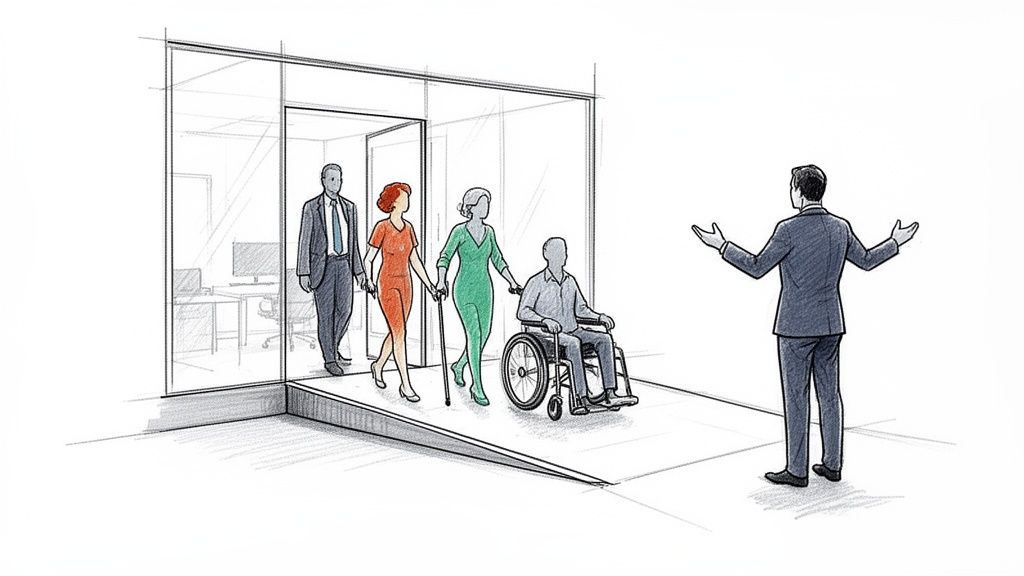
This concept applies to every part of the employment experience, from the application process to daily tasks and company events. It is designed to be a collaborative effort, initiated through a conversation known as the “interactive process,” where you and your employee work together to find a solution. The goal is to agree on a modification that is effective for the employee without creating an “undue hardship” for your business.
To help you keep these core ideas straight, here is a quick reference table.
Understanding these pillars helps transform a legal requirement into a practical tool for building a stronger, more inclusive team.
Managing accommodation requests correctly is not just about avoiding legal action—it is a strategic advantage. A smooth, respectful process can improve employee morale, boost productivity, and help you retain valuable team members. It also signals your company’s commitment to an inclusive culture. By grasping these core principles, you can confidently meet your employees’ needs while protecting your business.
A critical point for employers is that the focus is on "reasonableness," not just "necessity." Courts have clarified that an accommodation may be required to help an employee work with less pain or difficulty, even if they can technically perform their job's essential functions without it.
This proactive and supportive approach turns a compliance task into an opportunity to strengthen your entire workforce. If you are navigating complex employee situations and need guidance on maintaining defensible HR practices, our team can help. Learn more about how we partner with business leaders by reaching out to us.
The term "reasonable accommodation" can sound like a formal, legalistic phrase that makes business leaders nervous. In reality, the concept is very practical. An accommodation is simply an adjustment you make to the job or work environment that removes a barrier for a talented employee with a disability, allowing them to do their job effectively.
This entire framework comes from the Americans with Disabilities Act (ADA), federal law since 1990. Under the ADA, these accommodations can range from a change in the application process to a modification of the physical workspace. While the federal law applies to businesses with 15 or more employees, many states have laws that extend similar protections to even smaller companies.
To understand your responsibilities, you first need to know who the ADA is designed to cover. The law protects a "qualified individual with a disability," a phrase with two key parts.
First, a “disability” is a physical or mental impairment that substantially limits one or more major life activities. This broad definition includes everything from mobility challenges and chronic conditions like diabetes to mental health conditions like anxiety or PTSD. It also covers individuals with a history of an impairment, even if it is not currently active.
Second, a “qualified individual” is someone who has the skills, experience, and education for the job and can perform its essential functions—with or without a reasonable accommodation. In other words, they are fully capable of doing the work once workplace barriers are addressed.
The word "reasonable" is the cornerstone of this process. An accommodation is considered reasonable if it seems feasible or plausible. It does not have to be the most expensive or best possible option, just an effective one. Determining what is reasonable is a collaborative conversation between you and your employee, formally known as the interactive process.
A common misconception is that providing accommodations will be a massive expense. The data tells a different story. According to the Job Accommodation Network (JAN), nearly 50% of accommodations cost nothing to implement. For those that do have a cost, the median one-time expense is just $300. You can find more data on workplace accommodations from adata.org.
This statistic shows that effective solutions are often simple and affordable. Common examples include providing an ergonomic chair, allowing a flexible schedule for medical appointments, or reassigning minor, non-essential tasks. The focus is on finding a practical fix that allows the employee to contribute fully.
The “interactive process” is the heart of the ADA. It is not a rigid procedure but a legally required, good-faith dialogue between you and an employee to find a workable solution for their disability. Think of it as a collaborative problem-solving session rather than a negotiation.
Getting this dialogue right is essential. It is your key to compliance, a path to building a fair HR framework, and your best defense if a decision is ever questioned. Each step, from the initial request to final implementation, requires care, open communication, and solid documentation.
This visual breaks down the core ideas behind the process, focusing on who is involved, what a reasonable accommodation is, and why it is so critical.
As the infographic shows, this process is about the organization and the employee working together. It is about moving beyond simple compliance to foster an environment where everyone has an equal opportunity to succeed.
The process begins the moment an employee requests an adjustment for a medical condition. The request does not need to be in writing, nor must it include the words "reasonable accommodation" or "ADA." The employee simply needs to communicate that a medical condition is making it difficult to do their job.
For instance, an employee telling their manager, "I'm having trouble focusing at my desk because of my new medication," is a request. This is your signal to start the conversation. Your first action should be to acknowledge the request promptly and show you are ready to discuss it.
Once a request is made, you need to understand the specifics. You may ask for reasonable medical documentation to confirm the disability and clarify how it impacts job performance. However, you must be careful not to overstep.
Keep your questions focused on job-related limitations, not the medical diagnosis itself. You can ask for information that explains:
This information helps you understand the exact barrier you are trying to remove. Remember, keeping these conversations confidential is a legal requirement.
The interactive process is built on open dialogue, but knowledge gaps can derail it. One survey revealed 71.2% of physicians misunderstand who actually decides on accommodations, and 68.4% fear lawsuits. This highlights the need for a structured, defensible process to avoid compliance issues. You can find more on these findings from the AData network on mental health and the ADA.
This is the brainstorming stage. Work with the employee to identify potential solutions. Often, the person with the disability has the best ideas about what might help. Listen to their suggestions before drawing your own conclusions.
Explore a variety of options, such as modifying equipment, adjusting a work schedule, or reassigning non-essential tasks. You do not have to provide the exact accommodation an employee requests, but you must provide one that is effective. If you propose an alternative, be prepared to explain why it is a workable solution.
Documenting these conversations is essential. It creates a clear record of your good-faith efforts, which is invaluable if a dispute arises. Our guide on handling EEOC complaints shows just how critical that paper trail can be.
Once you and the employee agree on an accommodation, the final step is to implement it and check in later. Communicate the plan clearly, including a start date for the changes. It is also a good practice to schedule a follow-up meeting a few weeks later.
This follow-up confirms the accommodation is working effectively. It also reinforces a supportive culture where you are seen as a partner. If the first attempt is not quite right, you can restart the interactive process to find a better solution.
By following these steps, you can turn a legal duty into a structured, supportive process that works for everyone.
Knowing the definition of a reasonable accommodation is one thing, but seeing it in action clarifies the concept. The range of possible accommodations is as diverse as your workforce. Most solutions are not expensive or disruptive; many are simple, low-cost adjustments that empower a qualified employee to do their best work.
Let’s move from theory to reality and look at some common examples.
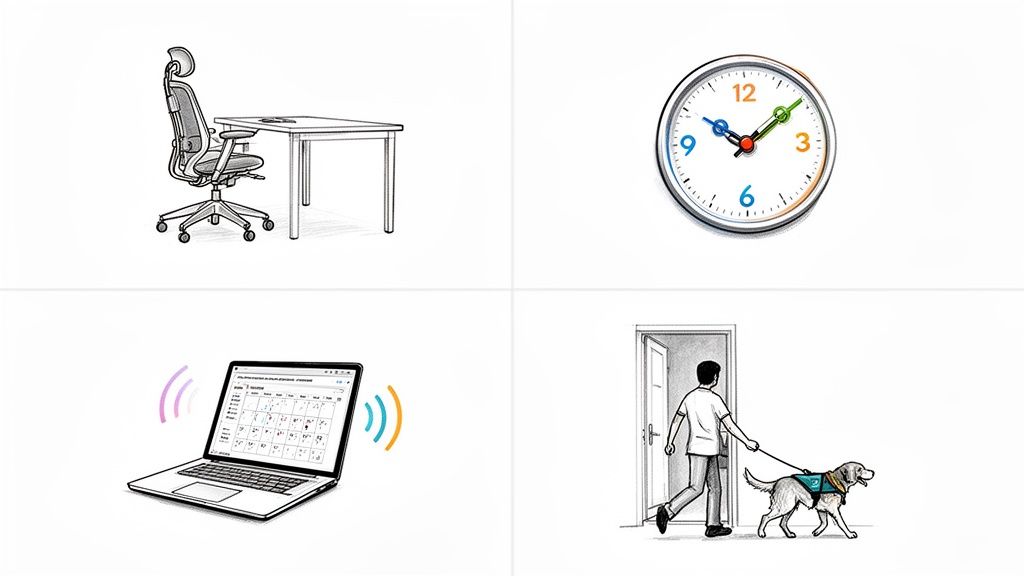
Remember, these solutions are never one-size-fits-all. The right accommodation always depends on the individual's specific needs and the essential functions of their job, which is why the interactive process is so important.
Some of the most straightforward accommodations involve modifying the physical workspace to improve access or remove a barrier. These changes can make a significant difference in an employee's daily comfort and productivity.
A few examples include:
Flexibility is a powerful—and often free—tool for accommodation. For many employees with disabilities, especially those with chronic health conditions, small adjustments to when or how they work can be game-changing.
These adjustments might look like:
The goal of an accommodation is to ensure an employee can do their job without unnecessary pain or struggle. Courts have made it clear that an accommodation can be "reasonable" even if the employee could technically perform their duties without it, but finds it incredibly difficult.
Technology and policy changes are two other key pillars of reasonable accommodation. These solutions ensure employees with sensory, cognitive, or physical disabilities have the same access to information and company perks as everyone else.
To get a clearer picture, we have broken down some common requests in the table below.
These examples just scratch the surface. An effective accommodation is born from an open-minded conversation focused on finding a practical solution.
For a deeper dive into specific scenarios, our guide offers more ADA accommodation examples. You can also find great examples of practical reasonable adjustments for neurodivergent employees at work that show how targeted support can make a difference.
One of the biggest concerns for any business owner is the bottom line. When an employee requests an accommodation, it is natural to wonder about the potential cost and operational impact. The ADA understands this. It states that you are not required to provide an accommodation if it would cause an undue hardship.
This serves as a safety valve built into the law. However, it is crucial to understand that this is a very high legal standard to meet. You cannot simply claim undue hardship because an accommodation has a cost. The law requires a much deeper analysis of the real-world impact on your specific business.
What exactly qualifies as an undue hardship? The Equal Employment Opportunity Commission (EEOC) defines it as any action requiring “significant difficulty or expense” when measured against your company’s unique situation. This is not a one-size-fits-all calculation.
An accommodation that is a minor expense for a large corporation could genuinely impact a small business with limited resources. The analysis is always relative and specific to the circumstances.
The EEOC considers several factors when determining undue hardship:
Simple inconvenience is not enough to prove undue hardship. The disruption must be significant and directly tied to the proposed change.
While cost is a valid concern, it is rarely a winning argument on its own. The focus is on the net cost to your business, not the sticker price. Before denying a request based on expense, you must explore all ways to reduce the financial impact.
This means doing your homework. Look into tax breaks like the Disabled Access Credit for small businesses, or check if state vocational rehabilitation agencies offer funding. If an employee requests a high-cost item, you are allowed to explore less expensive alternatives, as long as they are effective.
The core of the undue hardship analysis is whether an accommodation would fundamentally change the nature or operation of your business. The burden of proof is on you, the employer, to show that the proposed change is not just costly but truly unmanageable.
If you believe an accommodation request rises to the level of an undue hardship, your documentation is your most important defense. You cannot just say it is too expensive; you need a clear, objective record that proves it.
Conduct a thorough assessment and write down every step of your analysis. Your notes should detail the specific costs, anticipated operational disruptions, and any alternative solutions you explored during the interactive process. A well-documented, good-faith effort to find a workable solution is your best evidence of compliance.
Navigating this complex area requires careful judgment. If you are facing a difficult accommodation request and need help assessing undue hardship, contact our team for expert guidance.
When handling a reasonable accommodation request, proceeding without a plan is not a strategy. Navigating the ADA without clear procedures is messy, frustrating, and can lead to decisions that do not hold up under pressure. Strong documentation and consistent policies are your best defense against compliance risks.
This is one of the most critical, non-negotiable rules. Any medical information you receive during the accommodation process must be kept strictly confidential.
This means it cannot go into the employee’s general personnel file, where a manager might accidentally see it. You must create a separate, secure medical file for that employee. Access should be limited to a small number of people on a strict need-to-know basis, such as the HR leader managing the request.
In the world of compliance, if it is not documented, it did not happen. Meticulous documentation is the single most important tool you have to demonstrate you acted in good faith.
Your records should tell a clear, chronological story. Be sure to log everything:
This paper trail provides objective evidence that you ran a thorough and collaborative process if your decision is ever challenged.
Consistency is your shield against claims of unfairness. A formal, written reasonable accommodation policy ensures every request is handled the same way, regardless of which manager receives it. This prevents ad-hoc decisions that can create legal risks.
A strong policy should guide everyone through the steps for requesting an accommodation, explain the interactive process, and clarify responsibilities. Having clear, mandatory employee policies is a foundational piece of smart HR management that extends beyond the ADA.
A well-structured playbook creates a predictable and supportive experience for employees, which reinforces trust and shows that your organization is genuinely committed to inclusivity.
Your frontline managers are your first responders. They are often the first to hear about an accommodation need, and if they do not know how to respond, they can create a significant risk for the business. An untrained manager might dismiss a request or ask for medical details they have no right to see.
Training is non-negotiable. Your managers must understand:
When you invest in training, your managers become your first line of defense instead of a potential liability. By implementing these practices, you build a structured system that allows you to handle every request with consistency and care.
Getting reasonable accommodations right is about more than checking a legal box. It is about building a stronger, more capable, and inclusive organization where every talented person can contribute their best work. When you move beyond a compliance-only mindset, you transform a legal obligation into a powerful tool for employee engagement and retention.
The entire process boils down to a few key pillars. First, understand that what is reasonable accommodation under the ADA is about providing equal opportunity, not special treatment. From there, the interactive process is your roadmap for finding solutions together, and solid documentation protects your business.
A truly inclusive workplace does not just react to requests; it proactively builds support into its DNA. This means thinking about accessibility in everything you do, from how you structure jobs to the technology you use. For instance, to support neurodivergent team members, it’s worth exploring guidance on workplace accommodations for ADHD and autism, as targeted support can make a world of difference.
The ultimate goal is to create a culture where employees feel safe asking for the support they need. When the process is seen as fair, transparent, and respectful, it builds trust and reinforces that every team member's contribution is valued.
As a leader, your job is to champion a consistent and defensible approach. This means embedding these best practices into your daily operations and ensuring your management team is prepared to handle requests correctly from the start.
Keep these takeaways front and center:
Navigating complex employee situations, especially across different states, can be challenging. Expert guidance can provide the clarity and confidence needed to make the right decisions. For leaders looking to strengthen their HR framework, learning more about how to navigate these challenges is a critical next step.
If you need help building a consistent and defensible approach to ADA compliance, contact us to see how we can help.