
Regulatory compliance risk is the risk that your business gets hit with fines, audits, or even operational shutdowns because it failed to follow laws, regulations, or industry standards. The stakes are getting sharper: the financial consequences of regulatory non-compliance have surged by 52% over the past three years, and for growing businesses that means preventable errors now carry materially heavier consequences than they did just a few years ago.
If you're hiring in a new state, changing payroll practices, replacing a senior leader, or cleaning up a messy termination process, you're already dealing with regulatory compliance risk. Most owners don't experience it as a legal theory. They experience it as uncertainty. Can we classify this role the same way in Arizona and California? Does this final pay timeline hold up in both states? Did the manager document enough before ending employment? Those are business decisions with legal, financial, and reputational consequences attached.
For growing companies, this risk shows up fast. One out-of-state hire can trigger wage and hour obligations, leave rules, onboarding requirements, posting obligations, and documentation standards your team has never had to manage before. A leadership transition can create another problem entirely. The person who carried compliance knowledge leaves, but the exposure stays.
This is why what is regulatory compliance risk isn't just a definitional question. It's an operating question. It asks whether your leadership team can make high-stakes decisions in a way that is consistent, documented, and defensible.
You don't need to work in banking or healthcare to face regulatory compliance risk. A small business can trigger it by mishandling a termination, misclassifying a worker, skipping required documentation, or applying one state's rules to another state's employee. The issue isn't only whether you meant well. It's whether your practices hold up when someone reviews them.
Regulatory compliance risk is the potential for fines, audits, or operational shutdowns when a business fails to follow laws, regulations, or industry standards. That's the practical definition business leaders need to work from, especially in environments where a single people decision can create downstream exposure. The formal baseline aligns with Diligent's definition of this risk as exposure to fines, audits, or operational shutdowns for failing to adhere to applicable rules and standards in regulated environments and beyond (Diligent overview of regulatory compliance).
Most leaders blend two separate problems into one. That's a mistake.
Compliance risk means breaking rules that already exist. Think unpaid overtime, poor leave administration, weak documentation, missing required notices, or failing to follow an internal process you created to meet a legal standard.
Regulatory risk is different. It means the rules change and your current process no longer works. LSEG draws that line clearly. Regulatory risk is the threat of new laws making current activities illegal, while compliance risk is the threat of breaking existing rules such as failing to meet established security or operational requirements (LSEG compliance risk glossary).
Practical rule: If your team only checks whether today's process is legal, you're missing half the problem. Leaders also need to ask whether growth, expansion, or process change is about to make that process obsolete.
That distinction matters most during change. A stable business can hide sloppy compliance for a long time. Expansion, restructuring, new technology, or executive turnover tends to expose it.
Regulatory compliance risk isn't one thing. It's a cluster of exposures that hit your business from different directions at the same time. A wage error can become a legal claim. A legal claim can trigger a records review. A records review can expose broader process failures. Then leadership has to explain why no one caught it earlier.
That chain reaction is why owners should stop treating compliance as a filing exercise. It's a control issue inside operations, HR, management, and executive judgment.
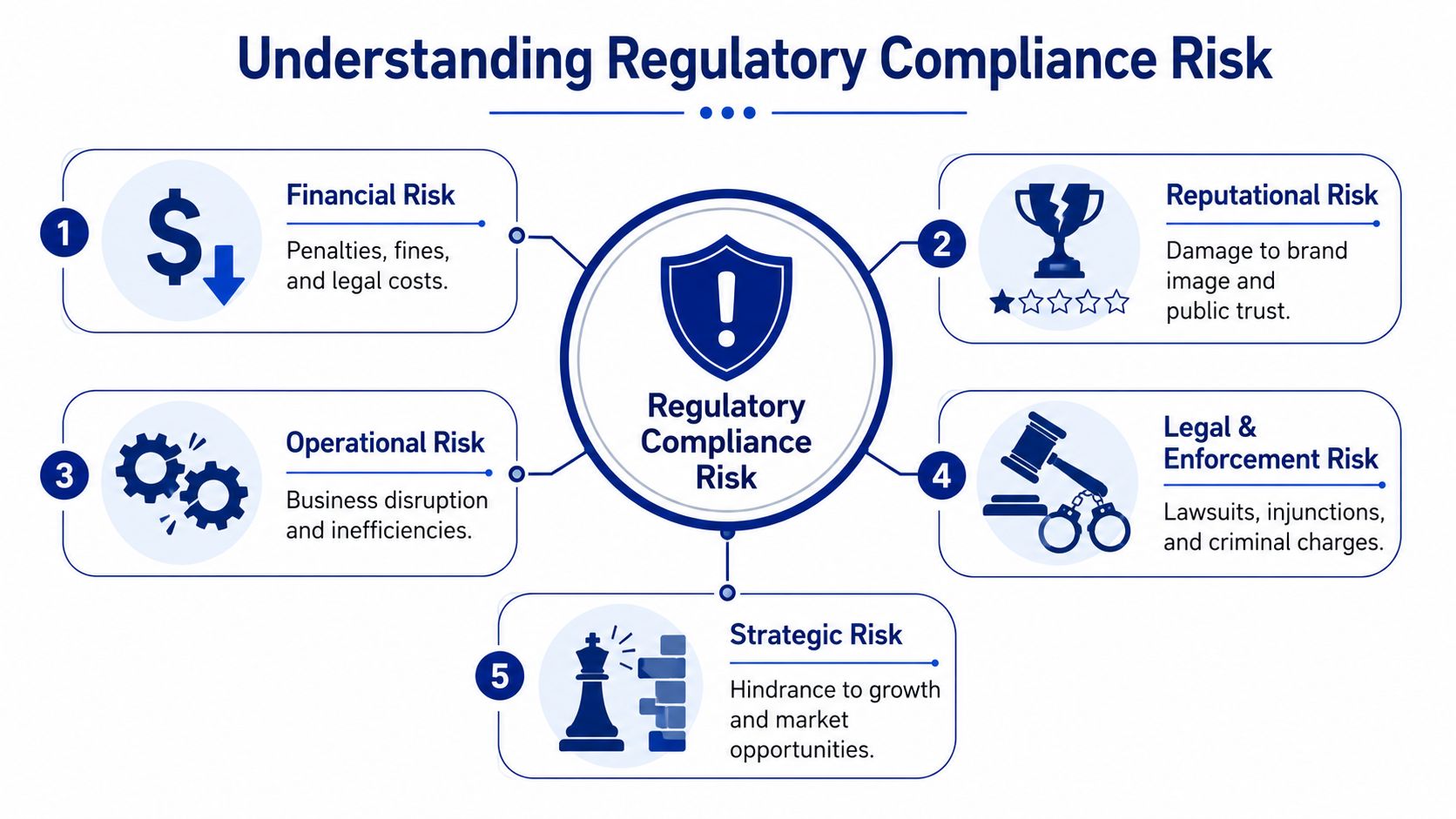
You can think about regulatory compliance risk in five practical categories:
The biggest blind spot for SMBs isn't daily compliance. It's compliance during transformation. PwC notes that 68% of organizations face new exposure when implementing new systems or processes, yet only 22% conduct pre-implementation regulatory assessments (PwC on regulatory compliance risk in transformation). That's exactly what many growing employers do. They change payroll providers, reorganize reporting lines, expand into new states, or hand off HR duties without assessing where the compliance gaps will open.
A simple example makes the point. You hire your first employee in another state. Payroll is set up. Offer letter goes out. Everyone assumes the process is covered because you've hired people before. But your old onboarding packet may not fit that state. Your handbook may be silent on required rules. Your manager may follow a discipline process that creates inconsistency. Now the exposure isn't theoretical. It's operational.
Good businesses get into trouble when they assume growth can ride on yesterday's process.
This is also why leadership needs to watch legal uncertainty, not just black-letter rules. When federal or state requirements shift, companies need judgment, not just checklists. A current example is the ongoing discussion around beneficial ownership reporting and the Corporate Transparency Act ruling, which is useful because it shows how quickly compliance assumptions can change.
If your team hasn't mapped HR and employment obligations in a structured way, start with a basic internal review like this HR compliance checklist for small businesses. Then go deeper. A checklist is a starting point. It isn't a substitute for risk analysis.
A lot of owners still think compliance failures mean a fixable fine. That mindset is outdated. The financial consequences of regulatory non-compliance have surged by 52% over the past three years (Veritas analyst report on regulatory intelligence). In practice, that means a preventable documentation error or termination mistake can hit much harder than it would have a few years ago.
The direct penalty is only the opening bill. The more expensive part is what follows.
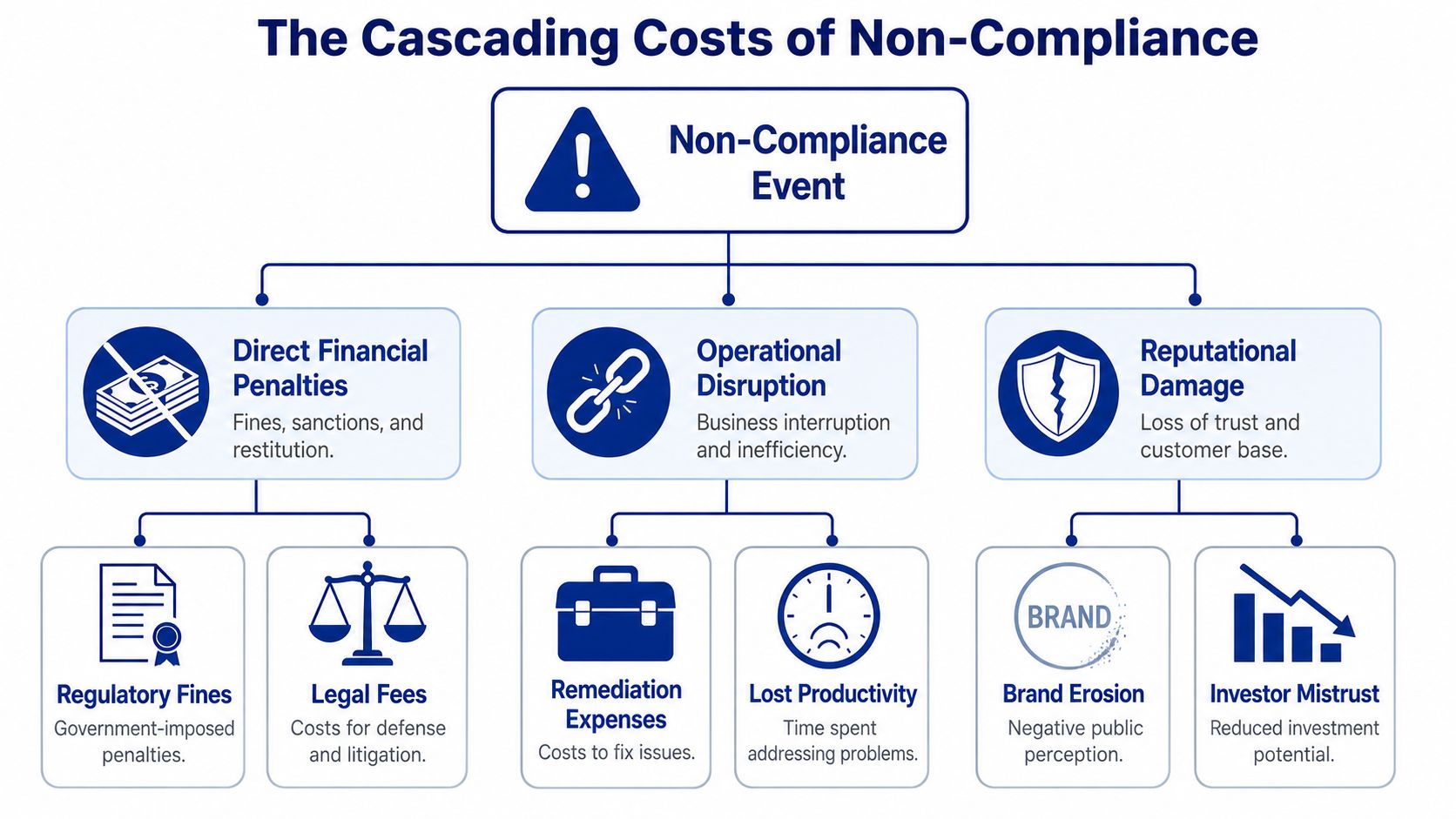
A manager wants to move quickly on a termination. Performance issues were discussed informally, but the documentation is weak. HR is stretched thin. The employee works in a state with specific final pay timing rules. Someone assumes payroll can catch up on the next cycle.
That single decision can create several layers of cost:
MetricStream highlights how tangible this has become in adjacent risk areas. In 2025, the global average cost of a data breach reached approximately $4.44 million, and 32% of those breaches directly triggered regulatory fines, with nearly half of those fines exceeding $100,000. It also notes that adverse media, reputational damage, and employee litigation were each reported as significant compliance issues by 14% of risk and compliance professionals (MetricStream guide to regulatory compliance). Even if your core issue is an employment process failure rather than a cyber incident, the lesson is the same. Compliance failures are expensive because they trigger multiple types of damage at once.
A compliance failure rarely stays in the lane where it started.
For SMBs, that cascade is often more dangerous than the original event. You don't just pay. You divert leadership attention, strain managers, unsettle staff, and invite more scrutiny into neighboring parts of the business.
| Stage | What leadership sees |
|---|---|
| Initial event | Complaint, mistake, audit notice, or internal escalation |
| Immediate response | Record gathering, legal review, manager interviews, payroll or policy corrections |
| Secondary fallout | Morale issues, slowed hiring, delayed decisions, reputational stress |
| Long-tail exposure | Ongoing scrutiny, stricter controls, more conservative operations |
If you want a practical takeaway, it's this: proactive compliance spending is usually cheaper than reactive cleanup. Not because every issue becomes catastrophic, but because every issue consumes time, judgment, and credibility.
A company opens in a second state, promotes a strong operator into a people management role, and keeps moving. Six months later, payroll is handling final pay wrong in one location, managers are approving overtime differently across teams, and a termination decision triggers questions no one can answer cleanly. That is how compliance risk shows up in growing SMBs. It arrives during change, when decisions speed up and no one owns consistency.
For a smaller business without a dedicated compliance team, the biggest exposure usually sits inside ordinary people decisions. Hiring, pay, leave, discipline, and separation all get riskier when growth outpaces process.
These are the pressure points I would review first:
One pattern matters more than any single policy gap. The same issue gets handled differently by different managers.
That is what makes growth dangerous. A founder-led business can get away with informal judgment for a while because a few people make most decisions. Once hiring spreads, locations multiply, or leadership changes, that informal model breaks. If your HR process lives in one experienced manager's head, you have a control failure, not a system.
Skip the policy binder for a minute. Check how decisions happen.
Review where change has outpaced process
Look at recent expansions, leadership transitions, reorganizations, and rapid hiring periods. Those moments create the most inconsistency.
Find the handoff points
Compliance failures often happen between HR, payroll, operations, and frontline managers. Final pay, leave tracking, accommodation follow-up, and termination approval are common weak spots.
Look for manager discretion without guardrails
If supervisors decide discipline, schedule changes, time edits, or leave responses with little review, risk is already in the workflow.
Check for state specific requirements
Multi-state growth is where many SMBs get surprised. Rules on pay, breaks, leave, and termination timing are not uniform.
Audit the documentation trail
If the file does not show what happened, why it happened, and who approved it, your defense gets weaker fast.
If a critical employment decision changes based on location, manager preference, or who happened to be available that day, your business is carrying avoidable compliance risk.
Use a practical model.
The point is not to build a perfect compliance program. The point is to prevent routine decisions from becoming expensive events during periods of growth, transition, and leadership strain. For SMBs, that is where compliance risk becomes an executive problem.
Your COO resigns on Monday. On Tuesday, a regional manager approves a termination in a new state without HR review. By Friday, payroll misses a final pay deadline, the personnel file is incomplete, and leadership is arguing over which rule applied. That is how compliance risk shows up in an SMB. Not as an abstract policy problem, but as an executive decision failure during a moment of change.
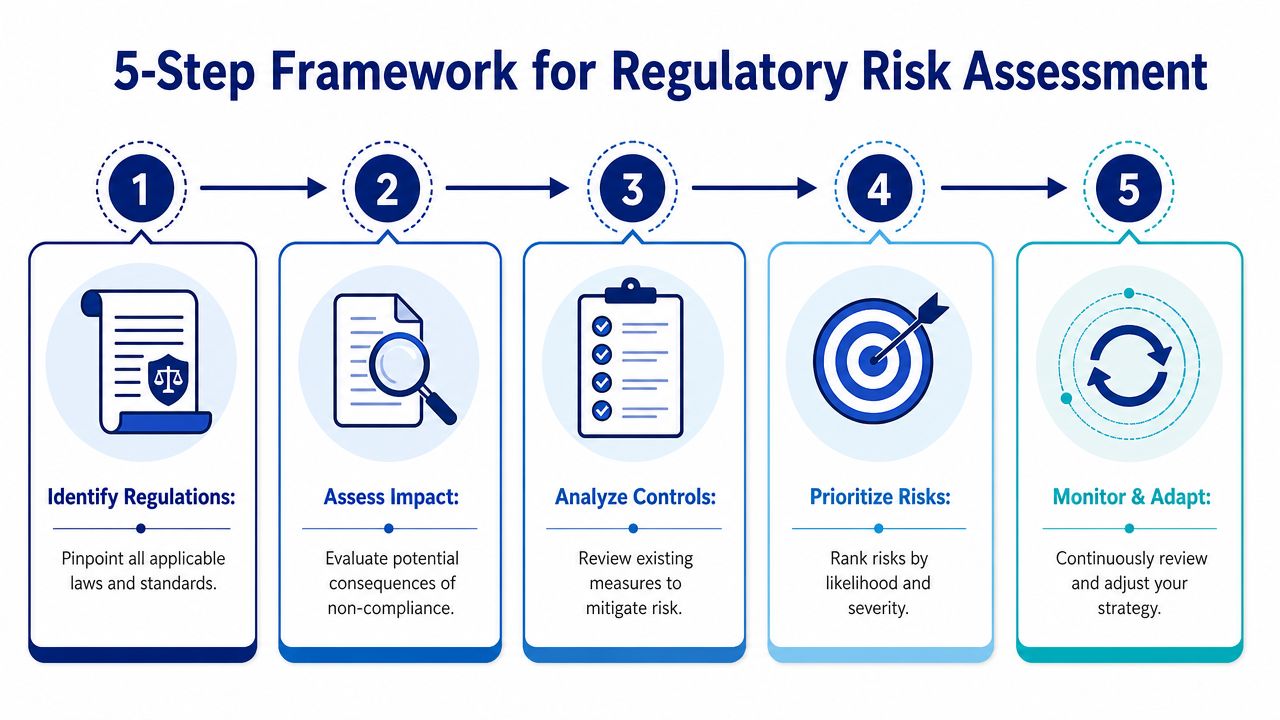
A useful assessment framework is simple: scope, identify, score, treat, and monitor. Keep it that way. SMBs without a dedicated compliance function do not need a complex model. They need a repeatable way to pressure-test decisions before a hiring push, a leadership handoff, a reorganization, or a multi-state expansion turns a manageable issue into a claim.
| Step | What to do in practice |
|---|---|
| Scope | List the laws, rules, and standards tied to your workforce, locations, pay practices, and employment decisions |
| Identify | Find the points where managers, HR, payroll, recruiters, or vendors can miss a requirement |
| Score | Rate each issue for likelihood and business impact using a simple 5 by 5 matrix |
| Treat | Put controls in place such as approvals, templates, checklists, documentation rules, training, or outside review |
| Monitor | Review files, decisions, and workflows regularly to confirm the controls are actually being followed |
Do not begin with policy binders. Begin with decisions.
Ask where your business is making judgment calls under pressure. Hiring, classification, schedule changes, leave responses, accommodations, investigations, discipline, pay adjustments, and terminations usually carry the most exposure because they move fast and often involve multiple owners. If no one can clearly answer who approves the decision, what standard applies, and what record must exist, the risk is already live.
This matters more during change. New leaders inherit old habits. New locations add state-specific rules. New systems break established workflows. A framework helps leadership slow down long enough to catch the failure point before it becomes a wage claim, agency complaint, or discrimination allegation.
Keep scoring blunt and useful. Rate each issue from 1 to 5 for likelihood and 1 to 5 for impact. Then map the result.
A manager who routinely skips review on terminations creates high likelihood. If those terminations affect final pay timing, documentation quality, or protected activity concerns, impact is high too. That issue goes to the top of the list. A rarely used form with a minor formatting problem does not.
Risk scoring should direct attention to the decisions that can hurt the business fastest.
If you're reviewing hiring outcomes and want a plain-language reference for disparate impact concepts, this explanation of interpreting the 80% rule is a useful companion resource. It will not replace legal analysis, but it helps leaders understand why patterns in decision-making deserve scrutiny.
Many SMB compliance failures come from blurred ownership, not ignorance. The manager assumes HR is reviewing. HR assumes payroll knows the state rule. Payroll assumes legal approved the process. No one owns the decision.
That breakdown gets worse during expansion and leadership turnover, which is exactly when executive teams tend to move faster. If your business is entering a new state, replacing a people leader, or centralizing operations, review the handoffs first. Those transition points expose gaps that stay hidden in stable periods.
A focused internal review can surface those gaps quickly. Use a HR risk assessment for managers to test whether frontline decisions, approvals, and documentation standards hold up under real operating pressure.
A risk framework is only useful if it changes behavior. Every high-scoring issue should lead to a named owner, a required control, and a review date. If you cannot assign those three things, you have identified a problem but you have not reduced the risk.
That discipline is what separates a workable SMB compliance process from a spreadsheet no one uses.
A manager in a new state approves a termination using the old process. Payroll applies the wrong final pay rule. HR realizes the file is missing documentation after the employee complains. That is how compliance risk shows up in SMBs. Not as a policy failure on paper, but as an executive decision made too fast, with no control strong enough to catch the mistake.

Start where decisions create exposure. If a manager can hire, discipline, reclassify, approve leave, or terminate without a standard process, your risk sits in daily operations, not in the handbook.
Set up controls that hold under pressure:
Sector rules can raise the stakes. In healthcare, finance, and other regulated fields, employment decisions often intersect with privacy, credentialing, billing, and recordkeeping requirements. If you operate in healthcare, this medical billing compliance resource shows how operational rules can affect day-to-day administrative decisions.
Some problems need outside review before anyone acts.
Seek guidance when:
These are decision points, not cleanup projects. Waiting until after a complaint, agency notice, or attorney letter arrives is poor risk management.
For many SMBs, support comes from employment counsel, an outside HR advisor, or a structured risk partner who can review the facts before a manager acts. Such partners work with SMB leadership teams in that capacity, especially when multi-state requirements, documentation quality, and manager execution create real exposure.
Use a simple rule. Get outside input when the decision affects employment status, pay practices, protected activity, reporting obligations, or the defensibility of the file.
Then keep reviewing your controls. One corrected mistake does not fix a weak system. A disciplined process for audits, document checks, and escalation review is what prevents isolated errors from turning into repeat violations. This guide to continuous compliance monitoring is a practical next step for teams that need a repeatable process instead of case-by-case damage control.
If your business is adding states, replacing key leaders, or growing faster than your internal controls, address compliance risk before the next major decision forces the issue. Learn more about working with Paradigm International Inc. if you want practical guidance on high-stakes people decisions and long-term HR risk management.