
Running a 25-to-500-person company across multiple states without a senior HR leader puts every hard people decision on someone who already holds a full-time executive job. A manager calls about an underperforming employee who just requested medical leave, a remote hire joins from a new state with unfamiliar rules, or a workplace complaint lands in the COO's inbox at 4:00 p.m. on a Friday.
Knowing when to hire an HR consultant vs a full-time HR manager isn't about hitting an arbitrary headcount number. It comes down to two variables: workload density and risk severity. Most growing multi-state employers don't need an all-or-nothing choice; they need internal ownership for daily operations, external judgment for high-stakes events, and a clear decision owner beyond their payroll platform.
Hire an HR consultant when HR demand is episodic and concentrated in specialized, high-risk work like terminations, investigations, leave escalations, or multi-state handbook updates. Hire a full-time HR manager when HR demand runs continuously every week, line managers need daily coaching, and recurring administration fills a permanent seat.
An HR consultant gives you senior judgment on demand; a full-time HR manager gives you daily execution.
That is the whole decision in one sentence. Everything below just helps you apply it.
Headcount alone misleads growing employers. According to guidance from the Society for Human Resource Management (SHRM), staffing benchmarks aren't rigid hiring rules because geographic dispersion, turnover, industry, and regulatory complexity change demand sharply. A 40-person company operating in four states often carries higher compliance exposure than a 110-person single-site business, even though its weekly administrative volume is much smaller.
| Criterion | HR consultant | Full-time HR manager |
|---|---|---|
| Cost model | Flat monthly retainer or hourly; no payroll taxes, benefits, or recruiting costs | A six-figure median salary per BLS data, plus benefits, taxes, recruiting, and training on top |
| Ownership of judgment calls | Employer-side advisor; you decide and document | Internal owner who decides and executes daily |
| Response time | Rapid-response advisory by phone and email; not on site daily | On site daily; immediate for managers and employees |
| Multi-state compliance | Specialized in state addenda, policy alignment across states, and handbook updates that track changing laws | Maintains policies but may lack specialized multi-state depth |
| Investigations and terminations | Independent senior review and investigation support | Handles routine discipline; high-risk cases still need outside review |
| Recurring administration | Not the core service; you or a platform handles transactions | Core service: onboarding, records, leave tracking, HRIS ownership |
| Strategic work | Project-based: handbook redesign, M&A integration, pay equity | Ongoing workforce planning, manager coaching, culture |
| Best fit | Episodic or high-severity demand; 25 to 500 employees without a senior HR leader | Continuous HR volume and daily manager support needs |
Read the cost row carefully. The consultant's retainer looks small next to a full salary, but the actual comparison is retainer plus your own administrative capacity against the fully loaded cost of an employee. If your managers and office staff already absorb onboarding, records, and leave tracking without strain, you are comparing the retainer against salary alone, and the consultant usually wins. If those tasks are slipping, the manager's higher cost buys back real hours every week.
The investigations row cuts the other way. Even a strong internal HR manager rarely runs a harassment investigation involving a senior executive cleanly, because personal relationships and reporting lines compromise impartiality. High-severity events favor outside judgment no matter which model you choose for daily work.
Owners face a similar build-versus-advise choice across other back-office functions. Leaders evaluating whether to bring on fractional finance expertise through resources like Hire Accountants or recruit a full-time controller apply the same logic: internalize predictable daily transactions, and bring in specialized expertise for high-consequence judgments.
Many operators assume a PEO or payroll platform removes the decision altogether. Those platforms process paychecks, benefits enrollments, and standard tax filings reliably, yet they don't take responsibility for employer judgment calls. Someone still has to decide how to classify a contractor, respond to a harassment complaint, or document a termination. That someone is either a person you hire or an advisor you retain.
Before posting a job requisition or signing a consulting agreement, run your company through two direct questions:
Low monthly hours paired with high-severity events point straight to an HR consultant. High monthly hours with steady daily interruptions point to a full-time HR manager. High scores on both mean a hybrid structure will serve the company better than asking one generalist to handle everything alone: an internal owner runs the recurring work while an outside advisor reviews the decisions that carry legal and financial exposure. That combination costs less than a senior hire and protects you better than either model on its own.
Waiting until an urgent dispute hits forces rushed choices. Separating consultant triggers from full-time manager triggers makes clear which events demand immediate outside expertise and which patterns justify permanent payroll.
Episodic, high-consequence matters require specialized judgment rather than a permanent daily presence. Bring in external expertise before acting when any of these events surface:
Continuous operational demand changes the math. Employers weighing how many employees require dedicated HR should look past total headcount and watch for daily operational strain.
The clearest federal milestone is FMLA coverage. The U.S. Department of Labor Wage and Hour Division explains that private employers are covered once they employ 50 or more employees during at least 20 workweeks in the current or preceding calendar year. Employees qualify after 12 months of employment and 1,250 hours worked in the prior 12 months, at a site with at least 50 employees within 75 miles. Eligible employees can take up to 12 workweeks of unpaid, job-protected leave in a 12-month period with continued group health benefits. Once coverage kicks in, someone has to track eligibility, notices, and intermittent leave schedules every single week. That workload alone often justifies a dedicated internal owner, and these rules sit under the Family and Medical Leave Act at 29 U.S.C. § 2601 and 29 C.F.R. Part 825.
Beyond that milestone, watch for these patterns:
State geography compounds these triggers quickly. Some states impose their own paid leave programs, pay transparency postings, and mandatory harassment training, while others layer few requirements beyond federal law. A handbook and manager playbook written for a headquarters in one state won't automatically satisfy statutory requirements for remote workers elsewhere. Because legislatures and labor agencies revise these mandates frequently, confirm current rules with each state's labor agency for every state where employees physically work before rolling out policies.
| Situation | Recommended option | Why |
|---|---|---|
| Termination after a complaint or protected leave | Consultant | Independent review and documentation before action |
| Workplace investigation | Consultant | Impartial fact-finding and report discipline |
| Handbook not updated for a new state | Consultant | State addenda and policy harmonization |
| First employee in a state with its own leave or pay-transparency laws | Consultant | State-specific leave, pay, and training rules |
| FMLA coverage triggered at 50 employees in a 75-mile radius | Consultant or manager | Eligibility analysis plus ongoing administration |
| Daily manager questions and coaching | Full-time manager | Presence and institutional knowledge |
| Continuous recruiting and onboarding | Full-time manager | Recurring volume and coordination |
| Recurring employee relations cases | Full-time manager | Case management and relationship building |
| Merger or acquisition integration | Consultant | Project-based workforce and culture integration |
| Multi-state expansion beyond five states | Hybrid | Manager for operations plus consultant for state rules |
A 40-person Florida business hires three remote employees across California, Illinois, and New York. Total headcount sits below federal FMLA coverage, and weekly HR administration takes only a few hours, yet state leave and pay-posting exposure jumped overnight. An HR consultant fits best here to build compliant state addenda, align onboarding notices, and stay on call for escalations.
Now take a 120-person single-site manufacturer. A shift supervisor faces a formal harassment complaint right as operations leadership wants to terminate another employee returning from medical leave. Even if an internal generalist tracks attendance and hiring, both situations carry high legal and operational stakes. Bring in an HR consultant and coordinate with employment counsel where appropriate before taking action. Impartial investigation handling and pre-termination review protect decision discipline.
Finally, look at a 300-person services firm hiring constantly across two regional offices with no senior HR leader. Managers improvise discipline. Onboarding slips every Monday, and FMLA tracking falls on a payroll clerk. This firm needs a full-time HR manager immediately to own daily operations, paired with targeted outside advisory for multi-state compliance and executive-level escalations. High volume plus high severity is exactly the combination that justifies both seats.
A full-time HR manager creates a fixed commitment, even when your HR workload is uneven. Compare the cost of owning recurring work with the cost of getting expert judgment when risk spikes. A salary-to-retainer comparison alone misses both.
The median annual pay for human resources managers was $149,280, or $71.77 per hour, across 224,900 jobs nationally, according to the U.S. Bureau of Labor Statistics (BLS). Use that benchmark as a starting point, then build a budget around your actual role and employment costs.

Budget for payroll taxes, health and retirement benefits, recruiting, onboarding, continuing education, executive management time, and paid time off. Include the tools and workspace the role requires.
Then assess quiet-period underutilization. If recurring work fills only part of the week, a senior salary still runs at full cost. That does not make an internal hire wasteful: consistent availability and ownership have value. The question is whether your daily workload uses that capacity.
An internal manager also does not eliminate every outside expense. High-risk investigations, complex multi-state audits, and senior executive separations can require independent expertise or employment counsel. Consulting provides HR guidance, not legal advice.
| Cost line | Full-time HR manager | HR consultant |
|---|---|---|
| Base pay | Annual salary for the role | Retainer or project fee for agreed services |
| Payroll taxes and benefits | Employer taxes, insurance, retirement contributions, and paid leave | Consultant's fees rather than employee payroll costs |
| Recruiting and onboarding | Search costs, hiring time, and training | Confirm setup, discovery, and onboarding charges |
| Tools and workspace | Budget for required systems, equipment, and space | Confirm existing-tool access and any additional charges |
| Quiet-period cost | Salary continues when workload falls | Retainer continues under agreed scope and terms |
| High-risk event cost | Outside expertise may supplement salary costs | Confirm whether included or separately priced |
| First-year budget | Salary plus taxes, benefits, recruiting, training, and tools | Contracted fees plus setup and out-of-scope work |
Use local salary quotes, actual benefit rates, and recruiting estimates instead of a generic salary multiplier. For consulting, request a defined scope that distinguishes routine advice from investigations, audits, and other project work. Reviewing how HR consulting fees and structures work helps you compare those commitments on equal terms.
Neither option is automatically cheaper. Workload density determines how much internal capacity you need; risk severity determines what expertise must be available.
Budget principle: Don't hire a full-time senior HR manager to solve an episodic risk problem, and don't under-hire a junior coordinator hoping they can carry multi-state compliance alone.
A customized HR compliance partnership can match support to your company's size, structure, and states of operation. The Core HR Compliance plan includes unlimited phone or email consulting, a federal and state handbook build or audit, core policy templates and documentation guidance, an HR file and I-9 audit, onboarding and offboarding checklists, and an annual compliance review.
Keep a named internal owner for recurring work and decisions, even with a PEO. Add external expertise for high-stakes issues, and fund a permanent manager when sustained daily demand justifies the commitment.
Your payroll runs on time, onboarding forms are complete, and an employee raises a complaint about their manager. Someone still has to decide who investigates, how to protect the employee against retaliation, and what action the findings support. A PEO or payroll platform leaves that employer-side decision ownership in place.

Payroll platforms and PEOs handle pay runs, tax withholdings, benefits administration, and standard onboarding forms. Define which tasks your provider handles and who approves decisions inside your business. Multi-state operations add policy coordination to that workload. The Mosey 2025 Compliance Benchmark Report discusses employers with differing state footprints; those differences do not establish that small and large employers face equal compliance burdens.
The practical question in a PEO vs HR consultant comparison is who supplies judgment and who owns the resulting action. Assign an internal owner for each responsibility, even when outside specialists perform the work:
Use actual decisions to test whether ownership is clear:
Choose support around workload density and risk severity. Keep recurring coordination with an internal owner and bring in external expertise for high-stakes matters. An HR consultant can advise leadership and handle ongoing compliance work alongside your administrative provider. A full-time HR manager fits continuous case management, daily coaching, and recruiting coordination, while still drawing on specialist or legal support when needed.
Gut instinct tends to push busy owners toward whichever option sounds faster to solve today's headache. A structured score separates recurring operational load from episodic compliance risk so you can design the right HR operating model before spending money.

Score your organization based on the last six months of actual operations, not how you hope next year looks:
Count your "yes" answers across two separate groups. Three or more "yes" answers in the daily-demand group (questions 1, 2, 6, and 7) point to a full-time HR manager, while three or more "yes" answers in the risk group (questions 3, 4, 5, and 8) point to hiring an HR consultant now. Multiple "yes" answers across both groups point directly to a hybrid model that pairs internal execution with outside senior oversight.
Treat this checklist as an operational starting point rather than a legal conclusion. Even if your daily-demand score is low and you plan to hold off on hiring internally, high-stakes events don't wait for headcount milestones. Terminations following a complaint or protected leave, workplace investigations, and situations where medical leave overlaps with a disability accommodation always warrant expert review before leadership acts.
Growing companies rarely pick one model forever. Most start with fractional HR leadership to stabilize compliance and build core processes, then add a full-time HR manager or shift to a hybrid structure once daily volume justifies a permanent seat. The mistake is treating the switch as an event rather than a staged handoff.
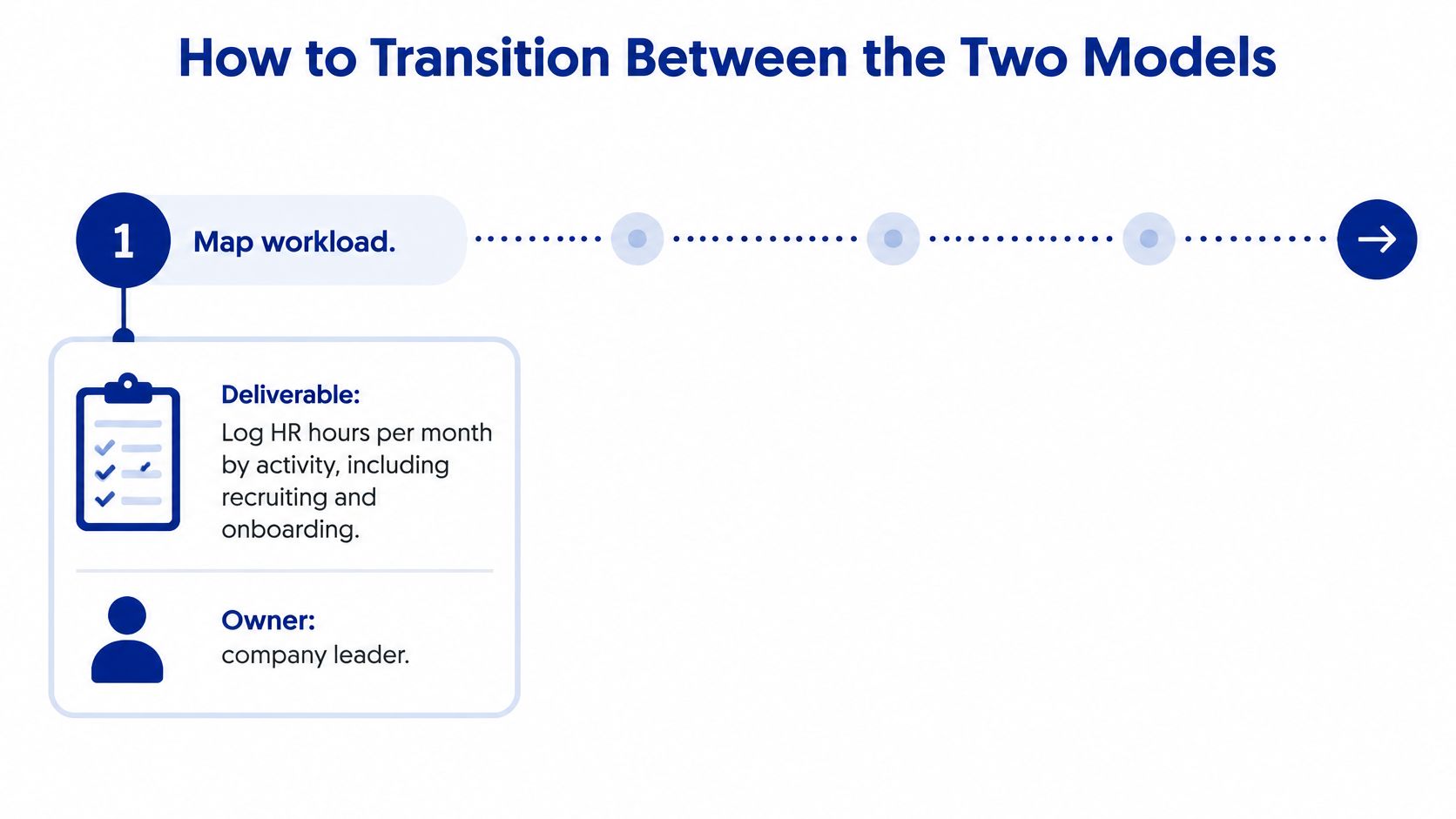
The SHRM Executive Network CHRO Benchmarking Survey points to a practical discipline: map recurring activities in monthly hours before committing to headcount, and recognize that one internal manager rarely covers both high operating volume and specialized exposure like complex investigations or executive separations. Moving cleanly between models takes six defined phases.
Never end an external consulting engagement before a new HR manager is fully onboarded on active cases, and never transfer an open termination or leave matter without a written handoff record.
Many 100-to-500-person employers keep a targeted external partner alongside an internal HR manager because the pairing covers more ground at lower risk than loading everything onto one permanent hire. The split is concrete. The internal manager owns recurring execution: onboarding, recruiting, supervisor support, leave tracking, and policy rollout. The external partner owns the high-stakes layer: investigations, multi-state policy questions, and sensitive separations.
Here is what that looks like in practice. The outside firm assigns an HR expert who joins the client's leadership team to advise on HR practices and recommend strategies, with rapid-response advisory included across all plans. Its Multi-State HR Advisory plan covers multi-state policy alignment and state addenda, oversight for high-risk investigations, leadership and board HR strategy sessions, concise quarterly executive HR memos, and counsel coordination for sensitive matters. When a harassment complaint lands in a state where your manager has never run an investigation, the external partner takes oversight of that file while the internal manager keeps onboarding next week's hires and coaching supervisors through routine corrective action. Nothing stalls, and no one improvises on unfamiliar state rules.
The workload split also protects the hire you worked to land. A manager buried in both daily volume and once-a-year high-risk events will sacrifice one for the other, usually the investigation or the policy update, which is exactly where the expensive mistakes live.
Picking a model is only half the job; tracking operational signals tells you whether it still fits six months later. Don't copy generic industry averages onto a dashboard and hope they apply. Establish your own baseline during the first quarter, then track movement against those concrete operational metrics.
| Metric | Target | Owner |
|---|---|---|
| Employee relations case resolution time | Under 30 days for routine cases | Manager or consultant |
| Policy currency by state | 100% updated within 12 months | Consultant for multi-state, manager for single state |
| Leave case cycle time | Eligibility and notice within 5 business days | Manager or consultant |
| Manager self-service rate | Baseline established in Q1, improving each quarter | Manager |
| Audit findings closed on time | 100% by target remediation date | Manager with consultant review |
| First-90-day turnover | Below 10% | Manager |
| Time to fill | Under 30 days | Manager |
| High-risk events reviewed before action | 100% | Consultant |
Assign a strict calendar to these numbers so they drive action instead of sitting in a spreadsheet:
Watch for two unmistakable red flags. If an internal HR manager's case volume exceeds capacity for two consecutive quarters, bring in external advisory support for employee relations documentation, complaint response, and targeted manager training before turnover or compliance errors climb. If a growing share of high-risk terminations or leave escalations happens without outside review, pause and tighten escalation rules immediately so leadership receives a clear snapshot of compliance risk and specific recommendations before acting.
Keep recurring HR inside the company. Bring in outside judgment when the risk is severe. Headcount is the wrong trigger. Workload density is the right one: how many employee relations cases, leave questions, and multi-state policy gaps hit the same few people, and what a bad termination or investigation would cost. A PEO or payroll platform runs administration. It does not make you the employer-side decision owner.
If the checklist still leaves the structure unclear, do not guess between a permanent salary and a monthly retainer. Book a free HR Risk Review. It is a 30-minute confidential call, followed by a short written summary of risks and recommended next steps. Use that summary to choose internal ownership, external advisory, or a hybrid before you post a job or sign anything.
Our firm focuses on regulated, compliance-sensitive, and founder- or operator-led companies, with rapid-response HR advisory and support across 30+ states. That work is HR consulting, not legal advice. State rules still belong with employment counsel.