A company hires a developer in another state, ships a laptop, and adds the employee to payroll. Months later, the developer requests leave, and the owner discovers that nobody checked which state's rules apply. For a growing business without a senior HR leader, this is a routine operating problem, not an unusual legal puzzle.
Start with the state where the employee physically performs the work. The headquarters address, hiring location, and state named in the employment agreement aren't reliable substitutes. But the work state isn't a universal answer either: wages, leave, taxes, insurance, and contract disputes require separate decisions.
The U.S. Supreme Court's decision in Oil Workers v. Mobil Oil Corp., 426 U.S. 407 (1976) treated employees' predominant work location as controlling for the right-to-work issue before it. That decision doesn't establish a universal remote-employment test. It does illustrate why employers should examine where services occur rather than assume headquarters law controls.
For a 2026 compliance review, the following table is a starting framework, not a substitute for checking the applicable law's current effective date. Federal requirements remain relevant alongside state requirements. The responsible agency and the particular legal issue determine the next check.
| Issue | Usually Controlled By | Basis and Source |
|---|---|---|
| Minimum wage, overtime and pay rules | State where the employee physically works | U.S. Department of Labor guidance under the Fair Labor Standards Act covers hours worked at home; state wage laws can add protections |
| Family and medical leave | Assigned worksite for federal FMLA; state leave laws apply separately | U.S. Department of Labor, FMLA, 29 C.F.R. Part 825 |
| Income tax withholding | State where services are performed, subject to exceptions | State tax agency rules on residence, reciprocity agreements, and convenience of the employer |
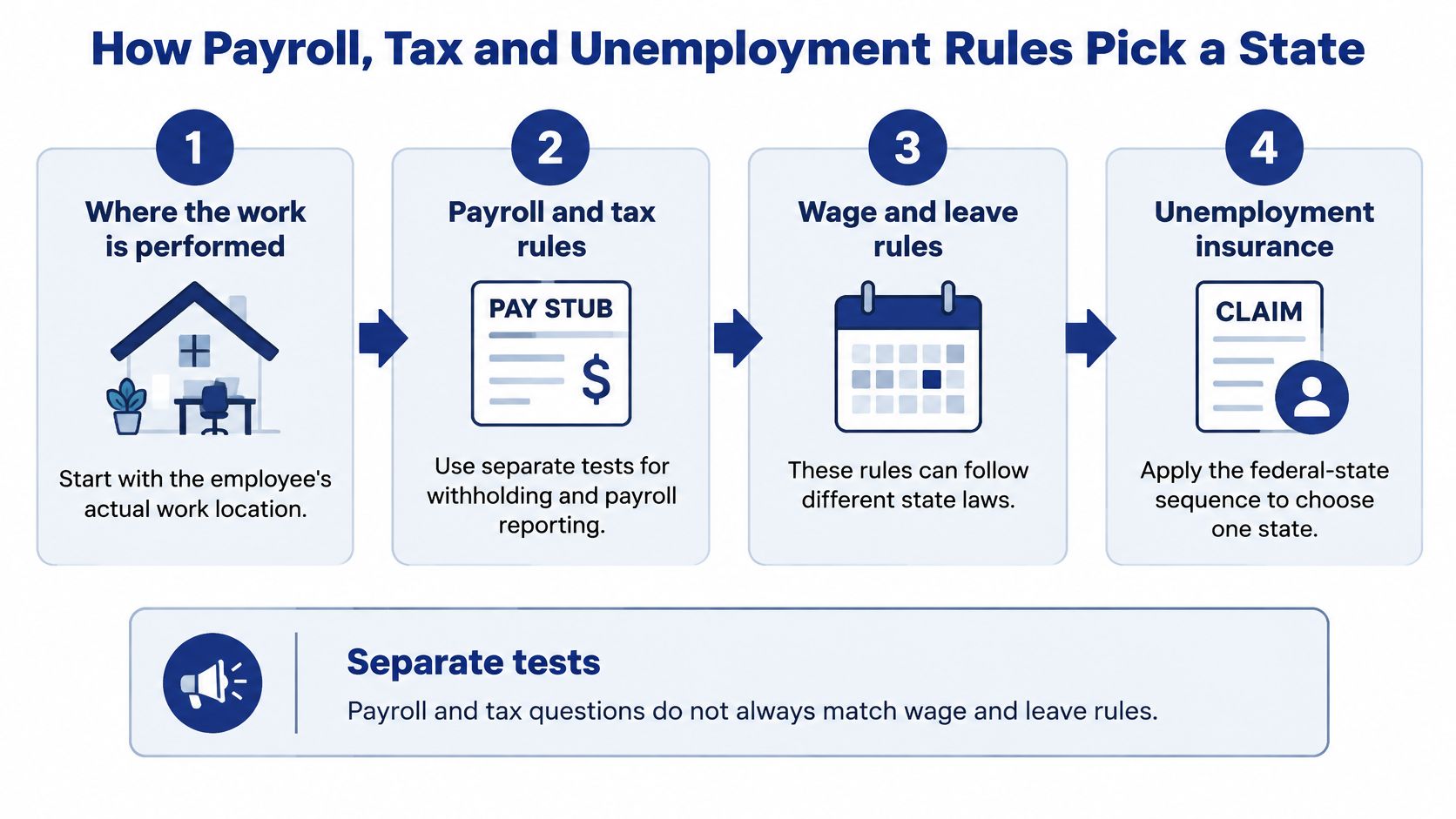
| Unemployment insurance | One principal state after the required sequence of tests | State unemployment agencies apply localization, base of operations, direction and control, then residence |
| Workers' compensation | Work state can create coverage duties | State workers' compensation rules; coverage should be confirmed with the carrier |
| Expense reimbursement and wage statements | State where work is performed | State wage-and-hour laws administered by the applicable labor agency |
| Local paid leave and ordinances | County or city where work is performed | Local wage and leave ordinances can change the result |
| Contract choice of law | Contract disputes, not automatically mandatory employment protections | Contract language and applicable choice-of-law rules |
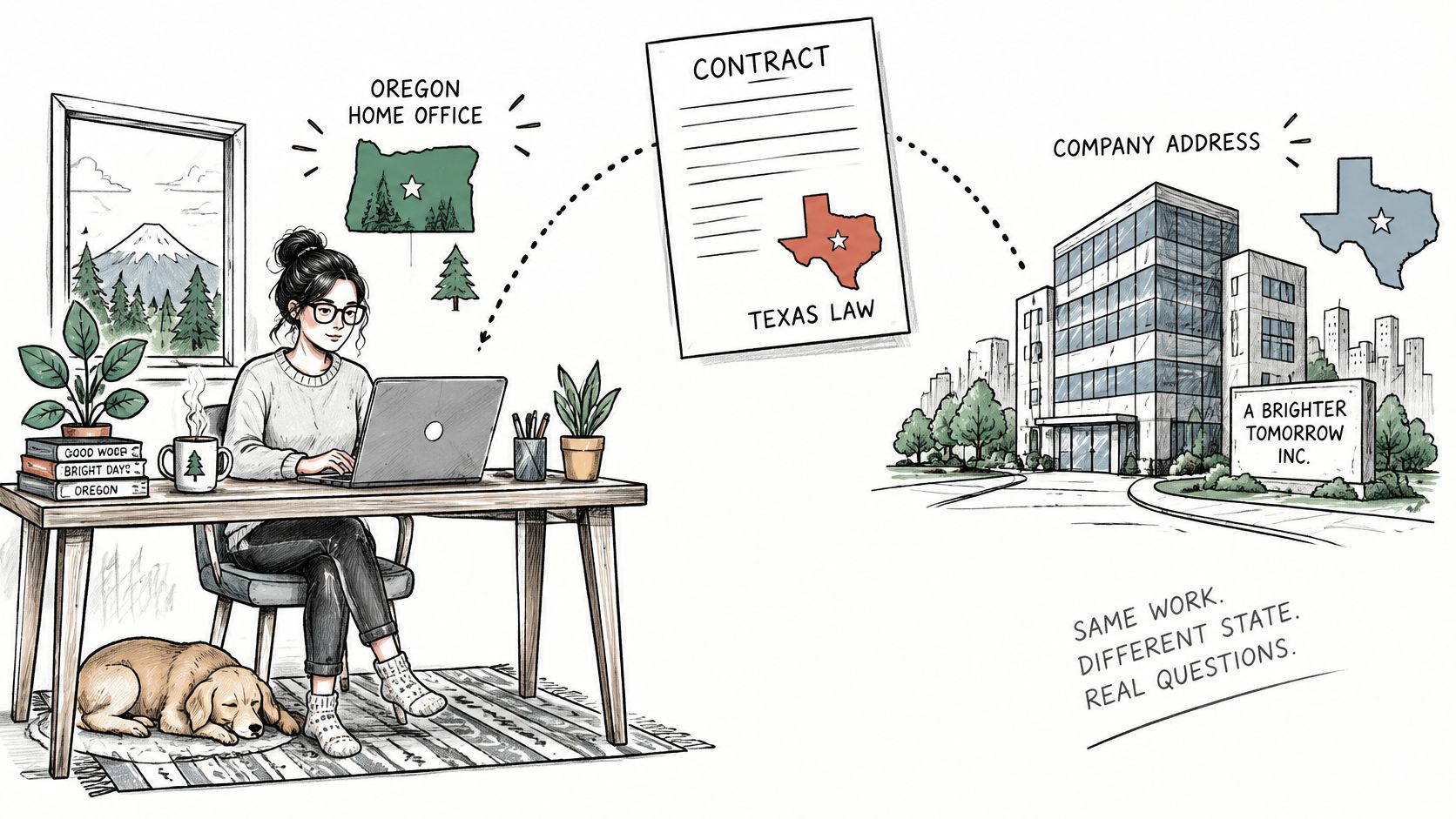
Consider an employee working from home in Oregon whose employer uses a Texas-based payroll system. Oregon minimum-wage requirements can still apply to that work. The payroll system processes the employer's instructions; its location doesn't establish the governing wage law.
Practical rule: Assign a governing-state answer to each issue, not a single state label to the employee.
An owner asking which state law applies to remote employees should expect an issue-by-issue worksheet. The useful answer identifies the work location, the question being decided, the applicable agency or law, and the date of review. That gives payroll and management something concrete to implement.
An employee hired in Texas moves to Oregon and keeps a contract naming Texas law. That clause may govern contract disputes, but it does not automatically determine which state's mandatory workplace protections apply. Treat the contract, work location, and each employment issue as separate questions.
Employment protections, tax obligations, and local ordinances can depend on different facts. The Legal 500's analysis of how remote work changes employer obligations explains why a choice-of-law clause may not extend one state's protections to work performed in another. Headquarters and payroll location do not settle every issue.
For a specific decision, the reviewer needs a record of the contract terms, the employee's approved work location, and the issue being decided. Keep the supporting documents together, including relevant approval records and the effective dates of policy or payroll changes. Preserve prior versions rather than overwriting them.
Capture the work address before onboarding. Require advance approval before an employee changes their regular work state, then route approved changes for payroll and HR compliance review. Update the applicable policies using employee handbook requirements by state. A manager's informal permission is not an adequate change record.
In a remote work case, International Inc. rewrote the client's remote and hybrid work policy to define approved work locations, employee obligations, and enforcement authority. The policy should make clear who approves a location change and what the employee must disclose.
A relocation disclosed only to a manager can leave payroll and compliance records out of date. Before acting, confirm the employee's approved work location, identify the issue under review, and document the determination.
An employee working from Oregon may be subject to a minimum wage tied to the specific work location, so a statewide label may not give payroll enough detail to set the right rate. Check the location category before configuring pay.
The Fair Labor Standards Act, 29 U.S.C. § 201 et seq., provides the federal wage-and-hour framework. The U.S. Department of Labor's 2023 Field Assistance Bulletin confirms that covered nonexempt employees must be paid for hours worked at home or away from the employer's premises. State rules may set higher minimum wages, daily overtime, meal and rest requirements, expense reimbursement, pay-frequency rules, and wage-statement requirements. Verify each applicable state labor department's current requirements. Federal rules alone do not cover state minimums and overtime.
Build the review into onboarding and relocation procedures:
An expense policy should specify how employees purchase equipment, handle internet or phone expenses, submit claims, and obtain approval. Compare those terms with the work state's reimbursement requirements. Do not rely on a blanket rule that employees cover every home-office expense without checking state law.
Review exempt status separately. For employees in California and New York, check the current state salary requirements and duties tests, not just the federal classification. Confirm the applicable rule and effective date with the state labor department or qualified employment counsel, since thresholds change.
A wage-and-hour compliance review should test the actual timekeeping process, too. Set a clear procedure for reporting unscheduled work, and give employees a usable way to record it. If payroll receives incomplete hours or the wrong work location, a sound policy will not correct the pay record.
A remote employee may work from home while reporting to an office with at least 50 employees within 75 miles. For federal FMLA eligibility, that assigned worksite can determine whether the employee meets the location test, even if few or no coworkers live nearby.
The Department of Labor's FMLA eligibility guidance sets out three tests: at least 12 months of employment, at least 1,250 hours worked during the preceding 12 months, and a worksite where the employer has at least 50 employees within 75 miles. The guidance includes part-time, temporary, and seasonal employees on payroll in the count. Distance is measured along the shortest route over public roads, streets, highways, and waterways.
Start with the employee's reporting arrangement. Identify the office to which the employee reports or from which work is assigned, then document the employee count associated with that worksite. The home address alone does not establish the federal FMLA worksite.
Keep the eligibility calculation, the reporting arrangement, and the records supporting the calculation in the leave file. If the organizational chart conflicts with how work is assigned, resolve the discrepancy before deciding eligibility.
Record both the eligibility calculation and why you used that worksite.
Federal eligibility answers only one part of the question. The Department of Labor's FMLA guidance explains that state laws may provide additional protections. When both federal and state laws apply, the employee receives the greater benefit or more generous applicable right. Check the relevant state's current family, medical, and paid-leave rules for each request.
A nationwide policy may need state addenda and separate eligibility determinations. Use this overview of state family leave laws to organize the review. Keep job protection, benefit payments, and the employer's approval process distinct in the record.
PEO and staffing arrangements need a separate worksite review. The DOL's joint-employment fact sheet explains that the primary employer's assigning or reporting office generally controls the worksite test. A secondary employer's facility becomes relevant when the employee has physically worked there for at least one year. Payroll administration alone does not resolve joint-employer status.
Before denying leave or disciplining an employee after a leave request, involve qualified employment counsel. Do the same when medical restrictions raise disability-accommodation questions, and resolve the applicable obligations before communicating a final decision.
Payroll withholding and unemployment reporting use their own tests. An employer shouldn't copy a wage-law conclusion into the unemployment account setup without checking it. For a 2026 payroll review, the relevant state tax and unemployment agencies should confirm current requirements.
The Washington Office of Financial Management's out-of-state remote-work guidance describes the federal-state unemployment sequence and directs the initial inquiry toward the state where the employee physically works. The purpose is generally to select a principal reporting state, not routinely report the same wages everywhere.
Keep the result with the account-registration records. The owner shouldn't accept the payroll system's default state as evidence that someone completed this analysis. A review of the state unemployment insurance tax definition helps separate that employer obligation from employee income-tax withholding.
PayrollOrg's multistate taxation overview explains the work-state starting point and exceptions involving residence, reciprocity, and convenience-of-employer rules. New York may source compensation to the office state when home working is for personal convenience rather than employer necessity, making workday records important. Current state tax agency instructions should govern implementation.
| Scenario | State Usually Used | What to Document |
|---|---|---|
| Employee works fully from home in another state | State where services are performed | Work address and approval date |
| Employee moves to a new state mid-year | Work state for each period, subject to applicable exceptions | Move date and dated worksite history |
| Employee works from home for personal convenience, New York example | Office state may apply under the convenience rule | Workday records showing whether employer necessity exists |
| Employee in a state with a reciprocity agreement | Residence or work state, as the agreement sets out | Agreement terms and employee's residence |
A remote employee can also create registration, withholding, or workers' compensation duties where the company has no office. Before approving the hire, document the regular worksite, assigned office, expected travel, business necessity for the arrangement, and any reciprocity agreement.
Personal tax changes should remain separate from the employer's jurisdiction decision. For employees also navigating a family-status change, Allied Tax Advisors on marriage taxes provides related personal-tax context. It doesn't replace the employer's work-location and withholding review.
An employee who works from a relative's home in another state and visits client sites during the same period has a location problem, even if the arrangement is temporary. A home address alone will not show where the employee performed services or whether work elsewhere was required.
Treat each work location according to the issue being reviewed. A short business trip does not automatically amount to a relocation, and calling an arrangement a trip does not exempt the employer from every work-state requirement. State rules may affect wages, withholding, registration, or insurance.
Set approval terms around the actual arrangement: identify permitted locations, the expected schedule, and whether the employer requires work outside the employee's usual location. Use the location file described in the Contracts section rather than creating a second work-location log.
For tax review, preserve the business reason for the arrangement. New York's convenience-of-employer approach makes that distinction relevant, but it does not determine tax treatment in other states. Have payroll review the rules of each applicable tax agency before promising that temporary work will have no payroll effect. Check city and county requirements where the employee works, including any applicable wage or paid-leave ordinance.
Written approval should state the start date, end date, approved locations, and how the employee must report changes. Name who will confirm the employee's return. An approval without follow-up leaves the company relying on an assumption.
Control point: Temporary-work approval should expire unless someone reviews and renews it.
Apply the same review discipline used for hiring employees in another state. The person approving the arrangement should confirm that payroll, policy, and insurance checks are complete.
If an employee has already moved without approval, establish where and when work occurred before deciding how to respond. A policy breach does not resolve obligations tied to work already performed. For an open-ended or disputed arrangement, or one connected to a complaint or accommodation request, get employment counsel's advice before acting.
The developer's leave request is ready for a decision, but the file shows a recent change in work location. Before responding, the employer should record where the developer worked during the relevant period, which leave rules apply to the request, and what policy language guides the response. The decision record should make the reasoning clear to the next person who reviews it.
For each remote-work decision, document:
For a legal determination, record the law and agency considered, the effective date, and the action taken. Assign unresolved questions to a specific person; an undocumented assumption is not a decision process.
A complaint, leave request, or accommodation issue may raise questions beyond the employee's payroll state. HR should organize the facts, records, and implementation steps, while employment counsel addresses legal conclusions when needed.
The firm supports leadership teams with high-stakes people decisions and multi-state compliance. Its remote-work case involved rewriting a client's policy to define approved work locations, employee obligations, and enforcement authority, restoring visibility over remote practices and eliminating hidden jurisdictional risk.
A review of the remote roster, location approvals, and current policies can show where the decision record is incomplete and which issues need a closer look.
For employers with people working across state lines, Paradigm International Inc. provides HR risk and decision advisory support, including multi-state policy alignment and guidance on sensitive matters.
This article is general information, not legal advice. Employment laws vary by state and change over time. Consult qualified employment counsel about your situation.