Most investigations fail to withstand scrutiny when inadequate training drives the process, and only 38.79% of organizations have fully trained investigators. That gap leaves many employers relying on improvised interviews, incomplete records, and inconsistent decisions.
A complaint arrives involving harassment, retaliation, or misconduct. The employee works in one state, the manager works in another, and key conversations happened through email, text messages, and video calls. The COO wants a prompt answer, but the organization has no clear threshold for opening a formal investigation or deciding who should lead it.
That situation is common among growing SMBs. Generic complaint handling may be sufficient for a routine policy question, but it breaks down when facts conflict, witnesses hesitate, or state requirements differ. Workplace investigation training gives leaders a repeatable way to make decisions, preserve evidence, and explain the process later.
A multi-state employer can't treat every complaint as an informal management issue. A vague report about a supervisor may involve harassment, retaliation, discrimination, wage concerns, protected activity, or a simple interpersonal conflict. The initial response determines whether the organization preserves options or creates avoidable risk.
The current capability gap is significant. A 2025 workplace investigations survey reported that only 38.79% of organizations had fully trained investigators, while 73.28% relied on generic or paper-based systems. The same survey found that 67.74% of investigations lasted more than one month, suggesting that weak systems and insufficient preparation can slow resolution.

Training doesn't turn every manager into an employment lawyer. It teaches investigators and decision-makers to distinguish the roles involved and follow a process that can withstand reasonable scrutiny.
A structured program should help the team:
The alternative is a reactive process. A manager interviews the first person who reports the issue, sends a broad email to gather information, or promises an outcome before the evidence is complete. Those actions can create witness contamination, undermine neutrality, and make later review more difficult.
Large employers may have dedicated investigators, legal teams, and case-management systems. An SMB often has one HR director, a COO, or an outside advisor managing several urgent responsibilities at once. Training creates a common operating language, so leaders know when to document first, investigate immediately, or escalate for specialized support.
The investment also supports operational consistency. Employees in different states shouldn't receive materially different treatment because one local manager is comfortable with investigations and another has never conducted one. A clear process helps the organization respond with appropriate flexibility while preserving the same core standards.
Effective training starts with the decisions investigators must make, not with a long list of legal terms. The curriculum should give participants a reliable sequence for intake, assessment, evidence handling, interviewing, analysis, reporting, and escalation.
Multi-state teams need to understand that a single national policy may not answer every operational question. Training should teach participants to identify the relevant work locations, reporting relationships, employee classifications, applicable policies, collective bargaining considerations, and potential privilege issues before they begin substantive interviews.
The program should also teach plain-language reporting procedures. The EEOC employer checklist says harassment guidance should educate employees about their rights and responsibilities and explain, in simple terms, how to report harassment they experience or observe. That makes reporting access part of the investigation system, not merely a policy-writing exercise.
Use the organization's actual reporting channels in exercises. Ask trainees where an employee can report a concern, who receives it after hours, what happens when the subject is the owner, and how an anonymous report is logged. A process that exists only in a handbook won't help if managers don't know how to activate it.
For related policy work, the Paradigm International handbook guide can help leaders review state-specific handbook requirements alongside investigation procedures.
Interviewing is more than asking open-ended questions. Investigators need to test timelines, separate first-hand knowledge from assumptions, identify corroboration, and ask the same core questions of relevant witnesses without treating them identically.
Training should include cognitive bias as a practical failure mode. Participants can examine how an early accusation, a senior employee's confidence, an emotional presentation, or a dramatic electronic message might influence judgment before all evidence is collected.
Evidence management needs its own exercises. Trainees should practice creating a chronology, naming documents consistently, identifying missing records, separating allegations from established facts, and documenting why a requested record was unavailable.
For organizations with distributed locations or franchise structures, it's also useful to consider how to measure training in franchise systems. The same principle applies to investigation teams: measure whether people can apply the process, rather than only whether they attended a session.
The right format depends on the organization's geography, investigator experience, case volume, and ability to protect time for practice. No delivery model solves every problem.
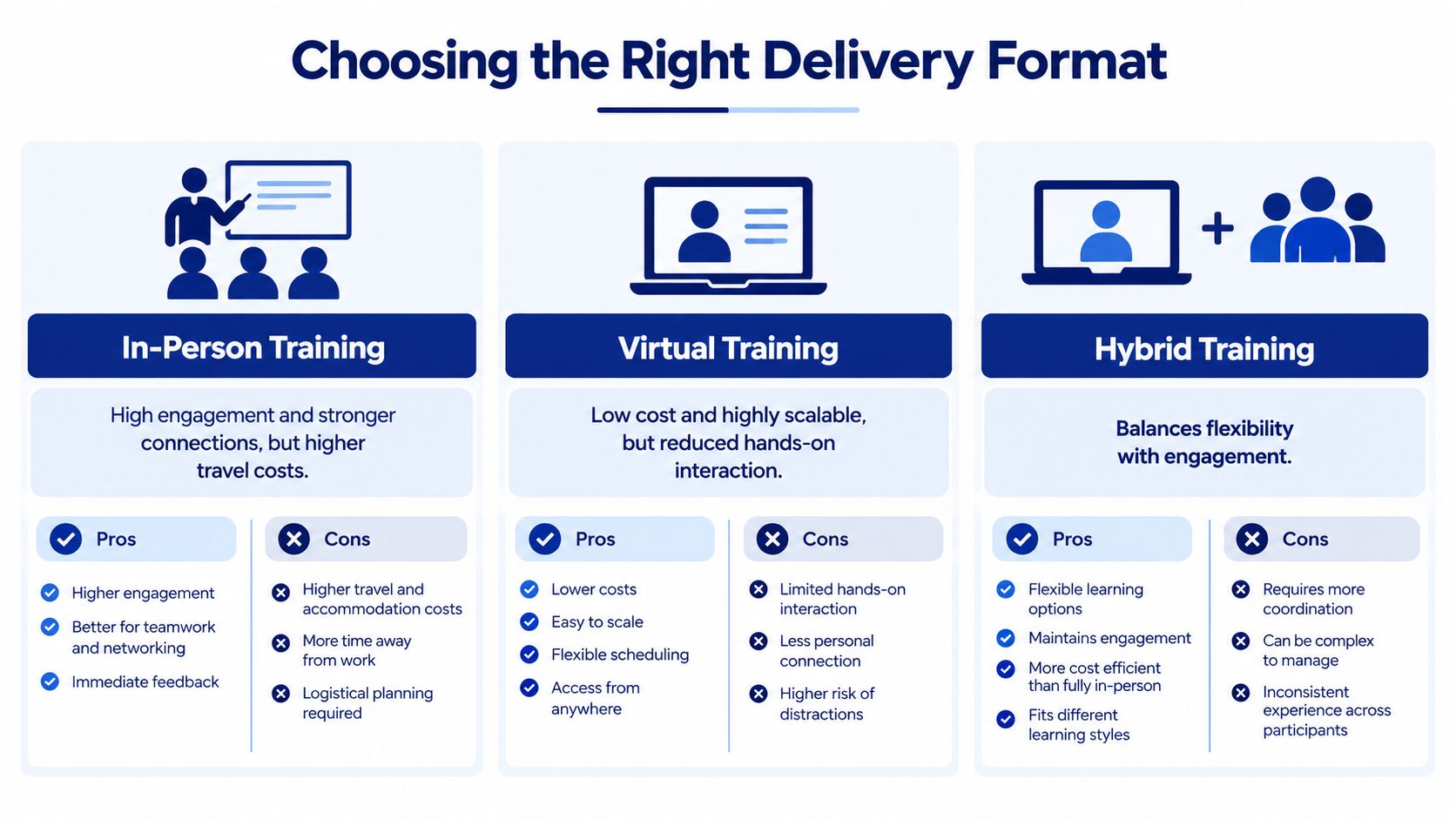
In-person sessions create strong opportunities to observe tone, pacing, hesitation, and group dynamics. That makes them particularly useful for interview practice, difficult role-play, and feedback on how an investigator responds to emotional or evasive witnesses.
The trade-off is coordination. Multi-state SMBs must bring people together, cover operational duties, and maintain consistent content across locations. In-person sessions can also create a false sense of competence if participants listen to a presentation but never conduct a simulated interview or write a finding.
Choose this model when the team is small, the investigation function is new, and leaders can protect uninterrupted practice time.
Virtual delivery reaches dispersed managers without requiring travel. It works well for policy orientation, intake decision trees, document-review exercises, and short refresher sessions.
It requires stronger facilitation than many organizations expect. A virtual instructor must prevent passive attendance, manage breakout exercises, and give participants realistic feedback. Interview practice can become artificial when participants read from scripts or keep cameras off, so the design should include live questioning, timed fact review, and written follow-up.
Virtual training is a practical choice when locations are spread out or managers need regular access to a common process. It shouldn't become a recorded slide deck that employees click through without demonstrating judgment.
Hybrid delivery combines shared online instruction with focused live practice. Participants can complete foundational material remotely, then attend a facilitated session to work through interviews, evidence conflicts, and report writing.
The risk is uneven participation. Remote attendees may receive less feedback than people in the room, and a poor technology setup can distract from the exercise. If the organization chooses hybrid delivery, use the same scenarios, evaluation criteria, and written templates for every participant.
The 2026 Employee Relations Benchmark Study reports that required investigation processes reached 62%, while 38% of organizations still lacked a required approach. That finding points to the priority: format matters, but a required process matters more. Leaders seeking HR advisory for complex employment decisions should select the format that makes consistent practice realistic for their workforce.
A participant can describe an impartial interview and still lead a poor one under pressure. Skill develops when trainees must decide what to ask, what to preserve, and what not to assume while another person provides incomplete or contradictory information.
Build the exercise around ambiguity rather than a neatly packaged complaint. For example, an anonymous report says a department leader “creates an unsafe environment,” but includes no date, event, or witness name. The trainee must decide what to document, whether to seek clarification, how to assess potential risk, and whether the available information warrants immediate escalation.
A second scenario can involve conflicting accounts. One witness remembers a meeting as confrontational, another describes it as routine, and an electronic message supports only part of each version. The trainee should identify what each person knows directly, test the timeline, preserve the message, and write a provisional assessment without overstating certainty.

Government guidance describes a practical workflow that includes recognizing when an investigation is necessary, defining the allegation and scope, selecting an investigator, planning witnesses and documents, conducting individual interviews, documenting findings in a report, securing records separately, and updating the plan as new facts emerge. The government investigation toolkit provides the foundation for turning that sequence into a training exercise.
Have trainees perform each stage instead of discussing it abstractly:
Role-play should include emotional dynamics. A respondent may become defensive, a witness may refuse to cooperate, or a complainant may worry about retaliation. The trainee needs practice acknowledging the concern without promising a result or revealing information that should remain restricted.
Facilitators should evaluate observable behavior. Did the trainee ask follow-up questions when the timeline changed? Did they distinguish direct knowledge from hearsay? Did they document an unanswered question? Did they avoid announcing a conclusion before reviewing the evidence?
Use a short written exercise after each role-play. Require a chronology, an evidence log, and a findings paragraph that identifies both support and uncertainty. This exposes gaps that a verbal discussion can conceal and gives the participant a work product to improve.
Practical rule: A safe training exercise should make uncertainty visible. If every fact points to one obvious answer, the exercise tests memory rather than investigative judgment.
Legal defensibility depends on more than reaching a sensible outcome. The organization must show that it received the concern appropriately, selected a suitable investigator, gathered relevant evidence, treated participants fairly, and based its decision on a documented record.
A useful report separates four categories:
That separation prevents a common reporting failure, where an investigator presents an inference as if it were a proven fact. It also helps the decision-maker understand which conclusions are firm and which require judgment.
Participants should practice using a consistent file structure, maintaining a chronology, preserving original records, and recording decisions made during the investigation. Separate records for the investigation can help limit unnecessary access, although the correct structure depends on the organization's policies and legal advice.
Privilege requires particular care. An employer shouldn't label an ordinary business investigation “privileged” merely because counsel is copied on an email. Training should teach staff to escalate privilege questions to counsel and to avoid making casual statements about legal protection.
The Massachusetts State University investigation program emphasizes planning the case, creating a file and timeline, collecting relevant evidence, conducting interviews, assessing credibility, confirming and disconfirming facts, and documenting the process. Those mechanics give trainees something concrete to perform and supervisors something concrete to review.
For leaders building a repeatable audit trail, Beyond Surplus compliance reporting offers a useful reference point for thinking about how records show actions, decisions, and accountability over time. The investigation file should make it possible for an authorized reviewer to understand what happened without relying on the investigator's memory.
SHRM's framework uses a 7-step process and teaches participants to apply it in person and remotely, as described in SHRM's workplace investigations framework. The sequence matters because it reduces the temptation to begin with a conclusion and collect only confirming evidence.
A practical workplace investigation report for SMBs should therefore show the scope, methodology, evidence reviewed, interviews completed, factual findings, unresolved issues, and any recommendations or handoff to the decision-maker. It shouldn't decide discipline automatically. The organization's designated decision-maker must apply policy consistently and consider any additional legal or operational advice.
Attendance isn't proof of competence. A useful evaluation asks whether participants can handle an unclear report, select an impartial investigator, conduct a focused interview, preserve records, and write findings that distinguish evidence from inference.
Use three forms of assessment:
Review the results with managers who oversee the investigation function. If participants repeatedly miss the same escalation point or write conclusions without explaining the evidence, change the process or the training rather than treating the problem as individual carelessness.
A multi-state SMB should also revisit its decision tree when locations, reporting lines, policies, or investigation resources change. The strongest program combines trained people, a required process, usable templates, clear escalation rules, and periodic review. That combination gives executives a more reliable basis for decisions when a complaint becomes operationally and legally significant.
International Inc. supports SMB leadership teams with workplace investigation structure, incident response, documentation discipline, and training on investigation protocols. Visit Paradigm International Inc. to discuss how to build a more consistent and defensible investigation system for your organization.