A supervisor receives a harassment complaint, tomorrow's schedule is already posted, and the owner is handling HR between customer calls. Someone suggests moving the employee who complained to another shift while the facts are checked. That ordinary operating decision, made before any finding, may create more risk than the original complaint.
Workplace investigations are neutral, documented inquiries into complaints and misconduct. They aren't a process for proving management right or validating the first account received. For an owner managing operations and HR, the immediate task is identifying which protections apply before anyone starts questioning employees.
Employee rights in an investigation by source
| Right | Source and agency | Who it protects | Employer check |
|---|---|---|---|
| Protection from retaliation | Title VII of the Civil Rights Act (1964), ADEA (1967), ADA (1990); EEOC | Employees who complain about discrimination, witness, or participate in protected activity | Document a business reason for every change after a complaint |
| Representative at an investigatory interview | National Labor Relations Act (1935); National Labor Relations Board | Union-represented employees who reasonably expect discipline | Honor a valid request, end the interview, or offer a lawful choice |
| Non-interference with FMLA leave | FMLA (1993); U.S. Department of Labor | Eligible employees who request or use leave | Separate performance evidence from leave-related absences |
| State-law protections | State civil rights and labor laws | Employees covered by their work state's law and applicable employer-size rules | Check each employee's work state before the first interview |
These are different protections, not interchangeable promises. A discrimination witness may have retaliation protection without having a right to bring a representative. An employee discussing attendance may also have protected leave that must be separated from the conduct under review.
Non-union private-sector employees don't have a general federal right to bring a representative under the NLRA's Weingarten rule. That doesn't settle obligations under company policy, an agreement, state law, or another applicable protection. Public-sector and federal employment require a separate analysis.
The employer's opening worksheet should identify each participant's work state, union status, employment setting, and connection to any leave or accommodation issue. Management should also distinguish a complaint about unlawful discrimination from a general disagreement about supervision. Both deserve a fair response, but their legal protections aren't necessarily identical.
Rumors introduce another problem: employees may confuse an investigation with permission to circulate accusations. Miles Hansford Law Firm's resource on how to protect your reputation after coworker rumors offers useful context for that separate concern. Management should preserve relevant reports without turning untested allegations into workplace announcements.
For workplace investigations, employee rights should be mapped person by person. Before the first interview, the employer should be able to identify which rows apply and which questions still require qualified review.
Under the EEOC's 2016 retaliation enforcement guidance, federal protections extend across Title VII, the ADEA, the Equal Pay Act, the ADA, the Rehabilitation Act, and GINA. Protected conduct can include internal discrimination reports, resisting sexual advances, reasonable opposition to unlawful conduct, accommodation requests, and witness participation. Employees don't need to use legal terminology or file a government charge first.
The scale warrants attention: the EEOC's fiscal year 2025 charge table_FY_1997_-_FY_2025_0.xlsx) records 54,350 retaliation-based charges, the largest single charge basis. Those are allegations, not findings that employers violated the law. The practical message is that everyday management decisions during an open case deserve their own review.
Actions during an open investigation and their retaliation risk
| Action | Usually defensible when | Creates risk when |
|---|---|---|
| Schedule change | Business need is documented and applied the same way to others | Timed to the complaint or applied only to the complainant |
| Performance scrutiny | Standards match prior documented expectations and reviews | Sudden stricter monitoring follows the complaint |
| Discipline | Comparable conduct has precedent and an independent reviewer approves it | A minor issue produces an unusual penalty without supporting history |
| Reporting-line change | Neutral and temporary, with pay and duties unchanged | The complainant loses meetings, responsibilities, or access |
| Termination or separation | Records support the reason, expert review occurs, and decision-maker knowledge is recorded | Separation follows a complaint without prior performance concerns |
A finding of no violation doesn't erase retaliation risk. The complaint's outcome and the legality of later treatment are separate questions. Equally, protected activity doesn't give an employee immunity from discipline for unrelated misconduct.
Before an employment change, the reviewer should establish the complaint date, what each decision-maker knew and when, and the documented business reason. That reason should match existing records and comparable treatment, not an explanation created after a manager has already decided. A reporting change that sounds protective can still disadvantage the complainant.
Practical rule: An interim measure should address the problem without quietly transferring its cost to the employee who reported it.
FLYP LTD's people ops compliance insights provide broader operational context for consistent people processes. The immediate priority remains a clear record of who proposed an action, why it was needed, and who reviewed it.
A proposed termination after an employee files a complaint deserves expert help before implementation. The same caution applies when separation follows protected leave.
Under the National Labor Relations Act (1935), the NLRB's Weingarten guidance recognizes a union-represented employee's right to request representation during an investigatory interview the employee reasonably believes could lead to discipline. A valid request changes what the employer may do next. Continuing substantive questioning while ignoring it isn't an acceptable shortcut.
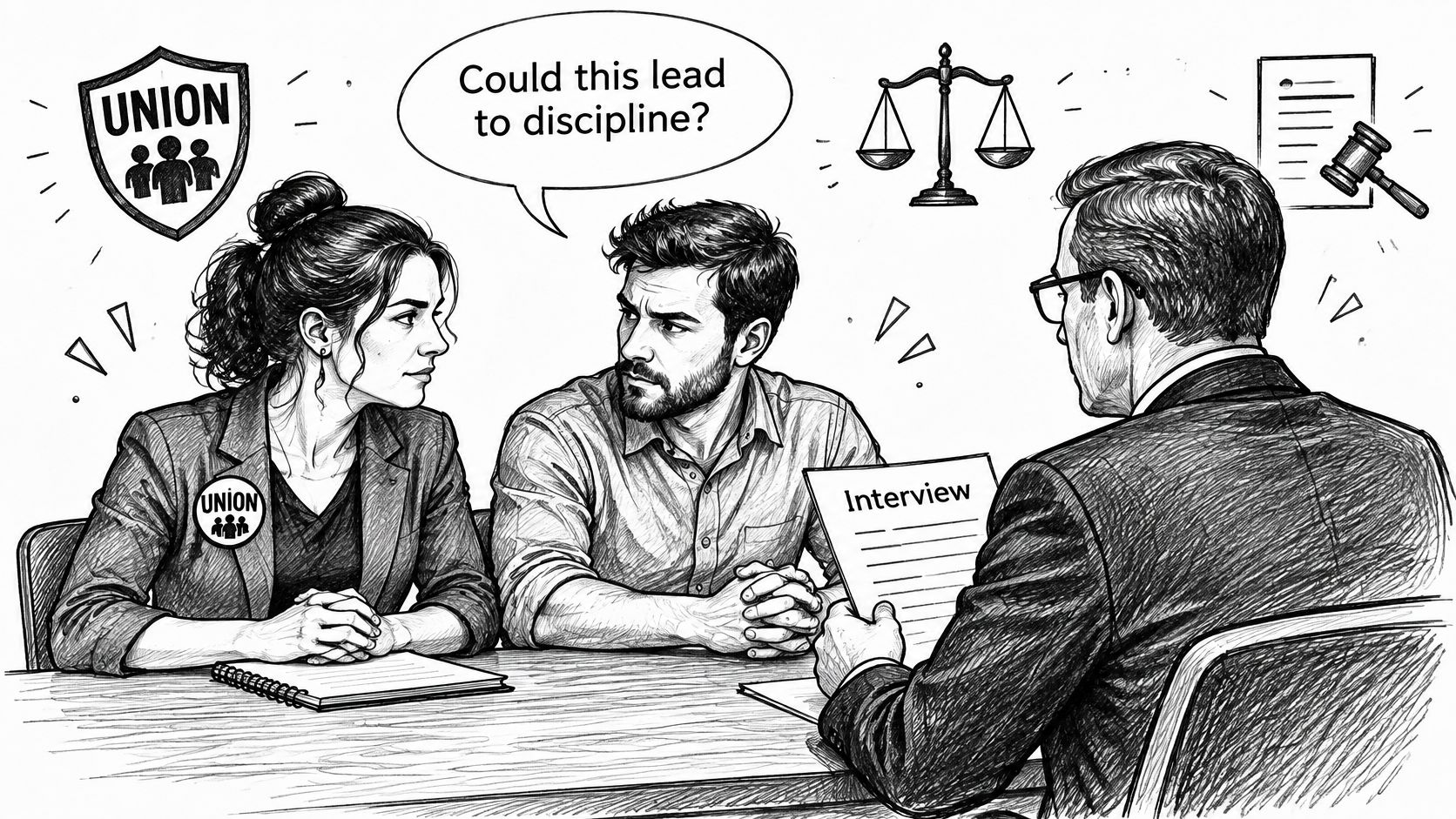
The employer may honor the valid request, end the interview, or give the employee the choice to proceed without representation or have no interview. Management mustn't retaliate for the request. An improperly denied request can create a separate labor-law problem even if the underlying misconduct occurred.
Say a warehouse employee is asked to explain an apparent timecard discrepancy. The employee believes falsification discipline is possible and requests a union representative. The interviewer should pause, not ask the employee to finish explaining the discrepancy first.
The representative doesn't have an automatic veto over questions. The employer should nevertheless allow the representative's lawful assistance rather than treat attendance as a silent formality. Labor counsel can resolve disagreements about participation before the meeting deteriorates.
For non-union private-sector staff, the federal Weingarten rule doesn't create the same entitlement. State law, company policy, agreements, or accommodation considerations may change the answer. Public-sector and federal employees follow different frameworks and shouldn't be placed into the private-sector rule by default.
A standard interview-opening script should identify the meeting's purpose and applicable representation arrangements without promising rights that haven't been checked. Management should establish an escalation trigger whenever representation, protected concerted activity, or possible discipline becomes an issue. That pause gives a multi-state employer time to obtain labor guidance instead of improvising in the interview room.
Complete secrecy isn't a realistic investigation promise. Under federal employment-discrimination laws enforced in 2025, the EEOC's employer checklist recommends protecting privacy to the greatest extent possible while maintaining a complete response. It also calls for protecting complainants, witnesses, and accused employees, monitoring retaliation, and avoiding premature presumptions of guilt.
A confidentiality agreement isn't a substitute for those distinctions. The nearshore NDA templates from GENTY recruitment offer context about written confidentiality arrangements, but investigation instructions require their own review. Management shouldn't use a broad NDA to improvise restrictions on protected employee activity.
May an employee discuss the experience? Management should explain its own need-to-know sharing with decision-makers, HR, counsel, investigators, regulators, and witnesses needed to test accounts. It shouldn't convert that explanation into a blanket employee gag order or promise that nobody else will hear the facts.
May an employee see or keep records? Good practice is to provide enough allegation detail for a meaningful response, not automatically distribute the complete investigation file. Management should prohibit unauthorized removal of company documents while preserving lawful reporting and access rights. In California, Labor Code section 1198.5 provides personnel-record inspection rights; that isn't unrestricted access to every investigation document, and current state requirements need checking.
May an employee bring support? Apply the representation analysis before answering rather than offering a universal yes or no. May an employee refuse? Record the response, don't treat silence alone as guilt, and obtain expert help before imposing a sanction.
Confidentiality should control unnecessary disclosure, not stop the investigator from testing the facts.
A sound communication protocol explains scope, identifies likely recipients, states the non-retaliation expectation, and documents appropriately limited restrictions. Status updates can confirm that work continues without disclosing another employee's personnel information. Paradigm's discussion of employee privacy rights provides additional context for those boundaries.
A defensible file should show how the investigator reached a conclusion, not merely announce one. The EEOC's promising practices guidance, addressing federal anti-discrimination obligations, recommends prompt, thorough, impartial investigations and realistic confidentiality expectations. The workflow below translates those principles into file-building practices rather than treating every recommendation as a separate legal mandate.
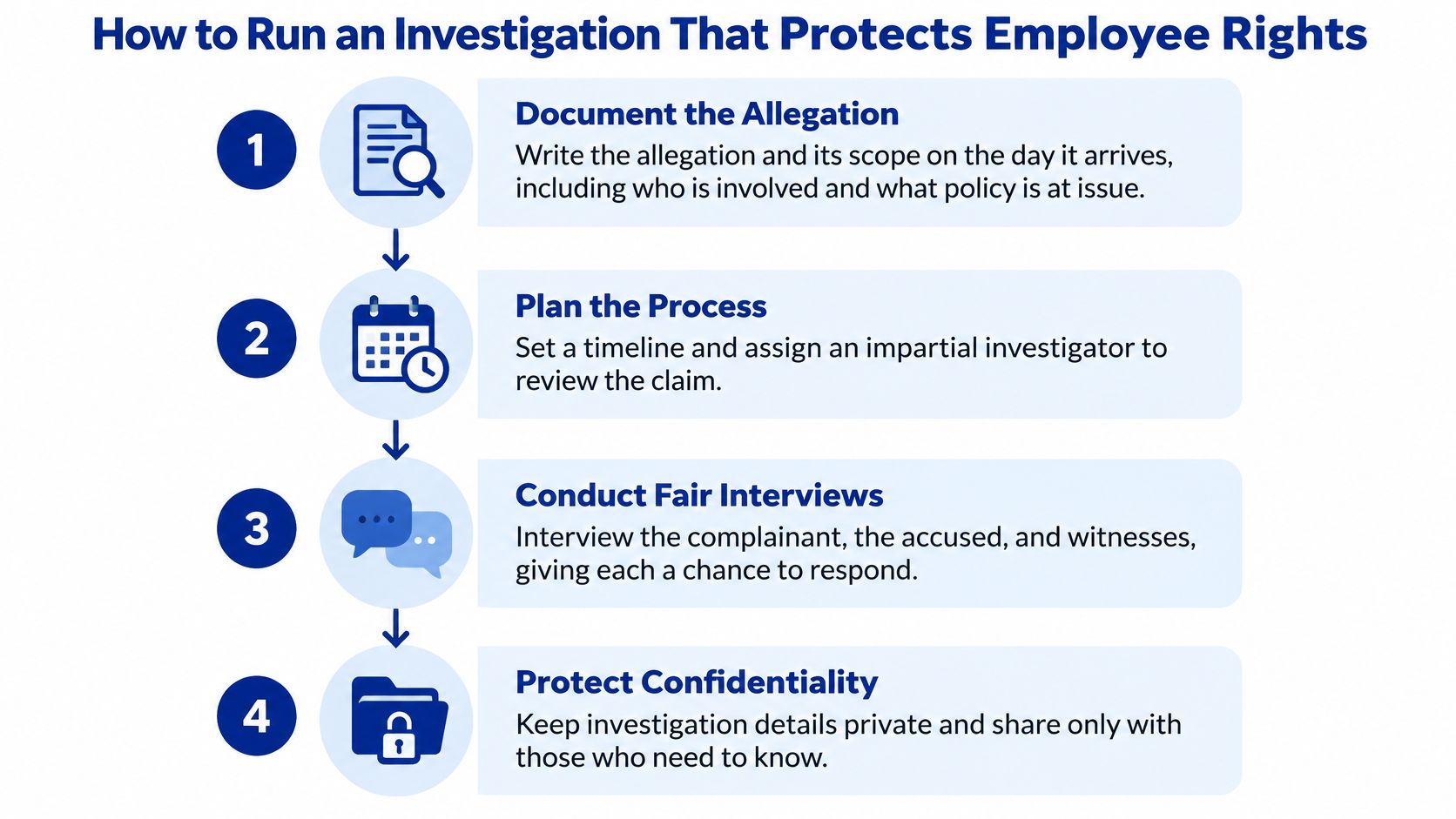
Document intake on arrival. Record who reported the concern, the date received, the allegation, and its initial scope. Identify the policy or conduct at issue without rewriting the report into a conclusion.
Create a participant map. List work states, union status, and private-sector, public-sector, or federal status. Flag unresolved coverage questions for review before interviews begin.
Assign an impartial investigator. Prefer someone outside the reporting lines of the complainant, accused employee, and material witnesses. If that isn't practical internally, document conflicts and arrange independent support.
Preserve evidence before routine deletion. Secure relevant emails, schedules, timecards, messages, and camera footage. Keep originals intact, record collection dates, and restrict access rather than forwarding material among managers.
Use a consistent interview opening. Record the purpose, confidentiality limits, non-retaliation expectation, and representation arrangements. Capture any new representation request word for word and pause to resolve it.
Build a chronology and test accounts. Use the same core questions for comparable witnesses, then ask account-specific follow-ups. Compare recollections against timestamps, documents, firsthand knowledge, and corroboration rather than confidence or seniority.
Review proposed employment changes separately. Enter the complaint date, decision-maker knowledge, and business rationale into the action record. Compare treatment with relevant precedents and obtain independent review before implementation.
Close with reasons, not labels. Assemble the chronology, interview notes, evidence index, findings, and corrective-action rationale. Distinguish established facts from unresolved conflicts so an outside reviewer can follow the reasoning.
For a professional services client's internal investigation, Paradigm International Inc. used consistent interview methodology and corroboration analysis, with findings documented for external legal scrutiny. That process illustrates the right standard: another reviewer should be able to trace a finding to supporting evidence. A polished summary can't substitute for missing notes or unexplained credibility judgments.
Managers responsible for intake and evidence handling also need preparation before a complaint arrives. Workplace investigation training can help establish consistent responsibilities and escalation points. A designated investigator shouldn't have to reconstruct who deleted footage or why a witness received different questions.
Stop for expert help when allegations name senior leadership, suggest criminal conduct, or move toward termination after leave. Those situations require decisions about investigator independence, evidence handling, and counsel involvement before management takes irreversible action.
Coverage thresholds for workplace protections
| Law or rule | Coverage threshold | Multi-state note |
|---|---|---|
| Title VII of the Civil Rights Act (1964) | 15 or more employees | Federal baseline in every state; EEOC enforcement |
| Age Discrimination in Employment Act (1967) | 20 or more employees | Federal baseline in every state; EEOC enforcement |
| Americans with Disabilities Act (1990) | 15 or more employees | Federal baseline in every state; EEOC enforcement |
| Family and Medical Leave Act (1993) | Private-employer coverage generally requires 50 employees; employee eligibility includes 50 employees within 75 miles of the worksite | Employer coverage and employee eligibility are separate checks |
| Florida Civil Rights Act (1992) | 15 or more employees | Florida requirements; Florida Commission on Human Relations |
| Texas Labor Code, Chapter 21 | 15 or more employees generally | Texas requirements; Texas Workforce Commission Civil Rights Division |
| California Fair Employment and Housing Act | 5 or more employees for discrimination coverage | California Civil Rights Department; harassment coverage is broader |
| New York State Human Rights Law | All employers, regardless of size | Expanded coverage effective in 2020; New York State Division of Human Rights |
These are screening thresholds, not complete coverage determinations. Counting methods, exceptions, employee eligibility, and the type of claim still matter. California's discrimination threshold, for example, shouldn't be used to dismiss a harassment concern below that headcount.
An employee's actual work location can bring additional state obligations into play; headquarters doesn't automatically supply the only applicable law. A remote hire in California or New York may therefore require a different review from an employee working in Florida or Texas. The analysis of which state law applies to remote employees belongs in hiring and location-approval procedures, not just complaint response.
Under the Family and Medical Leave Act (1993), the U.S. Department of Labor's FMLA protections guidance states that employers may not interfere with protected rights or use FMLA leave as a negative factor in hiring, promotion, or discipline. Protection also reaches people who file an FMLA-related charge, provide information in an inquiry, or testify about FMLA rights. That matters when an attendance investigation includes protected absences.
A company shouldn't treat an attendance report as a ready-made disciplinary record. When leave, disability accommodation, and discipline overlap, qualified HR and employment counsel review is worth obtaining before action.
Outside review is most useful while the employer still has choices. Once a termination notice has been delivered or evidence has been lost, an advisor can't restore the original decision point. The dangerous move is acting on a thin record while the investigation remains open.
An owner doesn't need to resolve every legal question before requesting help. The useful preparation is a chronology, the original complaint, preserved records, proposed action, and a candid account of what management has already communicated. Missing information should be identified rather than filled with assumptions.
Decision standard: Obtain review while management can still change course.
The firm conducts prompt, impartial, and thorough investigations into complaints, with processes built around EEOC, DOL, and Fair Labor Standards Act requirements. It is an HR consulting and advisory firm, not a law firm. Its role can include organizing the facts and coordinating with counsel when legal judgment is needed.
The discussion of external HR support for workplace investigations offers context for deciding when internal capacity isn't enough. Owners handling HR alongside operations can walk through an open file with an advisor before making the next employment decision.
International Inc. offers investigation planning, impartial fact-finding, documentation support, and multi-state HR decision guidance. Leaders assessing an open complaint can learn about that support through Paradigm International Inc. before deciding on schedules, discipline, or separation.
This article is general information, not legal advice. Employment laws change and vary by state; consult qualified employment counsel about your situation.