A manager has already had two conversations. The employee nodded both times, promised to improve, and then repeated the same problem the next week. Now the issue is affecting schedules, client confidence, or team morale, and the owner is stuck between wanting to be fair and needing to protect the business.
That's usually the point where written warning work starts to matter. Not because a form needs to be filled out, but because informal management has stopped creating enough clarity. A written warning gives the employee a documented explanation of what happened, what must change, and what happens next if it doesn't.
For multi-state SMBs, that document does more than record a problem. It helps leaders show consistency, support a later decision if escalation becomes necessary, and reduce the risk that a correction process turns into a dispute about fairness. Used well, a written warning is a structured communication tool. Used poorly, it becomes vague paper that satisfies no one and protects nothing.

Most leaders don't struggle because they're unwilling to act. They struggle because they want the next step to be proportionate, defensible, and useful. That's the right instinct. A written warning should help the employee correct course while giving the company a clean record of how the issue was addressed.
An employee has already been spoken to twice about the same issue. The problem keeps showing up in schedules, customer interactions, or basic policy compliance. At that point, a written warning stops being an administrative form and becomes a risk control.
A written warning is a formal record that identifies a specific conduct or performance problem, cites the workplace standard that applies, and states what correction is required by what date. For a small or midsize employer operating in more than one state, that matters for more than internal discipline. It creates a contemporaneous record of what the company knew, how it responded, and whether the employee was given a fair chance to correct the issue.
Managers often misuse warnings in two ways. Some issue them too late, after weeks of inconsistent verbal coaching. Others issue them too early for problems that are really training or performance management issues. Both mistakes create exposure. A late warning looks arbitrary. An early warning can make a fixable skill gap look like misconduct.
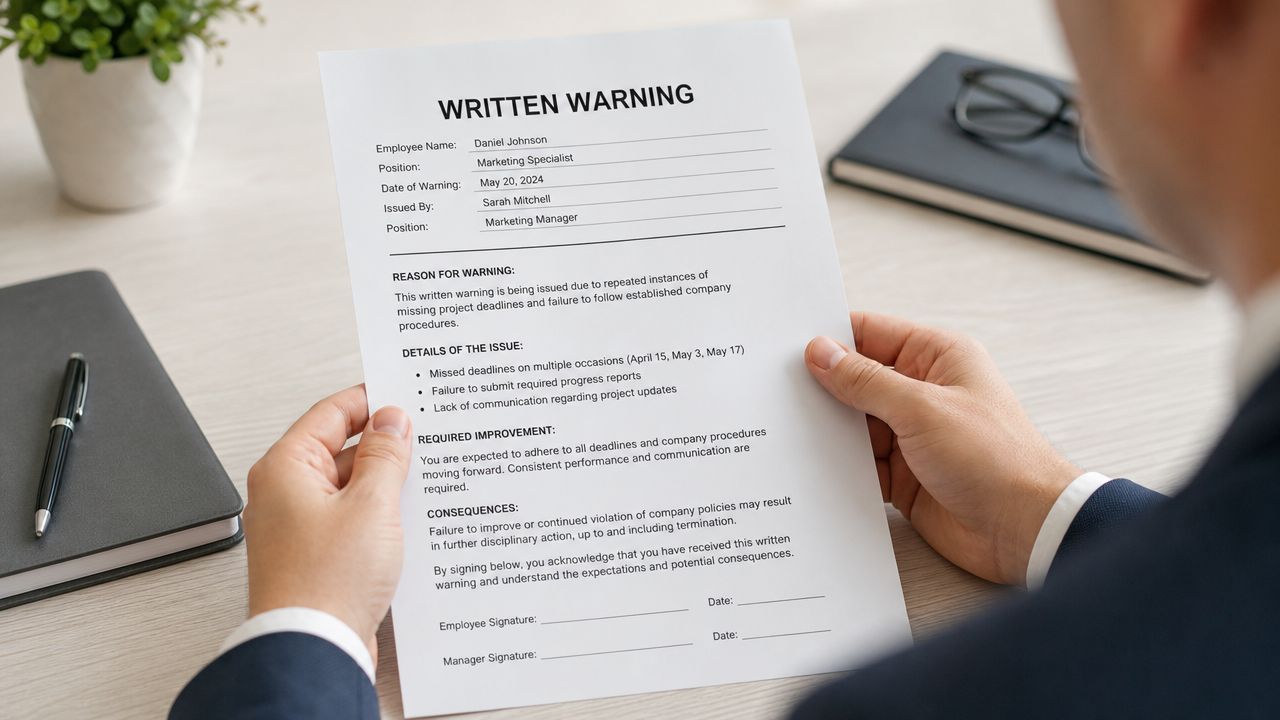
Used properly, written warning work gives the business three things at once. It tells the employee exactly what needs to change. It forces the manager to define the problem with facts instead of frustration. It also improves the company's position if the issue continues and a later decision is challenged.
The Society for Human Resource Management explains that written warnings are typically part of a progressive discipline process used to address repeated misconduct or ongoing performance concerns after earlier intervention has not worked, as described in SHRM's guidance on employee discipline.
A written warning fits best when the issue is specific, observable, and tied to an established rule, instruction, or job expectation.
A simple test helps. If a manager can identify the date, the conduct, the policy or expectation involved, and the prior discussion, a written warning is usually the right next step.
Some problems need correction, but not discipline. A performance improvement plan is often the better choice when the issue involves capability, clarity, or sustained development rather than a clear rule violation.
Here is the practical distinction:
| Situation | Better fit |
|---|---|
| Repeated attendance violations after coaching | Written warning |
| Safety rule ignored after prior instruction | Written warning |
| Supervisor missing several leadership expectations | PIP |
| New hire struggling with systems and workflow | PIP |
For multi-state employers, that distinction is not academic. It affects whether later action looks measured and consistent or rushed and uneven. Written warnings work best when the company is addressing a definable breach of expectation. PIPs work better when management still needs to diagnose the cause of underperformance and give structured support before deciding whether the employee can meet the role.
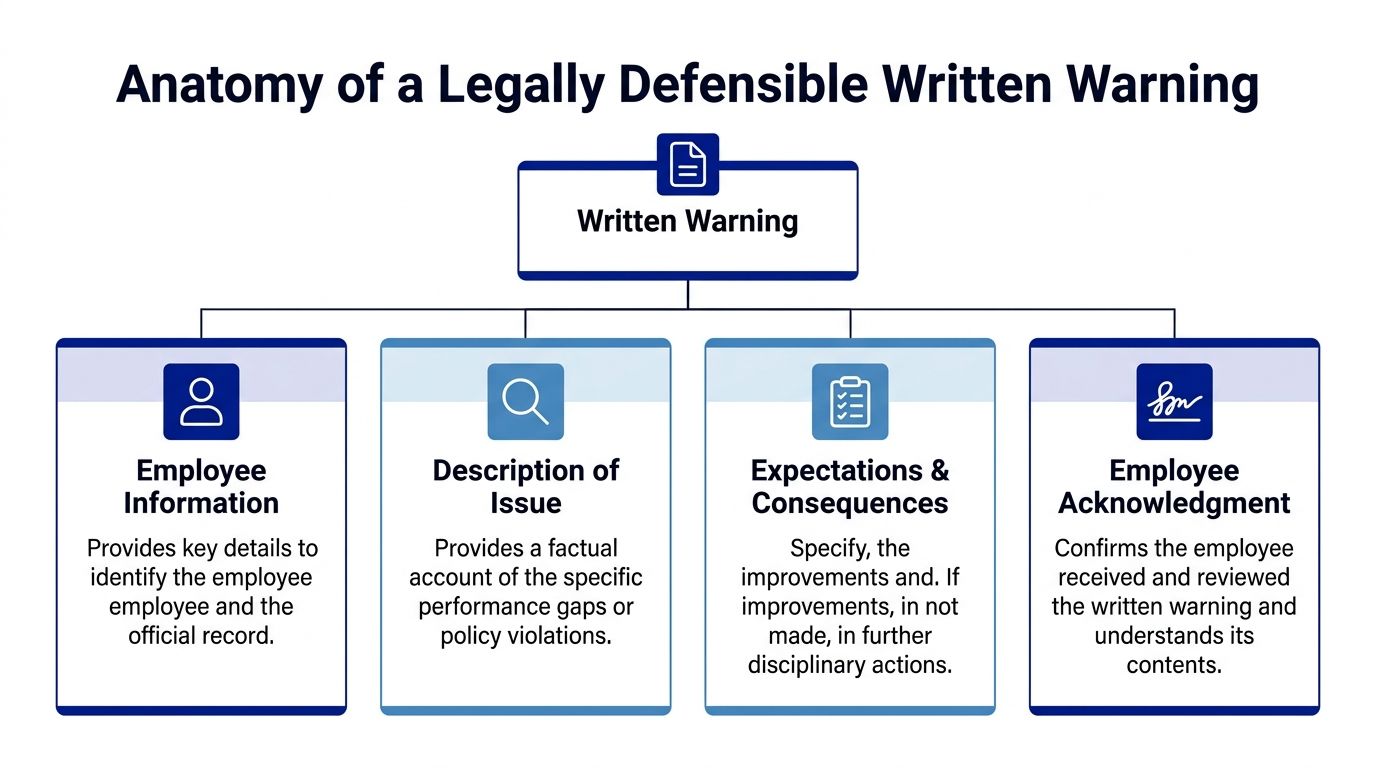
A warning becomes useful when it can answer simple questions later. What happened. Which rule or expectation applied. What support was offered. What deadline was set. What consequence was stated. If the document can't answer those questions, it may satisfy a manager emotionally while doing very little for the company.
The strongest framework I've seen for this is the FACTS standard. A warning should be Fair, Appropriate, Communicated, Timely, and Specific. The timing point is especially important. A legally defensible warning should be issued within 24 to 48 hours of the incident to help prevent claims of selective enforcement, as explained in Hilb Group's FACTS guidance.
A defensible warning usually needs four core components working together.
This isn't about legal style. It's about record quality. Vague warnings often fail because they rely on labels like “bad attitude” or “poor professionalism” without specific examples. Those phrases don't tell a reviewer, agency, or court what happened.
Strong written warning work uses observable facts. It avoids conclusions that sound personal or emotional.
Compare the difference:
| Weak phrasing | Strong phrasing |
|---|---|
| “You have been unreliable lately.” | “You were absent without prior approval on June 3 and June 10, and you arrived more than 20 minutes late on June 12.” |
| “Your attitude is disruptive.” | “During the team meeting on June 7, you interrupted two coworkers and refused a direct instruction from your supervisor.” |
| “You need to do better.” | “You must report for all scheduled shifts on time for the next review period and follow call-out procedures exactly as written in the attendance policy.” |
The more a warning reads like a factual timeline instead of a personal complaint, the more useful it becomes later.
Use this checklist before a warning goes out:
In some settings, related documents matter too. For example, if the issue touches confidentiality or handling of sensitive information, leaders often need aligned documentation across policies and employee agreements. A practical reference point is this download confidentiality template for 2026, which can help leaders compare whether their supporting documents match the expectations they're trying to enforce.
The biggest mistake multi-state employers make is assuming a generic warning form is close enough. It usually isn't. A warning that looks reasonable in one location can create unnecessary exposure in another if it ignores local leave rules, protected categories, wage-and-hour requirements, or industry-specific obligations.
That's why written warning work has to be built as a framework, not a single static template. The framework should standardize quality and process. The final document should still be adapted to the state, the role, and the underlying issue.
A generic warning often fails in three places.
First, it may reference a broad policy but miss the specific rule that mattered in that state or industry. Second, it may use language that unintentionally implies guaranteed continued employment. Third, it may ignore legally relevant context, such as protected leave, required breaks, or regulatory duties tied to the role.
For example, an attendance warning in one state may be straightforward. In another, the same fact pattern may require a closer review of protected sick leave, accommodation issues, or meal and rest break rules before discipline is issued. If the company skips that step, the warning can look retaliatory or careless even when the original concern was legitimate.
Better systems focus on precision.
That last point has real value. In multi-state SMB operations, warnings that integrate impact detailing reduce defending costs in wrongful termination lawsuits by 35% because they establish ascertainable harm rather than subjective dissatisfaction, according to SHRM's guidance on improving written warnings.
One common example involves break compliance. If a manager is warning a supervisor for scheduling practices, the company needs to know whether the issue intersects with state break obligations and recordkeeping. That's where a focused resource like an article on employment law breaks becomes relevant. The point isn't to turn every warning into a legal memo. It's to make sure the discipline reflects the actual compliance environment the business operates in.
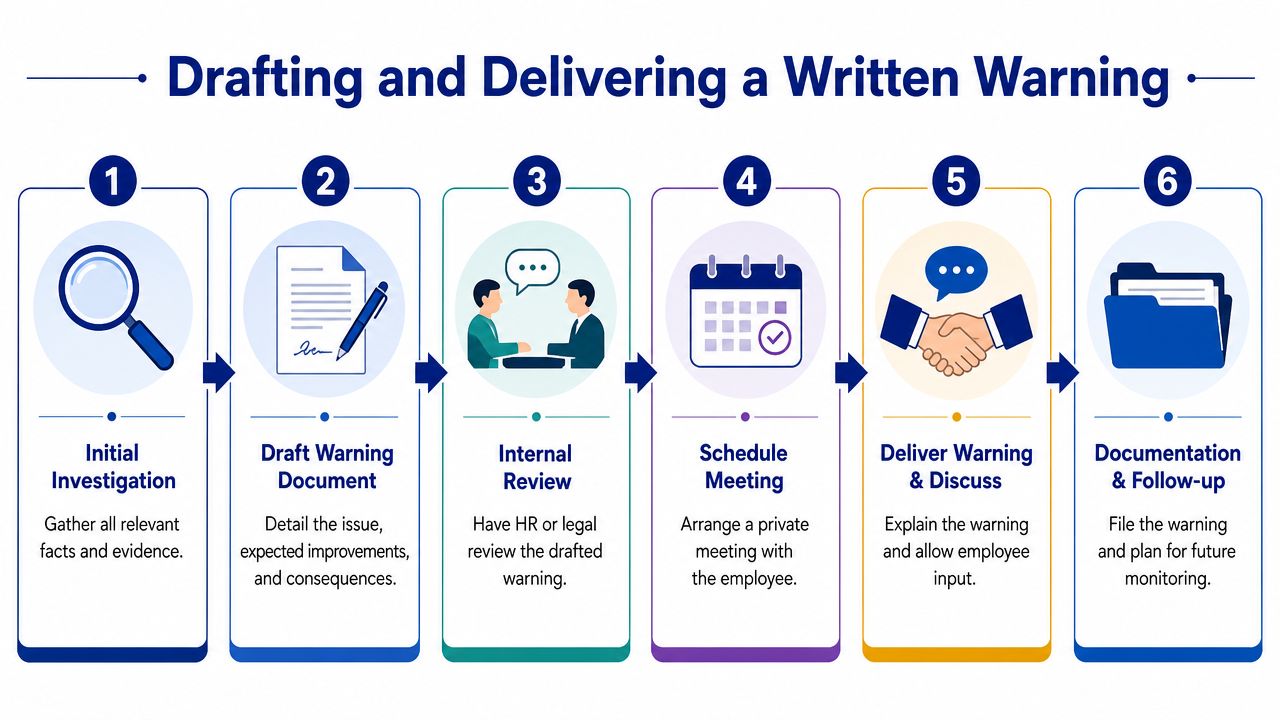
A good warning document can still fail if the process around it is sloppy. Delivery matters. Review matters. Follow-up matters. Leaders need a repeatable method so written warning work doesn't become improvised manager correspondence.
Many employers have already moved in that direction. According to the Bureau of Labor Statistics' 2024 Employment Practices Report, 64% of successful employers now use industry-specific written warning letter formats suited to their operational context, rather than relying on generic templates, as summarized in this employment practices discussion. That makes sense. Discipline documents need consistency, but they also need context.
Start with the facts, not the draft.
Some industries already understand this discipline well because supervision standards are formalized. If your managers need an example of how documented oversight works in regulated settings, the FINRA WSP definition is a useful reference point for why process and documented controls matter.
Delivery should be direct, calm, and private.
Manager guidance: Deliver the warning in a neutral tone. If the manager sounds angry, the employee will remember the emotion more than the expectations.
What works is straightforward communication. “Here is the concern. Here is the policy. Here is what has to change. Here is when we will review progress.”
What does not work is overexplaining, debating every past interaction, or trying to soften the message until it becomes ambiguous. Managers also hurt the process when they promise outcomes they can't control, such as saying termination “won't happen” if the employee just tries harder. A written warning should create accountability, not private side deals.
If your team needs structured support for this process, a corporate entity provides advisory help on documentation standards, manager conduct, and high-risk employee actions for businesses operating across states. That type of support is often useful when a manager has never delivered a formal warning before or when the issue may lead to termination if improvement doesn't occur.
The hardest part of written warning work is often wording. Leaders usually know there is a problem. They struggle with how to say it precisely enough to be fair, firm, and usable later.
The answer is to write in blocks. Don't start with a full template. Draft each part separately, then combine them into one document. That keeps the language cleaner and reduces vague phrasing.
Open with a factual statement tied to time and conduct.
If you need more reference points for how these statements can be adapted to attendance, conduct, and performance situations, this collection of employee write-up examples can help managers compare structure and tone.
Many warnings, unfortunately, become too soft or too vague. The employee should be able to read the paragraph and know exactly what must happen next.
“Effective warning language answers one question without guesswork. What, exactly, does the employee need to do now?”
Use phrasing like this:
| Section | Sample phrasing |
|---|---|
| Expected improvement | “Effective immediately, you are expected to report to all scheduled shifts on time and follow the attendance reporting procedure for any absence.” |
| Support provided | “Your manager will review the scheduling procedure with you and will be available to answer questions during the review period.” |
| Review timeline | “Your attendance will be reviewed through [date], at which time we will assess whether sustained improvement has occurred.” |
| Consequence statement | “Failure to demonstrate immediate and sustained improvement may result in further disciplinary action, up to and including termination of employment.” |
A good warning should also avoid creating accidental promises.
Use a direct sentence such as: “This written warning does not alter the at-will nature of your employment, where applicable under state law.”
For acknowledgment, keep it simple: “Your signature confirms receipt of this written warning, not agreement with its contents. If you wish to provide a written response, you may do so and it will be maintained with this document.”
That phrasing protects both clarity and process. It records notice without forcing agreement.
A written warning earns its value after the meeting, not during it.
For a multi-state employer, the primary test is whether the file shows a disciplined decision process. If an employee improves, the record should show that. If the employee does not improve, the record should show what standard applied, what support was offered, who reviewed the results, and why the company chose the next step. That is what makes the warning more than a form. It becomes evidence that leadership acted deliberately and consistently.
Start with the file. Place the final warning in the correct employee record, note whether the employee signed or declined to sign, and preserve any written response the employee submitted. Then calendar every follow-up date the warning promised. If a manager says there will be a 30-day review, hold the 30-day review. Missed check-ins create avoidable credibility problems later.
At the end of the review period, make a clear call. Ambiguity is what creates risk.
Performance cases usually require the most judgment. Misconduct often supports a faster disciplinary path. Performance problems usually call for a record that shows expectations, support, time to improve, and measured follow-up. In multi-state operations, that distinction matters because inconsistent handling across locations is often what turns an ordinary employee relations issue into a harder legal defense problem.
Retention matters too. Store the warning and all follow-up notes consistently, under the company's recordkeeping rules, and keep them for the required period. This guide to employment records retention requirements is a practical reference for what to keep, where to keep it, and how long to retain it.
When a written warning may later be reviewed by counsel, an agency, or a jury, the company needs more than a template. It needs a record that shows sound judgment. If your team is dealing with a sensitive employee issue in one state or across several, Paradigm International Inc. works with business owners and leadership teams to help them make defensible decisions and document them carefully.