


An affirmative action plan, or AAP, is more than just a compliance document to file away. Think of it as a dynamic management tool—a proactive program designed to ensure every qualified applicant and employee receives fair consideration in hiring, advancement, and all other aspects of employment. It is a self-analysis that prompts a company to examine its own employment practices and root out potential barriers to equal opportunity.

At its heart, an affirmative action plan is a formal strategy that helps you analyze your current workforce and ensure your employment practices are genuinely fair and inclusive. It is about taking deliberate, thoughtful steps to create a level playing field. The process involves a deep and honest look into your personnel data, from hiring and promotion to termination and compensation patterns.
In the United States, the primary driver behind AAPs is the Office of Federal Contract Compliance Programs (OFCCP). This agency ensures that employers doing business with the federal government follow nondiscrimination laws. An AAP is the main way these contractors demonstrate their commitment to those principles.
This requirement does not apply to every business; it is specifically for organizations holding federal contracts or subcontracts. If your business does not work with the federal government, you generally do not need a formal AAP. For those who do, the thresholds are specific and crucial to know.
Your organization is required to develop and maintain a written affirmative action plan if it meets both of these criteria:
A key detail is that the 50-employee threshold applies to your entire company, not just the people working on the federal contract. This means even a small business can easily trigger the requirement with a single qualifying contract.
Viewing an affirmative action plan as just a compliance headache is a missed opportunity. The data analysis it requires can provide powerful insights into your talent pipeline and how people move within your organization. Understanding the broader current issues surrounding DEI in the workplace helps clarify why these internal check-ups are vital for long-term health.
A well-executed plan can highlight unseen barriers in your hiring process or reveal new opportunities to broaden your recruitment and attract a wider pool of top-tier candidates. This aligns perfectly with the goal of building a culture of diversity and inclusion that is both resilient and innovative.
Navigating AAP compliance can feel complex, especially for growing businesses. If you have questions about your obligations, our team is here to help. Feel free to contact us to discuss what your organization needs.
A strong affirmative action plan is built from several key components that work together to tell the story of your workforce. Think of it not as a single document, but as a detailed blueprint for equal opportunity. Each piece provides a different perspective, combining data with forward-looking strategies to create a cohesive and defensible program.
This process starts with a deep dive into your company’s quantitative data, which forms the bedrock of your entire plan. The foundation for understanding your workforce and measuring your AAP's impact lies in robust Human Resources analytics. A data-driven approach is essential for creating a compliant and effective program.
The first step is creating a detailed snapshot of your organization as it stands today. This is not about assumptions; it is about collecting and organizing concrete employee data to see the complete picture. Three core analyses make up this quantitative foundation.
This comparison between your internal workforce and the external labor market reveals potential gaps and areas needing attention. It is the central analysis that informs everything else in your affirmative action plan.
Once you identify areas of underutilization, the focus shifts from analysis to action. Your plan must include practical, results-oriented components that show how you intend to address those statistical disparities. This is where the strategic part of your affirmative action plan comes to life.
These next steps involve setting targets—called placement goals—and defining the specific efforts your company will undertake. This is what transforms your AAP from a simple report into a genuine management tool for driving change. Remember, placement goals are not quotas. A goal is a target for good faith efforts, not a rigid requirement to hire a specific number of individuals.
A compliant AAP requires a careful assembly of these core elements. The table below summarizes the key components and their functions, providing a clear roadmap for building your plan.
Each of these components builds upon the last, creating a comprehensive strategy that moves from data analysis to real-world action and continuous improvement.
With placement goals established, you must develop action-oriented programs. These are the specific, measurable steps your company will take to broaden its recruitment and outreach. Think of these programs as the "how" of your AAP, demonstrating your good faith efforts to correct any identified underutilization.
Examples of action-oriented programs include:
Finally, an internal auditing and reporting system is essential for tracking progress. This system helps you monitor hiring, promotion, and termination activities to see if your programs are working. It ensures accountability and provides the necessary data for your plan's annual update, making your AAP a living part of your HR strategy.
Building a compliant AAP requires careful attention to each of these components. If you need help assembling these building blocks, our team can provide the guidance you need.
Knowing what goes into an affirmative action plan is one thing, but building it is another. The process can seem intimidating, but it is manageable when broken down into a logical sequence. Think of it as a roadmap that turns a complex compliance mandate into a series of clear steps. It all starts with having the right information—clean, accurate data is the foundation of a defensible plan.
The first real step is to compile a comprehensive employee data file. This is a detailed snapshot of your entire workforce on a specific "plan date." The file needs to include key demographic info for every employee, such as race, gender, job title, and hire date. Accuracy is everything here, as this data fuels every analysis that follows.
Next, you need to define logical job groups. This is about grouping jobs with similar work content, pay rates, and advancement opportunities. For instance, all your junior software developers might form one job group, while senior marketing managers would form another. This grouping allows for a meaningful, apples-to-apples comparison against the labor market.
Once your job groups are set, you must source the correct labor market availability statistics. This data, usually from U.S. Census information, tells you the percentage of qualified women and minorities available for hire in the geographic areas where you recruit. Using the most current data—for example, the OFCCP now requires federal contractors to use 2018 census data—is critical.
This sets the stage for the utilization analysis, which is the quantitative heart of your entire AAP. Here, you compare the percentage of women and minorities in each job group against the availability data you just sourced. If your workforce representation is significantly lower than the available labor pool, you have identified "underutilization."
This simple flow chart shows how the core pieces of your AAP connect, moving from hard numbers to goal-setting and continuous review.
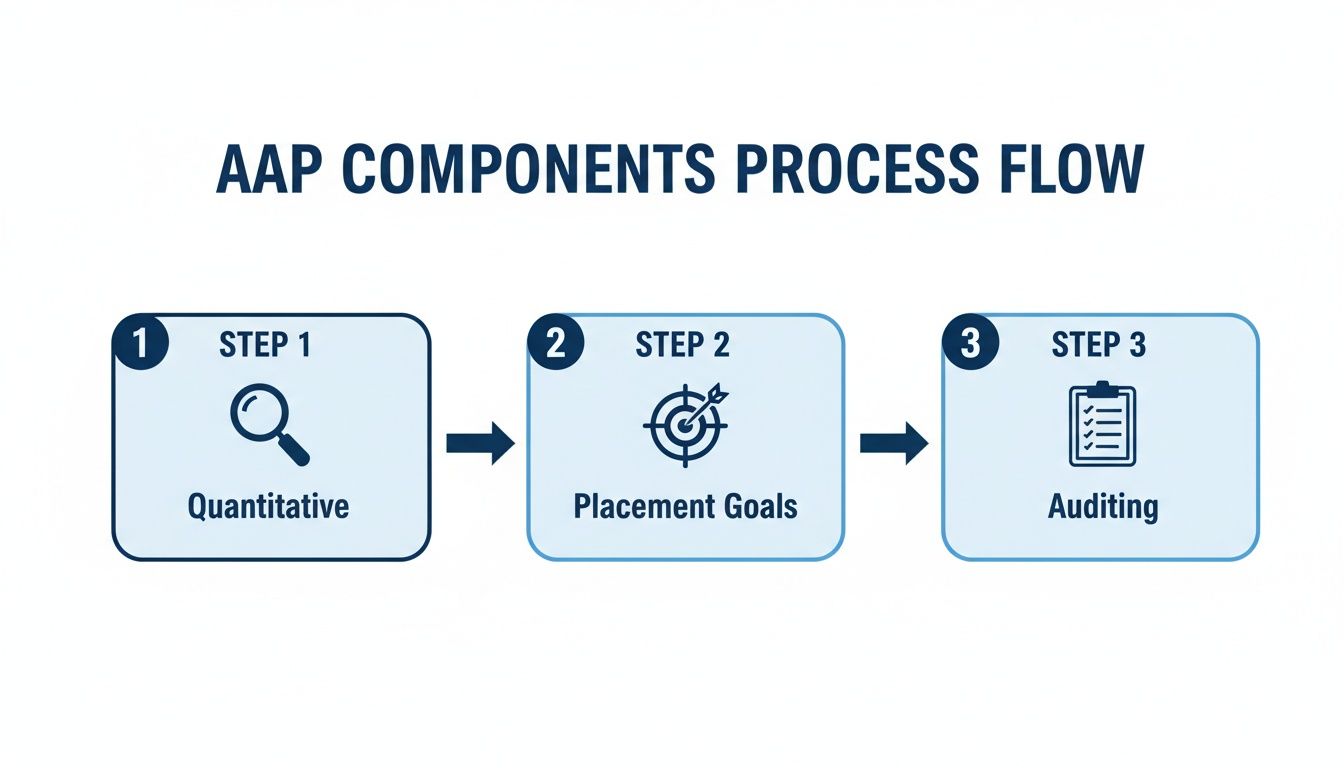
As the visual shows, the data-driven findings from your quantitative analysis directly inform your placement goals. Those goals, in turn, are measured and refined through your ongoing auditing process.
The results of your utilization analysis lead directly to the next phase: translating findings into realistic placement goals. Wherever you found underutilization, you must set percentage-based goals for improving the representation of women or minorities in those specific job groups.
It is absolutely critical to understand that these placement goals are not quotas. A goal is a target to measure the effectiveness of your good-faith efforts. Your company will not be penalized for failing to meet a goal, so long as you can show and document the proactive steps you took to broaden recruitment and encourage a diverse applicant pool.
With goals in place, the real work begins: developing effective, action-oriented programs. These are the tangible steps your company will take to address any underutilization. These programs must be specific and measurable.
Examples of effective action-oriented programs include:
Finally, a plan without clear ownership is just a document. You must assign responsibility for the plan’s implementation and success. This role usually falls to an HR leader or a designated EEO official who champions the plan, monitors progress, and reports results to senior leadership.
Getting your management team on board by communicating the plan’s objectives is also crucial for execution. While developing a compliant AAP involves many technical steps, the process often highlights areas where your overall HR strategy could be improved. You can explore HR risk assessments for managers to see how these concepts connect.
Turning these steps into a cohesive and compliant affirmative action plan is a detailed process. If you need expert guidance to ensure your plan is built correctly, feel free to reach out to our advisory team.
An Affirmative Action Plan is not a one-size-fits-all template. The reality of your business—whether you are spread across multiple states or are a lean small business—will present unique challenges. A truly effective AAP is tailored to these specific operational hurdles, making it both compliant and practical for how your organization works.
If you have teams in different states, for example, a key decision is how to structure your plan. For small and mid-sized businesses (SMBs), the biggest challenge is often managing the data with limited resources. Tackling these distinct situations head-on is the only way to build a sustainable and effective program.
When your company operates in more than one location, you must decide between two primary ways to structure your Affirmative Action Plan. This choice is critical because it dictates how you analyze your workforce and which labor market data you will use.
Picking the right structure is a foundational step to staying compliant across a distributed workforce.
Small and mid-sized businesses that are federal contractors often face a different set of challenges. They might have fewer employees, but their compliance obligations are just as serious. One of the riskiest assumptions is that a smaller headcount means less scrutiny from the OFCCP, which can lead to painful compliance issues.
Many smaller contractors lack the internal resources for heavy-duty data collection and analysis. The job of managing an AAP often lands on an HR generalist who is already juggling other responsibilities. For SMBs, the key is to develop practical, streamlined processes that do not overburden the team. Knowing how to properly document your outreach efforts, for instance, can be just as crucial as the statistical analysis. You might find our guide on handling EEOC complaints and investigations helpful.
The core challenge for any business, regardless of size, is transforming AAP compliance from a reactive task into an integrated part of its HR strategy. Effective planning helps turn this requirement into a valuable tool for organizational insight. To discuss your business's unique needs, we invite you to connect with our team.
Even with the best intentions, building a compliant Affirmative Action Plan is full of details where mistakes can happen. It is easy for well-meaning companies to make errors that undermine the plan’s purpose and expose them to serious compliance risk during an OFCCP audit. Knowing the common traps is the first step toward creating a defensible and impactful program.
Many of the most damaging errors are technical. For instance, incorrectly forming job groups by lumping dissimilar roles together will completely distort your utilization analysis. This foundational error makes every subsequent step, from setting goals to analyzing progress, unreliable.
Another frequent misstep is using outdated availability data. Sourcing the correct, most recent census statistics for your specific labor markets is a non-negotiable requirement. Relying on old data means you're setting inaccurate placement goals, either overstating or understating the actual availability of qualified talent.
One of the most dangerous misunderstandings is treating placement goals like rigid quotas. This mistake can pressure managers into hiring based on demographics instead of qualifications, which is illegal and contrary to the principles of equal opportunity.
A placement goal is an objective to focus your good faith efforts, not a mandate to hire a specific number of people. Your organization is not measured on hitting a numerical target. Instead, it is judged on the quality and consistency of its efforts—such as broadening recruitment outreach or training hiring managers on inclusive interview practices. A key sign of a healthy program is when managers understand their role is to widen the applicant pool, not just "hire to the numbers."
Perhaps the most critical failure is creating a "paper plan" that exists only to check a box. This happens when a company runs the required analyses but fails to implement and document its action-oriented programs. Without tangible efforts to back it up, an AAP is meaningless in the eyes of regulators. An OFCCP auditor looks for proof of your good faith efforts, not just your numbers.
Steering clear of these mistakes requires a proactive and detail-oriented approach. Here are a few key strategies to keep your affirmative action plan compliant and effective:
A successful affirmative action plan turns written commitments into real-world actions. This involves more than just crunching data; it requires consistent effort and rigorous recordkeeping. For a closer look at managing risk through data, you can explore more about HR compliance and risk resources.
Building a defensible program is complex. If you have concerns about your current plan or need guidance on implementing a new one, feel free to connect with our team.
An affirmative action plan is not a document you can file away and forget. Its value and your compliance depend on keeping it alive with continuous maintenance. Treating its upkeep as a core part of your annual HR cycle, rather than a last-minute scramble, is essential.

This proactive approach turns what could be a recurring stressor into a manageable part of your strategy. By staying organized and audit-ready, you can confidently demonstrate your commitment to equal opportunity at a moment's notice.
Every year, your affirmative action plan needs to be completely refreshed. This is more than a quick review; it is a full-scale update using a new 12-month snapshot of your workforce data. This annual cycle ensures your plan stays relevant and accurately reflects your organization's progress and current demographic landscape.
The process involves re-running all the key analyses from your initial plan. You will need to gather fresh data, reassess your job groups, and perform a new utilization analysis. This disciplined annual rhythm is what keeps your program defensible and effective over the long haul. A common mistake is simply rolling over last year's plan; a complete annual rebuild is a fundamental requirement.
Thorough documentation is the bedrock of an audit-ready affirmative action plan. During a compliance evaluation, the OFCCP will scrutinize not just your plan’s statistics but also the proof of your good faith efforts. Meticulous records are your best defense and the clearest evidence of your commitment. You can learn more about building strong documentation practices with this helpful HR audit checklist for SMEs.
Your documentation checklist should include:
Keeping these records organized and accessible is crucial. It demonstrates that your AAP is an active, integrated part of how you do business.
Navigating the annual cycle and maintaining audit-ready files is a detailed process. If ensuring your plan is consistently compliant feels like a challenge, we invite you to connect with our advisory team to learn more about your options.
It is natural for questions to arise when dealing with a subject as detailed as an affirmative action plan. Business owners and HR leaders often encounter the same sticking points regarding definitions, requirements, and what to expect during an audit. Getting these details right is what separates a basic plan from a truly effective and defensible program.
No, and this is the single most important distinction. Placement goals are targets for your good faith efforts to address areas where you have found underrepresentation. A quota, on the other hand, is a rigid and illegal requirement to hire a specific number of people from a certain group, which is not what an AAP does. Federal contractors are never penalized for failing to meet a placement goal, as long as they can show they made genuine, documented efforts.
Your affirmative action plan requires a full update every year. It is a living document, not a one-time project. Each year, you will choose a "plan date" and use a snapshot of your workforce data from that point to analyze the entire 12-month period leading up to it. This annual cycle keeps your plan relevant and ensures it accurately reflects your company's current demographics and progress.
If the OFCCP selects you for a compliance evaluation, you will receive a scheduling letter. This letter will request a copy of your Affirmative Action Plan and its supporting data, typically with a 30-day deadline for submission. The agency will then perform a deep dive into your materials to check for technical compliance. The process can escalate to include requests for more information, employee interviews, and even an on-site review.
This is why having a well-organized, compliant AAP ready to go is so critical. An audit can result in a finding of compliance, a notice of violations to fix, or more serious findings of discrimination that can lead to costly remedies.
Building and maintaining a compliant affirmative action plan requires careful attention to detail and a proactive approach. If you have further questions or need expert guidance on your specific compliance needs, the team at Paradigm is ready to help you navigate these complex regulatory environments. Please contact us to learn how we can help.


