
Choosing a Human Resources Information System (HRIS) is more than a software purchase; it is a foundational investment in your company’s future. For business owners and HR leaders, the goal is to find a platform that not only streamlines daily tasks but also strengthens compliance and supports growth. The best HRIS systems provide a stable framework for your people operations, helping you manage complexity with clarity and confidence.
The right HRIS is a foundational investment in your company’s stability and risk management. The best HRIS systems are not defined by flashy features, but by their ability to create a framework for defensible HR practices. This is especially critical for businesses in regulated industries or those operating across multiple states, where compliance demands are high.
A modern HRIS should be the central hub for all your people operations. It must move beyond a simple digital filing cabinet to become a strategic tool that supports compliance, secures sensitive data, and allows your company to grow without breaking its processes. For business leaders, this means turning HR from a cost center into a function that actively reduces risk and makes everyone’s job easier.
The right platform automates complex tasks, secures employee documentation, and provides the data needed for smart decision-making. These functions are non-negotiable for maintaining control as you scale. In the HR technology market, core functions like payroll and benefits administration are vital for small and mid-sized businesses. You can find more details on how these HR technology trends are shaping business decisions here.

For small and mid-sized businesses, the selection process demands focus. Avoid getting distracted by the system with the longest feature list; instead, find the one that solves your specific operational challenges.
Ultimately, you are looking for a solution that fits your unique operational needs. For specific platforms, it can be helpful to look at specialized partners, like F1group, an official UK partner for the Hubdrive HR solution. This guide provides a structured framework to help you make this important decision, arming you with the right questions to choose a system that truly supports your business goals.
Choosing the right HRIS platform demands a clear, disciplined approach. Before you review vendor demos and feature lists, you must establish your core evaluation criteria. This foundational step ensures your decision is driven by real business needs, especially for companies operating in high-stakes environments with complex compliance obligations.
Defining what truly matters helps translate technical jargon into tangible business outcomes. For instance, instead of asking about "payroll features," a multi-state business should ask how the system automates state-specific tax withholding and manages local labor law nuances. This shift in perspective moves the evaluation from a simple feature comparison to a strategic assessment of risk mitigation.

For any regulated or multi-state SMB, certain HRIS capabilities are not just helpful—they are essential for survival. These non-negotiables form the bedrock of your evaluation and should be prioritized above all else. Without them, even the most user-friendly system can become a source of significant legal and financial exposure.
Start by outlining the absolute must-haves for your organization. This list will become your primary filter, allowing you to quickly disqualify vendors that cannot meet your baseline requirements for security, compliance, and operational integrity.
Your core criteria should include:
Beyond the foundational elements of compliance and payroll, the best HRIS systems bring consistency to your daily operations. Workflow automation and document management are two critical areas that directly impact your efficiency and defensibility. Inconsistent processes, after all, are a leading cause of employment-related errors and legal challenges.
An effective HRIS enforces standardized workflows for key actions like onboarding, performance management, and terminations. This guarantees every manager follows the same approved steps, creating a consistent employee experience and a defensible record of every action taken. A strong HRIS does not just store documents; it creates an organized, searchable, and secure system of record, which is essential for responding to audits or legal inquiries.
Document management is equally important. Look for a system that provides centralized, secure storage for all employee-related documents, from offer letters to disciplinary action forms. The ability to control access, track versions, and set retention policies is crucial for maintaining defensible records and meeting compliance obligations.
Finally, no HRIS operates in a vacuum. Its ability to connect with your existing technology—particularly accounting and benefits platforms—is a key factor in its overall value. Seamless integration eliminates duplicate data entry, reduces the risk of errors, and creates a single source of truth for all people-related data.
Vendor support is the other side of this coin. Before you commit, scrutinize the vendor's Service Level Agreement (SLA). You need to understand their guaranteed uptime, support hours, and typical response times. A great platform with poor support can quickly become a major operational bottleneck. Given the competitiveness of the HR tech market, top vendors often differentiate themselves with superior support. You can explore more insights into the HR technology market.
This table breaks down the key areas to investigate, why they are critical for your business, and the specific questions you should be asking vendors.
Using this framework ensures you move beyond a surface-level feature comparison to conduct a true risk-based assessment of each potential partner. If you need help defining your specific requirements, our team can provide expert guidance. Learn how we can support your high-stakes HR decisions by contacting us today.
Once you have your core requirements defined, it is time to see how potential vendors actually measure up. A slick sales presentation can make any platform look like the perfect solution, but the real test is how it handles your specific, day-to-day tasks. This is where you move beyond marketing hype and start a disciplined, evidence-based analysis to see if a vendor’s product can handle your operational reality.

The goal is simple: systematically score each vendor against the criteria you have already set. A structured approach keeps you from getting distracted by features you do not need and maintains focus on what matters most for compliance and risk management. This means shifting from passively listening in a demo to actively testing the platform’s capabilities.
A standard product demo is built to showcase a platform's best features, not necessarily to solve your unique problems. To get the insights you need, you must take control of the demonstration. Insist that vendors show you exactly how their system handles your most critical and complex workflows.
Do not settle for a generic overview. Instead, provide vendors with a list of specific scenarios you want to see executed live. This approach forces a practical demonstration of the software's functionality, quickly revealing its true usability and its limitations.
Here are a few examples of use cases you should test:
By focusing on these practical tests, you will quickly learn if a system is going to make your life easier or create new bottlenecks. For a deeper dive into what to look for, check out our guide on HR compliance software comparison.
An HRIS must work well with your existing technology, especially your accounting and benefits administration software. A clunky integration leads to manual data entry, which is a time-consuming source of expensive errors. During your evaluation, demand a live demonstration of how the HRIS syncs data with platforms similar to yours.
Equally critical is the vendor’s commitment to support, which is detailed in the Service Level Agreement (SLA). This document is not just a formality; it is a contractual promise of the service you will receive when things go wrong. Do not take a vendor’s claims about support at face value. The SLA is your only binding assurance of uptime and response times, so it is essential to review this document carefully.
Look for specific, measurable commitments in the SLA. An uptime guarantee of 99.9% is the industry standard for reliable cloud-based software. Also, verify the guaranteed response times for critical issues and find out what penalties the vendor faces if they fail to meet those obligations.
The final step is to conduct comprehensive due diligence. This means looking beyond the software itself to assess the vendor’s stability, reputation, and security practices. For a high-stakes decision like an HRIS, arm yourself with a detailed vendor due diligence checklist to vet potential partners.
Start by checking references. Do not just take the list they give you; ask for current clients who mirror your business in size, industry, and complexity. When you speak with them, ask pointed questions about their experience with implementation, data migration, customer support, and any unexpected challenges they encountered.
Finally, verify the vendor's data security certifications. Look for independent audits like SOC 2 Type II, which confirms they have robust controls in place to protect your sensitive employee data. This third-party validation provides an objective measure of their commitment to security.
Choosing the right system is a huge milestone, but the real test of your investment is what comes next. A structured implementation and a thoughtful change management plan are what separate an indispensable tool from an expensive, underused subscription. The goal is not just to install software; it is to weave it into the fabric of your company, making it the undisputed source of truth for all people data.
This is a deliberate, step-by-step process of moving data securely, configuring the system to your real-world needs, and bringing your team along for the ride. Skipping this part is how even the best HRIS platforms fail to deliver on their promise.
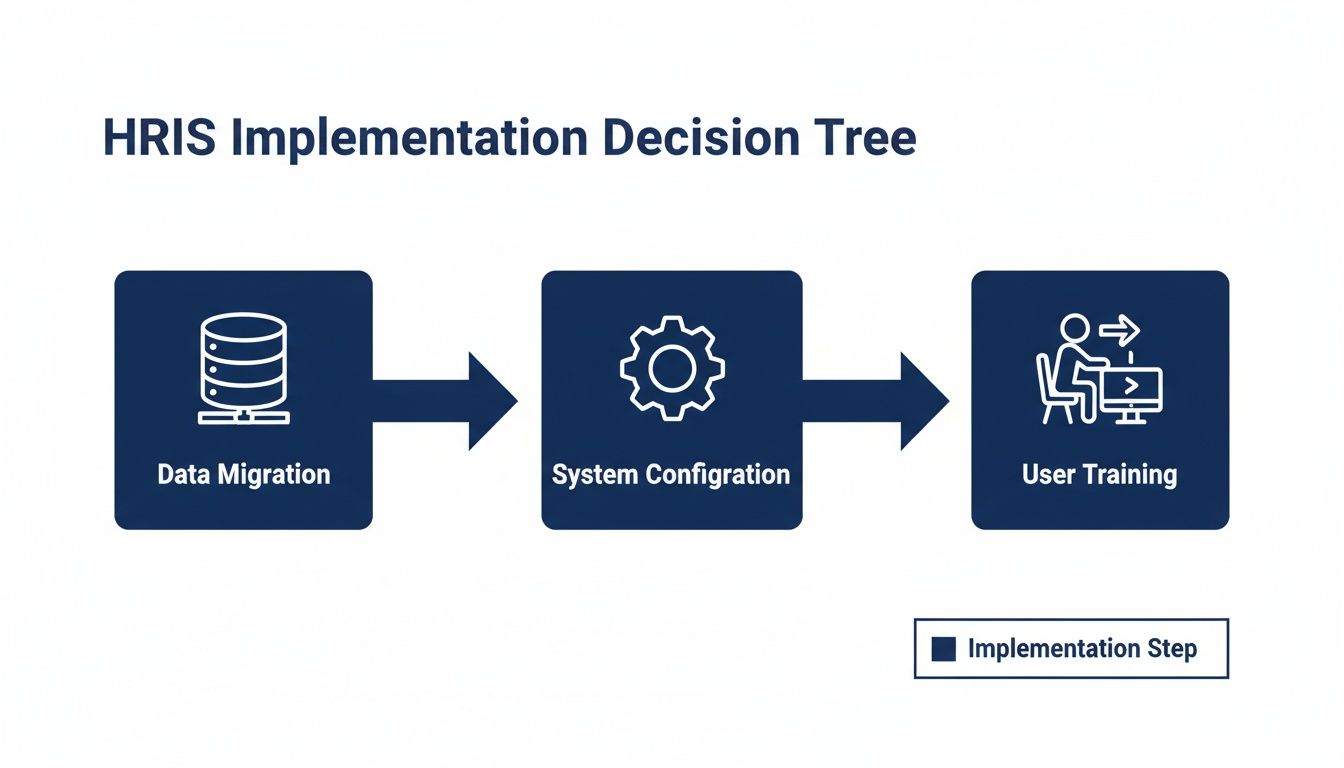
A "big bang" launch, where everything goes live at once, can lead to disruption and overwhelm. A phased rollout is a far more manageable and less risky path forward. This approach means you launch the HRIS module by module or department by department, allowing you to find and fix issues on a much smaller scale.
For instance, you could start with the core HR module for employee data management. Once that is running smoothly, you can roll out payroll and then benefits administration. This staged approach allows your team to build confidence with the new system gradually, creating small wins that build momentum for the rest of the project.
A successful HRIS implementation is less about the technology and more about the people. Poor user adoption is the single biggest threat to your return on investment. To get ahead of this, bring key stakeholders from different departments into the planning process early on. Their feedback is invaluable for spotting potential roadblocks and designing a rollout that works for everyone.
Data migration is one of the most critical stages of the entire project. This is where you move all historical employee data from old systems, like scattered spreadsheets, into your new HRIS. Accuracy here is completely non-negotiable, as even small errors in payroll history or personal details can create significant compliance issues.
Start this process by giving your existing data a thorough cleaning.
Once your data is clean, work closely with your vendor to map the fields from your old system to the new one. After the transfer, run a thorough validation by spot-checking a sample of records to confirm everything is accurate. This methodical process is the foundation for establishing your new HRIS as a reliable system of record. Learn more about system types in our article on custom vs. off-the-shelf HR solutions.
Your change management plan needs to be built around clear communication and comprehensive training. It is not enough for employees to know how to use the new system; they need to understand why the change is happening. Frame the transition around the benefits for them, such as easier access to payslips or streamlined time-off requests.
Create a training plan that is tailored to different user groups. The HR team will need in-depth "super user" training, while managers should focus on workflows like approving time off and completing performance reviews. All other employees can receive practical training on self-service features that will make their work lives easier.
Consistent communication ties this all together. Use all available channels—emails, team meetings, and intranet posts—to share updates on the timeline, announce training sessions, and celebrate milestones. A well-executed change management plan can turn a potentially stressful transition into a positive step forward for the entire company. If you need guidance on structuring your HR processes, our advisory team can help. Reach out to us to learn more.
After sitting through countless demos, how do you objectively compare one HRIS to another? This is where you move from subjective feelings to a data-driven decision. A structured checklist is your best tool for cutting through the marketing noise and focusing on what truly matters for your business.
This is not just a list of features; it is a framework for your internal evaluation or the backbone of a formal Request for Proposal (RFP). It pulls together all the critical pillars we have discussed—compliance, security, and support—into a series of direct questions. Your goal is to get concrete answers and see how each system stacks up against your non-negotiable needs.
First and foremost, the best hris systems must serve as an undisputed system of record and a powerful compliance engine. These questions dig into the platform's ability to handle the challenges of a multi-state or heavily regulated workforce.
Your employee data is one of your most valuable and vulnerable assets. A breach does not just cost money; it destroys trust. These questions are designed to put a vendor’s security claims under a microscope. Security is a foundational requirement, and verifying certifications like SOC 2 Type II gives you objective proof of their commitment to data protection.
For any business operating across state lines, payroll is a minefield of risk. A single mistake in tax withholding or filing can trigger steep penalties. These questions test whether a vendor can truly manage payroll complexity without errors.
An HRIS cannot operate in a silo. It needs to be a well-connected hub in your tech ecosystem. Just as important is the quality of support you will receive when something goes wrong. These questions evaluate both technical flexibility and the reliability of their partnership.
To make this process more concrete, use a scoring system. This simple table helps you quantify how each vendor stacks up against your priorities, making the final decision much clearer.
By the end of this exercise, you will not just have a feeling about which vendor is best—you will have the data to back it up. If you need expert guidance navigating high-stakes HR decisions that go beyond software selection, our advisory team is here to help. To learn how we can support your business, contact us today.
Choosing the right HRIS is a massive step forward, giving you a powerful framework to manage data and automate workflows. It is a strategic move that shores up your company's long-term stability and defensibility. However, technology alone cannot navigate every complex, people-related challenge you will face. An HRIS is an incredible tool, but it is not a substitute for expert human judgment.
Think about the toughest situations that land on your desk—sensitive employee relations conflicts, formal internal investigations, or ensuring your documentation standards will hold up under scrutiny. These are moments where a minor misstep can create significant legal or financial exposure. Your software can store the final write-up, but it cannot ensure the investigation was conducted fairly or that the document itself is defensible.
This is where the value of a trusted advisory partner becomes clear. A good partner does not replace your technology; they make sure the human processes behind it are sound and built to withstand scrutiny. They bring the critical thinking and objective perspective you need when the stakes are highest.
These situations often include:
Ultimately, your goal is to create a defensible HR function where both your technology and your decision-making processes work in sync. That alignment is what truly protects your business as it grows. Choosing one of the best HRIS systems is the first step, but the next is ensuring your leadership team has the expert support needed for the moments software simply cannot solve.
A strong system combined with sound judgment creates a truly resilient organization. If you need a partner for high-stakes people decisions that go beyond your software, our team is here to provide the expert advisory services you need. Contact us to learn more.
Making the final call on an HRIS is a big commitment, and it is normal to have a few lingering questions. Most business leaders wrestle with the same practical concerns right before they sign a contract. This section is designed to tackle those common last-minute questions, providing clear, straightforward advice so you can move forward with confidence.
For most small to mid-sized businesses, a standard HRIS implementation will take between 4 to 12 weeks. However, that timeline can shift based on a few factors unique to your company. The biggest variable is almost always payroll complexity. If you are running payroll across multiple states with different tax laws, the setup and testing phase will naturally take more time.
Other critical factors that can extend the timeline include:
To make the process more manageable, a phased rollout is almost always recommended. Launching modules one by one is a much smoother approach.
While the monthly subscription fee is usually front and center, other costs can appear later if you are not paying close attention. Knowing what to look for is key to building an accurate budget. Always insist on a complete, transparent pricing schedule upfront that breaks down every potential charge.
One of the most common hidden costs is for implementation and data migration services. Some vendors charge a hefty one-time fee for this work, and it is not always included in the initial quote. Always get it in writing whether these services are included or billed separately.
Other common hidden costs to watch for include:
Yes, an HRIS can automate many routine parts of multi-state compliance, which is one of its greatest strengths. For instance, it can automatically calculate the correct tax withholdings for employees across different states and keep minimum wage rates updated. This automation is a game-changer for reducing the risk of human error on repetitive tasks.
However, an HRIS is a powerful tool, not a substitute for human oversight. It excels at handling the "what" (like calculating a tax rate), but it cannot always manage the "how" (interpreting a nuanced local ordinance). Things like state-specific paid sick leave rules or meal break requirements often require careful, expert configuration to ensure the system aligns with complex laws.
So, while an HRIS automates a massive chunk of the administrative burden, human expertise remains essential to ensure your company is truly compliant.
Choosing one of the best HRIS systems is the first step, but ensuring your processes and high-stakes decisions are defensible requires expert guidance. The team at Paradigm International Inc. can provide the advisory support you need. To learn how we partner with leaders to protect their businesses, contact us today.