If you run a multi-state business, California is where “we’ve always done it this way” turns into payroll exposure rapidly. A title, a salary, and a manager’s assumption won’t protect you there. If your team has even one California employee in a salaried role, you need a classification system that can survive scrutiny, not just a payroll setting that feels convenient.
Most guides on california labor laws for salaried employees stop at listing rules. That’s not enough for a COO or HR leader making risk decisions. You need a framework for deciding who qualifies, where the exposure sits, and what documentation makes your position defensible if someone challenges it later.
The most expensive assumption I see is this: “We pay them a salary, so they’re exempt.” In California, that logic fails.
California treats exemption as something the employer must prove. It isn’t automatic, and it doesn’t travel well from other states. A classification that passes internal review in a lower-regulation state can fall apart the moment the same role is placed in California.

The problem often starts with standardization. A company creates one national job architecture, one offer letter template, and one compensation philosophy. That sounds efficient until California forces you to separate “salaried” from “exempt.”
As of January 1, 2026, California exempt salaried employees must earn at least $70,304 annually, which is based on twice the state minimum wage of $16.90 per hour for full-time work, according to Timeero’s summary of California salaried employee rules. That same source notes the federal Fair Labor Standards Act minimum is $684 per week, or $35,568 annually, which shows how far California has moved beyond the federal floor.
That gap changes business decisions. An employee who appears safely exempt under federal standards may be non-exempt in California the moment their salary falls below the state threshold or their duties don’t qualify.
Practical rule: If your classification process starts with pay method instead of legal tests, your process is already weak.
Treat California as its own wage-and-hour environment. Don’t force national templates onto California roles and hope they hold.
A smarter operating stance looks like this:
The strategic issue isn’t just compliance. It’s predictability. If you don’t know which salaried employees are exempt under California law, you can’t budget labor accurately, price services effectively, or assess litigation risk with confidence.
California forces discipline. That’s inconvenient, but it’s also useful. It pushes leadership teams to define roles clearly, align pay with legal standards, and document decisions before a dispute starts.
That mindset matters because california labor laws for salaried employees are built around proof. You either have a supportable classification decision, or you have exposure.
California’s exemption analysis has two gates, and you must clear both. Miss one, and the employee is non-exempt.
That’s the right mental model. Not “mostly exempt.” Not “exempt because they’re well paid.” Not “exempt because they’re trusted.” Two legal tests. Both matter.

The first gate is pay. But even this part gets oversimplified.
California’s exemption framework requires a qualifying salary threshold and a true salary basis. That means fixed, predetermined pay. The employee can’t be treated like an hourly worker in disguise.
The salary basis test is where many otherwise careful companies create avoidable risk. They dock exempt employees for partial-day absences, reduce pay based on output, or make inconsistent deductions that undermine the exemption structure itself.
A clean salary number won’t save a messy pay practice.
For internal planning, I recommend pressure-testing exempt salaries before the requisition opens. If you’re validating compensation bands, a market tool like this salary calculator can help with pay planning, but market alignment is separate from legal compliance. California requires both sound compensation design and a compliant exemption analysis.
The second gate is where most classification decisions win or lose. The employee must perform duties that fit an exempt category, and the job performed matters more than the job title.
Leadership teams need discipline here. Offer letters often describe a strategic role. Calendars, Slack messages, and task lists often reveal a hands-on coordinator doing routine production work.
A useful way to test this is simple. Ask what the employee spends most of their time doing. If the answer is frontline execution, customer response, scheduling, data entry, processing transactions, or following defined workflows, exemption may be difficult to defend.
If you need a deeper benchmark for role analysis, the guide on the duties test for exempt employees is a practical reference point for reviewing actual responsibilities against classification standards.
Don’t evaluate exemption as a compensation question. Evaluate it as an operational design question.
Use this sequence:
I see the same weak points repeatedly:
The lesson is straightforward. If you can’t explain both parts of the exemption test in plain English for a specific employee, you probably shouldn’t be treating that employee as exempt.
The duties test becomes manageable once you stop treating it like abstract legal language and start evaluating jobs the way work happens. Most salaried exemption questions in California fall into three white-collar categories: executive, administrative, and professional.
The mistake is assuming these categories are broad. They aren’t. California applies them narrowly, and borderline roles are where employers get burned.
| Exemption Category | Primary Duty Requirement (Must be >50% of time) | Key Disqualifying Factor |
|---|---|---|
| Executive | Managing the enterprise or a department, directing the work of others, and exercising meaningful supervisory authority | Spending most time doing the same frontline work as the team |
| Administrative | Office or non-manual work tied to business operations, with real discretion and independent judgment | Routine clerical, processing, or rules-based support work |
| Professional | Work requiring advanced knowledge in a recognized field, specialized expertise, or qualifying creative or technical professional duties | Work that is primarily standardized, routine, or heavily scripted |
A true executive manages people and operations. That usually means directing work, making staffing decisions, assigning priorities, and having real input into hiring, firing, or discipline.
A common failure point is the “working manager” in a lean business. If your store manager, clinic lead, or office manager spends most of the day covering shifts, answering phones, handling transactions, or performing the same production tasks as the team, the executive label may not hold.
This is especially important in founder-led and private equity-backed businesses. Lean staffing models often push managers back into frontline execution. Once that becomes the primary reality of the job, the exemption gets harder to defend.
If the business depends on the manager doing the team’s work most of the week, don’t assume you have an exempt executive.
This category is frequently misunderstood. “Administrative” in common business language does not equal “administrative exempt” in California law.
An exempt administrative employee typically supports business operations at a higher level and exercises discretion and independent judgment. That means they aren’t just following procedures, they evaluate options, make decisions on matters that affect the business, and operate with meaningful autonomy.
Examples that often fail this test include coordinators, assistants, schedulers, processors, and support staff whose work is important but highly structured. Important work is not the same as exempt work.
Use a few hard questions:
If the answers lean toward routine support, you may have a non-exempt role dressed up in a polished title.
Professional roles usually involve advanced knowledge, specialized education, recognized expertise, or qualifying creative work. In practice, this category is often easier to understand than the administrative exemption, but leaders still over-apply it.
The strongest candidates are roles where the business hires judgment, not just labor. The employee is expected to apply learned expertise, not follow established methods.
Still, watch for title inflation here too. Calling someone an analyst, specialist, designer, or consultant doesn’t make the role exempt. The actual work must reflect professional-level judgment and specialized function on a sustained basis.
Don’t ask, “Which exemption sounds closest?” Ask, “What would an outsider conclude from observing this role for two weeks?”
That question usually exposes the gap between job description and lived reality.
For california labor laws for salaried employees, the practical review standard should include:
Here, disciplined companies separate themselves from exposed ones. They don’t classify based on aspiration. They classify based on evidence.
Misclassification is rarely a one-issue problem. Once a California salaried employee is wrongly treated as exempt, the exposure usually spreads across overtime, breaks, wage statements, final pay, and representative claims. A payroll shortcut can become a litigation file.
For multi-state SMBs, that risk is more dangerous because leadership often assumes California will behave like the rest of the footprint. It won’t.
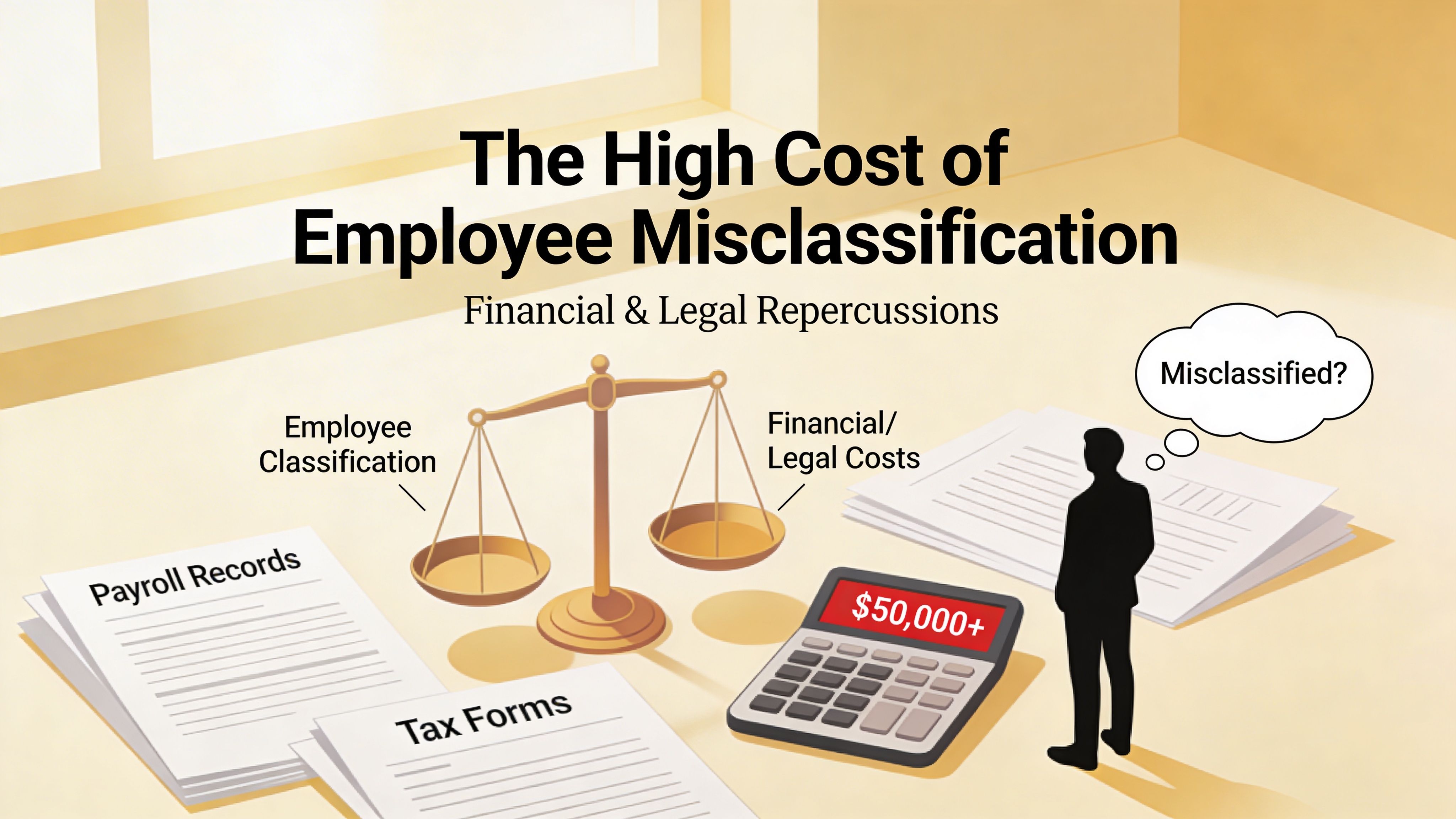
One bad classification decision can trigger retroactive overtime analysis. If the employee also missed compliant meal or rest opportunities, the claim expands. If the final paycheck was handled incorrectly at separation, the exposure grows again.
A significant problem is compounding liability. By the time counsel or an agency reviews the file, the issue usually isn’t just “exempt or non-exempt.” It’s whether the company’s entire wage-and-hour process can be trusted.
According to Eldessouky Law’s discussion of California salaried employee rules, the salary basis test requires fixed pay without deductions for quality or quantity of work or partial-day absences, and even one improper deduction can risk exemption loss for the year if it reflects an actual practice. The same source notes that paying a $65,000 “manager” in California can trigger DLSE audits averaging $50K+ settlements per misclassified employee, alongside a 15% wage claim uptick benchmarked to 2024 DIR data.
That should reset how you think about labor classification. This isn’t paperwork risk. It’s operating risk.
California creates an advantage for plaintiffs. One employee’s complaint can lead to review of similar roles, common policies, and standardized pay practices.
That’s why I advise COOs to stop thinking in terms of “isolated exceptions.” If five people share the same title, compensation structure, and manager, a challenge involving one of them can pull the other four into the same review.
A useful risk lens is this:
System errors are where claims get expensive because they’re easier to scale.
California also raises the stakes through representative actions under PAGA. You don’t need a broad operational collapse to face a serious claim. A narrow wage-and-hour problem can widen quickly if the same practice affected multiple employees.
That changes the right response. Don’t wait for a complaint before auditing. By then, the record already exists.
The costliest wage-and-hour problems usually weren’t hidden; the company just normalized them.
If you’re assessing downside in a disputed classification, this overview of employee misclassification penalties is a useful internal briefing tool for leadership.
Exposed employers rely on assumptions. Defensible employers rely on evidence.
That means:
If you operate in California, misclassification belongs on your risk register. It sits closer to payroll liability and legal exposure than to ordinary HR administration.
Some California employers know a role doesn’t qualify as exempt, but they still want the predictability of a salary. That’s allowed. The mistake is thinking the salary replaces overtime rules.
It doesn’t. A salaried non-exempt employee is still non-exempt.
California requires overtime pay for non-exempt salaried employees based on their regular rate. According to this California labor law attorney overview of salaried employees, non-exempt salaried employees are entitled to overtime at 1.5 times their regular rate for hours worked beyond 8 in a day or 40 in a week, and hours beyond 12 in a day trigger double-time. Those protections apply even when the employee receives a fixed salary.
This is one of the clearest examples of why california labor laws for salaried employees trip up out-of-state operators. In many businesses, “salary” has become shorthand for “not tracking hours closely.” In California, that’s a direct path to payroll error.
You don’t need a complicated formula to understand the principle. You need a disciplined payroll process.
Start with the salary and the employee’s defined work expectation. California requires employers to specify expected weekly hours for non-exempt salaried workers. From there, determine the regular rate and calculate any overtime owed based on actual hours worked.
The operating rules should be simple:
It looks administratively clean. That’s why companies like it. A fixed salary is easy to budget and easy to explain.
But operational ease creates false confidence. Managers stop monitoring hours, employees work through meals, and payroll treats the salary as all-inclusive even when the law doesn’t allow that shortcut.
A salaried non-exempt role only works if your timekeeping discipline is stronger, not looser.
If your team needs a practical refresher on the distinction, the guide to exempt vs. nonexempt is a useful baseline for manager and HR alignment.
Use salaried non-exempt status only when you can support it with process. That means reliable time entry, trained managers, and payroll that understands California premium pay logic.
For SMBs, my recommendation is blunt. If you can’t confidently capture actual working time and meal-period compliance, don’t use salaried non-exempt arrangements without due consideration. You’re adding complexity without enough control.
The salary may help with budgeting. It won’t shield you from overtime obligations, and it won’t help if your records are weak.
The right response to California risk is structure. Not panic. Not generic HR clean-up. Structure.
Most classification problems start long before a claim. They begin in recruiting, compensation planning, sloppy job descriptions, untrained managers, and payroll practices that were never built for California. A defensible framework fixes those points before they connect into liability.

Use this as an operating review, not a one-time legal exercise.
A defensible process produces evidence. If a regulator, attorney, or former employee asks why someone was classified a certain way, your team should be able to show more than opinion.
That record should include:
This is one place where outside review can be useful. For multi-state SMBs that need a structured advisory process, tools and advisors may include employment counsel, payroll specialists, and specialized compliance firms, which support leadership teams on HR risk, documentation standards, and multi-state compliance decisions.
Ask one question for every salaried California role: if this classification is challenged next quarter, what evidence will we have?
If the answer is “a title, a salary, and a general belief that the employee is senior,” your system isn’t ready.
If the answer is “documented duties, compliant pay structure, trained managers, tracked hours where required, and current records,” you’re operating like a business that understands risk.
California doesn’t reward assumptions. It rewards preparation.
California’s rules don’t need to slow your growth, but they do require more disciplined decisions than many SMBs are used to making. If your leadership team needs a clearer framework for classification, payroll risk, and defensible HR practices in California, a specialized compliance firm like this one can help you evaluate the exposure and put a more reliable structure in place.