Yes, you can generally require nonexempt employees to clock out for a bona fide 30-minute duty-free meal period, but you must pay them if they aren't fully relieved of duty, and state laws may add stricter timing and penalty rules. The clock-out entry alone doesn't make lunch unpaid.
A growing business often discovers the problem after expanding into another state. One manager tells employees to clock out at noon, another lets them eat at their desks while monitoring messages, and payroll assumes both practices produce the same unpaid meal period. They don't.
The question “can I require employees to clock out for lunch” has a straightforward federal answer, but a defensible business answer requires more. You need to distinguish nonexempt and exempt employees, confirm each state's timing rules, define what “duty-free” means, and create a reliable process for interrupted or missed meals.
That distinction matters because wage-and-hour rules focus on actual work performed, not merely what appears on a timecard. A policy that looks compliant can still create back-pay, premium-pay, retaliation, and recordkeeping exposure if supervisors expect employees to remain available.
A company with employees in California, Minnesota, and Washington may use one payroll system, one handbook, and one standard lunch schedule. That approach is efficient until a manager requires an employee to answer a customer call during an unpaid lunch or schedules the meal period too late under state law.
Federal law generally permits an employer to require a clock-out for a legitimate unpaid meal period. The employee must be completely relieved of duty, and the meal period must generally last at least 30 uninterrupted minutes to qualify as unpaid under the federal baseline. If the employee works, answers calls, monitors equipment, or performs another job duty, the employer must treat that time as compensable work time under the applicable rules. The U.S. Department of Labor's break guidance provides the federal framework for this distinction.
The operational mistake is treating the punch as the legal test. It isn't. A clock-out records what the employer expects to happen, but it doesn't erase work that occurred.
Executive answer: Require clock-outs only when the employee has a real, uninterrupted meal period and a clear way to report exceptions.
For a single-state employer, the federal baseline may provide a workable starting point. For a multi-state operator, it's only the floor. State requirements can control when a meal must begin, how long it must last, whether additional rest periods apply, and what remedies follow when the employer misses the rule.
This guide gives owners, COOs, and HR leaders a practical standard: build a lunch policy around duty-free time, accurate records, state-specific timing, and manager accountability. That approach is more defensible than relying on a uniform clock-out instruction.
The federal rule is narrower than many employers assume. Under U.S. federal wage-and-hour rules, employers aren't required to provide lunch or coffee breaks at all. Once an employer offers breaks, however, the law distinguishes between short rest periods and bona fide meal periods.
Short breaks of about 5 to 20 minutes are generally compensable work time, while a bona fide meal period of at least 30 minutes generally isn't work time when the employee is completely relieved of duty. These principles are summarized in the Department of Labor's federal break rules.
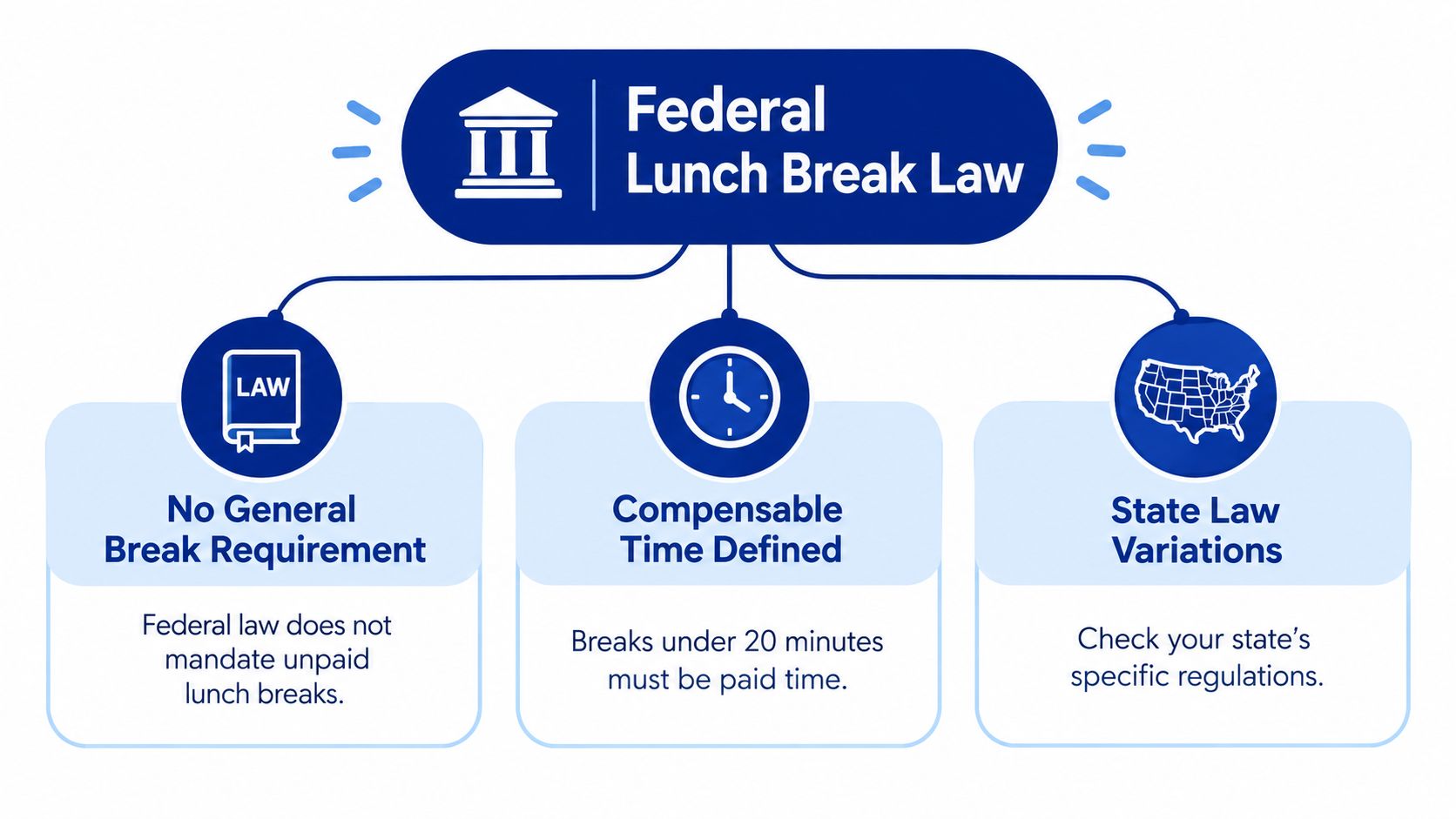
Think of the distinction as a transfer of control. During a short rest break, the employee remains within the workday and the employer generally pays for the time. During an unpaid meal period, the employee must be able to step away from work responsibilities and use the time for personal needs.
A clock-out is appropriate only for the second situation. If an employee eats lunch while answering customer messages, remains responsible for incoming calls, watches a production line, or handles a delivery issue, the employer hasn't created a clean duty-free meal period.
Managers often create liability without intending to. They may say, “Clock out, but keep your phone nearby,” or “You can eat while you monitor the front desk.” Those instructions undermine the unpaid classification because the employee remains responsible for business activity.
The Department of Labor also recognizes that an unauthorized extension of an authorized break need not be counted as hours worked when the employer clearly communicates the time limit and explains that violations will be disciplined. That requires more than a vague handbook sentence. Employees need a communicated limit, supervisors need consistent enforcement, and the company must still pay for time employees work.
A sound federal policy should therefore state that:
Federal law doesn't require a time clock if the employer maintains accurate records of actual hours worked. The legal question is whether the record reflects reality.
The lunch clock-out question matters most for nonexempt employees. These employees are generally paid for all hours worked, so the employer must capture working time accurately and must not classify active work as an unpaid meal period.
Exempt employees are usually salaried and aren't managed through lunch punches for overtime accounting in the same way. That doesn't mean managers can ignore workload, meal access, or applicable state requirements. It means the organization should avoid applying an hourly timekeeping model to every employee without considering classification.
The practical differences look like this:
| Employee classification | Primary lunch concern | Recommended management approach |
|---|---|---|
| Exempt | Avoid treating salary status as permission to impose inappropriate deductions or ignore state obligations | Manage outcomes, workload, and policy expectations without unnecessary lunch punches |
| Nonexempt | Capture every hour worked and correctly identify unpaid duty-free meals | Require accurate punches and a documented exception process |
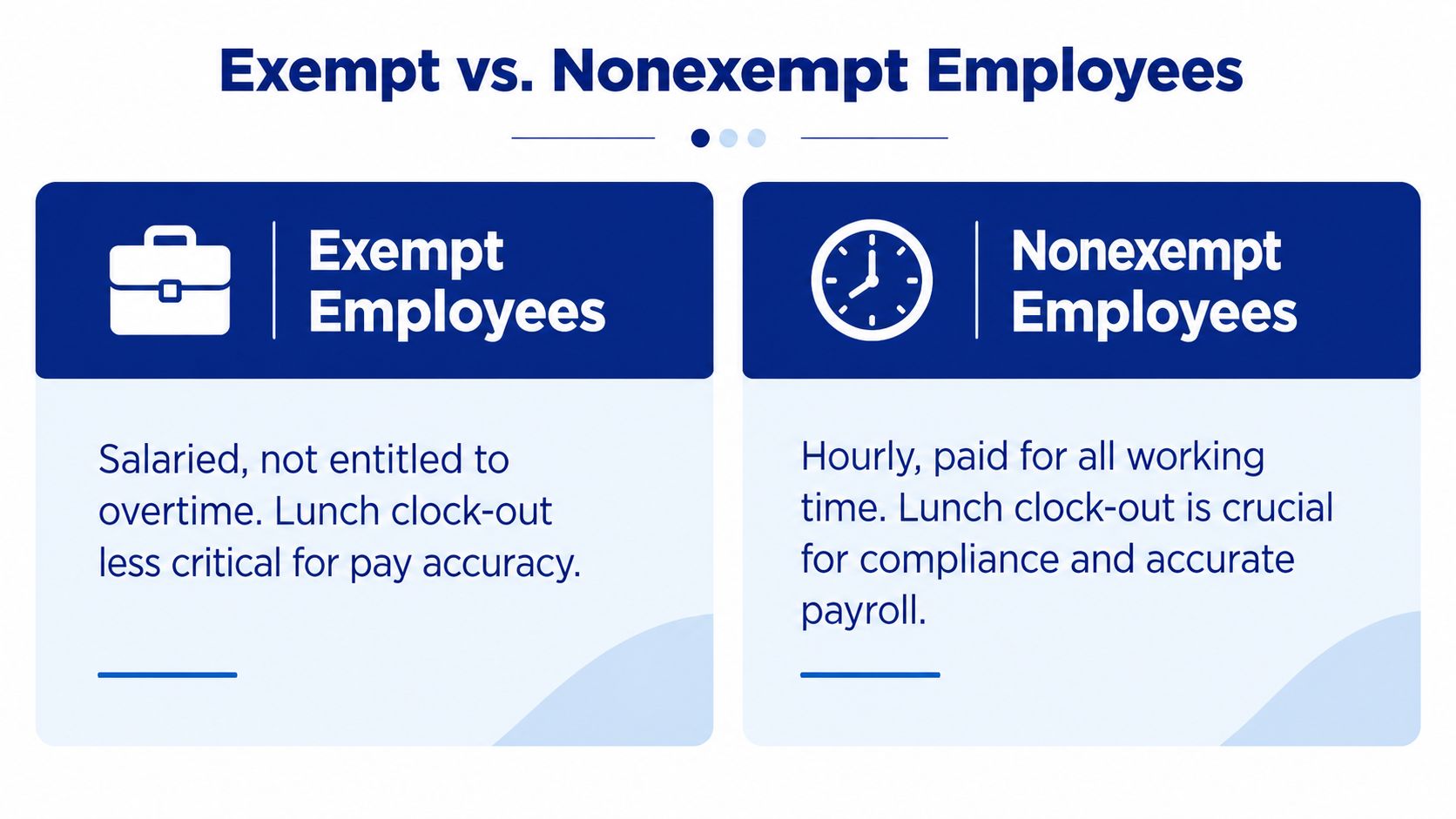
A nonexempt employee may need to clock out and back in for an unpaid meal period. An exempt employee typically shouldn't be required to punch out because the company wants identical records across the workforce. Applying one rigid process can create inaccurate records, unnecessary administrative work, and confusion about whether the employer is treating exempt employees like hourly workers.
Classification also affects manager instructions. A supervisor should never tell a nonexempt employee that working through lunch is acceptable because “you're already on salary,” nor should payroll assume a missed punch means the employee took the full meal period. The employee's actual classification and actual work activity control the response.
Review the distinctions before rewriting the policy with the Paradigm International employee class guide. Then separate the policy language by classification where the obligations differ.
For nonexempt workers, the policy should explain:
For exempt workers, focus on professional expectations, workload planning, and compliance with any applicable state requirements. Don't use a clock-out rule as a substitute for accurate classification analysis.
Federal law sets a baseline, but state and local rules can require specific meal timing, duration, paid rest periods, and remedies for missed or late breaks. A business can therefore comply with the federal rule and still operate an unlawful lunch process in a particular jurisdiction.
Recent 2026 materials illustrate the divergence. California requires a 30-minute meal break before the end of the fifth hour, Minnesota requires a 30-minute meal break after six consecutive hours, and Washington and Seattle materials emphasize mandatory meal and rest-period rules with wage-theft remedies. The state meal-break comparison highlights why a single national policy needs careful review.
| Jurisdiction | Meal Break Trigger | Timing and Key Requirement |
|---|---|---|
| California | More than 5 hours in a day | A 30-minute meal period before the end of the fifth hour. A second 30-minute meal period applies when the employee works more than 10 hours, subject to the statutory waiver conditions. |
| Minnesota | 6 or more consecutive hours | A 30-minute meal break after six consecutive hours under the stated state requirement. |
| Washington and Seattle | State and local rules apply | Mandatory meal and rest-period requirements can carry wage-theft remedies, so location-specific review is necessary. |
California provides the clearest example of why timing matters. Labor Code section 512 requires a meal period of at least 30 minutes when an employee works more than five hours in a day. The first meal period may be waived by mutual consent when the total work period is no more than six hours. A second 30-minute meal period is required when the employee works more than 10 hours, with waiver allowed only when the total hours worked are no more than 12 and the first meal period wasn't waived. See California Labor Code section 512.
California also ties unpaid status to duty-free time. The state's rest and meal period guidance explains that a meal period doesn't need to be paid only when the employee is relieved of duty. An employee who must answer calls, monitor equipment, or stay on duty may have performed compensable work.
That makes standardization a leadership decision, not merely a payroll setting. You can standardize the core principles, such as accurate punches and reporting interrupted meals, but you may need jurisdiction-specific schedules, waiver rules, and manager instructions. A useful review should also consider local requirements, employee age, industry, worksite staffing, and collective bargaining obligations where applicable.
Before issuing a nationwide policy, coordinate the meal rules with broader efforts to navigate leave compliance. Breaks, leave, scheduling, and attendance practices often intersect in the employee handbook and payroll process.
A defensible policy doesn't say only, “Employees must clock out for lunch.” It defines the conditions that make the clock-out accurate and gives employees a practical way to correct the record.
Start with the duty-free standard. Under the federal baseline, a bona fide meal period generally lasts at least 30 minutes, and the employee must be completely relieved of duty. The policy should identify prohibited expectations, including answering routine calls, monitoring business systems, responding to messages, or performing tasks during the meal.
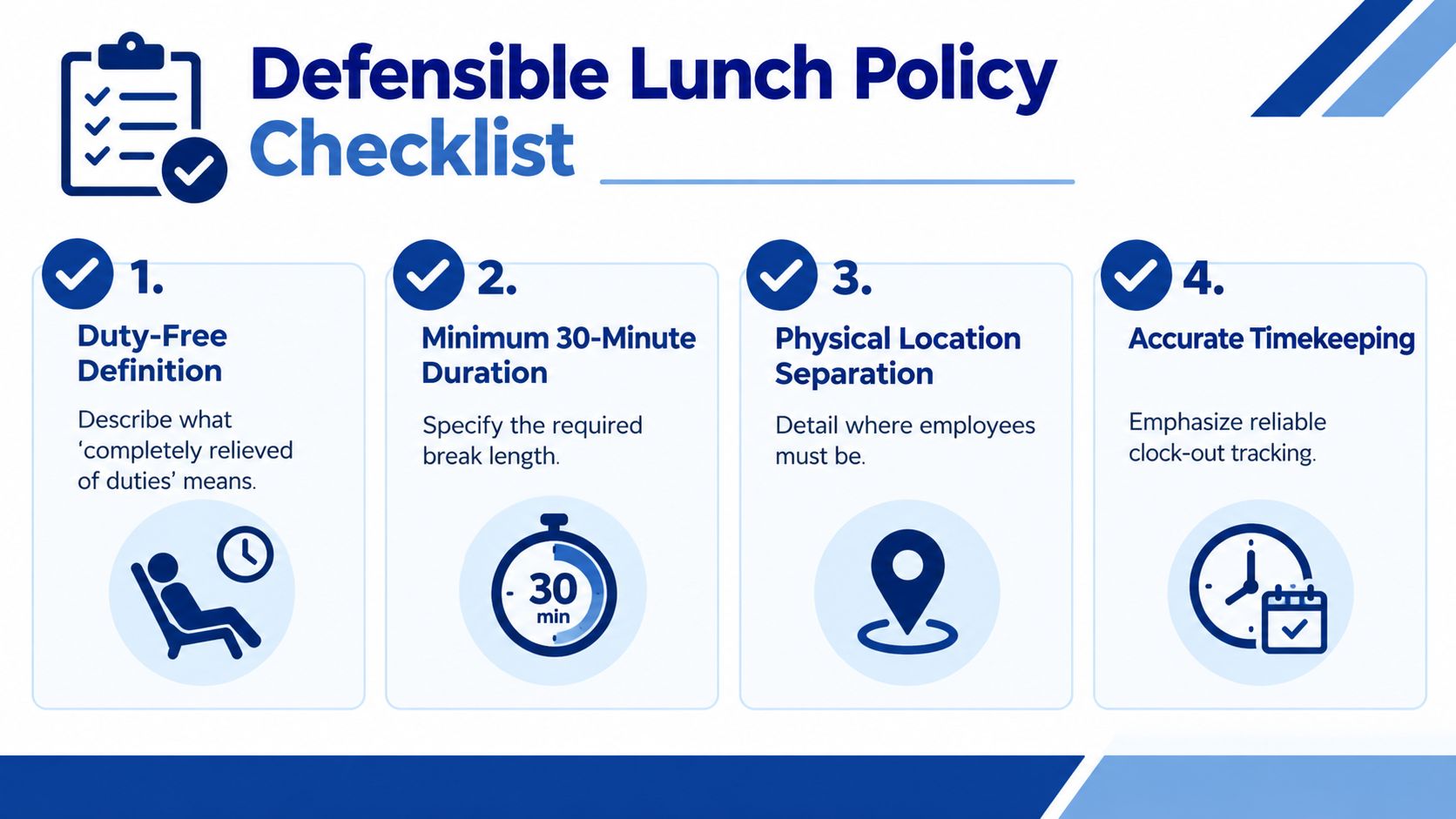
Use direct language that managers can apply without interpretation. A policy can communicate these concepts:
Policy principle: A meal punch records the intended break. The employee's report controls when work interrupted that break.
Time clocks aren't legally required if the employer accurately records actual hours worked, including work performed during lunch, as explained in the Department of Labor recordkeeping guidance. A digital clock can improve consistency, but it can't replace supervisor oversight or employee reporting.
The exception workflow should be simple enough that employees will use it. Let an employee select a reason such as “worked during meal,” “called back early,” or “could not take meal,” then route the entry to a supervisor and payroll reviewer.
Train supervisors on four nonnegotiable behaviors:
Review how the timekeeping process connects with broader payroll controls, from timekeeping to tax filing. The objective isn't a prettier timecard. It's a reliable record that payroll can use to pay employees correctly and preserve an audit trail.
Finally, test the policy against real scenarios. Ask what happens when a customer calls, a shift is understaffed, an employee forgets to punch back in, or a manager changes the schedule. If the answer depends on informal judgment, the process isn't ready.
Unpaid lunch errors become expensive because employers often repeat the same mistake across many employees and workdays. The Department of Labor's recordkeeping guidance gives a concrete illustration: if a 30-minute lunch is misclassified for 10 employees over 250 workdays, the result is 1,250 hours of potentially unpaid time in one year. That calculation appears in the Department of Labor's enforcement material.
The risk doesn't depend on an employee working an entire lunch. A short call, message, handoff, or early return can make the recorded unpaid period inaccurate. Payroll may then understate hours, overtime calculations may be affected, and the company may face back-pay or state-specific remedies depending on the jurisdiction.
An internal review should look beyond missing punches. The most revealing evidence often appears in the gap between written policy and daily operations.
California creates a particularly important state-level exposure because an unpaid meal period must be duty-free under the state guidance. An employer that requires a clock-out but continues assigning responsibilities may have a compensation problem, not merely a scheduling problem.
Leaders should also distinguish a policy violation from unpaid work. If an employee extends an authorized break without permission, the company can address the conduct when the time limit and consequences were clearly communicated. But the employer still must pay for work the employee performed, and discipline cannot be used to conceal compensable time.
The practical defense is consistent documentation. Preserve the policy version, training records, timecard corrections, employee reports, manager responses, and payroll adjustments. Those records help demonstrate that the company identified exceptions, paid working time, and addressed operational causes instead of relying on automatic deductions.
A lunch clock-out policy becomes defensible when the company can show that employees received a real opportunity to take an uninterrupted meal and that payroll corrected the record when work occurred.
Use a short implementation checklist:
Discipline should address unauthorized break extensions consistently, but it must never punish an employee for reporting compensable work. Payroll should correct the time first, then management can address conduct separately when the facts support it.
Review the policy whenever the company enters a new state, changes scheduling practices, adopts a new timekeeping system, or receives a complaint. A periodic review is more manageable than reconstructing years of lunch records after an audit.
If your current policy says only “clock out for lunch,” revise it. Define the duty-free standard, create an exception workflow, train supervisors, and test the process against actual worksite conditions.
Paradigm International Inc. advises owners, COOs, and HR leaders on multi-state employment compliance, documentation, manager conduct, and defensible workplace practices. For help reviewing your lunch clock-out policy and aligning it with timekeeping and state requirements, visit Paradigm International Inc. to discuss the next practical step.