
A familiar moment hits many growing businesses at once. A new HR system is going live, managers in different states need to follow the same process, a policy has to change, and leadership wants it done quickly. What looked like a routine operational upgrade suddenly carries legal, payroll, morale, and documentation risk.
That's where many organizations get exposed. They treat change as an announcement instead of a managed process. In practice, change management in HR is less about corporate messaging and more about moving people, managers, and documentation from one defensible state to another without creating preventable problems.
A foundational statistic in change management reveals that 70% of change initiatives fail to achieve their goals, often because of weak change practices, employee resistance, and lack of management support, according to the UC Berkeley-linked change management statistics summary. For an SMB, that kind of failure doesn't just mean inconvenience. It can mean inconsistent discipline, uneven policy enforcement, payroll confusion, manager improvisation, and avoidable employment claims.
A useful way to think about it is a ship moving through bad weather. The storm is the business change itself. HR's role is navigation. You need a route, a chain of command, clear signals, and a way to adjust when conditions change. Without that structure, people start making local decisions that feel reasonable in the moment and become expensive later.
That's why a written communications sequence matters before launch. If you're updating how information moves through the organization, a practical internal communications plan gives leaders a better starting point than a last-minute email and a manager talking points sheet.
Most business owners don't wake up thinking they need a change management framework. They wake up knowing the business has outgrown informal habits. Hiring now spans multiple states. A manager who used to handle issues by instinct now needs documented guidance. A software rollout affects payroll, scheduling, and employee records all at once.
That shift changes HR's job. HR isn't just helping people adjust. HR is reducing the chance that a business objective gets lost between leadership intent and front-line execution.
At its best, change management in HR creates order before confusion spreads. It answers practical questions such as:
Practical rule: If a change affects policy, pay, discipline, leave, scheduling, performance, or terminations, it needs more than enthusiasm. It needs governance.
A lot of generic advice treats change as a motivation problem. In small and mid-sized businesses, it's usually a coordination problem first. People aren't resisting because they dislike progress. Often, they're responding to vague expectations, conflicting manager instructions, or legal uncertainty that leadership didn't account for at the start.
The operational cost of poor execution is obvious. Projects drag. Managers ask for exceptions. Employees interpret silence as unfairness or instability. But the larger issue is defensibility. If the business can't show a rational process, a consistent communication path, and role-based decision-making, the change becomes harder to defend when challenged.
That's why HR-led change work belongs close to the leadership table. It isn't administrative cleanup. It's part of responsible growth.
Change management in HR is the structured process of moving the workforce from a current operating model to a new one with as little disruption, inconsistency, and exposure as possible. It covers communication, manager readiness, training, policy alignment, workflow redesign, and decision records.
Think of it like an architect's blueprint. Construction crews can't safely improvise a commercial building from a rough sketch. In the same way, leaders shouldn't ask managers to implement a new policy, technology, reporting line, or performance process without a clear people-side plan.
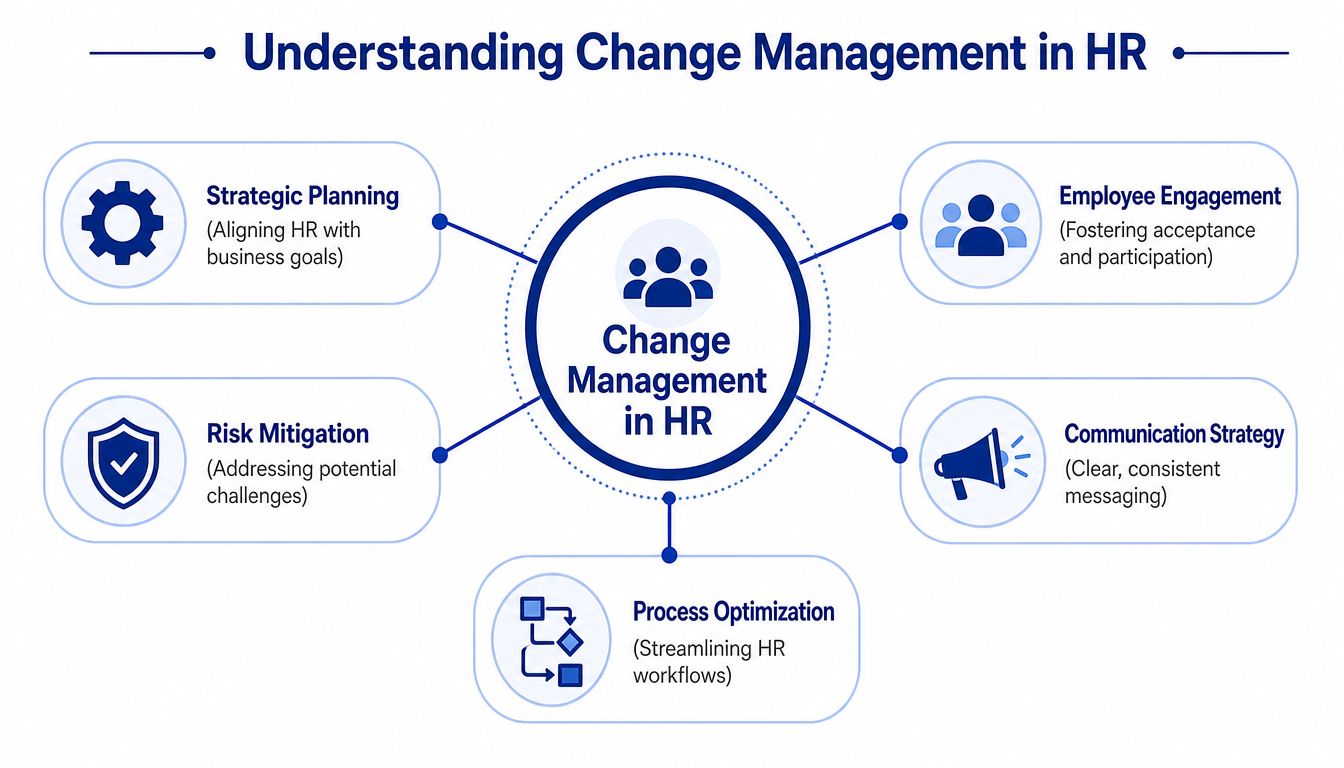
Many guides focus on broad ideas like buy-in, transparency, and engagement. Those matter, but they don't go far enough for SMBs. A multi-state operator has to ask different questions:
Those are not academic concerns. They shape whether a rollout is merely bumpy or involves considerable risk.
A second problem is trust. According to change management statistics compiled with Gartner and Accenture data, only 38% of employees are projected to be willing to support organizational change in 2026, down from 74% in 2016. The same source notes that technology, especially generative AI, became the number one driver of change in 2023, and the rate of business disruption has risen 183% since 2019, with a 33% increase in 2023 alone. In other words, leaders are asking more of employees at the same time employees are less prepared to absorb constant disruption.
Good HR change management doesn't try to remove every discomfort. It creates a controlled transition with clear ownership.
That usually includes:
Change fails when leadership communicates a destination but leaves managers to invent the route.
That's why change management in HR should be treated as a business control. It helps organizations implement change in a way employees can understand, managers can execute, and leadership can defend.
Growth across states changes the risk profile of routine HR decisions. A handbook revision, attendance policy, compensation process, or investigation protocol may sound standardized at headquarters and create problems in the field if local law or local practice differs. The larger the footprint, the less room there is for improvised implementation.

A common failure point is the executive mandate that moves too fast for operational reality. For multi-state SMBs, 71% of HR heads still default to a top-down change management approach despite evidence that it ignores local regulatory nuances and employee sentiment, often leading to compliance failures and legal exposure, according to Wowledge's analysis of next-level change approaches.
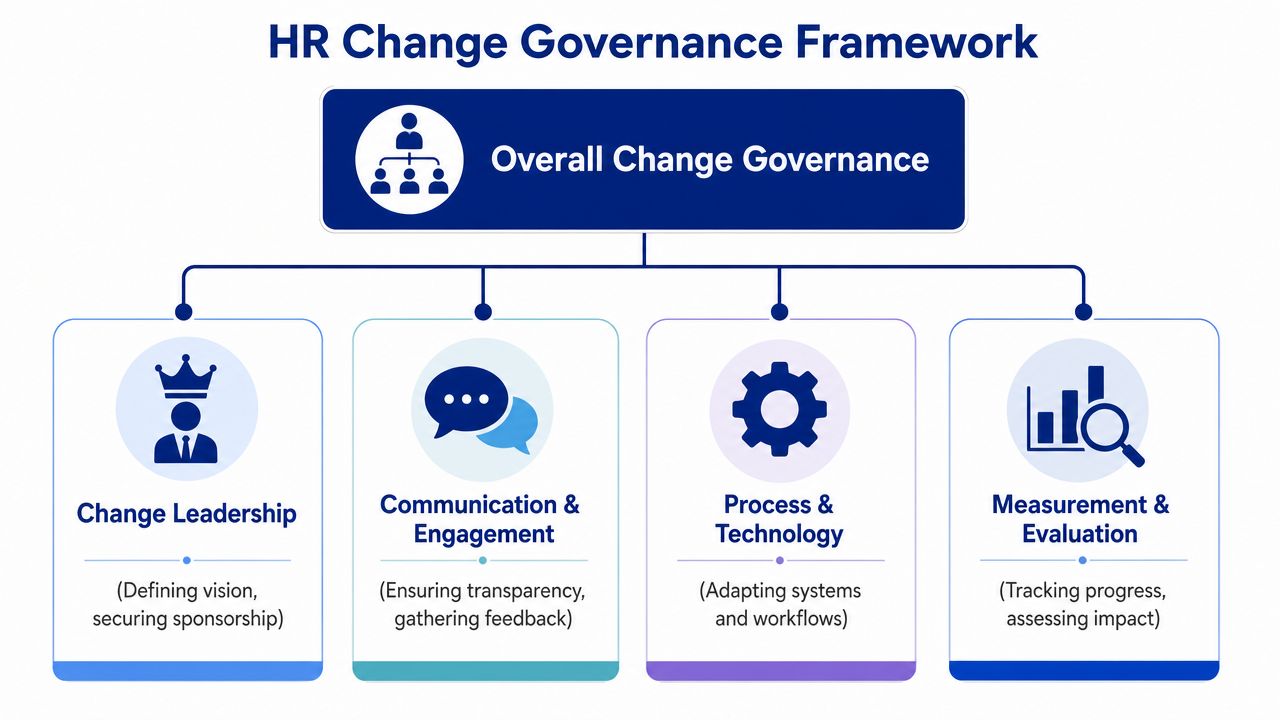
A practical governance model for multi-state organizations rests on four pillars.
That approach is slower on the front end. It's faster where it counts, because it reduces rework, employee confusion, and remedial corrections.
Leaders often assume that more information is always better. In sensitive HR changes, that isn't always true. During restructures, investigations, compensation redesigns, or planned terminations, oversharing can create panic, invite speculation, and lock the business into statements it may later need to revise.
The safer standard is controlled clarity. People should understand the business reason, what affects them now, and what comes next. They don't need every unfinished detail.
Employees don't need a live feed of leadership deliberations. They need accurate guidance they can act on.
Multi-state employers can easily get tripped up. One manager tries to be candid. Another says nothing. A third overexplains a decision that legal review hasn't finalized. The inconsistency becomes the risk.
In practice, ad hoc change tends to create the same pattern:
| Risk area | What goes wrong without structure |
|---|---|
| Policy rollout | One state receives a compliant version, another receives a generic one |
| Manager messaging | Supervisors promise exceptions that leadership never approved |
| Investigations | Timing and documentation differ by location |
| Employee relations | Staff interpret uneven communication as favoritism or retaliation |
For a single-site business, these issues are frustrating. For a multi-state operator, they can become evidence of inconsistent treatment.
A workable framework has to survive real decisions, not just planning sessions. The most useful models are simple enough for leaders to follow and disciplined enough to hold up under scrutiny. In HR, that usually means four pillars: stakeholder mapping, communication strategy, documentation standards, and legal checkpoints.
Start with a reduction in force example. Leadership may think the affected group is a list of employees. It's broader than that. Payroll, IT, direct managers, benefits administration, recruiting, and remaining team members are all part of the risk picture.
The first map should identify three categories:
Many change efforts destabilize when leaders identify who signs off, but not who shapes day-to-day adoption.
Communication is not the announcement. It is the sequence. Who speaks first matters. So does what they say, what they don't say, and what they're allowed to answer.
A useful outside primer on building that sequence is this overview of Communications strategy. In HR practice, the point is narrower. Every audience needs the right amount of information at the right time, in language they can use.
A hard truth: “Transparent” communication that is premature, incomplete, or inconsistent often creates more risk than a shorter, well-timed message.
A policy rollout shows the difference. If leaders send a companywide email before managers are briefed, supervisors will fill the gaps on their own. If HR trains managers first, then issues employee guidance with a clear effective date and escalation path, adoption is usually cleaner.
Documentation is what turns good intent into a defensible process. For a new attendance policy, that record should show why the policy changed, who reviewed it, what locations it affects, when managers were trained, and how employee acknowledgments will be tracked.
A sound recordkeeping standard should capture:
If your leadership team is refining structure more broadly, an HR operating design often affects how cleanly change gets executed. A stronger HR operating model usually reduces confusion about who owns what during implementation.
High-level plans encounter practical considerations. A restrictive policy may be lawful in one state and problematic in another. A performance process may require manager training before use. A restructuring may create notice, pay, or leave-related questions that need to be answered before communications begin.
A mini-case helps. Suppose a company wants to tighten remote work rules across several states. Without legal checkpoints, one manager may frame the change as optional, another may make disability-related errors in individual conversations, and a third may start documenting noncompliance under a policy that hasn't been properly issued. With checkpoints, the business reviews accommodation implications, state-specific rules, manager scripts, and documentation standards before launch.
A change is not ready because leadership has agreed to it. It is ready when the organization can implement it consistently.
One final point matters here. A counterintuitive principle is not oversharing during high-stakes HR changes. Gallup-backed guidance summarized by Teamraderie confirms that chunking information, focusing only on the next milestone, is more effective than maximum transparency, which can increase employment risk and overwhelm in this review of HR change management best practices.
The value of a structured process becomes clearest when the decision carries consequences. A reduction in force, a performance framework overhaul, or a new safety requirement can all be legitimate business moves. They become risky when leaders implement them unevenly or measure success too narrowly.
A defensible reduction in force starts with business rationale and selection criteria, not talking points. Leaders need to define the operational reason for the reduction, identify the affected functions, and confirm that managers are applying the same criteria across locations.
The HR task list should include:
What counts as success here is not whether the announcement feels polished. It's whether the business can show a rational, consistent process if challenged later.
Consider a business adding a stricter substance testing or safety policy across regulated roles. The risk isn't only employee pushback. It's whether the policy language, manager handling, and vendor process align with the regulatory environment. In transportation or safety-sensitive operations, leadership often benefits from subject-matter support such as expert DOT drug and alcohol testing guidance when policy enforcement intersects with compliance obligations.
In this type of rollout, good HR practice means the policy, training, vendor workflow, and manager script all match. If one piece is out of line, enforcement becomes harder to defend.
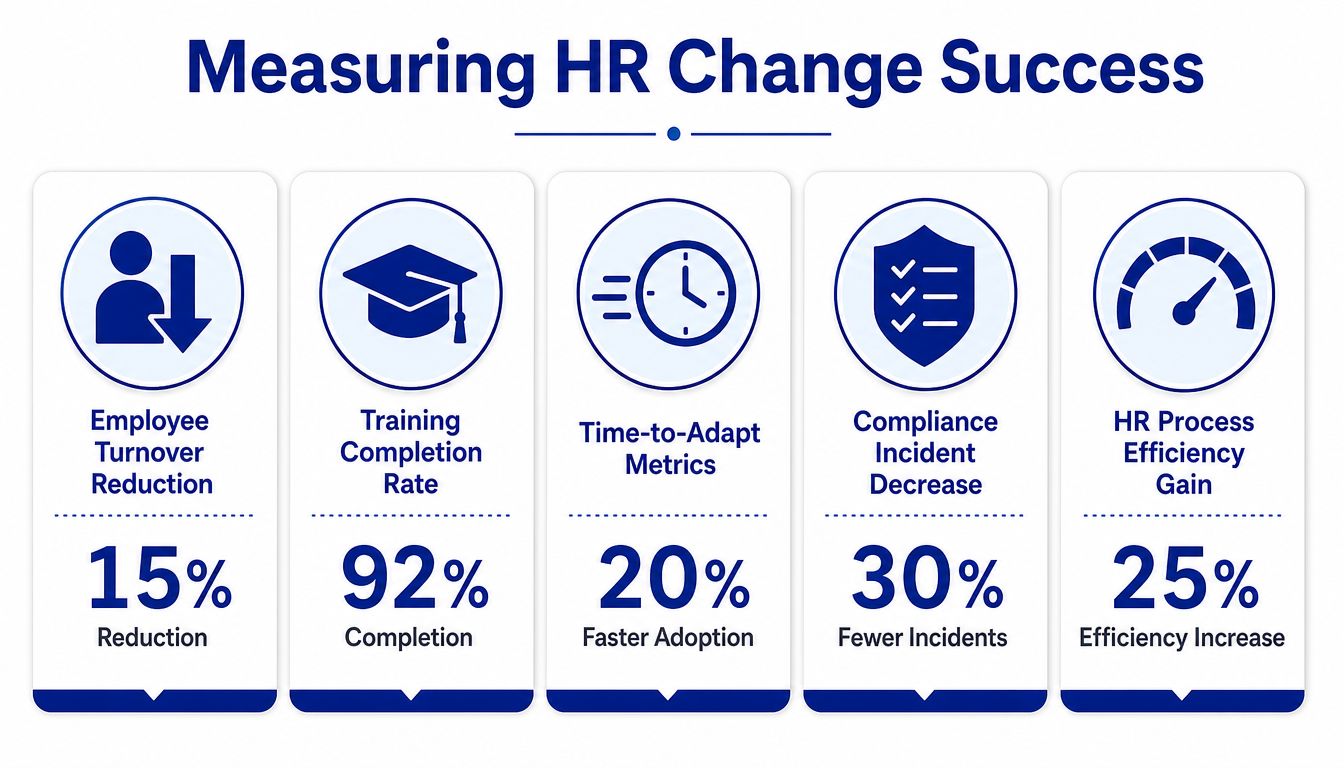
Employee reaction matters, but it isn't enough. The business also needs hard indicators that show whether the change was controlled.
Use metrics such as:
Disciplined change work proves its value. It protects continuity, supports manager execution, and limits the kinds of inconsistencies that later become legal or operational problems.
A change initiative succeeds when the business reaches the intended operating state without losing control of cost, compliance, or execution quality. That means measurement should focus on business outcomes first, then employee indicators in context.
Start with budget discipline. 81% of projects with effective change management implementation come in on or under budget, while ineffective change management is associated with overruns, according to Capacity for Health's summary of change management statistics. That matters because budget adherence often reflects whether planning, sequencing, and role clarity were handled well.
Then look at operational measures:
Leaders don't need a complex dashboard at first. They need a review cadence that catches drift early.
A practical rhythm looks like this:
If you already track employee sentiment, keep it. Just don't rely on it alone. A useful companion framework is this guide on how to measure employee engagement, especially when you need to separate normal adjustment from signals of deeper execution problems.
Structured change management in HR is part of responsible leadership. It helps businesses grow without asking managers to guess, employees to interpret, or legal risk to sort itself out.
If your team is facing a restructuring, policy rollout, multi-state expansion, or another high-stakes people change, Paradigm International Inc. can help you evaluate the risk, tighten the process, and move forward with a more defensible plan.