
An employee complaint letter arrives late on Friday while the owner is managing operations and covering HR. The employee names a supervisor, attaches messages, and asks what happens next. For a growing, multi-state company without a senior HR leader, the wording and handling of that letter will shape every decision that follows.
An employee complaint letter functions as a dated compliance record that the employer must preserve and answer. It fixes when leadership learned of a concern, which decision-makers knew, and what the company did next. The wording in the letter, and the route it takes after arrival, both shape later retaliation exposure.
The EEOC's fiscal year 2024 Annual Performance Report records 88,531 new discrimination charges, with retaliation alleged in 42,301 charges, or 47.8%. Those figures count agency charges, not internal letters. They still show why an internal record has to be tight. A later reviewer will set the letter beside schedules, performance notes, emails, and the employer's reason for any later decision.
A complete letter lets the recipient understand the allegation without rebuilding the story from scattered messages. Missing fields call for clarification. Do not treat an incomplete letter as if it never arrived. Use the fields below as the intake standard.
| Letter part | What to include | Why it matters |
|---|---|---|
| Date and delivery | Date received, delivery method, copy kept | Establishes notice timing and helps assess applicable deadlines |
| Complainant | Name, role, work location, contact details | Identifies who raised the concern and who needs updates |
| Concern | One sentence stating the problem | Frames the allegation for triage |
| Chronology | Dated events, one line each | Lets investigators test timing and motive |
| People involved | Decision-makers and witnesses with roles | Shows who knew what and when |
| Attachments | Emails, texts, schedules, discipline notices | Ties each claim to a record |
| Requested response | Specific action or review requested | Identifies what the employee wants addressed |
The receipt date matters, and it does not start every legal clock. Some deadlines run from the underlying event, so capture both event dates and delivery details. Consistent HR documentation templates help administrators collect those details without rewriting the employee's account.
Intake rule: An incomplete letter still needs a recorded receipt date and an accountable recipient.
Before anyone answers the substance, confirm four points:
Send the letter away from the person named in it. If that person drafts the reply, later questions about retaliation get harder to answer. A dated chronology and a named recipient give you a clear record of notice and of who was responsible for the response.
A schedule change lands three days after a safety report. The employee writes one letter. Months later, that letter is the dated record used to test whether the change was retaliation: what was reported, who received it, and what happened next.
The employee supplies the account. A manager can ask for dates, names, and documents without rewriting the substance. Formal tone adds no credibility; dated facts and labeled exhibits do.
For whistleblower-retaliation matters, OSHA's complaint guidance identifies protected activity, employer knowledge or suspicion, adverse action, and the activity's contribution to that action as central issues. An evidence map beats a long narrative. The letter should show what happened, who knew, what changed, and which records support that sequence. Loose wording and bad routing make those four points harder to prove or disprove later.
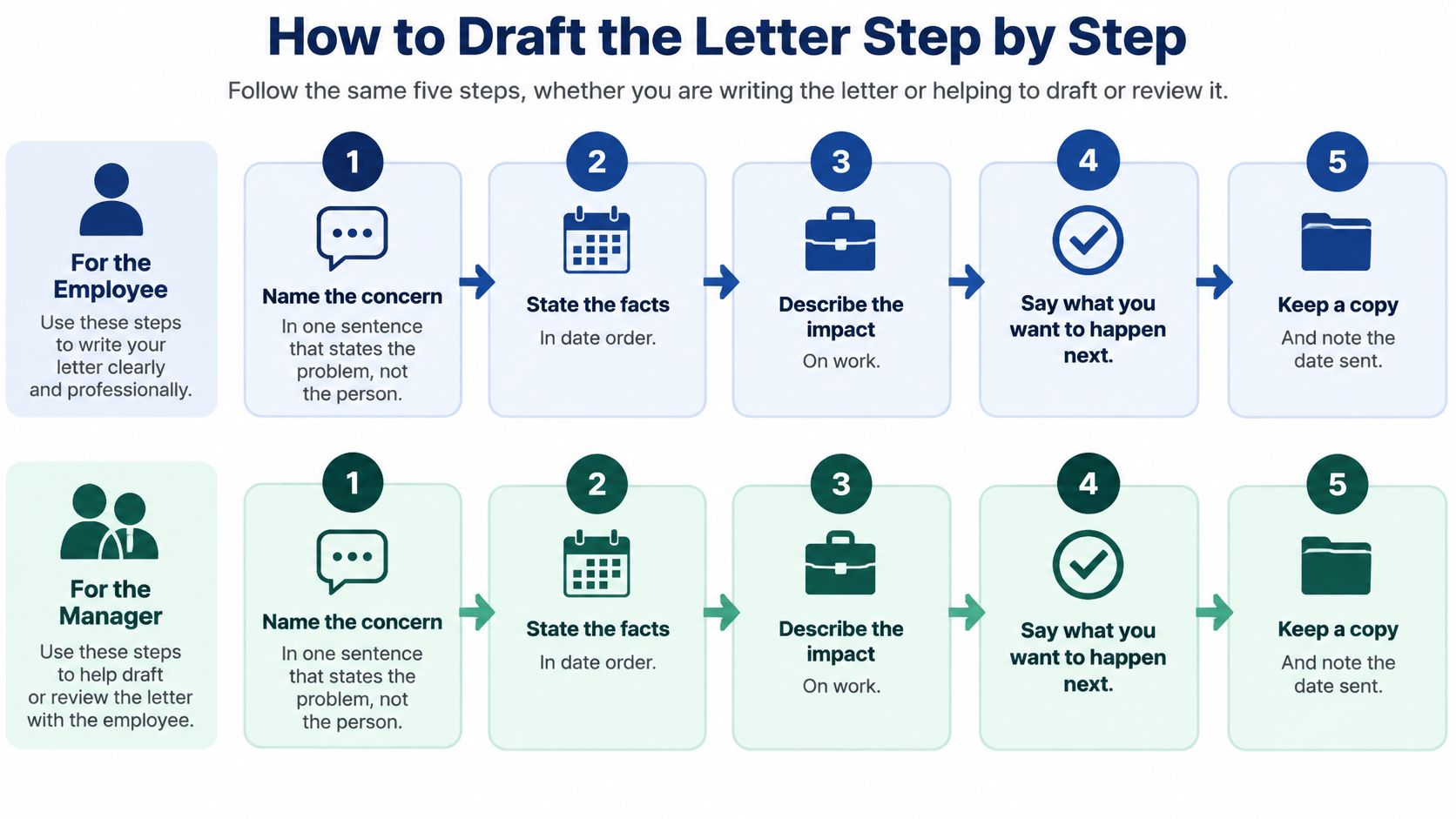
Name the concern in a sentence. Open with a schedule change after a safety report, not a claim that a supervisor is dishonest. A character judgment gives the reviewer no event to investigate and weakens the link between a protected report and a later action.
Put events in date order. Give each event its own line and say why it matters: the initial report, the supervisor's acknowledgment, the later schedule change. Replace “last month” with a date, or mark an approximate date. Timing is what later shows whether the adverse step followed the report.
Identify decision-makers and witnesses. Include each person's role and what that person saw, heard, or decided. A department name without available witnesses hides who knew about the concern before hours, duties, or discipline changed.
Separate observations from interpretations. “The manager said I would be fired if I raised this again” is a reported statement. “Management wants me gone” is an inference. Record both, and label which is which. Only the reported words can be matched to a witness or a document.
Connect allegations to exhibits. Label each attachment and name the event it supports: email, text, schedule, or discipline notice. Copy only records the employee may lawfully have. Do not pull restricted files or unrelated personnel records. An exhibit the employee was not allowed to take creates a separate misconduct problem and does not strengthen the complaint.
Use neutral, specific wording. Describe the conduct and its effect on work: lost hours, changed duties, exclusion from a meeting the job requires. Words such as “always,” and labels with no event behind them, are hard to test. They also blur whether the employee reported protected activity or only a personality conflict.
Address a recipient who does not control the decision. Send the letter to a manager or HR contact other than the person accused, and state that recipient and the send date in the letter. That line fixes when the employer knew. Handing the letter only to the accused supervisor leaves the response with the person whose conduct is challenged and muddies the knowledge date a retaliation review will ask about.
Ask for a review or a corrective step. Do not dictate the finding. “Review the scheduling records and reply in writing” is usable. “Fire the supervisor” is not. Leadership can set the scope of the review without promising the outcome the employee prefers. A demand for a specific punishment also shifts the letter from a dated report of facts into a dispute about the penalty.
Keep the main letter short. Put the chronology and the exhibit index on separate pages. Answer the letter on the dated facts even when the writing is emotional or long.
A production technician emails HR on a Tuesday: weekend shifts doubled after a safety report, with three dates and one witness named. That message is a dated compliance record. Keep the submitted wording, note the delivery method and who received it, and answer it in writing. Later retaliation questions often turn on the date, the words used, and the route the letter took.
Use one format every time so the file is easy to preserve and compare. Bracketed lines show hypothetical workplace events for layout only. Retain the employee's submitted wording next to any later clarification.
Treat the requested response period as a communication target and confirm the applicable deadline with counsel. Acknowledge the request in writing and state the process the employee should expect. Read the allegations and the available evidence before anyone commits to a completion date.
| Avoid | Write instead | Why it helps |
|---|---|---|
| My manager is trying to get rid of me | On 2 April, my shifts were cut two days after I reported safety concerns | Provides checkable timing rather than assuming motive |
| This is clearly illegal | I believe this may conflict with the company harassment policy, and I am attaching a copy | Separates a policy concern from a legal conclusion |
| Everyone knows about this | Coworkers named below saw the incident on [date] | Identifies witnesses available for interviews |
| I always get the worst shifts | Since March, I have been scheduled for more weekend shifts than comparable coworkers, with dates attached | Makes the alleged pattern testable |
| I demand an answer by Friday | I request a written response within [number] business days | States a clear request without threatening language |
Under Title VII of the Civil Rights Act of 1964, the Americans with Disabilities Act of 1990, and the Age Discrimination in Employment Act of 1967, the EEOC explains that protected activity need not use legal terms. An informal discrimination or harassment complaint to a supervisor can qualify. Participation as an investigation witness can qualify too. File and answer the letter when the wording is emotional or it lands with a manager outside the usual chain. The route and the wording both stay in the record, because both shape later retaliation exposure.
Log threatening language as its own conduct issue, and still answer the underlying allegation in writing. Apply the same evidence-handling procedures you use for any other complaint file. Get expert review before you discipline anyone for how the letter was written or delivered.
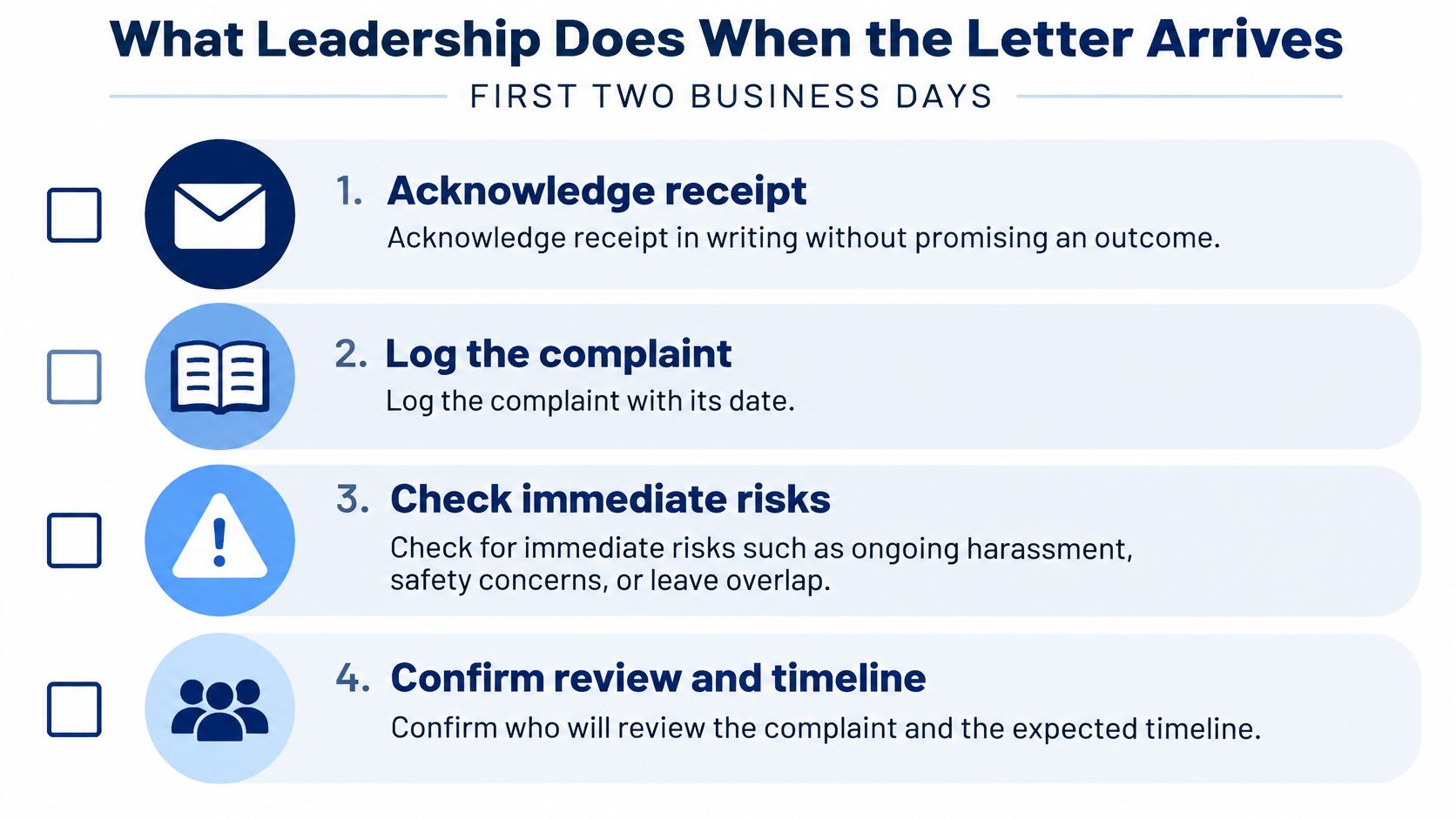
A complaint letter gives leadership a dated record of what the employee reported and when. Treat the first two business days as an internal intake target only. Acknowledge the letter in writing, log its receipt, and assess immediate risks. Ongoing harassment, safety threats, disappearing messages, or a complaint involving the usual recipient may require attention before routine scheduling.
The acknowledgment should name a contact person and state when the employee can expect an update. Avoid promising a finding, discipline, or absolute confidentiality. If the accused person normally receives complaints, assign an alternate reviewer.
Separate fact-finding from operational pressure. The OSHA Whistleblower Investigations Manual emphasizes individual interviews and preservation of relevant evidence. In OSHA matters, an employer's written response is a position statement, and the complainant may submit a rebuttal. Accurate exhibits and consistent explanations can matter beyond the initial letter.
Choose a neutral fact-finder. The investigator should not report to the accused person. If a senior leader is implicated or the accounts raise substantial credibility disputes, engage outside investigation support and employment counsel before interviews begin.
Interview witnesses privately and individually. Ask what each person directly observed before sharing other accounts. Group discussions can blur recollections and influence what witnesses report.
Send written preservation instructions. Identify relevant emails, messages, phone logs, meeting notes, personnel files, contracts, and work products. Name the people responsible for those records and address routine deletion settings.
Test explanations against records. Compare the allegations with policy, prior reports, discipline history, comparable employees, and the stated business reason. Gather evidence that challenges the allegation as carefully as evidence that supports it.
Record a finding for each allegation. Apply substantiated, unsubstantiated, or inconclusive consistently. Explain evidence gaps and credibility reasons. Lack of corroboration alone does not establish that someone lied.
Review consequential decisions separately. Have qualified HR or counsel review related discipline or termination. Where feasible, keep the investigator separate from the person deciding corrective action.
A complete file should contain the complaint, interview notes, exhibits, findings, decision rationale, and remediation steps with an owner and deadline. The closure notice should confirm that the process is complete and restate anti-retaliation expectations without disclosing confidential personnel details. Assign someone to check that corrective measures are completed.
The firm conducts neutral, documented workplace investigations of complaints and misconduct, including harassment, discrimination, retaliation, and employee misconduct claims. Its investigation management process supports a documented inquiry and follow-through. In a manufacturing plant case, the firm interviewed 8 employees, reviewed camera footage and timecards, and documented 5 separate violations of company conduct policy.
An employee emails a dated complaint on Monday. By Friday a supervisor has cut her hours and pulled a client account. Preserve that letter and answer it. Its wording and the route it took will shape any later retaliation claim, because the sequence is now one file.
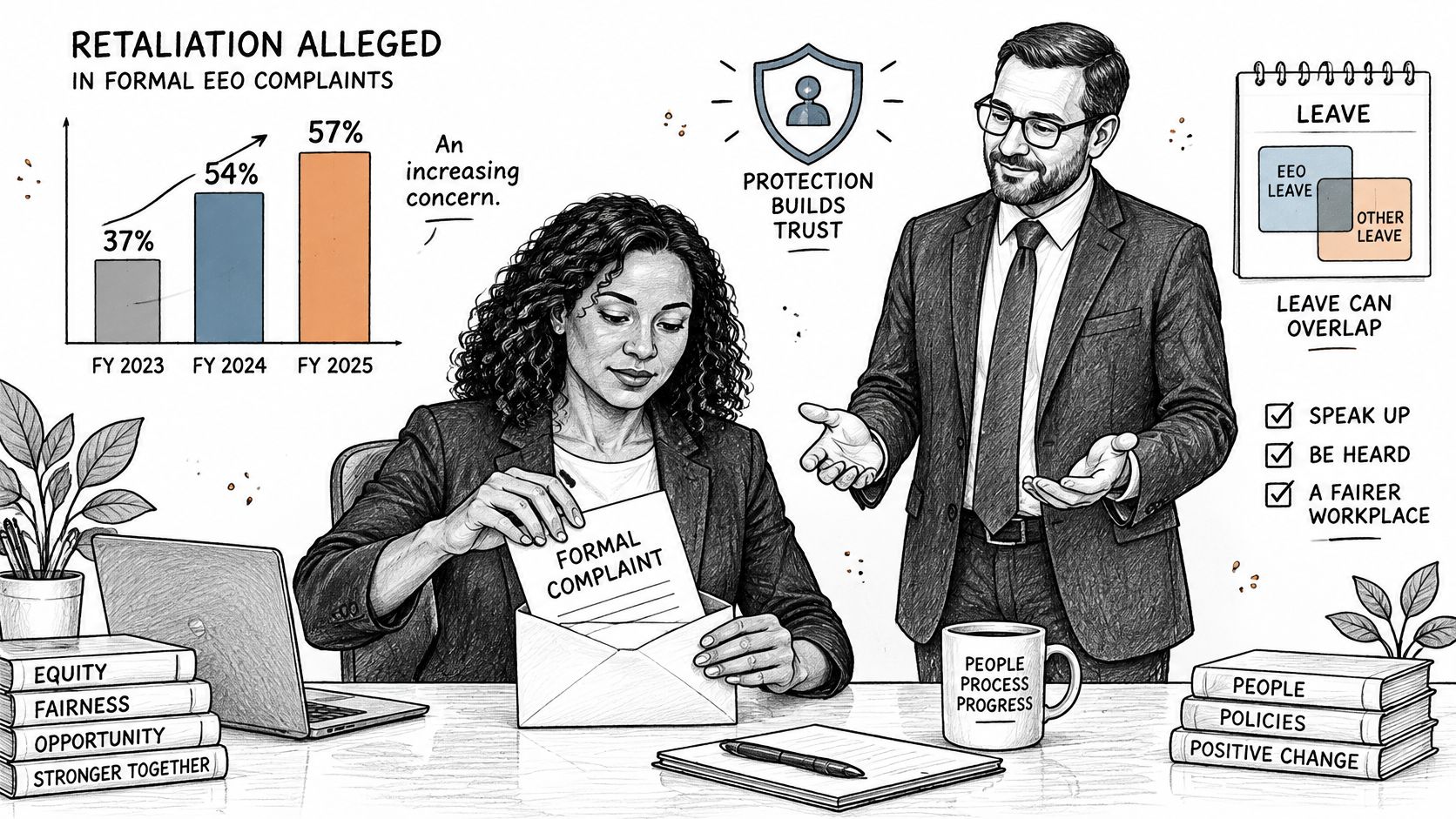
Retaliation was alleged in 57% of formal EEO complaints in the U.S. Department of State's FY 2025 No FEAR Act report, compared with 54% in FY 2024 and 37% in FY 2023. These figures describe one federal department and do not generalize to private employers. A clear letter still cannot control what managers do after it arrives.
Screen every later decision against that dated record. Discrimination reports and participation in an investigation require retaliation review before you change schedule, pay, or status. For each subsequent concern, write the date, the decision-maker, the stated reason, and how comparable employees were treated.
A letter that mentions medical leave, caregiving, or attendance may also involve the Family and Medical Leave Act of 1993, 29 U.S.C. § 2601 et seq.; 29 C.F.R. Part 825, which the EEOC identifies as enforced by the Department of Labor's Wage and Hour Division. Disability accommodation under the Americans with Disabilities Act of 1990 can overlap that leave question. Keep eligibility, medical restrictions, and return-to-work on a separate review. Do not settle leave rights through an adverse credibility finding in the complaint file.
Check current state law before you act. Use the rows below as the coverage and process points that change the response, then confirm filing deadlines and notice rules for every state where people work.
| State | Governing law | What changes |
|---|---|---|
| California | California Fair Employment and Housing Act | Covers many employers with five or more employees; complaints go to the Civil Rights Department |
| New York | New York State Human Rights Law | Harassment protections reach employers of every size; check state notice and policy requirements |
| Each other state where staff work | State fair-employment, leave, and paid-leave statutes | Check coverage, filing deadlines, and notice rules for each state |
A complaint leaves legitimate management decisions available. It makes the timing, evidence, and consistency of those decisions the record you will have to defend.
In a multi-state case, a nationwide employer with approximately 75 employees and no in-house HR department had a sensitive termination paused, then had its handbook rebuilt for enforceability in every operating state. Pause when the complaint file or state coverage is unclear. A proposed termination after an employee complaint, or discipline that follows protected leave, needs qualified HR review before anyone acts.
An employee sends a short complaint on a Tuesday and copies two managers. That message is a dated record you must preserve and answer. The reply's wording, and who the letter is routed to, is what a later retaliation claim will test.
A January 2025 Minnesota legislative audit found that the state health department lacked written procedures for consistently managing employee complaints. Weak files made consistent handling hard to assess, and anti-retaliation notices appeared in interviews but not at intake. Size does not save you when nobody owns the process.
When an acknowledgment produces no real update, the employee should send a dated status request, use the alternate channel if silence continues, and keep the later messages. Tell them what you can share: who owns the case and when the next update is due. Investigation details can stay private. Do not treat confidentiality as a blanket refusal.
The company provides complaint-response support, impartial workplace investigations, and multi-state HR decision guidance. Its HR email address is available upon request. Book a Free HR Risk Review.
This article is general information, not legal advice. Employment laws change and vary by state; consult qualified employment counsel about your situation.