
One employee knows payroll corrections. Another knows how to close the month. A third is the only person who can handle a regulator request without scrambling. Most leaders don't call that a cross-training issue until someone quits, goes on leave, or gets pulled into an urgent project.
That's why employee cross training belongs in operations, not just in learning and development. If your business depends on a handful of people who hold critical knowledge, you don't have a talent program problem. You have a continuity risk.
Cross-training gets framed too often as a morale tool or a way to keep work interesting. That undersells it. For a COO, cross-training is a way to reduce single points of failure, protect service continuity, and lower the chance that one absence disrupts the whole business.
When more than one person can perform a critical task, the organization has options. That matters in multi-location operations, regulated environments, and lean teams where one vacancy can trigger missed deadlines, service failures, or compliance gaps. It also matters because replacing people is expensive, and structured skill-building supports retention over time.
A practical reason this deserves executive attention is that cross-training is still underused. One estimate says only 45% of companies offer formal cross-training programs according to SelectSoftware Reviews on cross-training adoption. That creates an opening for SMBs that are willing to build this intentionally rather than reactively.

The strongest business case isn't that employees like variety. It's that the company becomes less fragile.
AIHR notes that cross-training is associated with lower turnover and stronger retention, while also improving versatility and productivity, and reports that U.S. employees spent an average of 57 hours in training in 2023 in the broader workforce development context through AIHR's cross-training overview. The practical takeaway isn't just that training happens. It's that cross-training turns training into protection.
Practical rule: If a task is critical enough to hurt the business when one person is out, it's critical enough to cross-train.
Many organizations still treat employee cross training as informal shadowing. Someone sits with a more experienced employee for a few hours, takes notes, and everyone assumes there's now a backup. That usually fails the first time the backup has to perform under pressure.
A formal approach gives leadership something more valuable than goodwill. It gives visibility. You can see which roles are exposed, which tasks have no coverage, and where a modest investment in training would stabilize the business. That same discipline often improves handoffs, documentation quality, and manager accountability.
If your team is also focused on throughput and role clarity, this related perspective on improving staff productivity complements cross-training well. Productivity rises more reliably when work isn't trapped with one person.
A defensible program starts with structure. Informal coverage habits don't hold up when a manager is challenged on favoritism, when quality drops, or when an employee is asked to perform work they were never properly prepared to do.
The strongest design follows a clear sequence. According to Wellhub's guidance on cross-trained employees, a defensible program should: identify critical roles and single points of failure, map task-level overlaps, define minimum proficiency standards, assign trainers and schedule time-boxed job rotation, and validate readiness with simulations before relying on the backup.
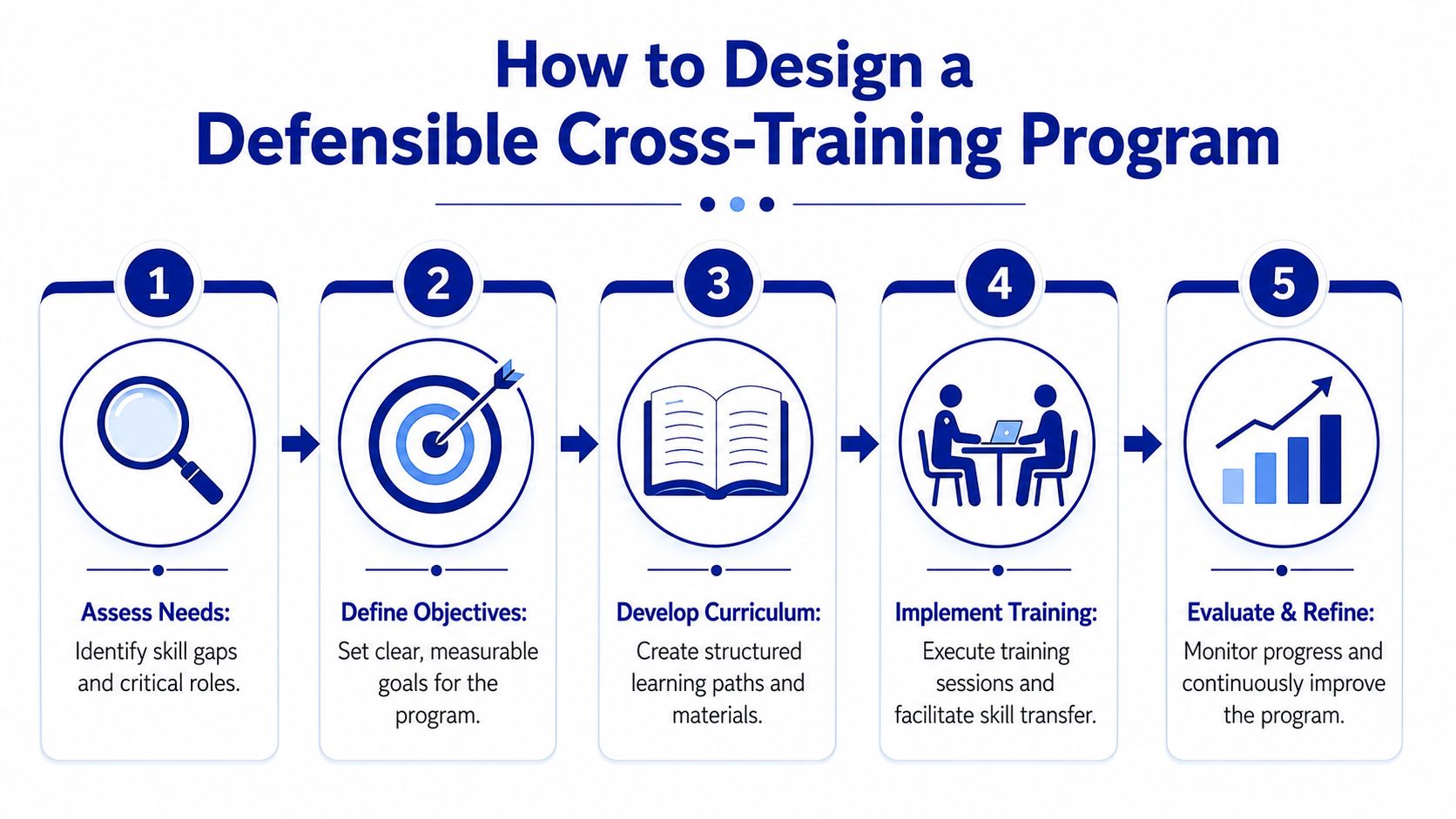
A common mistake is choosing participants first. The better starting point is the work itself.
Ask four operational questions:
That last point is where many SMBs need more discipline. Not every role deserves the same level of redundancy. Some jobs justify broad coverage. Others are better left specialized with a documented contingency plan.
A competency matrix turns cross-training into an operating document. It should sit at the task level, not at the job-title level. “Cross-trained in Accounts Payable” is too vague to manage. “Can enter invoices, match POs, resolve exceptions, and process urgent vendor corrections under supervisor review” is usable.
Below is a simple example.
| Sample Competency Matrix: Accounts Payable Specialist | |||
|---|---|---|---|
| Critical Task | Primary Owner | Backup 1 (Proficiency) | Backup 2 (Proficiency) |
| Vendor invoice entry | AP Specialist | Staff Accountant (working) | Office Manager (basic) |
| Three-way match exception review | AP Specialist | Senior Accountant (working) | None assigned |
| Urgent payment run preparation | AP Specialist | Controller (advanced) | Staff Accountant (basic) |
| Vendor master data updates | AP Specialist | HR/Payroll Admin (basic) | Office Manager (basic) |
| Month-end AP close support | AP Specialist | Senior Accountant (working) | Controller (advanced) |
Your proficiency labels should mean something. “Basic,” “working,” and “advanced” are fine if each level has a written definition. A working-level backup, for example, may complete the task independently for routine situations but escalate exceptions.
A matrix is only defensible if it shows task scope, expected proficiency, trainer assignment, and proof of validation.
Most failed cross-training programs skip this step. They assume exposure equals competence.
Readiness should include:
This is also where onboarding discipline matters. If your organization struggles with role clarity in the first place, strengthen that foundation with a more structured orientation for a job before layering in cross-training.
Cross-training isn't automatically worth doing for every role. Smaller teams can't afford training plans that pull too much time away from primary responsibilities without clear operational benefit.
Use a simple decision filter:
This keeps employee cross training focused where it reduces risk. The goal isn't to make everyone do everything. The goal is to make sure the business can function when normal staffing assumptions fail.
A strong design can still collapse during rollout. The usual reason is simple. Managers schedule cross-training like an extra task instead of a planned operating activity. That creates resentment, uneven participation, and rushed instruction.
The implementation model should match the work. Some functions need controlled job rotation. Others work better with peer coaching or task-specific handoffs. What matters is that the schedule reflects business rhythm, trainer capacity, and the employee's actual ability to absorb the material.
Three models work well in most SMB environments:
The mistake is mixing these without deciding what the business needs. If the goal is true backup coverage, project exposure alone usually won't be enough.
Cross-training should be time-boxed and predictable. Don't leave it to “whenever things slow down,” because things rarely slow down in a meaningful way.
A workable schedule usually includes:
For leaders trying to coordinate coverage while preserving service levels, a practical guide for employee scheduling programs can help clarify how to build schedules that support both daily operations and planned training time.
Employees need to know why they were selected, what they'll be expected to learn, and how success will be judged. Managers need to know how much time the process will require and what they can't shortcut.
A clean rollout message should answer:
| Implementation question | What employees and managers should know |
|---|---|
| Why this role? | It's tied to continuity, coverage, or operational risk |
| Why this employee? | Selection is based on skills, role fit, and business need |
| What's the expected scope? | Only defined tasks, not an open-ended expansion of duties |
| How long will it run? | Time-boxed periods with checkpoints |
| How will readiness be confirmed? | Observation, scenario testing, and manager sign-off |
Cross-training works best when employees see a clear path, not an invisible pile of extra work.
Cross-training can reduce operational risk while increasing legal risk if it's handled casually. That tension is where many businesses get exposed. A manager borrows an employee to cover a gap, expands the work beyond the original scope, and assumes the training effort itself makes the arrangement safe.
It doesn't. Indeed's guidance highlights a key issue: asking a borrowed employee to perform tasks outside their classification or qualifications can create wage-and-hour, licensing, or safety problems, especially in regulated or multi-state businesses where job duties and training records need to be defensible through Indeed's overview of cross-training risk considerations.
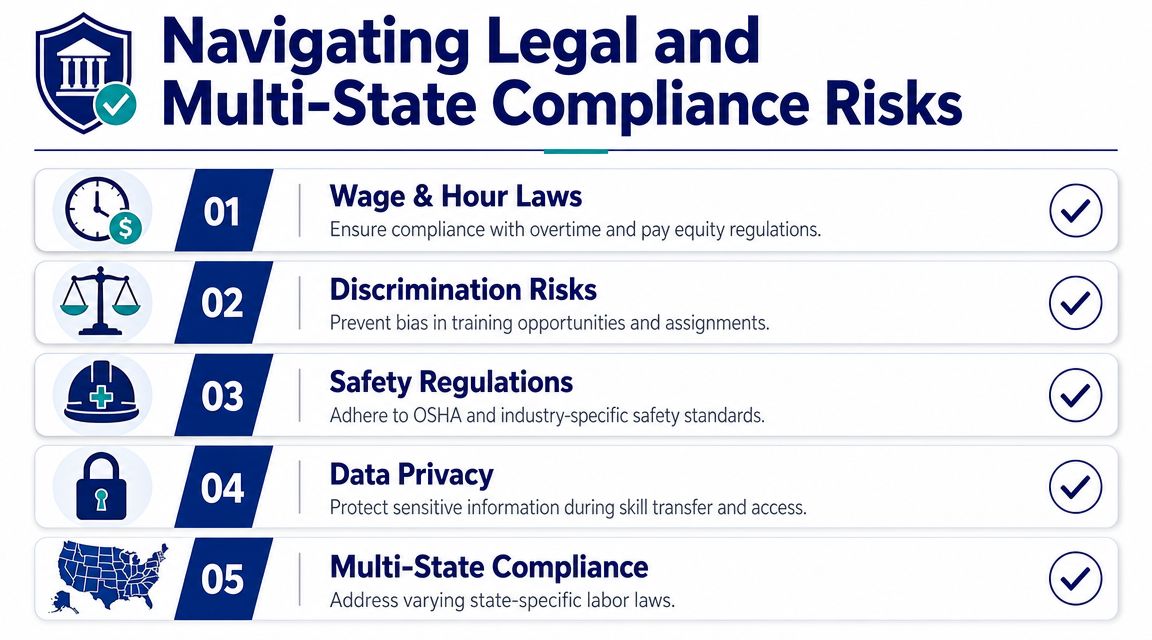
The risk rarely starts with the concept of cross-training. It starts with poor controls.
Look closely at these areas:
A frequent weakness in multi-state businesses is inconsistency. One site may run a disciplined sign-off process while another relies on verbal approval. That's hard to defend later.
A defensible program creates a paper trail that shows intent, limits, preparation, and authorization. That doesn't require overlawyering every training event. It requires consistency.
Your file for each cross-trained employee should typically include:
If cross-training involves exposure to sensitive information, leaders often also review confidentiality controls. In some cases, using a clear non-disclosure agreement form can support broader documentation practices around access to financial data, personnel records, trade information, or client information.
If the employee's authority isn't documented, managers will expand it in practice.
Multi-state employers have an added layer of risk because training practices can drift from location to location. The safest approach is to standardize the framework while allowing local review for state-specific rules and role restrictions.
That means using one core template for role scope, one approval process for competency sign-off, and one retention standard for training records. It also means checking whether state-specific meal and rest break practices, overtime handling, job duty definitions, or regulated role requirements affect the borrowed work arrangement. If your team is already reviewing state-specific work rules, this related guide on employment law breaks is a useful reminder that small operational choices can create bigger compliance consequences.
A cross-training program isn't successful because employees attended sessions. It's successful when the business can absorb disruption without losing control of quality, deadlines, or compliance. That's the standard worth measuring against.
The sources are consistent on one point. Cross-training improves flexibility, productivity, retention, and disruption recovery when it's run well, and common failures include training overload, unclear goals, and insufficient rewards according to the ABAcademies article on cross-training impact and implementation risks.
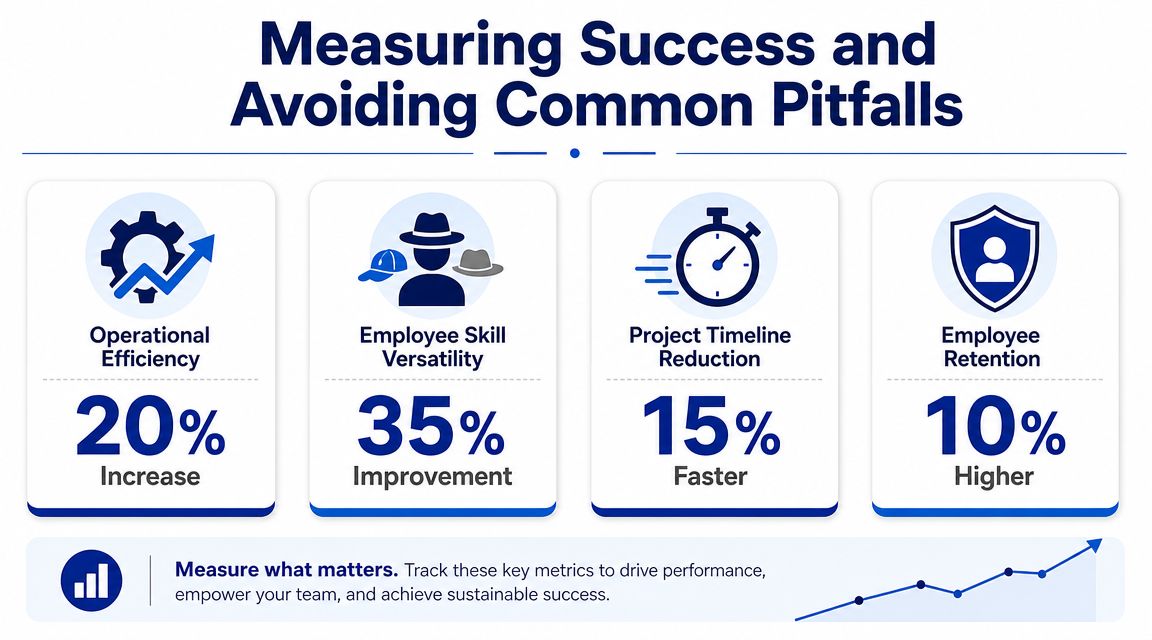
The most useful indicators show whether coverage works when tested.
Track questions like these:
| Business outcome | Useful indicator |
|---|---|
| Reduced key-person dependency | Number of critical tasks with an approved backup |
| Better continuity | Ability to cover absences without missed deadlines or service disruption |
| Stronger flexibility | Manager ability to reassign work within defined scope |
| Higher quality confidence | Fewer escalations or rework when backups perform routine tasks |
Performance reviews can help, but only if they go beyond attendance. Look at on-the-job effectiveness, judgment, and whether the backup can handle routine work without creating hidden cleanup for someone else.
Most cross-training problems are visible before the program fails. Leaders just don't always treat them as warning signs.
Watch for these patterns:
Each of these weakens trust. Once employees see cross-training as code for “do more with less,” engagement drops and manager cooperation usually follows.
Leader check: If managers can't state the purpose, scope, and success standard for each cross-training assignment in one minute, the program isn't ready.
The best programs get tighter over time. They narrow role scope where quality suffers, expand training where coverage is still fragile, and remove assignments that add complexity without resilience.
That's the overlooked discipline in employee cross training. You don't need to prove the original plan was perfect. You need to show that leadership monitors the results, corrects weak spots, and keeps the program aligned with business risk.
Some of the most important decisions in cross-training sit in edge cases. These usually involve specialized roles, manager discretion, and changing work arrangements.
Here's a practical reference point.
| Question | Answer |
|---|---|
| Should cross-training be mandatory or voluntary? | It depends on role criticality. For business-critical coverage tasks, participation may need to be a job expectation if it's applied consistently and documented clearly. For broader developmental cross-training, voluntary participation often gets better buy-in. |
| What about highly specialized technical roles? | Don't force full redundancy where the training burden is too high or the error risk is too severe. Instead, define limited backup tasks, preserve expert oversight, and document escalation points carefully. |
| How many people should be trained as backups? | Start with the highest-risk gaps. The practical standard is that at least one backup should be able to step in for a critical role on short notice when the role truly affects continuity. |
| Can remote or hybrid teams be cross-trained effectively? | Yes, but the program needs stronger documentation, clearer access controls, and more deliberate observation. Recorded process walkthroughs, screen-share demonstrations, and live scenario checks can help, but sign-off still needs to be explicit. |
| How do we avoid claims of favoritism? | Publish assignment criteria in advance. Tie selection to business need, current capability, role fit, and workload capacity. Then apply the same process across teams. |
| When is specialization better than cross-training? | Specialization is usually the better choice when a task is high-risk, infrequent, difficult to learn well, or tightly tied to a license, credential, or senior judgment. In those cases, improve documentation and contingency planning instead of broadening task ownership. |
Cross-training works best when leadership treats it as a controlled business system. If the scope is clear, the records are clean, and managers respect the limits of what the employee is authorized to do, the program strengthens resilience instead of creating preventable exposure.
If your organization is building or repairing a cross-training program in a multi-state or regulated environment, it often helps to pressure-test the design before it becomes a legal or operational problem. Paradigm International Inc. works with leadership teams that need defensible people practices, stronger documentation, and clearer guidance on high-stakes HR risk decisions.