
A termination is scheduled for Friday. The COO has approved the business reason, the manager has prepared talking points, and HR has drafted the separation letter. Then someone asks the question that creates the exposure: When must the employee receive final pay, and what else has to happen before the separation is complete?
That question defines the practical challenge behind employment termination laws by state. The firing decision may be permissible under an at-will rule, yet the execution can still create wage, notice, retaliation, contract, or WARN Act risk. For a multi-state SMB, the defensible approach is to treat the first several days after separation as a controlled compliance window, not as payroll cleanup.
Most leadership teams don't struggle to identify a business reason for termination. They struggle to execute the decision consistently once the employee's work location, contract terms, payroll schedule, and separation type enter the analysis.
A California employee and a Georgia employee may receive the same message from the same manager. Their legal and operational treatment can still diverge immediately. One state may require immediate payment after an involuntary termination, while another may allow the next scheduled payday or have no state-specific final-pay deadline. A reduction in force can also trigger notice analysis that a single-employee termination won't.
The core mistake is treating termination as one event. It is a sequence of obligations:
Operating principle: A defensible termination decision can still produce liability if the employer mishandles final wages, notice, deductions, or post-separation records.
The employment termination laws by state are not a single national checklist. Federal law creates an important floor, but state rules determine many of the details that leaders have to operationalize. The right question isn't, “Can we end this employment?” It's, “What must the company complete before, during, and immediately after the separation?”
This guide focuses on that decision point. It isn't a substitute for jurisdiction-specific legal advice, but it gives owners, COOs, and HR leaders a practical screening framework for deciding which separations can follow a standard workflow and which require an HR risk review before action.
At-will employment is the starting rule in 49 states plus the District of Columbia. In those jurisdictions, an employer or employee can generally end employment at any time and for any reason, subject to contracts, collective bargaining agreements, public-sector protections, and other legal limits. Montana is the only state that doesn't follow the at-will model in the same way, making the state-by-state review essential for employers with distributed teams. These baseline rules are summarized by the U.S. government termination guidance.
The doctrine became entrenched in the late nineteenth century. Horace Wood's 1877 treatise helped popularize at-will employment as American common law, and New York's 1895 decision in Martin v. New York Life gave the doctrine stronger judicial authority. Those historical roots explain why employers often begin with a permissive default, but they don't eliminate the exceptions that control modern risk.
The three major common-law exceptions are public policy, implied contract, and the implied covenant of good faith and fair dealing. A U.S. government labor analysis found that only six western states, Alaska, California, Idaho, Nevada, Utah, and Wyoming, recognized all three major exceptions, while Florida, Georgia, Louisiana, and Rhode Island recognized none of them. Most states recognize at least one exception, so the national picture is a patchwork rather than a uniform defense. The underlying analysis is available through the Bureau of Labor Statistics review of employment-at-will exceptions.
An employer may have a stronger defense where the employee has no contract and the reason is legitimate, documented, and unrelated to protected conduct. That defense weakens when a handbook promises progressive discipline, a manager makes an implied job-security commitment, or the employee recently engaged in protected activity.
| Exception Type | Where It Applies | Trigger for Employer | Documentation Required |
|---|---|---|---|
| Public policy | State-specific jurisdictions that recognize the exception | Termination connected to conduct protected by public policy, such as whistleblowing, jury duty, or certain workers' compensation activity | Complaint history, decision timeline, policy references, and business rationale |
| Implied contract | States that treat handbooks, offer letters, or manager statements as enforceable promises | Departure from promised procedures or job-security language | Signed agreements, handbook acknowledgments, policy versions, and discipline records |
| Implied covenant of good faith and fair dealing | A narrower group of states that recognize this exception | Evidence that the employer acted in bad faith or used termination to deprive the employee of an earned benefit | Compensation records, commission terms, performance history, and approval notes |
At-will status also doesn't override discrimination, retaliation, wage, leave, or contract obligations. A resource such as this Mississippi employment law office can provide additional context when a termination overlaps with leave or retaliation concerns, but leadership should still evaluate the employee's actual work state and the facts surrounding the decision.
For a broader explanation of the baseline, review the Paradigm International Inc. employment doctrine. The practical conclusion is direct: at-will employment is a starting position, not a shield.
State variation becomes manageable when leadership separates the issues instead of asking one broad question about whether termination is legal. The highest-risk dimensions are notice, final pay, post-employment restrictions, unemployment treatment, and protected categories.
Notice is often the least complicated dimension for a single termination because most states don't require advance notice for an ordinary individual firing under the at-will baseline. That changes when a contract, collective bargaining agreement, handbook promise, public-sector rule, or WARN statute applies. Leaders should never assume that a lack of general notice means a lack of notice obligations in a restructuring.
Final pay creates more immediate execution risk. Some states require payment at separation, while others use a next-payday rule or a deadline measured in working days or calendar days. The employee's work location matters more than the payroll department's location, especially when a remote employee moved across state lines.
Non-compete and non-solicit restrictions also require a separate review. State approaches differ on enforceability, permitted scope, notice, consideration, and restrictions involving lower-paid workers or particular industries. A termination letter that casually repeats a restrictive covenant can create confusion if the underlying clause isn't enforceable where the employee works.
Unemployment eligibility is another variable. The separation reason, available documentation, and state administration process can affect the claim, and an employer's internal label doesn't decide the outcome by itself. Managers should use consistent factual language rather than exaggerating misconduct after the decision.
| Dimension | Low-Variance Approach | High-Variance Approach | Representative States |
|---|---|---|---|
| Advance notice | No general notice for an individual at-will termination | Contractual, union, public-sector, or mass-layoff notice obligations | Most states compared with jurisdictions applying contract or WARN rules |
| Final pay | Next scheduled payday or a similar payroll cycle | Immediate, next-business-day, or short working-day deadline | Texas, California, Alaska, Utah |
| Restrictive covenants | Existing agreement reviewed under applicable state law | State-specific limits on non-compete or non-solicit enforcement | Multi-state comparison required |
| Unemployment | Claim evaluated under ordinary separation rules | Disputed misconduct, layoff, or inconsistent employer records | All states, with state-specific administration |
| Protected categories and activity | Federal baseline applies | State or local law adds categories or protected conduct | California and other jurisdictions with broader protections |
A remote employee can create a jurisdiction problem even when the company has one payroll system and one handbook. Confirm the employee's actual work location, any recent relocation, the assigned worksite, and the state in which the employee performed the relevant conduct.
That check should happen before the termination date is scheduled. A uniform process is useful for consistency, but a uniform legal assumption is dangerous.
Final pay is a separate compliance trigger. It doesn't depend on whether the employer's reason for termination was sound. If the employee was lawfully terminated but the company misses the applicable wage deadline, the company can still face a wage dispute or penalty exposure.
The operational range is wide. Current state summaries identify immediate payment rules, short deadlines measured in hours or working days, and next-payday approaches. Examples include immediate payment in California, payment within three working days in Alaska, payment within 24 hours in Utah, payment within six calendar days for Texas involuntary terminations, and payment within 48 hours or the next scheduled payday in South Carolina, subject to an outer limit of 30 days. These examples are drawn from the 2026 state final-paycheck chart.
| State | Final Pay Deadline for Involuntary Termination | Penalty Type | Exposure Range |
|---|---|---|---|
| California | Immediately | Per-day wage-withholding penalties may apply for delay | Daily wage exposure that can continue under the applicable waiting-time rule |
| Alaska | Within three working days | Wage claim and possible statutory consequences | Amount depends on wages, delay, and applicable enforcement |
| Utah | Within 24 hours | Wage claim and possible statutory consequences | Amount depends on unpaid wages and enforcement |
| Texas | Within six calendar days | Additional wage consequences may apply for delay | Unpaid wages plus potential statutory exposure |
| South Carolina | Within 48 hours or the next scheduled payday, with an outer limit of 30 days | Wage claim and possible enforcement consequences | Amount depends on wages, timing, and facts |
The company must calculate more than regular salary. Final wages can include earned compensation, overtime, commissions, bonuses, and vacation or PTO where applicable under the governing law and company policy. Wage deductions for equipment, advances, or other amounts also require caution because state deduction rules differ.
Assign payroll ownership before the termination is approved. The owner should have the employee's last day, work location, separation type, scheduled payroll date, earned variable compensation, PTO treatment, deductions, and payment method.
A late check often results from a missing input rather than a deliberate decision. The termination manager may know the last day, while payroll lacks the approved commission calculation. HR may know the state, while finance assumes the ordinary payroll cycle. Put all required facts in one approval record.
A clear termination letter should match the payment plan and avoid unsupported promises. Guidance on drafting defensible employment letters can help teams structure the communication, but the letter shouldn't replace a state-specific payroll check. For a focused Texas reference, see Texas final paycheck law explained.
WARN analysis belongs in the planning stage of a reduction in force, not after the termination list is final. The federal WARN Act generally requires employers with 100 or more employees to provide at least 60 calendar days' notice before a covered plant closing or mass layoff affecting 50 or more employees at a single site. The federal framework is summarized in the state WARN Act comparison from the State Chambers.
State mini-WARN laws can be stricter. California's mini-WARN coverage applies to employers that employed 75 or more persons in the preceding 12 months and requires 60 days' notice before a layoff during any 30-day period affecting 50 or more employees at a covered establishment. Washington's newer state law uses a 50-employee employer threshold and requires at least 60 days' advance written notice before a qualifying business closing or mass layoff. These state details are summarized in the state mini-WARN threshold reference.
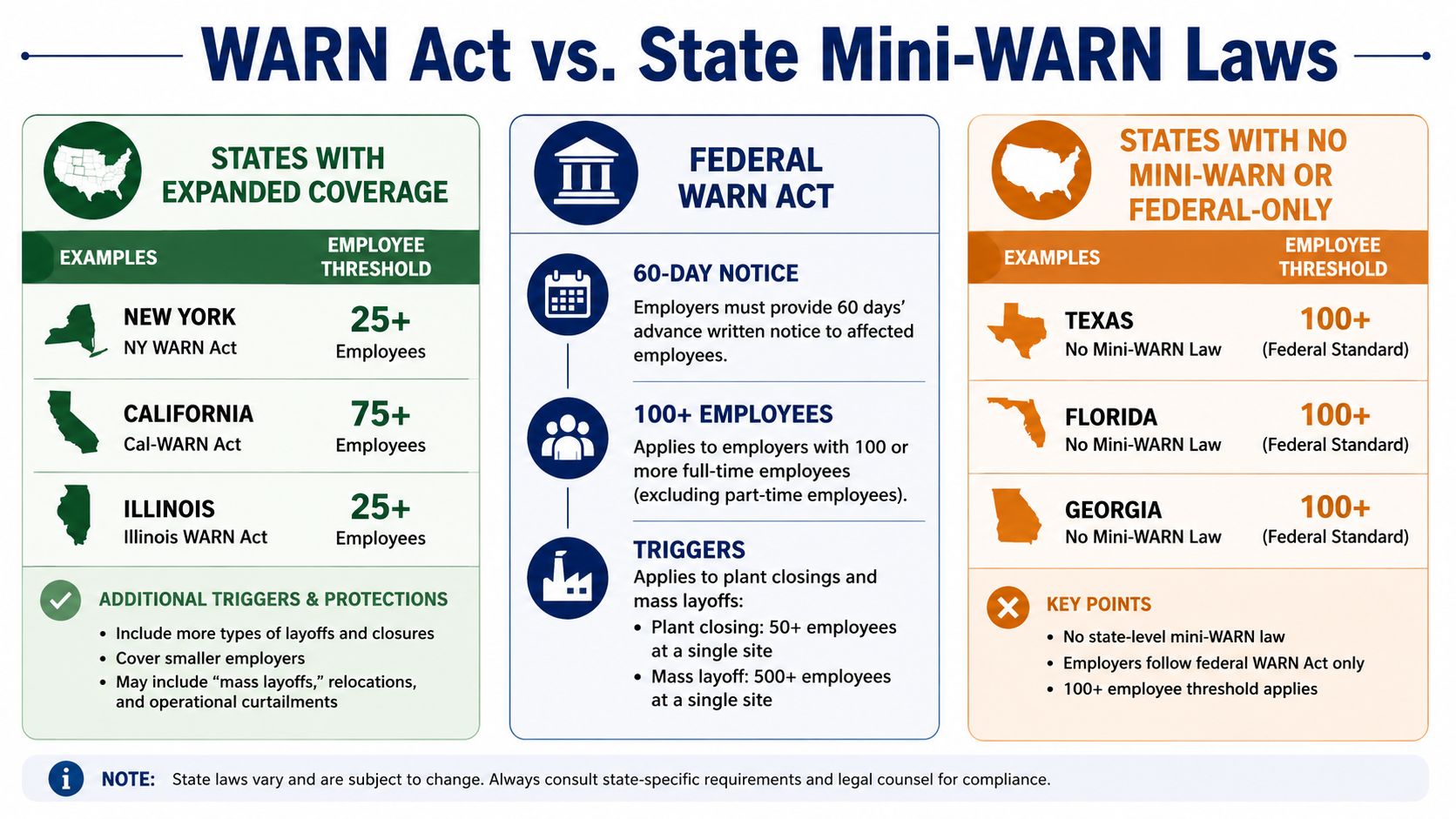
The trigger may depend on more than the number of people in one meeting. Leaders should assess the affected site, the relevant period, whether the company is closing or reducing operations, and whether state law covers categories of employees that the federal framework treats differently.
New York and New Jersey are often identified as jurisdictions with lower employee-count triggers, while California's coverage is broader than the federal baseline. The exact application depends on the statute, the employer's workforce, the affected establishment, and the structure of the planned action.
Planning rule: Never approve a mass termination list until someone has documented the federal WARN analysis and every potentially stricter state mini-WARN analysis.
Notice may require coordination with employees, government agencies, and other stakeholders. Some state laws also impose obligations beyond notice, including severance or broader coverage. A company that waits until the day of separation to ask whether WARN applies has already lost the sequencing advantage that compliance requires.
A defensible workflow gives each decision a jurisdiction, an owner, and a timestamp. It also prevents the common failure mode in which the manager approves the termination while payroll, benefits, IT, and legal review remain undefined.
Confirm jurisdiction. HR identifies the employee's actual work state, remote location, assigned worksite, recent relocation history, and any applicable contract or collective bargaining agreement. Record the source of the location information and the person who verified it.
Classify the separation. The COO or business leader identifies whether the action is an individual termination, resignation, layoff, mass layoff, or plant closing. This classification controls whether the ordinary final-pay workflow is enough or whether WARN analysis is required.
Map timing obligations. Payroll records the applicable final-pay deadline, payment contents, deduction restrictions, PTO treatment, commission calculations, and any notice obligations. The owner should attach the planned payment date to the approval record before the meeting is scheduled.
Screen protected activity and status. HR reviews complaints, investigations, leave activity, workers' compensation issues, wage concerns, accommodation requests, and relevant federal, state, and local protections. The purpose isn't to prevent every termination. It is to identify facts that require a reasoned review before action.
Execute and archive. The assigned team delivers the separation communication, final pay, benefits notices, property instructions, and access changes according to the approved plan. HR then archives the decision record, supporting documents, payment confirmation, signed agreements, and delivery evidence.
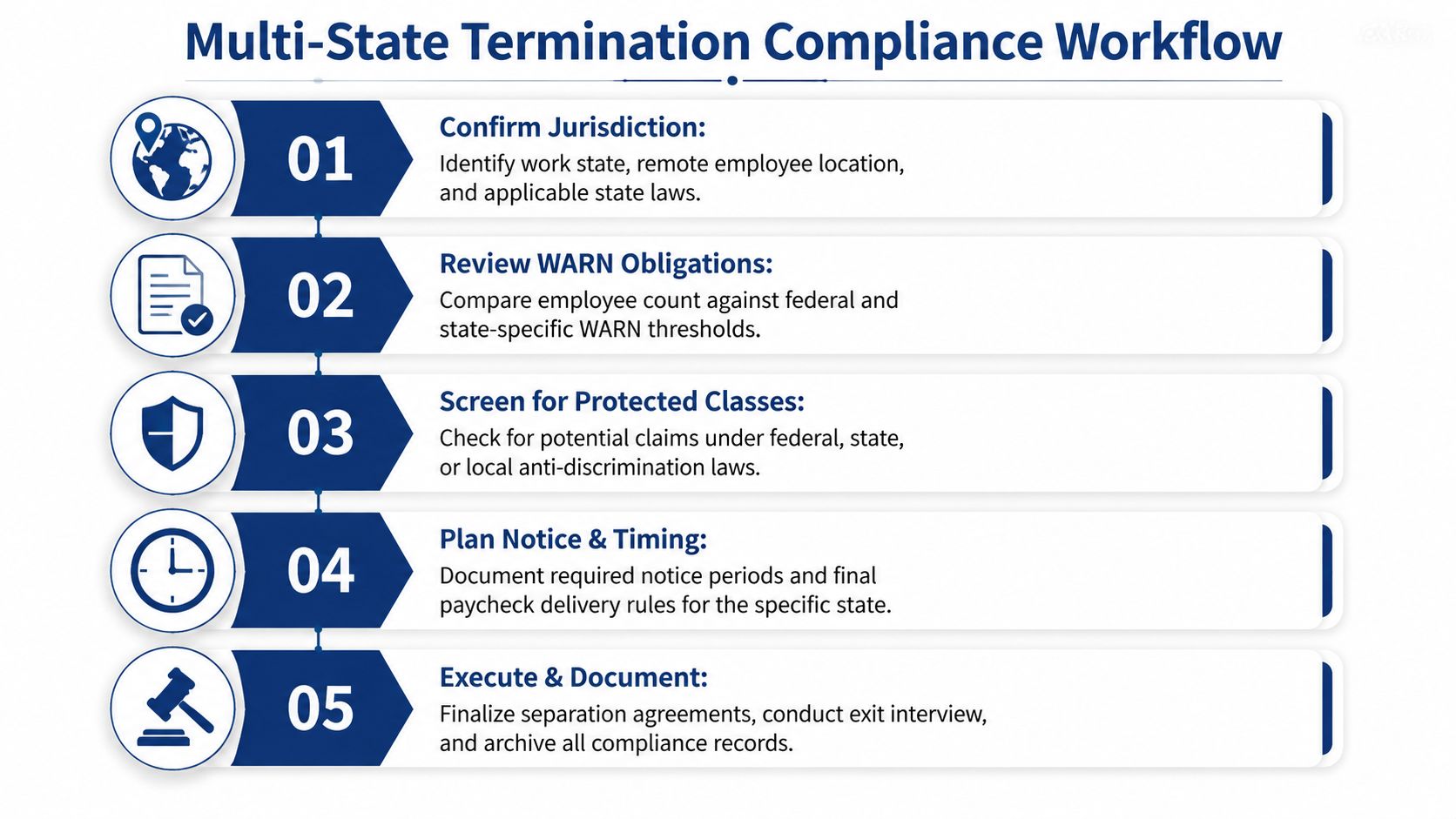
The manager owns the factual business reason. HR owns the jurisdiction and protected-activity screen. Payroll owns final-pay calculation and delivery. Finance confirms variable compensation, and IT manages access and company property.
Remote separations need a property and security plan as well. A practical resource on laptop retrieval after termination can help teams coordinate equipment recovery without withholding earned wages.
The handbook should support the workflow rather than create unintended promises. Review the handbook requirements for multi-state employers to identify where one national policy needs state supplements or clearer disclaimers.
Pre-action review is justified when the cost of an error exceeds the cost of slowing down the decision. It isn't a sign that leadership lacks authority. It is a control for situations where the termination record, payment timing, or protected-activity history may be challenged later.
Bring in an HR risk advisor before action when any of these conditions applies:
A COO can also use a simple escalation rule. Any reduction in force crossing 20% of a location, any separation involving a recent internal complaint, or any termination in a state with a final-pay deadline under 72 hours should receive review before the manager schedules the meeting. These are decision triggers, not conclusions about liability.
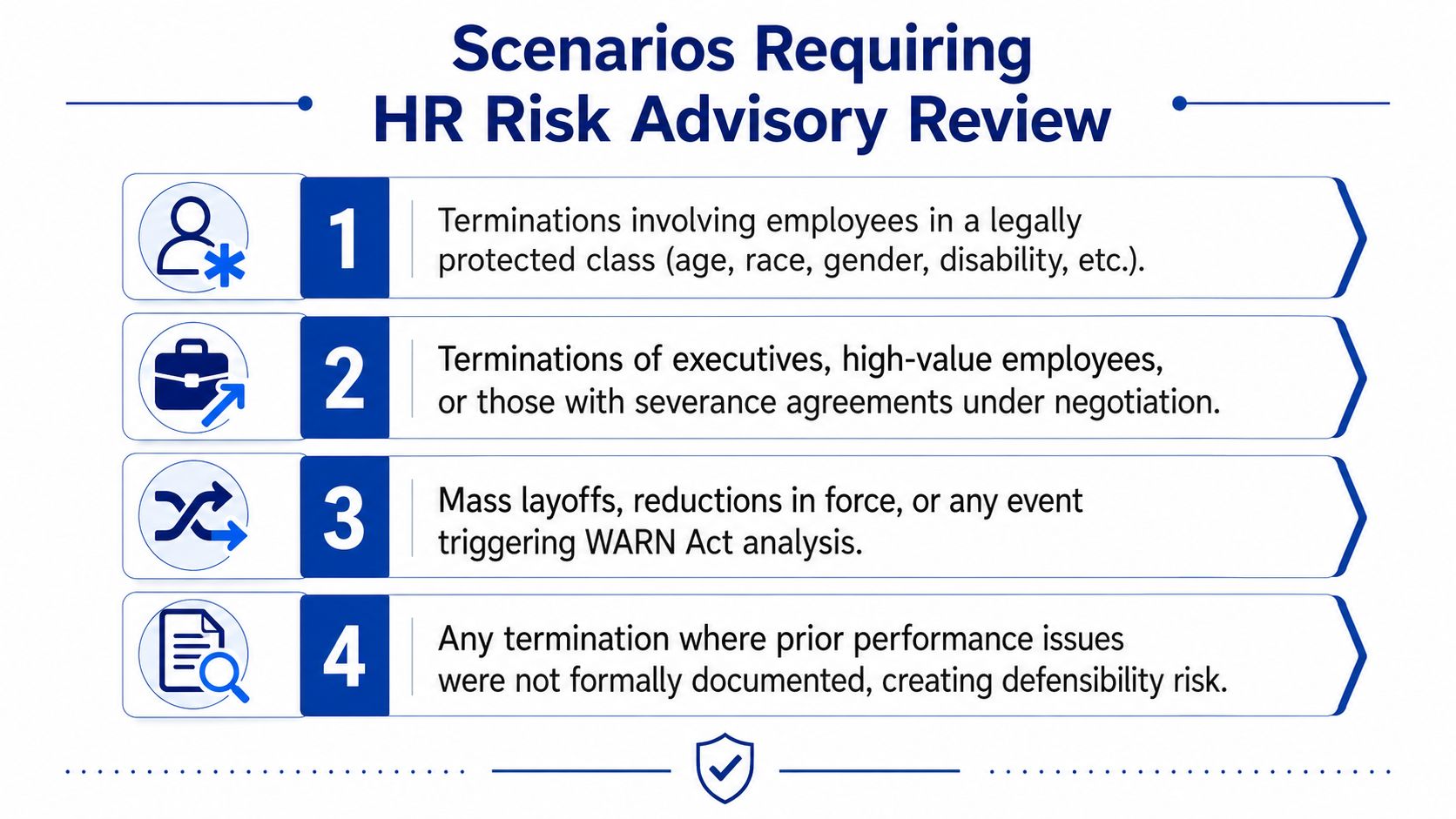
An advisory review should end with evidence, not a verbal “looks fine.” The file should show:
That record helps leadership distinguish a difficult decision from a careless one. It also gives counsel a clearer factual foundation if a claim arrives months later.
Paradigm International Inc. can function as one advisory option for owners, COOs, and HR directors who need structured review of terminations, investigations, manager conduct, documentation standards, and multi-state compliance considerations. The value lies in converting a general checklist into a documented decision process suited to the employee, state, and separation type.
For a termination decision involving multiple states, protected activity, a compressed final-pay deadline, or a possible WARN trigger, contact Paradigm International Inc. to discuss a defensible review process before action. Their HR risk advisory approach helps leadership teams organize the facts, assign compliance ownership, and document the decision with the post-separation window in view.