
You're probably dealing with this right now. Your company added staff, opened in another state, or picked up a government-facing client, and suddenly the people side of the business got more dangerous. The hiring habits and manager judgment calls that felt manageable when everyone sat in one office don't hold up once you cross legal thresholds and state lines.
That's where equal employment opportunity compliance stops being an HR formality and becomes an operating discipline. If you run a multi-state SMB, you need a system that keeps your hiring, pay, promotion, complaint handling, and reporting practices consistent enough to defend.
Your business adds a second state, a few more managers, and a faster hiring pace. Then a routine people decision turns into legal exposure. A rejected candidate says the interview felt biased. An employee complains that discipline is inconsistent across locations. A manager makes a call that seems reasonable, but nobody documented the reason.
That is the point where equal employment opportunity compliance becomes a management system, not an HR side task.
EEO compliance means your employment decisions must rest on legitimate business reasons that you can explain and document. That applies across the full employee lifecycle: recruiting, interviewing, pay, scheduling, promotion, discipline, termination, accommodations, and complaint handling. If a manager cannot clearly state why a decision was made, and your records do not back it up, your process will be hard to defend.
Growth exposes inconsistency.
Small employers often rely on founder judgment, informal manager discretion, and a general belief that people are being treated fairly. That approach breaks down once you add locations, layers of management, and different state rules. Good intentions do not matter much in an investigation. What matters is whether your standards are clear, applied consistently, and supported by records.
Multi-state SMBs face a harder version of this problem because they are not dealing with one rule set. They are dealing with overlapping federal, state, and sometimes local requirements, often with different thresholds, protected classes, training mandates, and documentation expectations. If you run the business as though one policy covers every location by default, you will miss something.
Use a simple operating rule. Build your people practices to the strictest rule that applies across the states where you employ people, unless a state requires a separate process.
Owners who treat EEO as a paperwork issue usually pay for it elsewhere first. Managers start making uneven decisions. Employees stop trusting complaint channels. Leadership loses time reacting to preventable disputes instead of running the business.
A defensible EEO approach gives you three things:
Federal contractors have even less room for error. EEO reporting and affirmative action obligations can trigger compliance reviews, and reporting failures can put contracts at risk. If your company is growing into government work, treat that as an early warning sign to tighten your HR controls now, not after a notice arrives.
My recommendation is simple. Treat EEO compliance as a business control built into everyday management decisions. Put standards in writing. Train managers on what they can and cannot do. Require documentation for judgment calls. Audit for consistency across states before a complaint forces you to.
The cleanest way to think about this is simple. Federal law is the floor. State and local law often raise the ceiling. If you operate in multiple states, you don't comply once. You comply across layers.
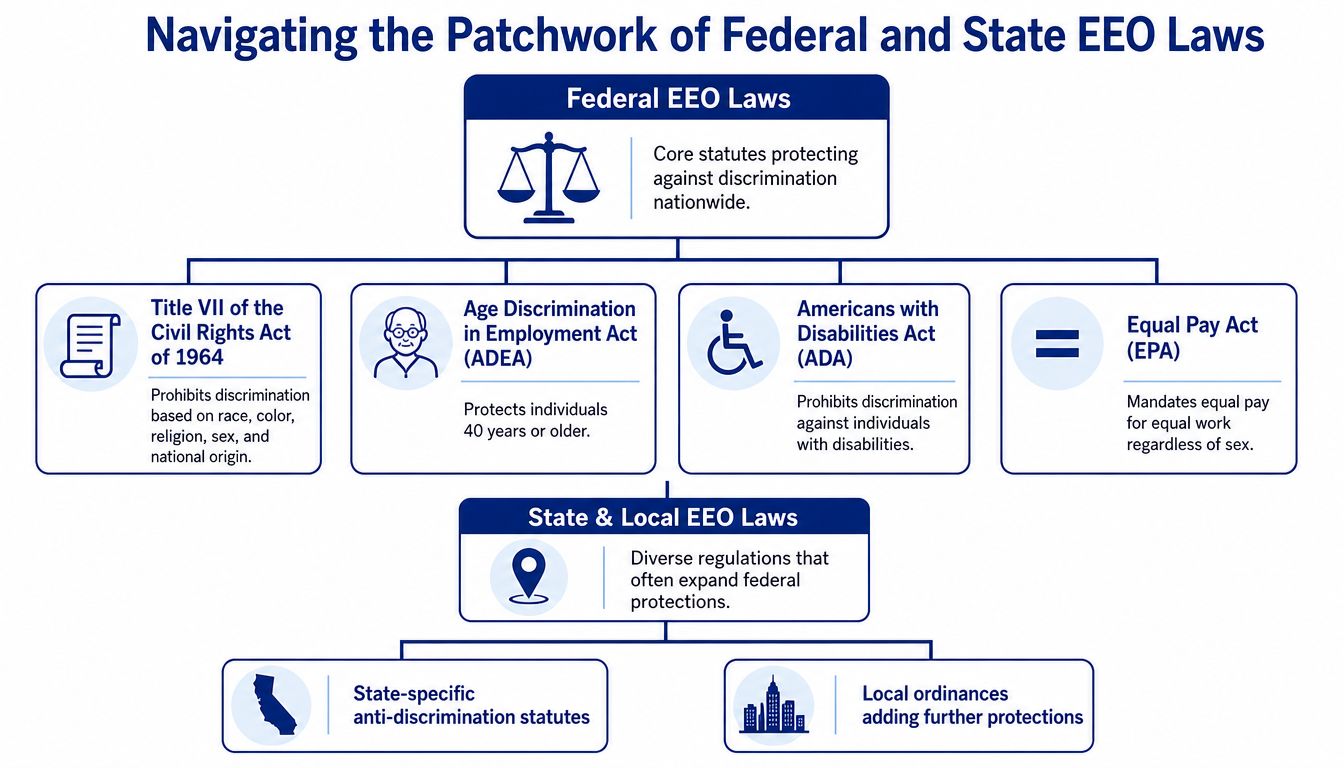
Federal EEO laws apply based on employee-count thresholds. That matters because many SMBs inadvertently cross those thresholds, then keep operating like nothing changed.
Under the multi-state framework outlined by Mosey's overview of equal opportunity employer obligations, federal EEO laws apply to businesses with 15+ employees, while state and local jurisdictions often impose stricter thresholds and broader protected class definitions. That same analysis notes that employers with 14 or fewer employees may only be required to provide equal pay, while employers with 20+ employees face expanded bans including age discrimination for individuals 40 or older.
Here's the practical federal baseline most SMB leaders should know:
Once you add states, uniformity becomes difficult. One jurisdiction may require a narrower set of policies while another expects broader protections, more posting obligations, different complaint procedures, or tighter documentation.
That means your leadership team should stop asking, “What's the federal rule?” and start asking, “Which state we operate in has the strictest applicable requirement?”
A practical way to organize this is to maintain a location-by-location compliance matrix. It doesn't have to be fancy. A spreadsheet works if someone owns it and updates it. The point is to map your business against the relevant rules.
| Compliance area | What to track |
|---|---|
| Hiring and interviewing | Restricted questions, protected classes, required notices |
| Pay practices | Equal pay rules, pay transparency expectations, documentation |
| Accommodations | Disability and religious process standards |
| Harassment and discrimination policies | State-specific wording and complaint channels |
| Posters and notices | Required federal, state, and local postings by location |
If you're stretched thin, do these in order:
If your company has offices in different states but one handbook, one interview guide, and no state addenda, you should assume gaps exist.
You open an email from a state agency on Monday morning. They want hiring records, complaint files, pay data, and policy acknowledgments across three states. If your managers handled issues differently by location, or nobody kept clean documentation, you are already behind.
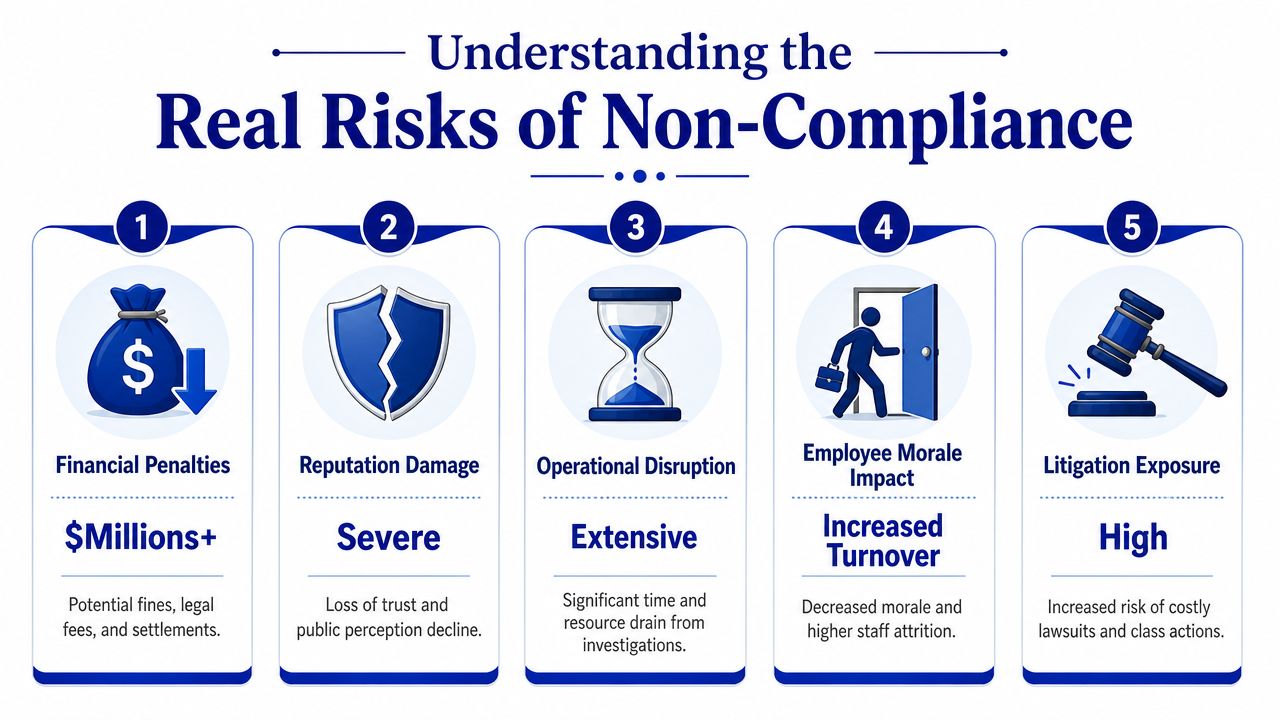
Owners often assume EEO exposure begins with a formal complaint. It usually begins earlier, with a supervisor who improvised an interview, a promotion decision nobody wrote down, or a reporting duty that sat in limbo because everyone thought someone else owned it. By the time an agency contacts you, the first problem is often proof. You cannot show that decisions were consistent, lawful, and tied to business reasons.
For a multi-state SMB, the burden hits harder because small HR teams are supporting different state rules without the infrastructure larger employers have. One weak process can spread across locations quickly.
The legal risk matters. The business disruption usually shows up first.
A lot of smaller employers still treat EEO reporting as somebody else's problem. That is a mistake.
In May 2025, the EEOC filed 15 lawsuits across 10 states against employers that failed to submit required EEO-1 demographic reports, according to Phelps on the EEOC's reporting enforcement actions. That same source notes that 28% of federal contractors are SMBs with 50–250 employees, which makes this a significant middle-market risk, not a Fortune 500 problem.
If you also hold federal contracts, review whether you need an affirmative action plan for covered federal contractors. That obligation often gets missed until an audit forces the issue.
Compliance failures rarely stay isolated. A missing report, inconsistent pay decision, or weak complaint response gives investigators a reason to look wider.
Companies rarely have one people-process problem at a time. If your hiring standards are loose, your worker classification practices may be loose too. That combination creates expensive exposure because agencies and plaintiff lawyers do not review HR decisions in isolation.
If that sounds familiar, review Avoid contractor misclassification penalties as a parallel risk area.
Act before a charge, audit, or demand letter forces the issue. Multi-state SMBs do not need a large compliance department. They need disciplined records, clear ownership, and consistent manager behavior that can hold up across every state where they operate.
You don't need a bloated compliance bureaucracy. You need a defensible system. That means a small set of practices your managers can follow, your HR team can document, and your leadership can enforce consistently.
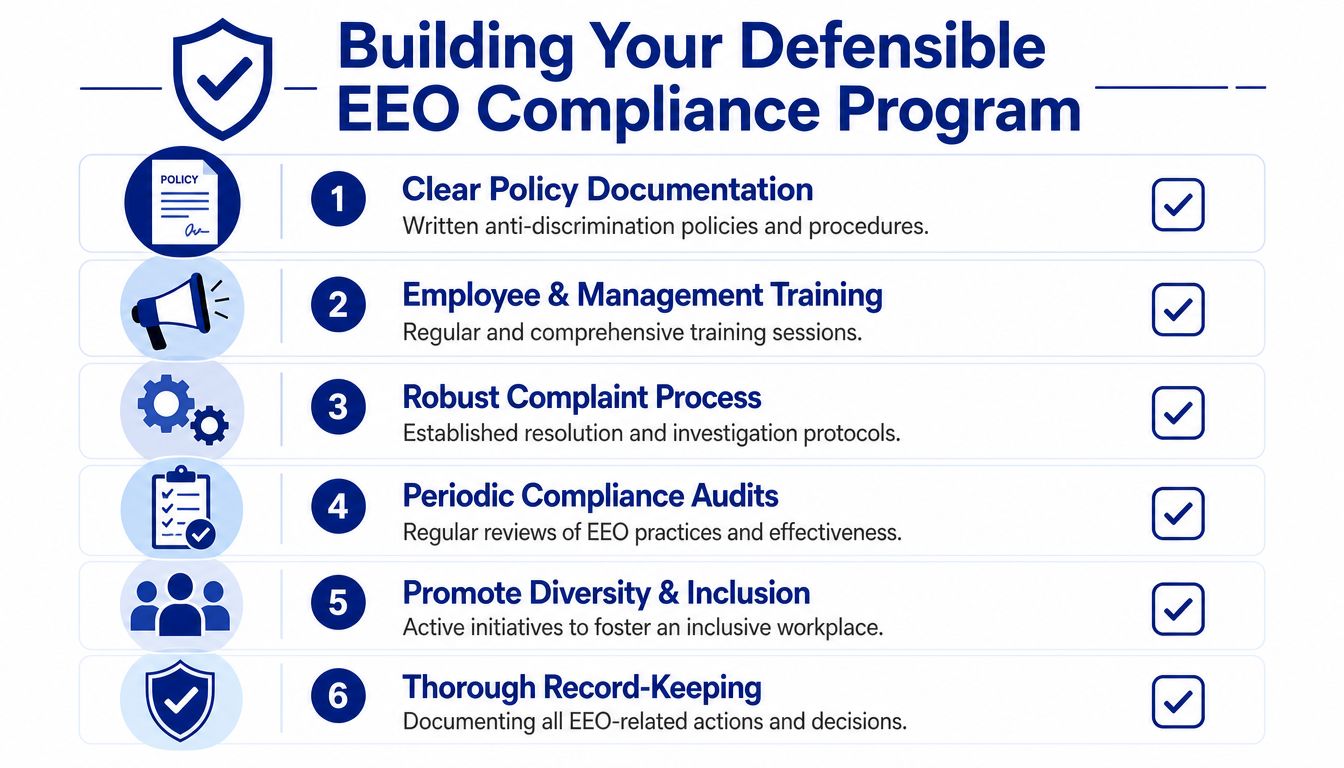
Start with policy documentation. Your handbook should clearly prohibit discrimination, harassment, and retaliation. It should also explain how employees report concerns, who can receive complaints, and what the company does after a report is made.
Don't rely on a generic template you downloaded years ago. Multi-state employers need policy language that aligns with where they operate, especially on reporting channels, accommodations, leave interactions, and complaint escalation.
A practical tip: require signed acknowledgments when policies change, then keep those acknowledgments in a place you can retrieve quickly.
Managers are where good policies go to fail. Most EEO problems don't start with a written policy. They start with a supervisor who freelances.
Your manager training should cover:
If your operation includes regulated or care-based settings, structured leadership development can support consistency. Resources like governance training for care organisations can be useful where manager judgment and accountability are tightly linked to workplace risk.
Clear ownership is mandatory. If nobody owns reporting, reporting doesn't happen.
According to Business News Daily's summary of EEO-1 filing obligations, businesses with 100 or more employees, as well as federal contractors with at least 50 employees and $50,000 in contracts, must file the annual EEO-1 Employer Information Report with the EEOC. If your business is approaching those thresholds, assign responsibility now, not later.
Keep a documented calendar for:
If your federal contracting obligations are expanding, it also helps to understand how an affirmative action plan fits into a broader compliance structure.
Leadership test: If an agency asked for your policy, your training records, your complaint log, and your reporting history this week, could you produce them quickly and confidently?
A defensible program includes periodic self-audits. Not endless meetings. Short, targeted reviews.
Look at a sample of hires, promotions, terminations, accommodation requests, and complaints from across locations. Check whether managers followed policy, whether documentation exists, and whether one site is operating differently from the rest.
Here's a practical sequence:
That's how SMBs stay ahead. Not with more paperwork. With sharper controls.
An employee complains about harassment on Tuesday. A manager gets an accommodation request on Wednesday. An agency notice shows up on Friday. For a multi-state SMB, those three moments expose the core issue. Policy language may be centralized, but execution usually is not.

The companies that stay out of trouble do three things well. They give managers clear rules, they route sensitive issues to the right owner fast, and they document each step in a way that holds up across locations. If one branch improvises while another follows process, you have a liability problem.
A sales manager tells HR that an employee reported repeated comments from a supervisor. Delay creates risk immediately. So does letting the accused supervisor “work it out” informally.
Set one complaint intake process for every location. Then require the same first steps every time: assign an investigator, preserve messages and notes, interview relevant witnesses, and warn everyone involved against retaliation. Keep the group small and controlled.
Use one investigation template across the business. It should capture the report date, allegations, witness list, documents reviewed, interview summaries, credibility assessments, findings, and corrective action. Multi-state employers need that consistency. It is how you show that Denver, Dallas, and Newark are operating under the same rules even when state law details differ.
A front-desk employee says a medical condition is affecting attendance and asks for an adjustment. A manager should not approve or deny that request on the spot. The manager should escalate it.
Your process needs four parts. Clarify the request. Identify the job duties that matter. Gather the support needed to evaluate the limitation. Assess reasonable options and document why you chose or rejected them. Apply the same discipline to religious accommodation requests.
Clear job documentation makes this easier and safer. If your job descriptions are padded with vague physical demands or inflated requirements, your accommodation analysis will fall apart under review. Fix that now with a stronger compliant job description process.
A fair process is not about saying yes to every request. It is about showing that the company took the request seriously, applied the same method each time, and kept records that support the decision.
An owner forwards an agency letter and asks whether someone can send a quick explanation. Stop that instinct. Early, sloppy responses create bigger problems than the original notice.
Centralize the response immediately, especially if you operate in several states and local managers are used to handling issues their own way. One person should control the timeline, the documents, and the communication. Preserve records at once. Review exactly what the agency requested. Match the response to your policies, prior records, and actual practices before anyone sends a word.
Use this response standard every time:
High-risk HR events expose weak systems fast. Multi-state SMBs do not need more theory here. They need repeatable, location-proof process rules that managers can follow under pressure.
You don't need a 50-item compliance project plan this quarter. You need the few actions that reduce risk fastest. For most multi-state SMBs, the right sequence is to fix foundational controls first, then tighten execution.
Do these first because they affect nearly every employment decision:
These are basic controls. If they're missing, every other compliance effort is weaker.
Once the baseline is set, focus on the people making daily decisions. Most employment risk in SMBs is manager-created, not policy-created.
Prioritize these actions:
If you're unsure whether your business is already in reporting territory, review the filing triggers and practical implications in this guide to what an EEO-1 report is.
The biggest compliance mistake after inaction is overengineering. Don't create a system your team can't maintain.
Use a simple cadence:
| Timing | Priority action |
|---|---|
| Monthly | Review new complaints, accommodation requests, and any unusual discipline decisions |
| Quarterly | Audit a sample of hiring, promotion, and termination files across locations |
| Annually | Refresh policy acknowledgments, manager training, and reporting responsibilities |
Small businesses don't need a massive compliance department. They need ownership, documentation, and repeatable judgment.
If you're operating across states, that discipline is what keeps growth from turning into preventable exposure.
If your leadership team needs help pressure-testing policies, investigations, reporting duties, or manager decision-making across states, Paradigm International Inc. can help you build a more defensible approach without adding unnecessary bureaucracy. It's a practical next step for owners and operators who want clarity before a complaint, audit, or agency notice forces the issue.