

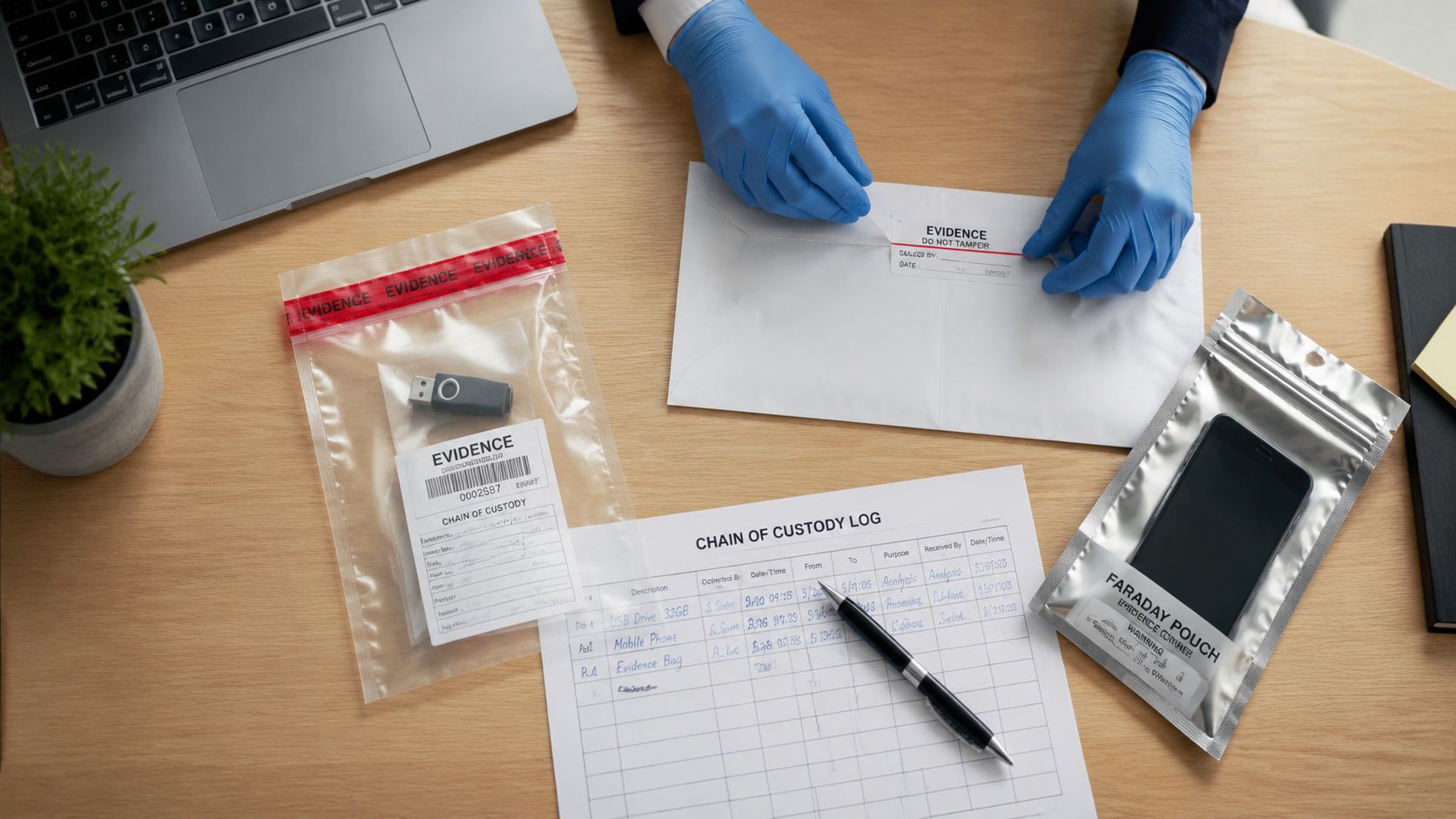
A complaint lands on your desk at 4:45 p.m. A manager says an employee altered records, the employee says the records prove retaliation, and someone mentions text messages, camera footage, and a company laptop. Most small and mid-sized businesses don't have an in-house forensics team waiting for that call. They still need a process that protects the facts, the people involved, and the company.
That's where evidence handling procedures matter. In a workplace investigation, the outcome often turns less on dramatic evidence and more on whether leaders preserved the right materials, documented each step, and avoided preventable mistakes under pressure.
A defensible investigation starts with a simple point. You're not trying to prove a criminal case. You're trying to make a fair employment decision based on the information available.
The standard in workplace investigations is preponderance of the evidence, which means it is "more likely occurred than not" rather than the higher criminal thresholds used in court, as outlined in Northwestern's workplace investigation guidance. For business leaders, that changes how evidence handling procedures should work. You don't need dramatic proof. You need reliable facts gathered and preserved in a way that shows consistency and fairness.

This standard doesn't lower the need for discipline in your process. It raises it.
If two employees tell different stories, the question isn't which person sounds more confident. The question is which account is better supported by emails, timestamps, notes, device records, witness statements, and preserved documents. A weak process makes even good evidence harder to trust.
A practical investigation framework usually comes down to three questions:
Practical rule: The first hours of an investigation often matter more than the last interview. Evidence lost early rarely comes back.
Many leaders hear chain of custody and assume it's only for criminal evidence rooms. In HR investigations, it matters for a simpler reason. It shows that the information you relied on is the same information you originally collected, and that no one handled it casually along the way.
That record becomes the narrative of your process. It shows when an item was found, who secured it, where it was stored, who reviewed it, and what happened to it at the end. Without that record, your investigation can look improvised even if the conclusion was reasonable.
A useful starting point is to align evidence handling procedures with the broader discipline used in a structured HR investigation process. The strongest investigations don't treat evidence collection as a side task. They build it into the decision-making flow from the first allegation forward.
A few trade-offs show up in almost every high-stakes matter.
| Approach | What usually happens |
|---|---|
| Fast but undocumented collection | You save time early, then lose credibility later |
| Narrow, role-based access | Fewer contamination risks and cleaner testimony about process |
| Informal screenshots and forwarded files | Metadata questions, version confusion, and disputes about authenticity |
| Contemporaneous notes | Stronger support for why decisions were made |
The most common failure isn't bad intent. It's informality. Someone forwards a screenshot, prints an email without preserving the original, or takes possession of a phone without logging it. Those shortcuts create openings that can overshadow the facts themselves.
Physical evidence in HR matters more often than leaders expect. It may be a handwritten notebook, a printed schedule, a disciplinary memo pulled from a desk, a key card, a damaged device, or a box of files stored in an office. If you collect it loosely, you'll spend the rest of the investigation explaining your process instead of evaluating the facts.
The better approach is methodical and boring. That's good. Evidence handling procedures should feel repeatable, not clever.
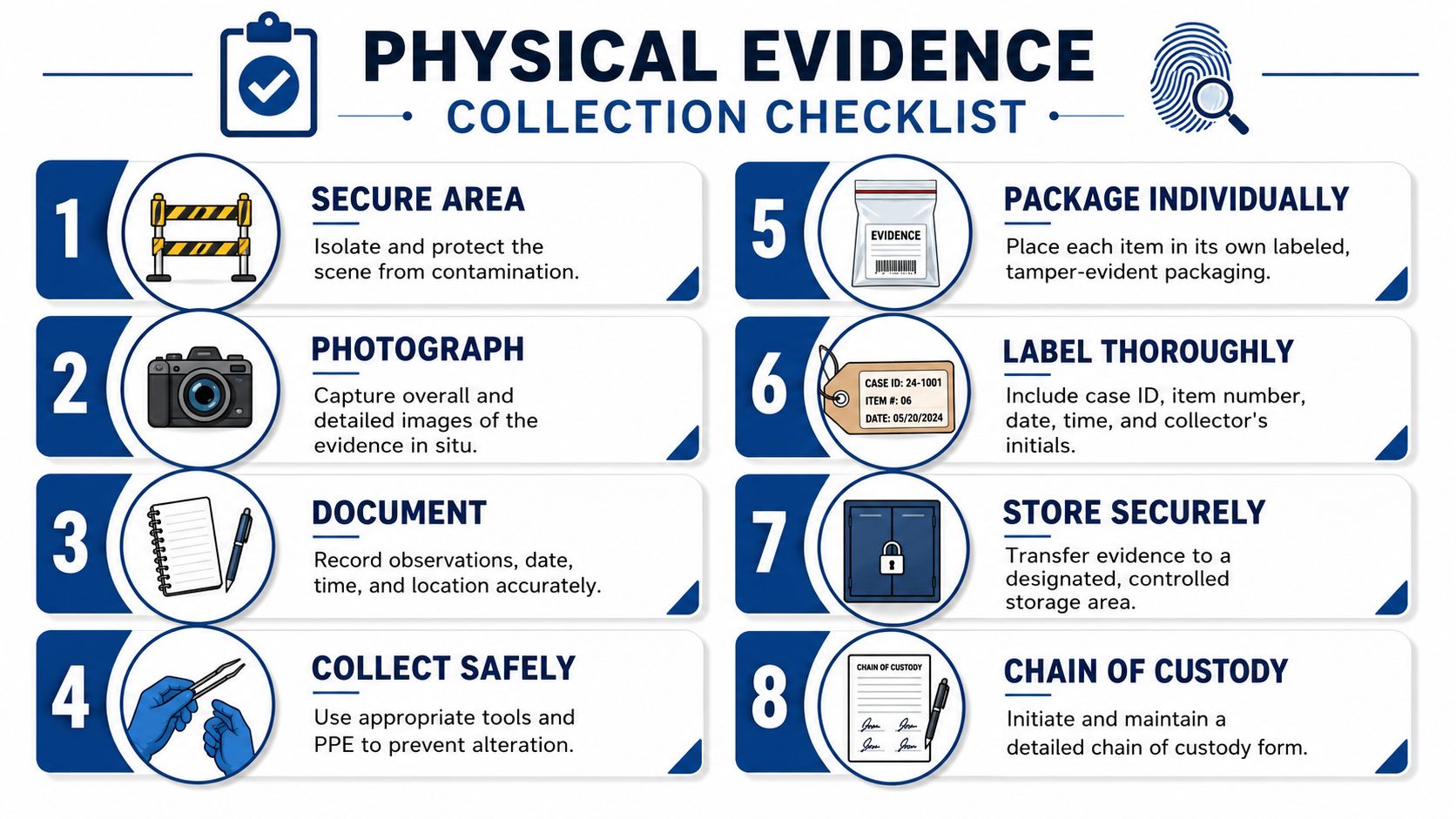
Physical evidence handling calls for ASTM-standard unique identifiers and documentation that records initial recovery, secure storage, transfers, and disposition. It also starts with pre-collection assessment, detailed photographs and notes about location and condition, and sealed tamper-evident packaging marked with item number, collector ID, description, date, and time, as summarized in this physical evidence management guide.
For an SMB leader, the workflow can be straightforward:
Decide whether the item is relevant.
Don't sweep up every paper in the room. Ask whether the item helps prove or disprove the allegation.
Document before touching anything.
Photograph the item where it was found. Capture surrounding context if that matters, such as an open desk drawer, a shared office, or the condition of a laptop on a workstation.
Record the basics immediately.
Write down where the item was located, when it was found, who found it, and any visible condition issues.
Package each item separately.
A manager's notebook shouldn't share packaging with printed emails or a USB drive. Separate packaging reduces contamination and confusion.
Seal and label the package.
Use tamper-evident packaging whenever possible. If you don't have formal evidence bags, use the most secure sealed option available and log exactly what you used.
Move it to controlled storage.
Don't leave collected items in an unsecured office, conference room, or car overnight unless there's no alternative and you document that temporary storage decision.
Suppose HR receives a report that a supervisor kept handwritten notes about employee complaints that were never entered into the official file. The notebook sits in the supervisor's office.
The wrong move is to grab it, flip through it at the desk, and carry it back to HR while answering emails. The stronger move is to photograph it in place, note the office location and condition, secure it in a sealed container, label it, and log who took custody. If the contents later become important, you can show the notebook wasn't casually handled or altered.
If an item may become important later, preserve first and interpret second.
Small companies often don't fail because they ignored evidence entirely. They fail because they treated collection like ordinary office work.
A short checklist helps teams stay disciplined:
Businesses don't need a law enforcement setup to do this well. They need consistency. A simple written procedure, used the same way every time, is far stronger than an improvised response by well-meaning managers.
Digital evidence is where many workplace investigations go off track. A printed memo usually stays what it is. A phone, laptop, email account, Slack workspace, or HRIS record can change the moment someone opens it, forwards it, or lets it stay connected to a network.
That matters because digital evidence handling procedures aren't just about finding information. They're about preserving integrity while avoiding accidental alteration of timestamps, metadata, or account contents. The risk grows when a business operates across states or holds employee data subject to different privacy expectations. Leaders who need a policy baseline often benefit from understanding the practical limits discussed in employee monitoring laws.
Digital materials can disappear through routine deletion, remote wipe, sync activity, or ordinary user access. Even a well-intentioned manager can damage evidence by opening files on the original device and changing access dates or metadata.
A recurring governance gap appears here. One source notes that 38% of law enforcement agencies lack clear retention policies for biological evidence in a broader discussion about evidence governance challenges and the unresolved application of these standards in decentralized digital environments, which is relevant to SMB leaders dealing with cloud-based records and cross-jurisdictional data handling in this NIJ-related discussion. The lesson for employers is qualitative but clear. If large institutions struggle with retention discipline, smaller employers shouldn't assume their current digital practices are defensible.
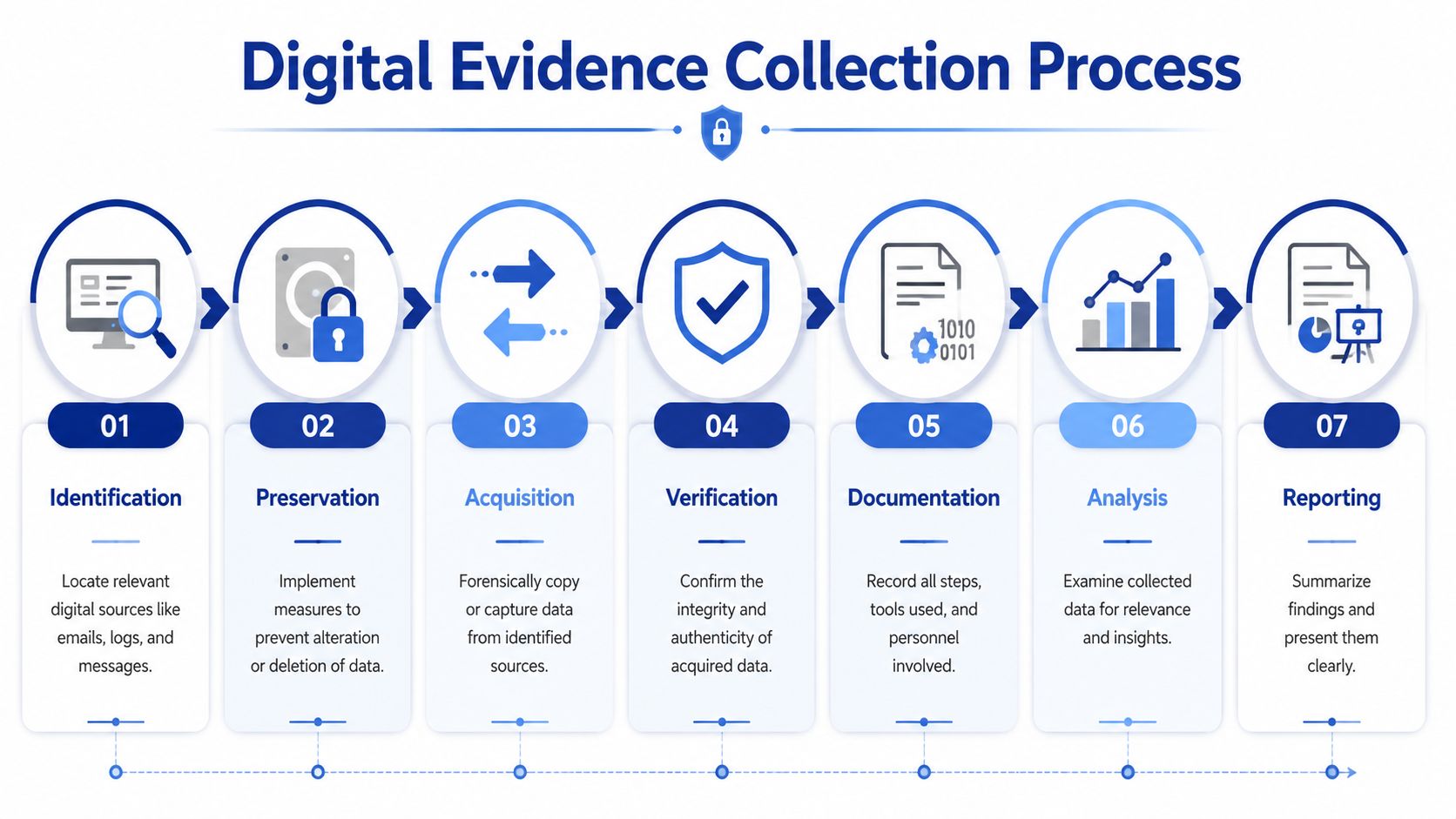
Expert digital evidence handling requires creating a bitwise forensic image with SHA-256 hash verification, while the original device is never analyzed directly. The core protocol includes photographing the device, isolating it from the network, verifying the image hash, and storing the original securely, as described in this digital evidence handling guide.
For non-specialists, the immediate response should look like this:
Delayed documentation creates doubt. Real-time notes create a record.
You don't need to perform forensic imaging yourself to make a defensible first move. You do need to avoid the mistakes that destroy later options.
A simple decision table helps:
| Situation | Best immediate action |
|---|---|
| Company laptop may contain altered files | Secure device, restrict access, document who had possession |
| Employee phone may hold relevant texts on a company matter | Preserve status, limit access, get legal guidance before collection scope expands |
| Slack or email records may be deleted | Work with admin access to preserve exports and suspend deletion where authorized |
| Security footage may overwrite automatically | Preserve footage immediately before the retention cycle removes it |
The biggest practical error is overconfidence. HR teams sometimes assume screenshots are enough. Often they aren't. Screenshots can help orient the investigation, but they are not a substitute for preserving the underlying record in a way that can be authenticated later.
Strong evidence can still fail under scrutiny if the documentation is weak. Chain of custody is where many investigations become either defensible or vulnerable. Leaders often think of it as paperwork. In practice, it's the audit trail that proves your evidence handling procedures were disciplined from the first touch to final storage.
The core requirement is specific. According to ASTM standards, every evidence item must include five data points: item number, case number, collector ID, date of collection, and a brief description. Failing to include any of those details, or failing to use tamper-evident packaging and document the full chain from recovery to disposition, is a primary cause of inadmissibility, as explained in this ASTM-based evidence handling overview.
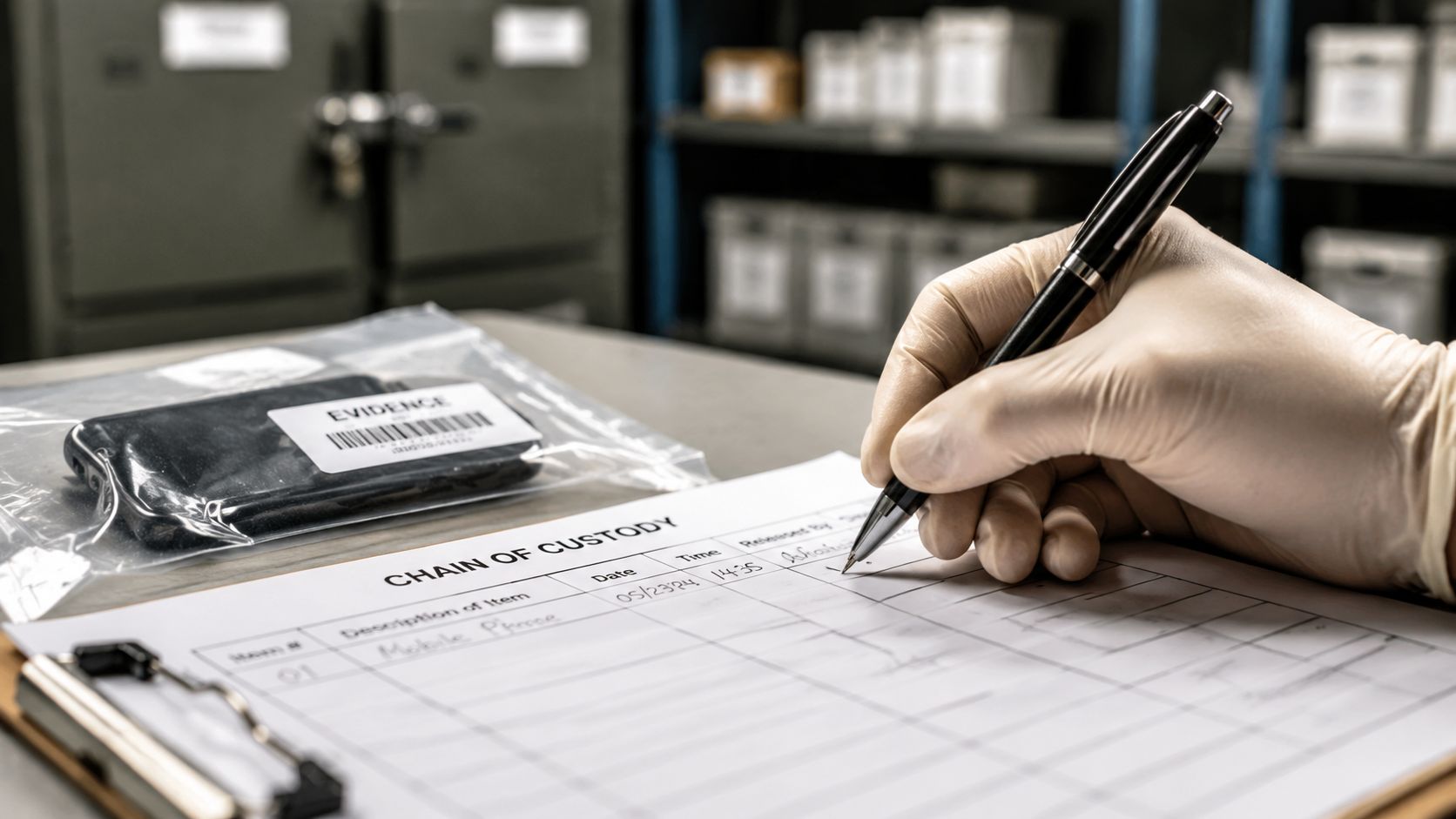
A usable chain-of-custody record answers a series of plain questions.
| Field | Why it matters |
|---|---|
| Item identifier | Distinguishes this item from every other item in the case |
| Case identifier | Ties the evidence to the correct investigation |
| Collector identity | Shows who first secured the item |
| Collection date | Establishes timing and sequence |
| Brief description | Prevents confusion about what was actually collected |
| Transfer entries | Shows every handoff and each purpose |
| Storage location | Proves controlled possession |
| Final disposition | Closes the record cleanly |
That record shouldn't be reconstructed from memory. It should be updated each time custody changes.
The weak point is often a handoff that felt too routine to log. A company laptop goes from HR to IT. Printed text messages move from a manager to outside counsel. A flash drive sits with an executive for a weekend review. Each unrecorded transfer gives the other side room to argue the evidence may have been altered, mixed up, or selectively handled.
This is especially important for digital records. Teams trying to improve their process around building credible digital evidence often realize the issue isn't only collection. It's proving who exported the data, where the original file lived, and what happened between export and review.
Key judgment call: If you can't identify who had the item at each stage, assume you'll have trouble defending it later.
An SMB doesn't need a complicated evidence management platform to maintain chain of custody. A controlled form, used every time, is enough if it's complete.
Include these prompts on the form:
What doesn't work is partial compliance. A beautifully labeled envelope doesn't fix a missing transfer log. A detailed spreadsheet doesn't help if three people accessed the evidence room without notation. The record has to stay unbroken.
Many investigations are damaged after collection, not during it. The organization preserves the right records, then undermines its own position by storing them loosely, granting broad access, or letting routine deletion continue. Good evidence handling procedures don't stop when the item is bagged or the export is saved.
Storage and access control aren't administrative extras. They're risk controls. They show that the company treated the matter seriously and protected the integrity of the materials while the investigation was active.
Only people with a clear role should have access to evidence. In a small business, that may mean one HR lead, one executive sponsor, and one IT custodian for technical preservation. It should not mean every manager who is curious about the matter.
Use a controlled approach:
If your company is formalizing physical storage, operational references like a complete guide to evidence room planning can help leadership think through layout, control points, and handling flow without overbuilding the solution.
Investigators must take immediate action to preserve materials that might be "routinely (or pre-emptively) deleted," including security footage, company emails, and personnel records, because failure to preserve them before the investigation begins can invalidate the process, according to the Employers Council guidance on workplace investigations.
That means a legal hold, or at minimum a clear internal preservation notice, should go out as soon as the business reasonably anticipates the need to investigate relevant facts. Waiting until after interviews begin is often too late for footage, messaging data, or auto-deleting logs.
A practical notice should be clear enough for non-lawyers to follow. It doesn't need legal jargon to work.
Include:
A legal hold also reduces inconsistent behavior. Without one, one manager saves texts while another deletes messages under ordinary retention habits. That inconsistency creates avoidable exposure.
Strict storage and access control also protect the accused, not just the company. If witness statements circulate too widely, people talk. Accounts shift. Retaliation concerns grow. Rumors fill gaps that should remain confidential within the people who need to know.
That same principle applies when speaking with witnesses. Investigators should never promise absolute confidentiality. The correct approach is to explain that information will be shared only with people who need to know, as stated in Maynard Nexsen's workplace investigation best practices. That language is more honest, and it aligns with how defensible investigations work.
A sound report shows that the investigation was objective, disciplined, and tied to evidence rather than instinct. If the evidence handling procedures were solid, the report should read cleanly because the underlying record is clean.
Investigation reports should separate Findings of Fact from Recommendations for Corrective Action. They should also include an executive summary, the allegations, and a summary of steps taken, including who was interviewed and what evidence was reviewed, as outlined in this workplace investigation reporting guide. That separation matters because it shows the company first determined what likely happened, then made an employment decision.
A defensible report usually includes these parts:
If you're assembling multiple exhibits, interview notes, screenshots, and logs into a single file for review, a simple utility like Merge PDF can help organize the appendix set into a cleaner packet.
The report should avoid loaded language. It should also avoid hiding uncertainty. If evidence conflicts and the record doesn't support a clear conclusion, say that. "Inconclusive" is often more defensible than stretching weak facts into a finding the documentation can't support.
A useful drafting discipline is to ask whether each conclusion points back to preserved evidence, a documented interview, or a recorded fact pattern. If it doesn't, it may be commentary rather than a finding. Teams that want a stronger reporting format often start with a structured workplace investigation report template so the final document stays consistent across matters.
The report is where process becomes proof. If your handling was disciplined, your conclusions are easier to defend.
A strong close also addresses what happens next. Identify any corrective action owners, retention expectations for the file, and whether follow-up monitoring is needed. That keeps the investigation from ending as a memo that sits in a folder without operational follow-through.
When a complaint exposes legal, operational, and reputational risk at the same time, leaders need more than generic HR advice. Paradigm International Inc. works with SMB owners, executives, and HR leaders who need defensible judgment, disciplined documentation, and steady guidance during high-stakes workplace investigations.


