Retaliation accounted for 56.8% of EEOC charges in fiscal year 2023, with 46,047 retaliation charges out of 81,055 total charges, according to the EEOC's civil rights enforcement history, which identifies retaliation as the most frequently alleged category since fiscal year 2010. For an owner preparing to dismiss someone who complained weeks earlier, the immediate problem is practical: can the company explain the firing without making the complaint part of the reason?
Firing an employee after a complaint isn't automatically unlawful. Under the federal anti-retaliation framework administered by the EEOC, the central issue is whether protected activity caused the adverse decision. For a termination being considered in 2026, leadership should examine the applicable law and the actual decision record before approving the meeting.
The EEOC figures describe allegations, not findings that employers violated the law. They don't establish the likelihood that a particular employee will bring or win a claim. They do justify treating a post-complaint termination as a decision requiring independent review, rather than routine offboarding.
An owner may know that an employee has struggled for months. The file may tell a different story: acceptable reviews, no written warnings, and an urgent recommendation to terminate immediately after a complaint. That mismatch deserves attention before anyone drafts a termination notice.
The following checks identify where the proposed decision needs stronger support. The legal frameworks behind leave, disability, and group complaints require separate review, not just a manager's assurance that the complaint was irrelevant.
| Risk signal | What it looks like | Why it matters | Check first |
|---|---|---|---|
| Close timing | Firing days or weeks after the complaint | Timing can support an inference of motive | A dated conduct or performance record from before the complaint |
| Decision-maker knew | The person approving the firing heard or handled the complaint | Knowledge connects the complaint to the decision | Who knew about the complaint and on what date |
| Shifting reason | The explanation changes after the complaint | Inconsistent reasons weaken the file | One written reason tied to specific facts |
| Uneven discipline | Coworkers with the same conduct were not fired | Uneven treatment suggests the complaint changed the outcome | Names and outcomes for similarly situated employees |
| Leave or medical overlap | The firing follows FMLA, ADA, or a complaint about leave | Under the FMLA, using protected leave as a negative factor is prohibited | Conduct facts separated from leave dates and restrictions |
| Group workplace complaint | Pay, safety, schedules, or conditions raised for coworkers | Under the NLRA, concerted activity can be protected without a union | Whether the employee spoke only about a personal issue |
A weak row is a reason to pause, not a verdict on the case. Missing documentation doesn't establish retaliation. It means the person approving the firing needs to investigate the gap rather than fill it with assumptions.
A delay should have a defined purpose. Assign someone to retrieve the relevant records, reconcile conflicting accounts, and identify the decision that management proposes. Don't allow several managers to develop different explanations while that review is underway.
Waiting alone doesn't improve a weak decision. A later firing based on the same unsupported explanation still leaves the central question unanswered. Conversely, a newly discovered, serious incident requires a factual review, not an automatic assumption that discipline must stop because a complaint exists.
Practical rule: The company needs evidence supporting the decision, not merely confidence in the manager recommending it.
A leader already facing a challenge can also benefit from understanding the records involved in responding to a wrongful termination suit. Before termination, that perspective helps identify what a later reviewer would struggle to understand. For a high-stakes post-complaint firing, outside HR review and qualified employment counsel are worth involving before acting.
A complaint made at work isn't automatically protected. A disagreement about a manager's style differs from a report of unlawful discrimination, denied leave, unsafe conditions, or group workplace concerns. The actual words and surrounding circumstances matter more than the employee's chosen label.
Changing the referee immediately after a foul is called raises an obvious question about why the change occurred. A similar question arises when management changes an employee's treatment after a complaint. The comparison identifies the issue; it doesn't decide whether any law was violated.

For a 2026 review, Title VII of the Civil Rights Act of 1964, enforced by the EEOC, protects qualifying opposition to suspected discrimination or harassment and participation in protected proceedings. Employees don't need legal vocabulary, and an unsupported allegation doesn't necessarily eliminate protection. Participation and opposition have different requirements, so counsel should assess disputed coverage.
In Burlington Northern & Santa Fe Railway Co. v. White, decided June 22, 2006, the Supreme Court held that Title VII's retaliation protection extends beyond discrimination in employment terms. The question is whether the action might dissuade a reasonable worker from making or supporting a discrimination complaint. Reassignment, suspension, surveillance, or undesirable duties can therefore require review alongside firing and pay reductions.
Other frameworks also matter:
The NLRB's protected concerted activity guidance explains that a single employee may qualify by bringing a group complaint, acting with coworkers' authority, or initiating group action; charges generally must be filed within six months. It also identifies limits involving egregiously offensive conduct and knowingly and maliciously false statements.
Use working categories: personal grievance, EEO complaint, leave complaint, safety report, or group working-conditions complaint. More than one category may apply. Don't classify a report as a general gripe merely because the employee expressed anger.
State exceptions also deserve attention. For Connecticut operations, Kons Law's resource on understanding Connecticut at-will employment exceptions offers useful context for counsel discussions. An at-will label isn't a substitute for identifying protected activity.
The useful management test is whether the same firing would have happened without the complaint. That's a decision audit, not a substitute for the causation standard under the governing law. A real performance problem can exist while the decision to accelerate termination still requires scrutiny.
The EEOC's retaliation guidance questions and answers identifies timing, inconsistent explanations, witnesses, and preexisting documentation as relevant causation evidence. For a 2026 review under the federal EEO laws the agency enforces, the employee's earlier awareness of performance concerns also matters. A warning discussed before the complaint is different evidence from a manager's later recollection that warnings were probably given.
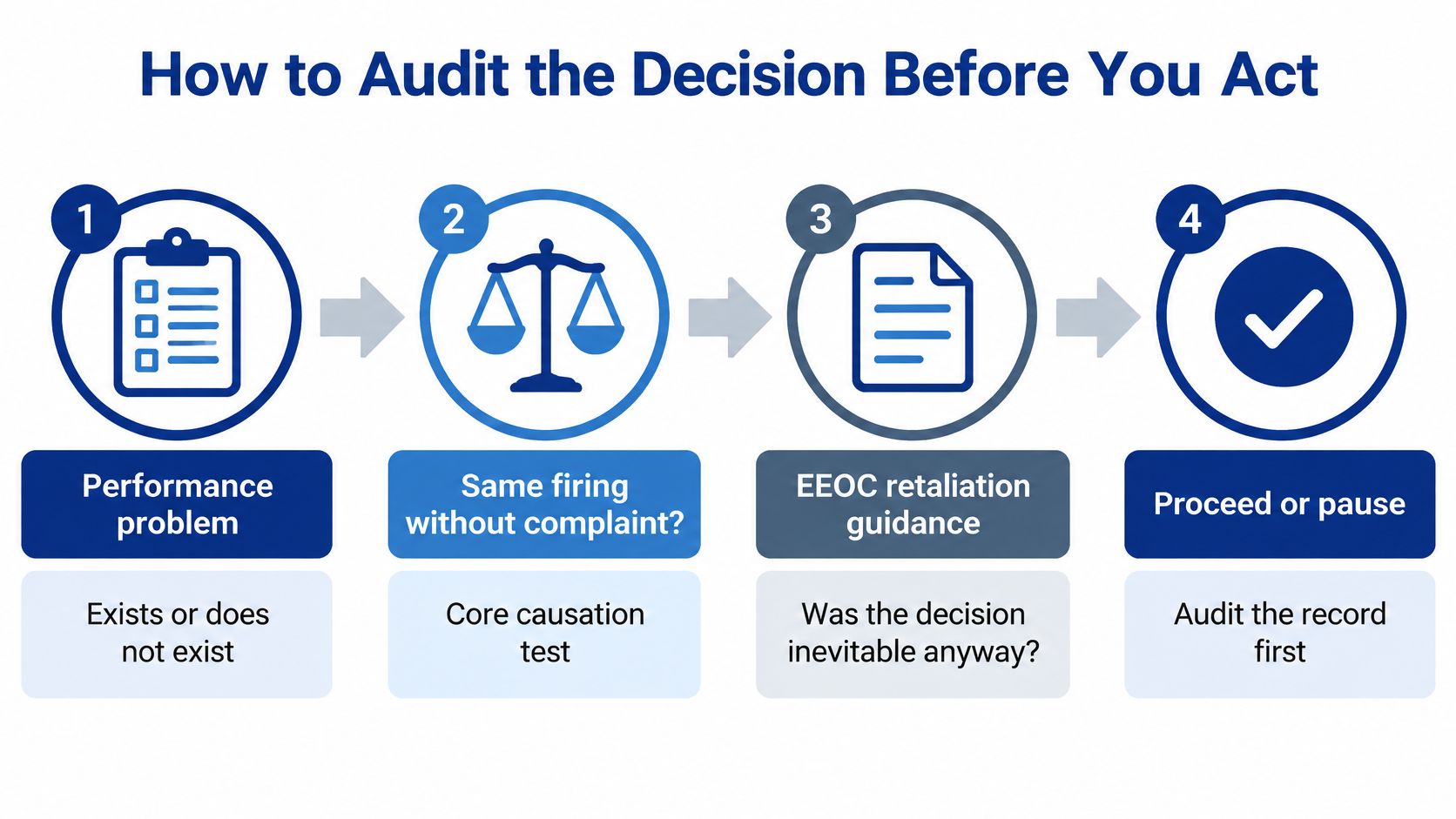
Preserve the complaint and its context. Save the original message, intake notes, date, exact concern, and surrounding communications. Preserve originals rather than relying on a manager's shortened summary.
Map who knew and when. Include the proposed approver, the recommending manager, and anyone supplying evidence. An owner's lack of knowledge doesn't resolve questions about information supplied by others.
Separate investigation and decision roles where practical. Use an uninvolved reviewer when the company lacks enough people for fully separate assignments. Record who reviewed the recommendation and what information that person examined.
Write the business reason in a sentence. Tie it to observable facts, such as a specific unauthorized transaction or repeated errors after instruction. Terms such as difficult or disloyal don't explain what happened.
Compare similar employees. Examine relevant roles, conduct, disciplinary history, and applicable rules. Record meaningful differences rather than selecting only examples that support termination.
Test whether termination was already underway. Retrieve dated recommendations, approvals, warnings, or meeting notes. A manager's statement that termination had been considered isn't equivalent to evidence of a settled decision.
Add new facts without changing old records. Use a current, dated supplement explaining what was discovered and how. Don't rewrite earlier reviews to make the history appear more consistent.
Pause for expert help when the review exposes material concerns. Close timing, a new explanation, accelerated discipline, harassment allegations, or leave and disability overlap justify review before acting. Involve qualified employment counsel for legal conclusions and an experienced HR advisor for investigation and decision structure.
The reviewer should be willing to recommend a different action. That may mean further investigation, consistent corrective action, or postponement while missing facts are verified. An audit completed only to endorse a predetermined firing has little management value.
This is an HR consulting firm, not a law firm. Its decision review provides structure, not a legal conclusion, and completing an audit doesn't prevent a lawsuit. The practical considerations in high-stakes firing decisions for business owners help distinguish an understandable business concern from a sufficiently supported employment decision.
An unsubstantiated complaint doesn't erase protection, and a policy violation doesn't automatically justify firing. Those shortcuts skip the important work of determining what occurred and why management proposes a particular response. A finding of insufficient evidence also isn't a finding that the employee knowingly lied.
The Department of Labor's employer retaliation guidance explains federal protections for reporting discrimination, participating in investigations, and serving as a witness, even when the underlying allegation isn't substantiated. For a 2026 decision under EEOC-enforced laws, protected activity doesn't provide blanket immunity for unrelated misconduct. Management still needs to distinguish independently verified conduct from the report itself.
Close the complaint with a neutral account of the allegation, interviews, documents, and finding. Use substantiated, unsubstantiated, or inconclusive only when the record supports that description. Avoid language suggesting the company proved dishonesty merely because witnesses disagreed.
A complaint about harassment paired with a proposed firing is worth expert help before acting. The same applies when the investigation begins focusing on the complainant's tone rather than the alleged conduct. Leadership's frustration isn't an investigation finding.
An unproven allegation and a proven policy violation are separate findings. Neither should be used as shorthand for the other.
The conduct review should identify:
In the manufacturing plant case, the company interviewed 8 employees, reviewed camera footage and timecards, and documented 5 separate violations of company conduct policy. Those are concrete investigative activities, not a conclusion drawn from someone's reputation or management's reaction to a complaint.
For multi-state employers, inconsistent manager handling deserves its own review. One location may coach conduct that another treats as grounds for dismissal. Paradigm International's handbook compliance guide provides context for checking whether local managers are applying the correct policy.
The 2026 NLRA review should also screen for group concerns about pay, safety, scheduling, or conditions. A report presented by an individual may still concern coworkers. If the only new fact supporting termination is that the employee complained, the conduct review hasn't established an independent reason.
A leave or medical complaint adds another legal framework to the termination review. Leadership must distinguish attendance or conduct issues from protected absences, medical restrictions, and requests requiring assessment. A payroll absence code doesn't establish that an absence should count toward discipline.
Under the FMLA, 29 U.S.C. § 2601, administered by the U.S. Department of Labor, interference and retaliation protections apply to qualifying leave activity; Section 105 and 29 C.F.R. § 825.220 prohibit using protected leave as a negative factor in employment decisions, as explained in the DOL's FMLA guidance. For a 2026 coverage review, distinguish the employer threshold from employee eligibility: federal FMLA generally covers private employers with 50 or more employees, while employee eligibility generally includes 12 months of service, 1,250 hours in the preceding 12 months, and 50 employees within 75 miles of the worksite. Coverage requires checking the complete rules, not just company headcount.
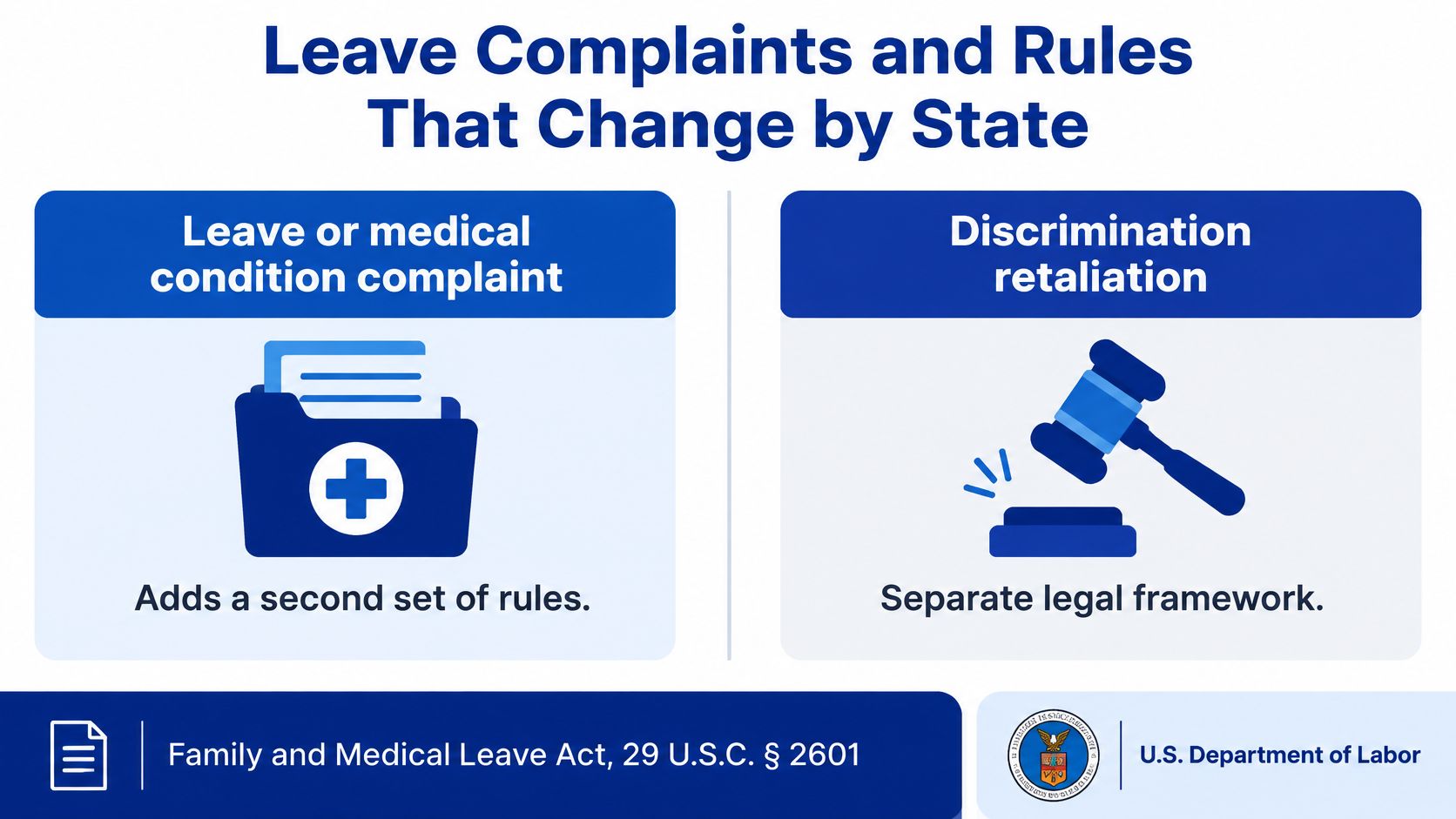
A 2026 multi-state review cannot apply the headquarters state's approach everywhere. The relevant differences include both leave coverage and separate discrimination or discharge protections. Qualified counsel should confirm the current requirements before a sensitive termination.
| State | Framework requiring attention |
|---|---|
| California | CFRA covers employers with five or more employees. The California Civil Rights Department also administers FEHA discrimination and retaliation protections. |
| New York | The New York State Human Rights Law, administered by the Division of Human Rights, applies to employers of all sizes. Separate leave requirements also require review. |
| Florida | Florida has no general private-employer equivalent of federal FMLA. Federal coverage remains an initial check, alongside other applicable protections. |
| Montana | The Wrongful Discharge from Employment Act limits discharge differently from the usual at-will framework and requires a separate state-law assessment. |
At-will employment doesn't override statutory protections. The ADA, enforced by the EEOC, may also require a separate assessment when restrictions or accommodation requests overlap with leave. A manager shouldn't treat an exhausted leave balance as the complete answer to a disability-related situation.
Review whether the termination recommendation changed after a leave request, certification dispute, absence, or complaint about administration. Identify which absences management counted and remove assumptions about medical restrictions. Benely's leave compliance guidance for HR teams can help organize the administrative questions for expert review.
For a leave and PTO eligibility case, the team reviewed the employee's work status, medical restrictions, and employer policy language, then guided leadership on a consistent, defensible response. In a separate multi-state case, the team paused a sensitive termination and rebuilt the client's handbook with a focus on enforceability across all operating states. Both examples show why the underlying records and applicable policies matter more than a manager's summary.
Termination, leave, and disability overlap warrants expert help before acting. The reviewer needs the employee's actual work status and restrictions, not a conclusion that the employee is unavailable.
The file should let a later reader understand the decision without guessing. Assemble a dated decision memorandum and attach the records it relies on. The memorandum should describe the evidence available at the time, including material gaps or conflicting accounts.
Keep the complaint investigation and employment decision linked but distinct. Medical information should remain appropriately restricted rather than copied throughout the personnel packet. A decision-maker can document relevant restrictions without circulating unnecessary medical detail.
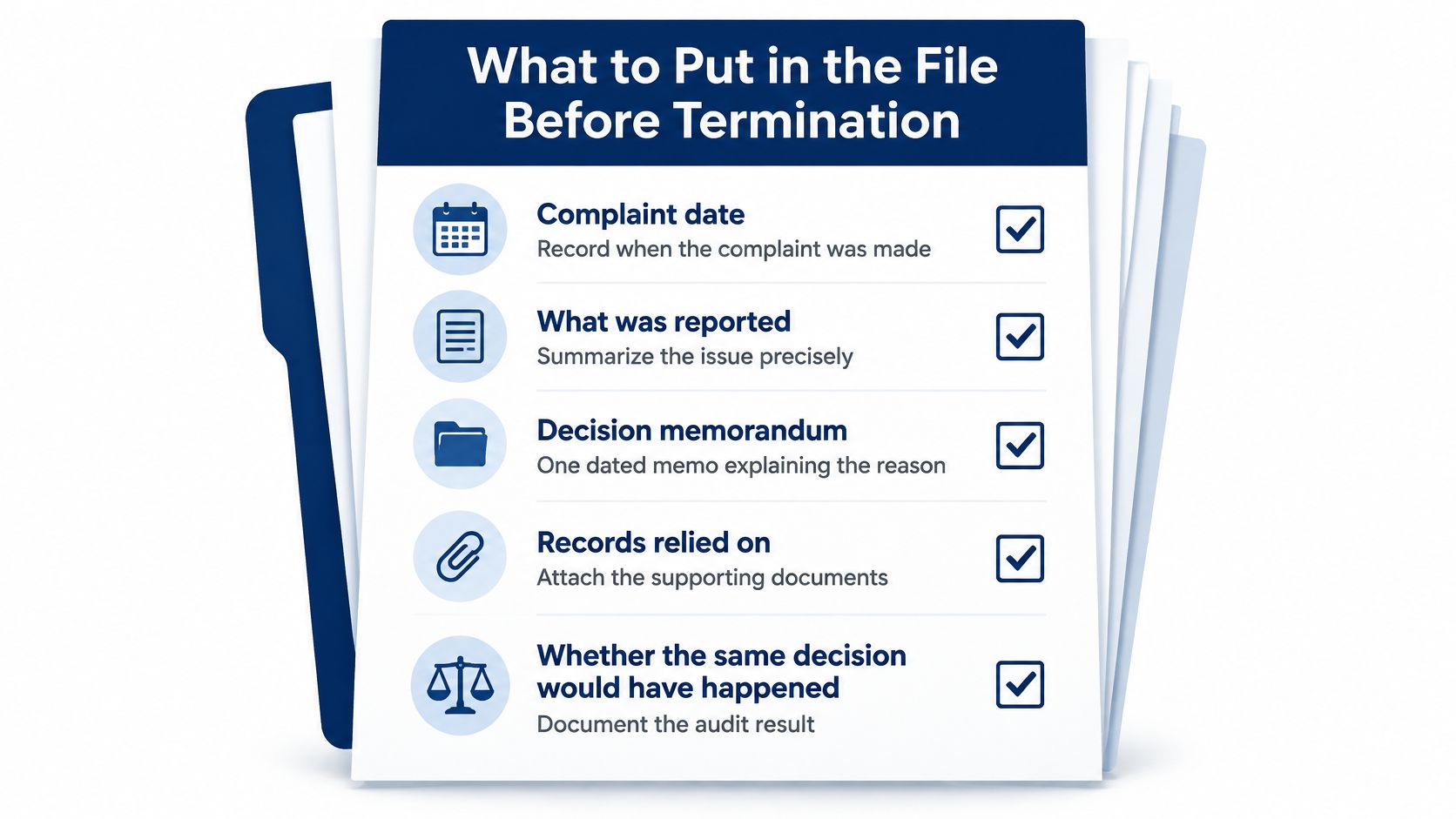
Don't backdate warnings, revise old reviews, or add unsupported descriptions of attitude. A current note may accurately record a manager's recollection, but it must be identified as a recollection created now. It must not masquerade as a contemporaneous warning.
File discipline: If a necessary document doesn't exist, pause and assess the gap. Don't manufacture the history the decision needs.
HR recordkeeping templates from Paradigm International can help organize the packet, but a completed form can't replace missing facts. The process includes a written investigation report with conclusions and next steps, with its work documented so decisions are supported if challenged. That packet supports an explanation; it doesn't guarantee a result.
Approve the decision only when the independent business reason and supporting evidence withstand review. Relevant proof may predate the complaint or come from a separate, properly documented conduct investigation. Comparable treatment, decision-maker knowledge, and the sequence of events should be clear enough that an uninvolved reviewer can follow them.
Pause when the reason first appeared after the complaint, explanations changed, or discipline accelerated without a supported explanation. An investigator who also recommends termination needs meaningful independent review, especially when that person is implicated in the complaint. Leave, disability, harassment, safety, and group concerns justify outside review before the meeting is scheduled.
The owner doesn't need a thicker file merely for its own sake. The owner needs an accurate account, a consistent standard, and a recommendation that addresses inconvenient facts. If the evidence supports a different response, leadership should change the response rather than reshape the record.
Paradigm's Terminations and Separations service gives a plain recommendation before the client acts and supporting documentation afterward. That is HR decision guidance across states, not legal advice or a promise about claims or lawsuits. A discussion of the actual file is a useful next step before a sensitive separation.
International Inc. offers post-complaint decision support, impartial workplace investigations, and multi-state policy review for owners handling difficult employment decisions. Owners can visit Paradigm International Inc. to learn how those reviews connect the proposed firing to the underlying evidence.
This article is general information, not legal advice. Employment laws change and vary by state; consult qualified employment counsel about your situation.