


A Florida manager has a new employee starting Monday, payroll runs through a PEO, and the owner assumes someone else handles employment verification. Meanwhile, employees in other states may affect whether the business falls under Florida's E-Verify requirement. The immediate problem isn't choosing software. It's knowing which entity must act, who owns the deadline, and where the proof will be stored.
A Florida business reaches 25 employees, and its onboarding obligations change. Under Florida Statutes § 448.095 (2023), private employers with 25 or more employees must use E-Verify for each new employee hired on or after July 1, 2023. The 2023 Florida statute sets the coverage rule. It applies to new hires, not as a blanket requirement to rerun existing employees.
Florida E-Verify coverage by employer situation
| Situation | E-Verify required? | Basis |
|---|---|---|
| Private employer with 25 or more employees, new hire in Florida | Yes, for each new employee | Florida Statutes § 448.095 (2023), effective July 1, 2023 |
| Private employer with fewer than 25 employees | No Florida private-employer E-Verify mandate | Florida Statutes § 448.095 (2023) |
| Employee hired before July 1, 2023 | Not required solely because of the expansion | Florida Statutes § 448.095 (2023), applies prospectively |
| Public employer or certain public contractor | Yes, under the existing public-employer and contractor requirements | Florida Statutes § 448.095 (2023) |
| Fewer than 25 employees in Florida but 25 or more company-wide | Get a documented coverage determination | Confirm the employing entity and counting method with employment counsel |
Federal Form I-9 requirements apply to employers regardless of whether Florida's private-employer E-Verify threshold covers them. Florida Statutes § 448.095 (2023) adds E-Verify for covered employers. Federal E-Verify participation is generally voluntary for private employers unless another law or contract requires it.
For a business with employees in several states, review the company-wide workforce and identify the legal employing entity before deciding whether the Florida threshold applies. A Florida location report alone may not resolve affiliate or co-employment questions. Ask employment counsel to assess those facts.
Practical rule: A payroll platform's ability to run E-Verify does not establish that the employer is enrolled or that a case was created.
Build the coverage check into offer approval and onboarding assignments. A clear hiring compliance process for employers should identify who checks the headcount, confirms the employing entity, and assigns the verification task before a new hire starts.
The process has two tracks: employers complete Form I-9 for new hires, and covered employers also use E-Verify. Under Florida Statutes § 448.095 (2026), employment eligibility verification must occur within three business days after the first paid workday, with covered private employers using E-Verify, as stated in the 2026 Florida statute. The practical response is a timed assignment with a primary owner and a backup.
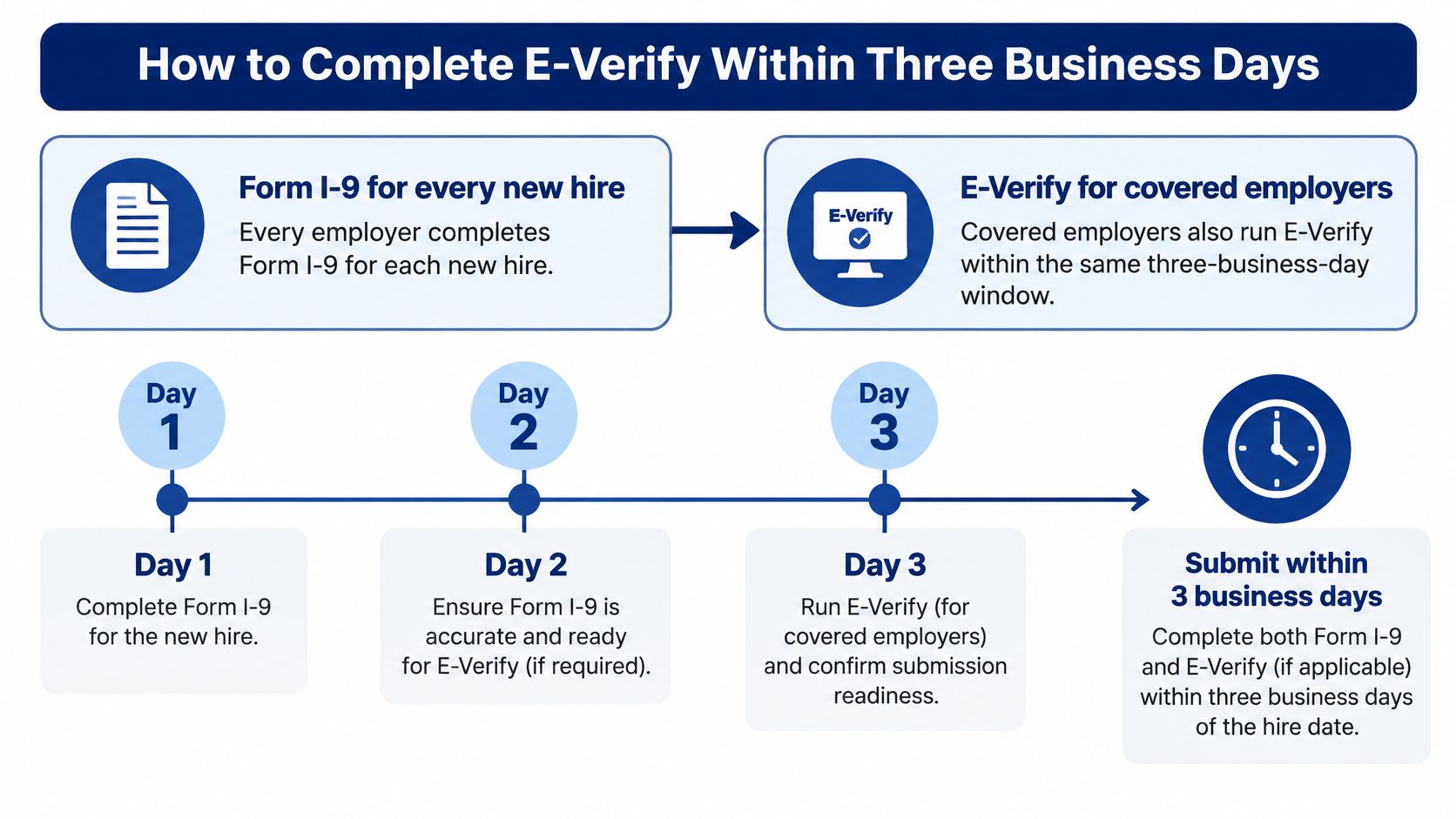
Confirm coverage and record the first paid workday. The onboarding owner should identify the employing entity, work location, and applicable verification process before opening a case. The common mistake is tracking the offer date or payroll processing date instead of the employee's actual first paid workday.
Complete Form I-9 Section 1 first. Under federal Form I-9 requirements administered by USCIS in 2026, the employee completes this section no later than the first day of work for pay. Running E-Verify before the underlying form is ready creates an avoidable sequencing problem.
Finish document review and create the case. The authorized representative completes Form I-9 Section 2 under the federal process, and the assigned E-Verify user submits the covered hire within Florida's statutory window. The owner should check the actual case submission, not accept an onboarding status marked complete as proof.
Review the response rather than merely submitting. Under the federal E-Verify process applicable in 2026, an employment-authorized result should be handled through the system's applicable completion instructions. A tentative nonconfirmation requires employee notification and access to the federal resolution process, not a manager's independent judgment about eligibility.
Preserve the transaction trail. The administrator should record the case number, result date, and person responsible for the submission. A generic administrator login or an unassigned task makes later questions harder to answer.
A workable process can't depend on the only trained administrator being available every morning. The business should assign a backup, test that person's access, and establish an escalation route for incomplete forms or system problems. A reminder that goes to an unattended inbox isn't an effective control.
The hiring manager should report start-date changes immediately. Payroll should confirm the first paid workday, while the verification owner manages the case itself. Those are different responsibilities, even when a small company assigns them to the same person.
An owner doesn't need to inspect every completed case. A short exception report showing missing submissions, unresolved responses, and unassigned tasks is more useful. The related records should let a reviewer trace each employee from the hiring list to a completed verification transaction.
A hire who works from Florida can affect the company's onboarding process even when the employer's headquarters and payroll team are elsewhere. Under Florida Statutes § 448.095, as amended by Senate Bill 1718 in 2023, employer identity and Florida business connections matter. The enrolled bill sets out the relevant statutory language. Don't let a payroll location code or local manager decide which legal entity employs someone.
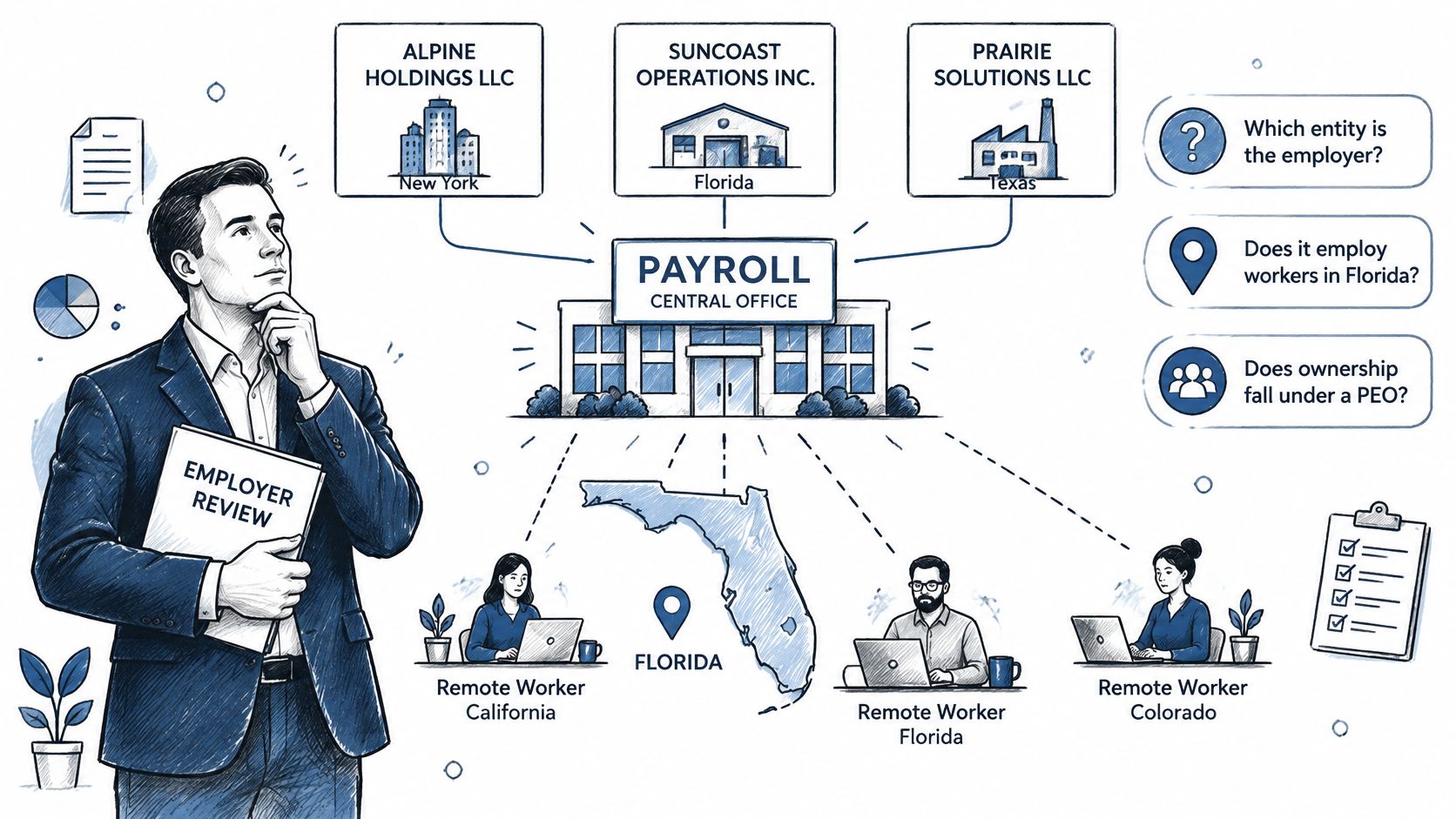
Identify the employing entity. Compare the offer letter, payroll record, and named employer. Resolve any mismatch before relying on the onboarding workflow.
Locate the employees. Include remote employees who work in Florida, not just those assigned to a Florida office. A headquarters designation or mailing address may not show where the employee performs work.
Document the counting method. Start with a company-wide workforce report. Separate legal entities, then refer questions about affiliates, staffing arrangements, and co-employment to employment counsel. Keep the determination with the onboarding procedure.
Name the responsible parties. Confirm whether the business, PEO, or staffing company completes Form I-9 and operates the E-Verify account. Put each party's duties in writing rather than relying on assumptions.
Hypothetical example: A company has 19 employees in Florida and 14 in Georgia, for 33 employees company-wide. Its Florida hires may fall within the covered workflow, subject to counsel's review of employer identity and the counting method. This illustrates an operational question, not a conclusion about Georgia law.
The agreement should identify who owns each step:
Outsourcing the work does not remove the need for leadership to know who is accountable.
A nationwide employer with approximately 75 employees across multiple states and no in-house HR department paused a sensitive termination while its handbook was rebuilt for enforceability across its operating states. The employer avoided proceeding under defective policies and eliminated systemic multi-state exposure. The practical lesson is to assign ownership before a high-stakes decision, not after a process fails.
A PEO or payroll provider may handle payroll and benefits, while the client remains responsible for other assigned onboarding steps. For hires across state lines, a written process for hiring employees in another state should name the responsible entity and the record custodian. Give each case record a clear storage location, controlled access, and an owner who can retrieve it.
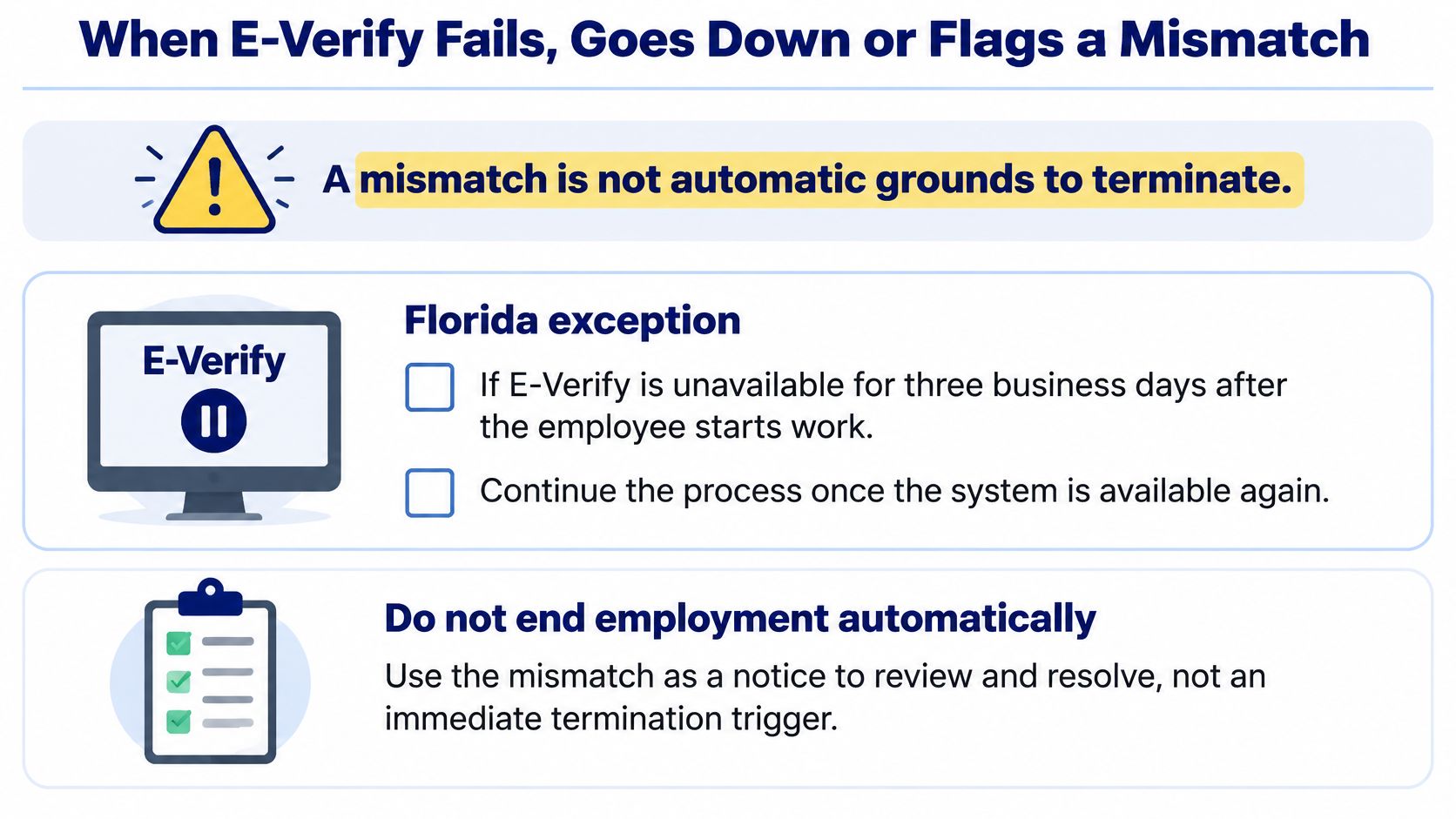
A tentative nonconfirmation triggers employee notification and the federal contest process. Follow the steps shown in E-Verify, give the employee the required notice, and allow the employee to contest the result. Do not take adverse action based solely on a mismatch while the contest is pending.
Under Florida Statutes § 448.095 (2026), an employer may use Form I-9 procedures if E-Verify remains unavailable for three business days after the employee's first paid workday, as described in the Florida Department of Revenue's reemployment-tax guidance. Keep evidence of the outage and create the E-Verify case when access returns. A failed third-party onboarding screen does not, by itself, establish that E-Verify is unavailable.
E-Verify problems and the response that fits each
| Event | Response | Timing |
|---|---|---|
| E-Verify unavailable for three business days after the first paid workday | Complete and retain Form I-9; document the outage | Within the three-business-day period |
| E-Verify access returns after an outage | Create the case and record the reason for delay | As soon as access returns |
| Tentative nonconfirmation | Notify the employee and explain the federal contest process | Promptly after the result |
| Employee contests the result | Avoid adverse action based solely on the mismatch and preserve records | Throughout the contest |
| Final nonconfirmation or a proposed termination | Consult employment counsel before acting | Before any action |
Federal anti-discrimination protections under 8 U.S.C. § 1324b address discriminatory employment-verification practices. Do not demand specific documents or treat workers differently based on citizenship status or national origin. Consult counsel when a disputed verification may affect an employment decision.
Keep outage notices or screenshots, the completed form, employee notices, case updates, and factual administrator notes in the incident file. HR should coordinate the process, payroll should confirm relevant employment information, and managers should receive clear instructions on permitted next steps. Employment or immigration counsel should guide high-stakes decisions.
International Inc. has provided employer-side HR compliance since 1994, and its investigations are built around EEOC, DOL, and FLSA requirements. Those investigations are separate from E-Verify case resolution. For a final nonconfirmation or proposed termination, seek expert guidance before acting.
Florida law sets different consequences for failing to use required E-Verify procedures and for knowingly employing an unauthorized worker. The amounts below are listed in Florida Statutes § 448.095 (2023) for verification violations and § 448.09 (2023) for knowing-employment violations. Review the Florida Department of Revenue's reemployment-tax requirements and have counsel confirm which provision and enforcement conditions apply.
| Violation | Penalty | What it depends on |
|---|---|---|
| Failure to use E-Verify when required | $1,000 per day under the applicable enforcement conditions, under Florida Statutes § 448.095 (2023) | Statutory findings and how long noncompliance continues |
| Knowing employment of an unauthorized worker, first violation | $5,000 per worker under Florida Statutes § 448.09 (2023) | Number of workers involved and violation findings |
| Knowing employment of an unauthorized worker, second violation | $7,500 per worker under Florida Statutes § 448.09 (2023) | Number of workers and prior violation |
| Knowing employment of an unauthorized worker, later violations | $10,000 per worker under Florida Statutes § 448.09 (2023) | Number of workers and prior violations |
| Repeat violations | License suspension or revocation may be possible under Florida Statutes § 448.095 (2023) | Agency action, statutory provision, and license involved |
A missed E-Verify case does not, by itself, establish knowing employment of an unauthorized worker. The first issue concerns whether the employer followed the required verification process; the second concerns the facts supporting a knowing-employment finding. Don't estimate a penalty by multiplying a headline amount before counsel checks the statutory triggers and applicable notice provisions.
Owner's priority: Fix the workflow that caused the violation, not just the file identified in an agency notice.
If a licensed business faces possible suspension or revocation, leadership should identify the affected licenses and consult counsel before responding to the agency. Licensing action can affect operations, contracts, and staffing beyond HR.
A named process owner and documented steps help explain the company's actions during an audit, but they don't guarantee an outcome or eliminate exposure. If an audit notice, employee complaint, or termination decision is active, have employment counsel review the response before submission or action.
Keep a verification file for each hire with the completed Form I-9, E-Verify case number and result, the date of the result, and the name of the person who handled the case. Include relevant notices and notes explaining any exception. This lets the company distinguish a completed verification from an onboarding task that was only marked complete.
Under federal 8 C.F.R. § 274a.2, Form I-9 retention runs for three years after hire or one year after employment ends, whichever is later. Keep this calculation separate from the general personnel-file schedule. The company's employment records retention procedure should address both active employees and former employees.
Florida Statutes § 448.095 (2023) requires the applicable E-Verify or Form I-9 certification on the first reemployment-tax return filed each calendar year. The 2026 statutory text connects verification compliance with tax reporting. Have the filing owner confirm the current requirement with the company's tax adviser before submitting the return.
Set the compliance calendar around the actual filing event, with a named person responsible for reviewing supporting records. Finance needs evidence, not a verbal assurance that onboarding is handled.
The client must be able to produce a document even when the provider holds it. Test permissions and export capability, and confirm that each Form I-9 can be matched to its E-Verify case record.
Use the annual certification review to identify exceptions, assign owners, and document corrections for finance and the tax adviser to assess.
A Florida hire can change how onboarding must work once the employer reaches the state's coverage threshold. Set the process before the next start date, especially when staff work in several states or a PEO handles part of onboarding.
If the company is near the coverage threshold, get a documented legal determination rather than relying on a local headcount. If a mismatch, leave request, complaint, or termination is pending, consult employment counsel before taking action. Florida HR compliance guidance for employers can help identify related process gaps.
The AI legal assistant for business owners can help organize preliminary questions for a discussion with counsel. An HR risk review can assess headcount, onboarding responsibilities, and record access together, then identify issues for leadership to resolve.
This article provides general information, not legal advice. Employment laws vary by state and change over time. Consult qualified employment counsel about your situation.


