
A manager calls you after a difficult review and says, “We need to let this employee go today.” The employee is at-will, the manager has a list of performance concerns, and everyone assumes the decision is straightforward. Then someone remembers that the employee recently reported harassment, requested leave, or filed a workers' compensation claim.
That's where Florida employment termination rules become a business issue rather than a simple legal slogan. Florida gives private employers substantial flexibility, but the defensibility of a termination depends on the reason, the timing, the records, the payroll process, and the consistency of the decision. For SMB owners and COOs, the priority is not avoiding every difficult termination. It's making sure a lawful business decision remains lawful after someone challenges it.
Consider a growing professional services firm with no dedicated HR department. A department head wants to terminate an employee for missed deadlines and repeated client complaints. The employee's performance concerns are real, but the manager hasn't documented them consistently. Two weeks earlier, the employee also raised a concern about unequal treatment.
The owner may still have a legitimate reason to end the employment relationship. Florida's at-will framework gives the business room to act. But the manager's urgency doesn't answer the questions an agency, attorney, or judge may ask later: What was the actual reason? When did the concern begin? Were similar employees treated the same way? Did the complaint influence the decision?
Florida's baseline rule is flexible, not unlimited. The state generally doesn't require a private employer to prove cause or provide advance notice for an ordinary termination, but protected rights can change the analysis. The practical risk often appears after the separation, when the business must explain its decision and produce records supporting the explanation.
Executive judgment: At-will status helps you make a decision. It doesn't excuse an unexplained, inconsistent, or retaliatory decision.
Use the following sequence before acting:
This process doesn't turn every termination into a legal proceeding. It creates a disciplined pause before a manager's frustration becomes the company's official explanation. That pause is especially valuable for businesses where one executive, founder, or supervisor controls the entire decision.
At-will employment means an employer may generally terminate employment at any time, for any lawful reason or no reason, and without advance notice unless a contract or specific legal protection applies. Florida has no general private-sector statute establishing a just-cause termination standard, so the default framework remains common-law at-will employment rather than a notice-or-cause model, as summarized in this Florida termination law overview.
That rule gives an employer meaningful discretion. A business usually doesn't need government approval before ending an employment relationship, and an ordinary termination generally doesn't require a state-mandated notice period. But “lawful reason or no reason” is not permission to act for an illegal reason disguised as a neutral one.
At-will status generally allows an employer to:
The exception is the critical part. A contract, collective bargaining agreement, or protected statutory right can alter the default position. Written promises, handbook language, compensation plans, and manager statements can also create questions about what the company represented to the employee.
Think of at-will employment as a wide operating lane, not an open road without traffic rules. You can change lanes quickly, but you still can't cross a protected boundary.
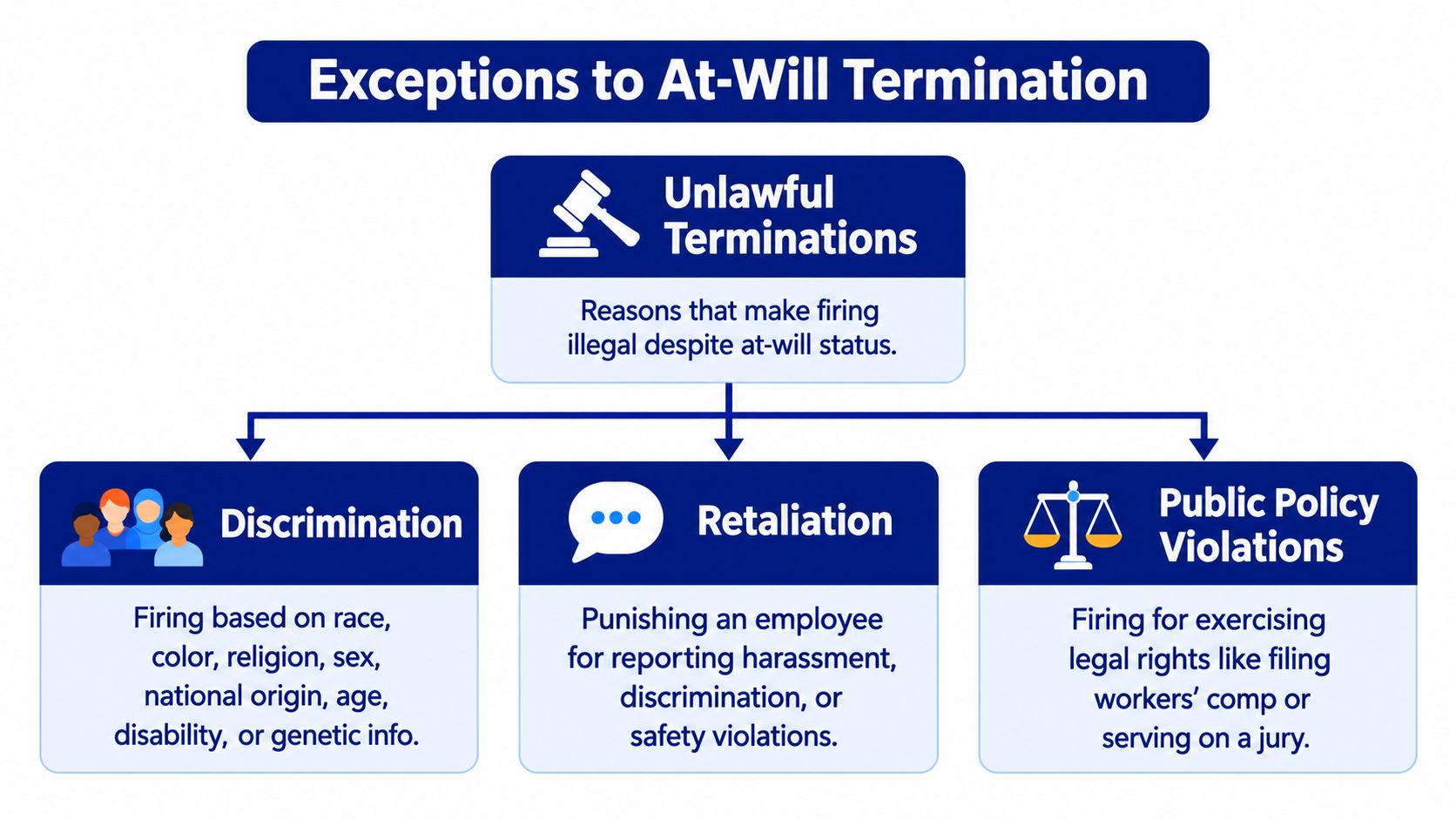
A manager may believe that no notice means no explanation is needed. That's poor risk management. The absence of a notice requirement doesn't prevent a former employee from alleging discrimination, retaliation, breach of contract, or another unlawful basis.
The stronger question is not, “Can we terminate without notice?” It's, “Can we show that this decision follows our stated standards and doesn't violate a protected right?” That requires a stable explanation, comparable treatment, and records created before the termination meeting.
For an SMB, the mental model is simple:
The default rule creates flexibility. Your process determines whether you can defend how you used it.
The most dangerous Florida termination mistakes happen when leaders stop at the phrase “at-will.” The relevant legal question is whether the reason intersects with a protected category, protected activity, contractual promise, or public policy.
At-will employment doesn't override statutory rights. It only governs the relationship where no separate legal protection controls.
An employer can't make a termination decision because of a protected characteristic. The risk increases when a manager uses vague terms such as “not a good fit,” “too difficult,” or “not aligned with the team” without connecting the decision to documented, job-related conduct.
Review the decision for patterns involving race, color, religion, sex, national origin, age, disability, or genetic information. The business should also examine whether it applied the same performance or conduct expectations to employees outside the affected employee's protected group.
Retaliation claims often focus on timing and decision-maker knowledge. A termination shortly after an employee reports harassment, discrimination, safety issues, wage concerns, or another workplace problem deserves careful review, even when performance concerns exist.
That doesn't mean a complaining employee can't be terminated. It means the company should separate the complaint investigation from the performance decision, use an impartial reviewer where possible, and preserve evidence showing when concerns arose and who knew about them.
Florida protections can also apply when an employee reports legal or regulatory violations or exercises a recognized legal right. Workers' compensation retaliation and leave-related claims require particular care because the employee's injury, medical issue, or protected absence may be central to the decision timeline.
Common red flags include:
Neutral legal guidance identifies discrimination, retaliation, whistleblower protections, workers' compensation retaliation, and federal leave protections as key limits on Florida's at-will baseline. SMB leaders who need to evaluate the issue through a legal operations lens may also find a skills-first legal analyst role useful for understanding how structured legal review supports business decisions.
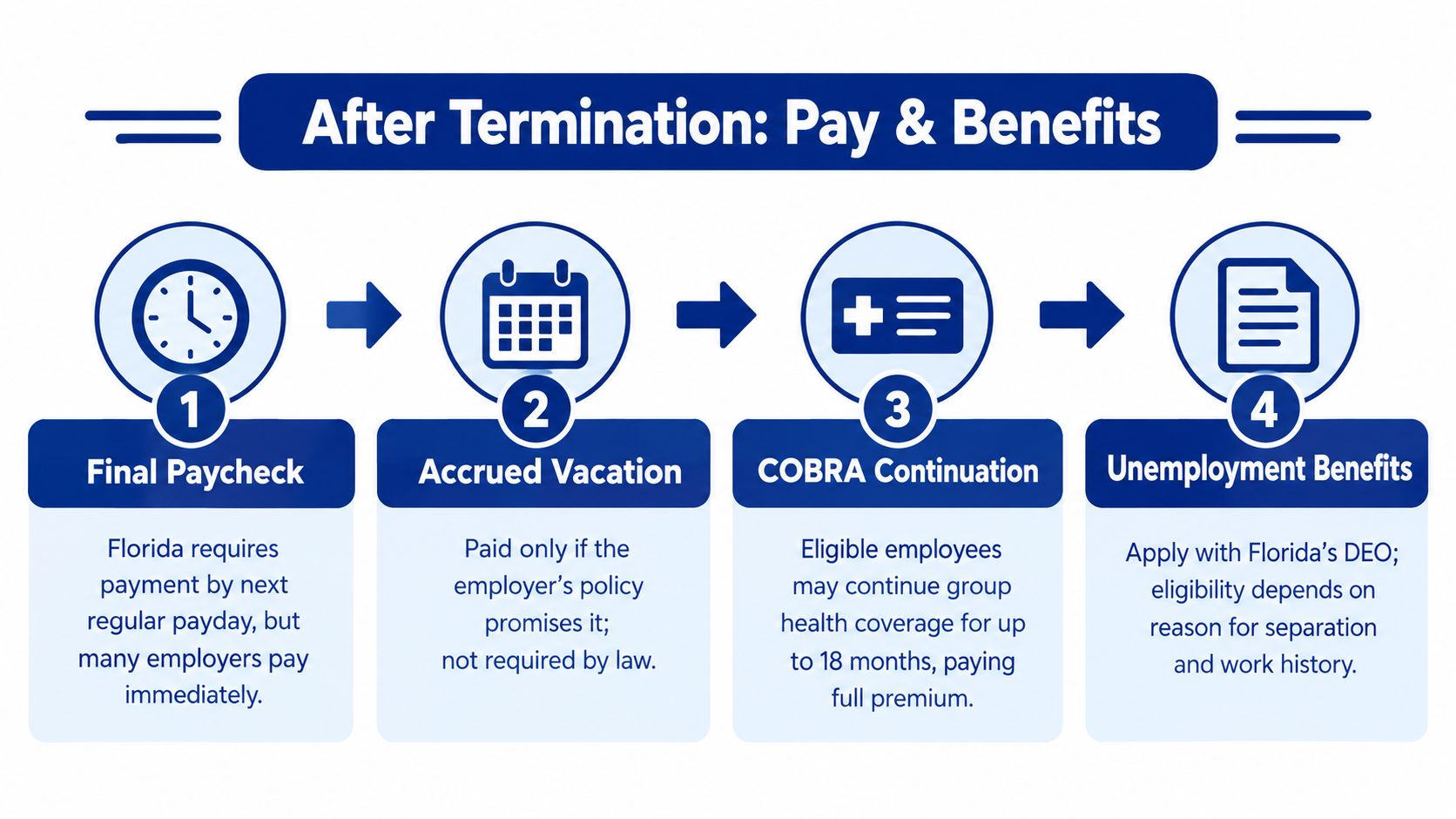
The right response to an overlap isn't automatic termination or automatic delay. It's a documented review of the reason, evidence, decision-maker, comparator employees, and sequence of events.
Florida employers need a payroll plan before the termination meeting. Florida has no separate private-sector final-paycheck deadline statute. The guiding rule is that earned wages generally must be paid on the next regular payday after separation, as explained in this Florida final paycheck discussion.
That rule makes the employer's regular payroll calendar operationally important. The company shouldn't assume a same-day payment obligation under Florida law, but it also shouldn't use the payroll cycle as an excuse for inaccurate or delayed calculations.
Before the meeting, payroll or finance should calculate:
The separation letter should state when the employee can expect earned wages without promising a payment date the company hasn't verified. Payroll, HR, and the manager should use the same explanation.
Health coverage, retirement plans, leave rights, and group benefits can create obligations separate from Florida's wage-payment framework. Review whether the employee has rights under federal continuation coverage requirements, whether a leave-related protection applies, and whether a larger workforce reduction raises federal notice questions.
FMLA issues require special caution where the employee has taken or requested protected leave. WARN considerations may arise in qualifying mass layoffs or plant closings, so leaders shouldn't treat a single termination checklist as sufficient for every workforce action. Federal requirements depend on the facts, the employer, the benefit plan, and the nature of the separation.
For benefits administration, use this COBRA notice guide for SMB firms to coordinate the required communication process with the company's plan administrator and benefits partners.
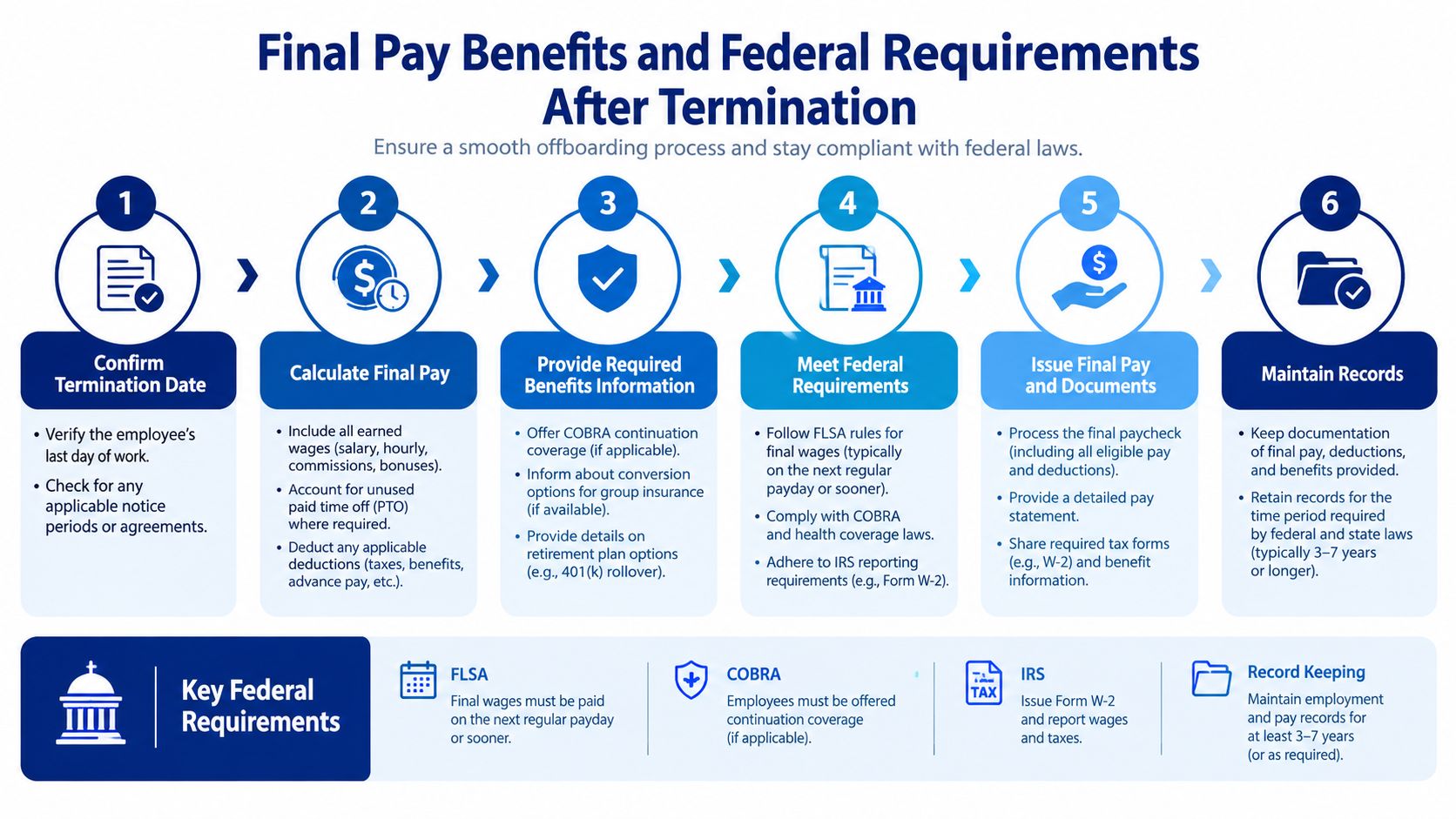
The cleanest approach is to treat the termination as a controlled handoff. The manager handles the employment conversation, payroll handles earned compensation, benefits handles coverage communications, and an executive or HR reviewer confirms that the records tell one consistent story.
A weak termination file says, “Performance issues.” A strong file identifies the expectation, the observed conduct, the dates, the business impact, the employee's response, and the action taken.
Florida's at-will framework means the employer may not need to prove cause for an ordinary termination. Still, documentation and consistency matter because legal exposure often shifts toward discrimination, retaliation, or contract claims after separation, as explained in this Florida at-will employment rights resource.
| Risky practice | Defensible practice |
|---|---|
| “The employee isn't a fit.” | “The employee missed the documented reporting deadline after receiving written coaching and a defined improvement expectation.” |
| Notes created after the termination | Contemporaneous records showing the concern and the response |
| One manager's opinion | Input from relevant witnesses, records, and the employee |
| Immediate action after a complaint | Separate review of the complaint and performance record |
| Different explanations in different documents | One accurate explanation used consistently |
The purpose of documentation isn't to manufacture a case. It's to preserve what happened while the facts are fresh. If the company's reason changes after the employee challenges the decision, credibility suffers.
When a complaint precedes a performance action, assign someone who can review both issues without defending the manager's preferred outcome. Gather relevant messages, attendance records, performance reviews, policy acknowledgments, customer feedback, and witness accounts.
Ask four practical questions:
Avoid deleting or editing records because the termination is complete. Preserve the decision file, complaint materials, payroll records, benefits communications, and agency correspondence according to the company's retention practices and any legal hold.
A documented review of this guide for COOs on handbooks can also help leaders identify where policy language, manager practice, and termination decisions diverge. The handbook won't replace judgment, but unclear or inconsistently applied policies create avoidable questions.
The termination meeting ends the employee's work, not the company's risk. The business may still need to respond to an unemployment claim, agency charge, benefits question, demand letter, or internal complaint long after the employee leaves.
Florida's unemployment framework creates a specific distinction for misconduct. A worker discharged for misconduct connected with work can be disqualified from reemployment assistance benefits, and Florida law defines misconduct to include willful or wanton disregard of the employer's interests or repeated carelessness showing culpability or intentional disregard. Employers should therefore avoid labeling ordinary poor performance as misconduct unless the evidence supports that characterization under the governing standard. Review the Florida statutory unemployment provisions before submitting the separation response.
The unemployment response should match the termination documentation. If the separation letter says role elimination but the unemployment response says misconduct, the inconsistency can create unnecessary scrutiny and weaken the company's position.
Maintain a central file containing:
A multi-state workforce complicates the process because the employee's work location, payroll registration, policy language, and protected rights may not all point to the same jurisdiction. A Florida-based company can also have managers supervising employees elsewhere, creating consistency problems when one state requires a different notice, final-pay, leave, or separation process.
Use one core decision framework, then add a location-specific review. Don't assume the Florida baseline controls every employee because the company is headquartered in Florida.
The company's response discipline matters as much as its initial decision. Leaders should route unemployment notices and agency communications promptly, identify who owns the response, and prohibit informal manager commentary that conflicts with the official record. For process support, review Paradigm International Inc. unemployment claims as part of a broader post-termination workflow.
A sound termination process should be repeatable enough for a small company to use under pressure. It should also be flexible enough to account for complaints, leave, contracts, compensation plans, and multi-state obligations.
Use this checklist before approving the separation:
The strongest leaders don't confuse speed with control. They make the decision promptly when the facts support it, but they pause long enough to test the exception risks and align the follow-through.
Paradigm International Inc. provides HR risk and advisory support for owners, COOs, and leadership teams handling terminations, investigations, manager conduct, documentation, and multi-state employment decisions. Visit Paradigm International Inc. to discuss a structured review process before a high-stakes separation becomes a long-running dispute.