

Navigating Pennsylvania’s employment rules can be a challenge for even the most diligent business owners and HR leaders. A common and costly misconception is that the state mandates specific meal and rest breaks for adult employees. Understanding the nuances of these regulations is the first step toward building a compliant and defensible workplace policy.
The truth is, Pennsylvania law does not require employers to provide breaks or meal periods for adult workers. This hands-off approach often creates a false sense of security. While the state is lenient, federal law steps in to fill the gap, creating important compliance obligations for any business that chooses to offer breaks.
There are a few key exceptions for specific industries and for minors, which we will cover. For now, let’s focus on the general rule for your adult workforce and how federal regulations shape your responsibilities.
Just because Pennsylvania state law is mostly silent on breaks for adults does not mean there are no rules to follow. This is where federal law, specifically the Fair Labor Standards Act (FLSA), comes into play. The FLSA sets the rules for how you handle break time if you choose to offer it.
This is the single most important concept for Pennsylvania employers to grasp. You do not have to give a break, but if you do, federal rules decide whether you must pay for it. Getting this wrong can lead to serious wage and hour violations, especially around what counts as "hours worked" and overtime calculations.
For a quick overview, here is how state and federal rules apply to adult employees in Pennsylvania.
This table highlights the core distinction: your choice to offer a break triggers specific federal payment rules.
The FLSA has a very clear standard for short rest periods, like a 10 or 15-minute coffee break. The logic is that these brief interruptions benefit the employer by helping employees stay focused and productive.
The takeaway is simple: in Pennsylvania, if you offer a short break, you must pay for it. Failing to do so is a violation of federal law, not state law.
The rules are different for longer breaks, such as a half-hour or hour for lunch. The FLSA calls these "bona fide meal periods." For a meal break to be legally unpaid, it must meet one critical test: the employee must be completely relieved of all duties.
This means if your employee is eating lunch at their desk and answers the phone, responds to a quick email, or handles any other work task, their break becomes paid work time. This is where many employers get into trouble. That "quick question" during lunch can turn an unpaid break into paid time, potentially pushing an employee into unexpected overtime.
It is crucial to properly distinguish between paid and unpaid time, especially when managing exempt vs. non-exempt employee classifications. Getting these federal rules right is the foundation of a solid break policy in Pennsylvania.
If you are unsure whether your current policies are compliant, our team can help you design a clear and defensible framework. To learn more, we invite you to contact us.
Since Pennsylvania does not require meal or rest breaks for adult employees, the federal Fair Labor Standards Act (FLSA) becomes the de facto rulebook. It is a classic mistake to focus only on PA law, because federal regulations introduce major compliance duties you cannot afford to ignore. Getting this relationship right is the key to a defensible break policy.
The FLSA’s rules all come down to one simple but powerful concept: "hours worked." Any time an employee is not completely and entirely free from their job duties, they are working and must be paid. This is where the line between a short rest break and a longer meal break becomes incredibly important.
Think of it like being "on-call." If an employee cannot use their break time for their own purposes because they are still tied to work duties, they are essentially still on the clock. The FLSA uses this logic to decide if a break is paid or unpaid.
This flowchart breaks down the decision-making process for Pennsylvania employers, all based on these federal rules.
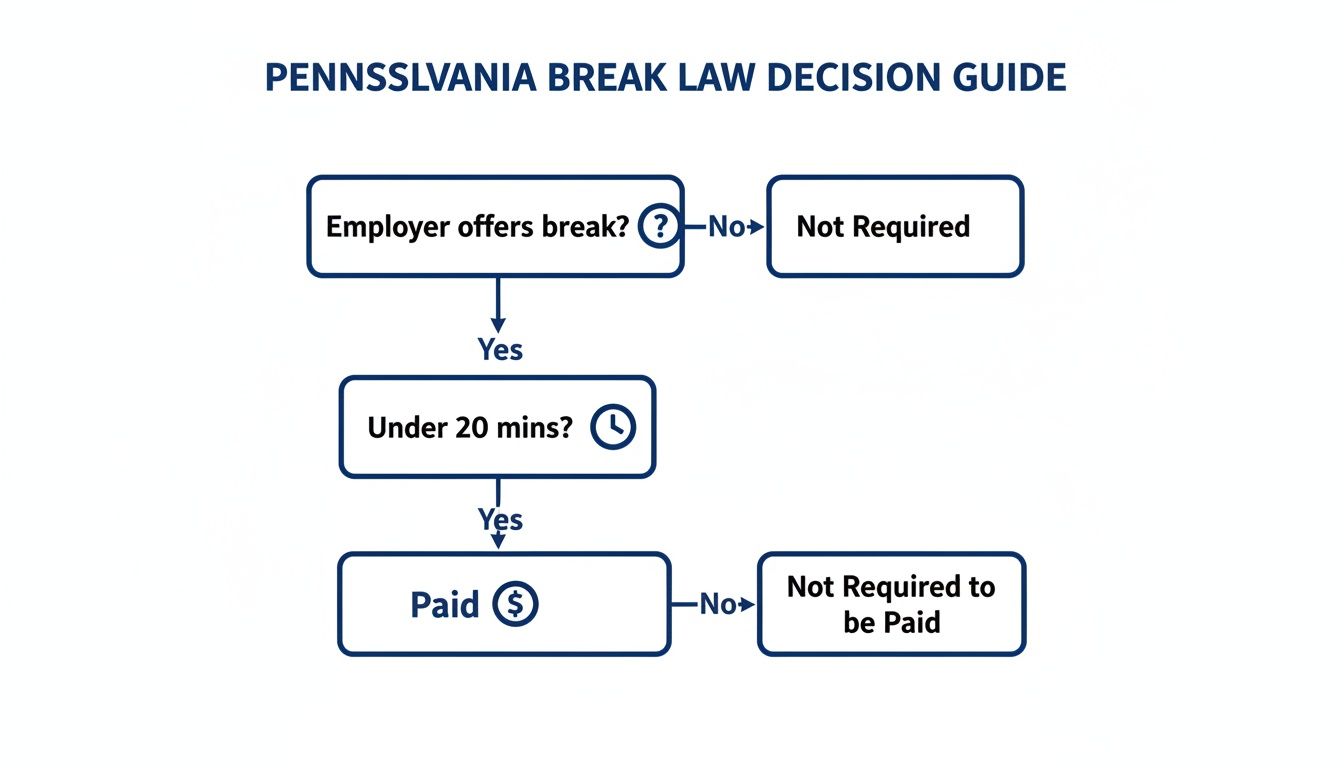
As you can see, the length of the break is what primarily determines whether it must be paid under federal law.
Even though Pennsylvania does not force you to offer breaks, any policy you create must be built on this federal framework to keep you safe from wage and hour claims. Your best defense is a clear, written policy that is shared with every employee and consistently enforced by your managers.
The core principle is straightforward: if you offer short breaks, pay for them. If you offer unpaid meal breaks, ensure your employees are truly and completely off the clock. Any ambiguity can lead to significant liability.
While this guide is focused on Pennsylvania, it is smart to understand the bigger picture of federal mandates. This includes not just the FLSA but other laws that intersect with employee leave and scheduling, like the federal FMLA rules and regulations. If your business operates in more than one state, a solid grasp of different requirements is essential. For instance, you can read also about California meal break laws, which are far stricter than what we see in Pennsylvania.
By building your policy around these clear federal guidelines, you can stay compliant and drastically reduce your risk of facing a costly wage dispute.
While Pennsylvania gives employers significant leeway on breaks for adult employees, that flexibility vanishes when you hire someone under 18. This is a critical compliance area for any business in retail, hospitality, or food service that relies on a younger workforce. Getting these specific rules wrong can lead to steep fines under the Pennsylvania Child Labor Act.
The single most important rule for Pennsylvania employers to know is that state law mandates a meal break for minors. This is a non-negotiable requirement that stands in sharp contrast to the rules for adults.

Pennsylvania’s Child Labor Act is crystal clear on this point. For any employee younger than 18, you must follow these guidelines:
For example, if you schedule a 17-year-old at your retail shop for a six-hour shift from noon to 6:00 PM, you are legally required to give them a 30-minute unpaid meal break before they hit that five-hour mark. Simply allowing a few short, paid breathers does not satisfy the law. The flexibility you have with adult employees disappears entirely when minors are involved.
Beyond the rules for minors, some industries fall under federal regulations that can override state law. These rules are almost always tied to safety and are strictly enforced by federal agencies. If you're in one of these sectors, federal mandates come first.
The most common example is the transportation industry. The U.S. Department of Transportation (DOT) and the Federal Motor Carrier Safety Administration (FMCSA) have detailed "hours of service" regulations for commercial truck drivers. These rules dictate mandatory off-duty periods and rest breaks to prevent fatigue-related accidents. For instance, a driver may be required to take a 30-minute break after eight hours of driving.
These federal requirements always take precedence over Pennsylvania’s lack of a break mandate for adults. If your business operates in a federally regulated field, you must build your compliance program around those specific federal rules first. You can also discover more insights about international policies on yourduedate.com to understand how these rules compare globally.
Navigating the special rules for minors and regulated industries is a core part of risk management. If you have questions about how these specific PA break laws apply to your business, our team is here to provide clarity. For more information, consider getting in touch with us for a consultation.
Handling employee accommodations is a core part of HR, but lactation breaks are a critical and often misunderstood area of compliance. While Pennsylvania’s break laws are minimal for adults, federal protections for nursing mothers are strong and non-negotiable. A misstep here can create significant legal exposure, so it is essential for every employer to know exactly what is required.
These rules are not just suggestions; they are federal laws designed to support working parents. Both the PUMP for Nursing Mothers Act and the Fair Labor Standards Act (FLSA) place clear duties on employers. Failing to comply can lead to costly penalties and serious damage to your company’s reputation.
The main regulations you need to know are federal. The PUMP (Providing Urgent Maternal Protections) for Nursing Mothers Act expanded protections under the FLSA, setting clear standards that apply to nearly every employer in Pennsylvania.
The law is built on two fundamental requirements: providing reasonable break time and a private space.
That last point is absolutely crucial. A locked storage closet with no electrical outlet or a shared office where people might walk in will not suffice. The space must be private, secure, and practical enough for an employee to actually use a breast pump.
This is one of the most common questions we receive, and the answer ties directly back to your general break policies under the FLSA. Whether you must pay an employee for lactation breaks depends on their length and how you handle other breaks.
The federal law itself does not require lactation breaks to be paid. However, if an employee uses a paid break period—like a standard 15-minute rest break you already offer—to pump, you must pay them for that time. If a nursing employee is not completely relieved of duties during the break, the time must be paid as "hours worked," just like any other break.
The distinction is clear: if the time taken is short and fits within your existing paid rest break policy, it is paid. If the employee needs more time and is completely free from all work duties, that extra time can be unpaid, much like a bona fide meal period. You can read more about the data on paid leave and workplace accommodations on wifitalents.com.
A proactive approach is always the best way to manage lactation accommodations. A clear, written policy ensures everyone—managers and employees alike—understands their rights and responsibilities.
Key elements of a strong policy include:
Putting this in writing protects both the employee and the company. By creating a supportive and compliant environment, you not only follow the law but also build a workplace culture that values and retains talented employees.
If you need help developing a compliant lactation accommodation policy or training your managers on these important PA break laws, our team can provide the expert guidance you need. For a confidential discussion, please contact us.
Getting Pennsylvania break laws right means looking beyond state-level rules and focusing on how federal law applies in the real world. While PA’s requirements for adults are minimal, the federal Fair Labor Standards Act (FLSA) creates several compliance traps that are easy to fall into. A small mistake in your break policy can quickly snowball into a major wage and hour claim.
Even employers with the best intentions can make expensive mistakes with meal and rest breaks. These errors usually come from a simple misunderstanding of federal rules or from managers applying policies inconsistently. By spotting these common pitfalls, you can build a stronger, more defensible policy.
It may seem efficient, but using an "auto-deduct" feature in your timekeeping system is one of the riskiest things you can do. This function automatically subtracts 30 or 60 minutes from an employee's timecard each day, assuming they took a meal break.
The problem is, what happens when an employee works through lunch to hit a deadline? If your system automatically deducted that time, the employee was not paid for all hours worked—a clear violation of the FLSA. This can lead to huge back-pay liabilities, especially if it affects multiple employees.
This brings us to a closely related trap: letting employees do any work during an unpaid meal period. For a break to be legally unpaid, the employee must be 100% duty-free. There is no gray area here.
This means the employee cannot:
If an employee performs any work, no matter how minor, the entire meal break becomes compensable time. If that time pushes a non-exempt employee over 40 hours for the week, you also owe them overtime.
The final pitfall is when your written policy does not match what actually happens on the floor. Maybe your handbook has a perfect, legally sound break policy, but in practice, managers regularly ask employees to handle small tasks during their lunch. This kind of inconsistency completely undermines your policy's credibility.
Consistent manager training is the only way to close this gap. Your supervisors are on the front lines, and they must understand the legal and financial importance of protecting an employee's unpaid break time. A clear rule that's enforced uniformly across all teams is your best defense against claims related to PA break laws.
Taking a hard look at your current break and timekeeping practices is a crucial first step in managing your HR risk. If you have any concerns about your existing policies, we can help you identify and correct these potential vulnerabilities.
To ensure your approach is fully compliant and defensible, please reach out to our expert team.
Crafting a solid break policy is a strategic move to insulate your business from legal headaches. Since Pennsylvania's rules for adult workers are minimal, your policy needs to be built around the federal FLSA to be truly defensible. A clear, written, and consistently enforced policy is your best defense against costly wage and hour disputes.
The goal is to leave no room for guesswork. A strong policy clearly defines what constitutes paid versus unpaid time and spells out the exact procedures for recording breaks. This clarity is the bedrock of your defense if your practices are ever questioned.
To be effective, your break policy must be specific and easy for everyone to understand. Think of it as a user manual for breaks at your company—it needs to cover all the bases so there are no surprises.
Your policy language should explicitly tackle:
A well-written policy is your first line of defense. It demonstrates a good-faith effort to comply with PA break laws and federal regulations, shifting the burden of proof away from you in a potential dispute.
A great policy is only paper until you put it into practice. Your managers are on the front lines, and their actions ultimately determine whether your policy is an effective shield or just words in a handbook. For this reason, consistent and mandatory training for supervisors is non-negotiable.
Focus your manager training on real-world scenarios. Provide them a simple script for when they see an employee working through an unpaid lunch: "Sarah, I appreciate your dedication, but our policy requires you to be completely off the clock. Please stop working and take your full break." This exchange reinforces the policy and protects the company.
Your break policy also needs a home—a central, accessible location for everyone. For tips on creating a single source of truth for all your company rules, check out our guide on employee handbook requirements by state. Pairing clear documentation with consistent enforcement builds a system that minimizes risk and fosters a fair work environment.
To learn more about how we can support your business, feel free to get in touch with our team.
Even with the rules laid out, day-to-day situations often cause the most confusion for employers. Here are answers to some of the most common questions we hear from Pennsylvania business owners and HR leaders.
Yes, you do. While Pennsylvania law does not require you to offer short breaks, federal law steps in if you choose to. The Fair Labor Standards Act (FLSA) is very clear that any rest period of 20 minutes or less is considered compensable time. These short breaks are seen as promoting employee efficiency, which ultimately benefits your business.
If an employee does any work at all during an unpaid meal period, that time must be paid. It does not matter if it is "just" answering a few emails or taking a quick work-related call—that activity makes the entire break compensable. This is a huge compliance trap. If that extra paid time pushes a non-exempt employee over 40 hours for the week, you are on the hook for overtime pay.
No, they are not. The rules around paid versus unpaid breaks are designed for non-exempt, hourly employees whose pay is directly tied to the hours they work. Salaried exempt employees receive a fixed salary regardless of their hours, so the concept of paid breaks does not apply in the same way. Of course, encouraging all employees to step away from their desks is simply good management.
Navigating the complexities of PA break laws, manager training, and documentation is essential for protecting your business.
If you have more questions or need help creating a defensible HR framework, our team is ready to provide expert guidance. We encourage you to contact us to learn more.


