A growing business can add Florida employees in a single hiring cycle and still miss the controls that matter most. The payroll team may be prepared for federal requirements, while the hiring manager misses Florida's verification clock, the HRIS uses the wrong separation workflow, or payroll overlooks a wage change that takes effect in late September rather than at the start of the year.
Florida can feel simple because it lacks many state-specific mandates found elsewhere. That simplicity is deceptive. Florida HR compliance for employers depends less on memorizing a long checklist and more on building reliable processes for hiring, payroll, documentation, notices, leave, and multi-state decisions.
Consider a professional services company that employs people in several states and opens a small Florida office. Its leadership team already has an employee handbook, a payroll provider, and a standard onboarding packet. The company assumes Florida can use the same process with minor edits.
That assumption creates risk. Florida requires employers to report newly hired and rehired workers, and the duty can also reach certain non-employee service providers. Private employers with 25 or more employees must use E-Verify for each new hire, and the verification process has a short deadline. Payroll must also account for Florida's scheduled minimum-wage change on September 30, 2026, not a January effective date. Those controls don't appear in a generic national checklist.
The same problem arises with remote teams. A Florida employee may work alongside colleagues in states with different leave rules, final-pay deadlines, wage floors, or restrictive-covenant requirements. If the company applies one national workflow without checking work location and employment status, the policy may be consistent on paper but wrong for the person involved.
Operating principle: Treat Florida compliance as a set of timed business controls, not as a folder of policies.
The right starting point is a clear distinction between federal baseline obligations and Florida-specific overlays. Federal law supplies much of the foundation for discrimination, harassment, wage and hour, leave, and employment eligibility. Florida then adds technical requirements that affect onboarding, reporting, payroll calendars, notices, and employment agreements.
Your handbook still matters, particularly when employees work across state lines. A useful starting point is this guide to employee handbook requirements by state, but a handbook review alone won't fix a day-three verification failure or a payroll date configured incorrectly.
The practical test is simple. Can a manager follow the process without guessing? Can payroll prove that the correct rate and payment timing were used? Can HR produce complete records and explain why the company treated similar employees consistently? The sections ahead apply that test to the areas where Florida employers most often need stronger operational discipline.
Florida employment law works like a building with a federal foundation and state-specific add-on systems. The foundation includes federal rules governing equal employment opportunity, harassment, wage and hour practices, disability accommodation, family leave, and employment eligibility. Florida employers must operate within that foundation even when state law doesn't add a separate requirement.
The add-on systems are where many businesses stumble. Florida has specific rules for new-hire reporting, E-Verify coverage, minimum-wage timing, reemployment tax, and restrictive covenants. Some obligations depend on employer size, worker classification, payment amount, or the employee's work location. A national policy can therefore be lawful in one state and incomplete in Florida.
Florida generally follows the at-will employment model. That means an employer or employee can end the relationship for a lawful reason, subject to applicable contracts and legal protections. At-will status isn't permission to act inconsistently, retaliate, discriminate, ignore wage obligations, or skip documentation.
A termination decision should have a clear business rationale, reliable records, and consistent application of the company's policies. Managers need to know which facts they can document, which questions require HR review, and when a complaint, accommodation request, leave issue, or protected activity changes the risk analysis.
Florida may not require every policy that a multi-state employer chooses to provide. An employer might offer paid leave, bonus eligibility, expense reimbursement, severance, or PTO cash-out through its own policy or an agreement. Once those commitments exist, payroll and managers must follow the language consistently.
Wage and hour administration deserves particular attention because Florida employers must coordinate federal requirements with state wage rules and company practices. Leaders assessing insurance exposure alongside employment processes may also find a practical overview of cost and coverage for Florida employers useful when reviewing broader risk controls.
The strongest employers don't ask only, “What does Florida require?” They also ask:
That approach turns legal requirements into repeatable operating practices.
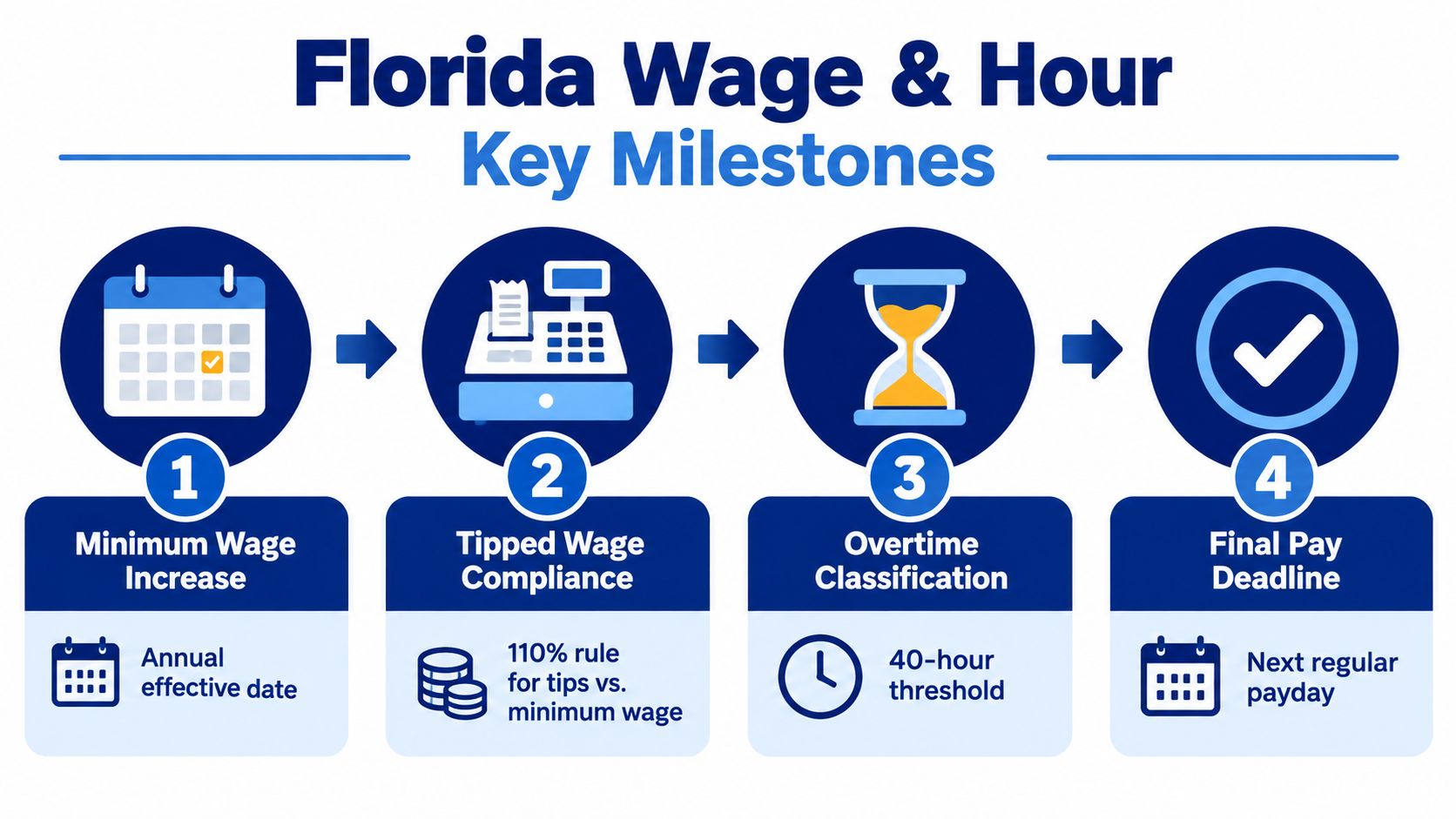
Florida payroll errors often come from calendar design, not intentional misconduct. The most important example is the minimum-wage schedule. Florida's minimum wage is scheduled to reach $15.00 per hour on September 30, 2026, and the required cash wage for tipped employees is scheduled to be $11.98 per hour on that same date. Employers must also post the official minimum-wage notice in a conspicuous and accessible location where employees can see it. Florida Restaurant and Lodging Association guidance provides the relevant rate and notice reference.
The timing matters because many payroll systems are built around January policy changes. Florida's voter-approved schedule moved the rate up by $1.00 each year from $10.00 in 2021 until it reaches $15.00 in 2026. The Florida wage schedule overview explains that the change occurs on September 30, which should be a controlled payroll implementation date.
Payroll and HR should test the change before it becomes active. The review should cover hourly employees, tipped employees, overtime calculations, offer letters, job postings, pay notices, payroll codes, and manager communications.
For tipped employees, don't rely on a manager's informal understanding of tip credits. Confirm that the payroll configuration, tip records, and employee-facing materials match the applicable rules and the company's practice. If the business imposes service or operations charges, keep those amounts separate from gratuities in the records and review any industry-specific disclosure duties.
Overtime compliance depends on accurate classification and actual duties, not just job titles. Review what employees do, how they're paid, who controls their work, and whether their responsibilities support the classification used. Revisit the analysis when a role changes, a team expands, or an employee begins performing substantial duties outside the original job description.
Use the company's timekeeping system as a control, not as a substitute for judgment. Managers should know that discouraging employees from recording time, editing time without documentation, or treating off-the-clock work as harmless can undermine an otherwise sound payroll process.
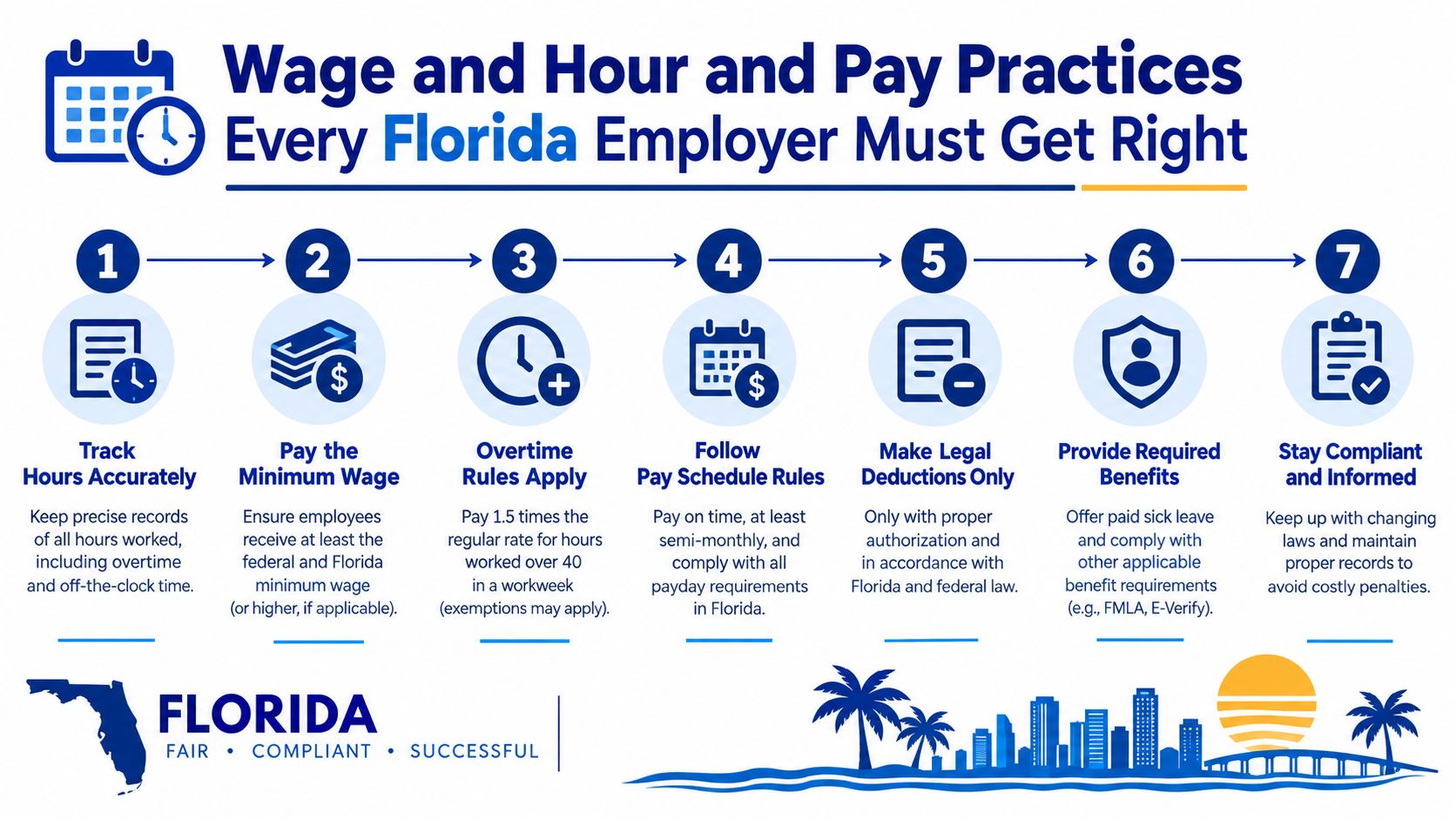
Florida doesn't impose a standalone private-sector final-pay deadline. The practical standard is payment of earned wages on the next regularly scheduled payday for the period worked, with no special acceleration solely because employment ended. Florida final-pay guidance explains this framework.
That doesn't eliminate risk. A separation checklist should identify earned wages, commissions, bonuses, expense reimbursements, PTO treatment under the company's policy, deductions, benefits, and any contract terms. Multi-state employers must also prevent a Florida employee from being placed into a different state's final-pay workflow because the company uses one national termination template.
For a broader review of HR compliance for multi-state businesses, connect payroll rules to the employee's actual work location and agreement terms. The safest configuration is one that makes the correct decision visible before payroll closes.
Florida employers often ask whether the state requires a broad private-sector paid-leave program. The better question is which federal protections apply, which company policies create additional commitments, and whether another employee's work location triggers a different state rule.
The federal framework remains central. The Family and Medical Leave Act may provide qualifying employees with protected leave when the employer and employee meet the applicable coverage and eligibility requirements. The Americans with Disabilities Act can require a reasonable accommodation for a qualified individual with a disability. Pregnancy-related limitations and requests should receive careful review under applicable federal protections and the employer's neutral accommodation practices.
Florida employers also need a functioning anti-discrimination and anti-harassment program. A handbook statement isn't enough if managers don't know how to receive complaints, preserve records, escalate concerns, and prevent retaliation.

When an employee raises a health, family, pregnancy, or workplace concern, managers should follow a defined sequence:
Adult employees shouldn't be assumed to have a state-mandated meal or rest break entitlement because another state requires one. Employers may still provide breaks through company policy, federal requirements, industry practice, or a collective agreement. The important control is accurate policy language and consistent administration.
Workers' compensation is another area that should be coordinated with HR rather than treated as a separate insurance file. Employers reviewing employer coverage in Florida should connect injury reporting, supervisor response, medical documentation, leave analysis, and return-to-work planning.
Manager standard: A manager doesn't need to diagnose a legal issue. The manager does need to recognize a trigger and escalate it without delay.
Florida onboarding has several points where a generic hiring workflow breaks. New-hire reporting, employment verification, tax setup, worker classification, and restrictive-covenant drafting each require a different trigger. Combining them into one “new employee” task can cause the company to miss a deadline or apply the wrong rule to a nontraditional worker.
Florida law requires employers to report each newly hired or rehired worker to the State Directory of New Hires. The duty also reaches certain non-employee service providers. Reports generally include the worker's name, address, date of hire, and Social Security number, along with the employer's name, address, and FEIN. Employers generally must file within 20 days of the hire date, while electronic or magnetic-tape filers may use two monthly transmissions spaced 12 to 16 days apart. Florida's Revenue guidance also states that independent contractors paid $600 or more per calendar year for services in the course of a trade or business must be reported within 20 days of the start date or first payment. The Florida new-hire reporting statute provides the governing reference.
| Requirement | Who It Applies To | Timing and Threshold |
|---|---|---|
| New-hire and rehire reporting | Florida employers reporting covered workers | Generally within 20 days of the hire date |
| Certain contractor reporting | Independent contractors paid $600 or more for covered services | Within 20 days of the start date or first payment |
| E-Verify | Private employers with 25 or more employees | Each new hire, within 3 business days after the first day of paid work |
| I-9 alternative process | Employers using the document-review route where permitted | Within the required federal and Florida onboarding window |
| Verification record retention | Employers completing Florida employment verification | At least 3 years |
| Reemployment tax planning | Florida employers subject to the system | First $7,000 of each employee's wages, with a new-employer rate of 2.7% |
Private employers with 25 or more employees must use E-Verify for each new hire. The employee's work eligibility must be verified within 3 business days after the first day of paid work. If E-Verify is unavailable for 3 business days, the employer must use Form I-9 instead. Florida requires verification records to be retained for at least 3 years. These requirements appear in the Florida E-Verify statute.
An HRIS should create a hard stop at day three. Payroll, HR, and the hiring manager should know who owns the exception when the system is unavailable, the employee's start date changes, or the person begins paid work before onboarding is complete. Employers that want to refresh their I-9 compliance steps for SMBs should align that process with the Florida-specific E-Verify decision.
Florida's CHOICE Act became effective July 1, 2025 and applies to agreements entered into on or after that date. The framework is more employer-friendly for certain noncompetition agreements, but enforceability still depends on technical requirements, including a written agreement, a legitimate business interest, and a salary threshold that can vary based on compensation. The Florida CHOICE Act statute should be reviewed before issuing or revising a restrictive covenant.
The law also creates specific requirements involving written notice of counsel rights, 7 days' notice, and garden-leave arrangements. Don't insert Florida terms into a national agreement without checking the employee's role, compensation, work location, and timing.
A workable compliance program gives every recurring obligation an owner, trigger, record, and review date. Start with the documents employees and managers use, then connect them to payroll and onboarding systems. A polished handbook can't compensate for a missing reporting queue or an untrained supervisor.
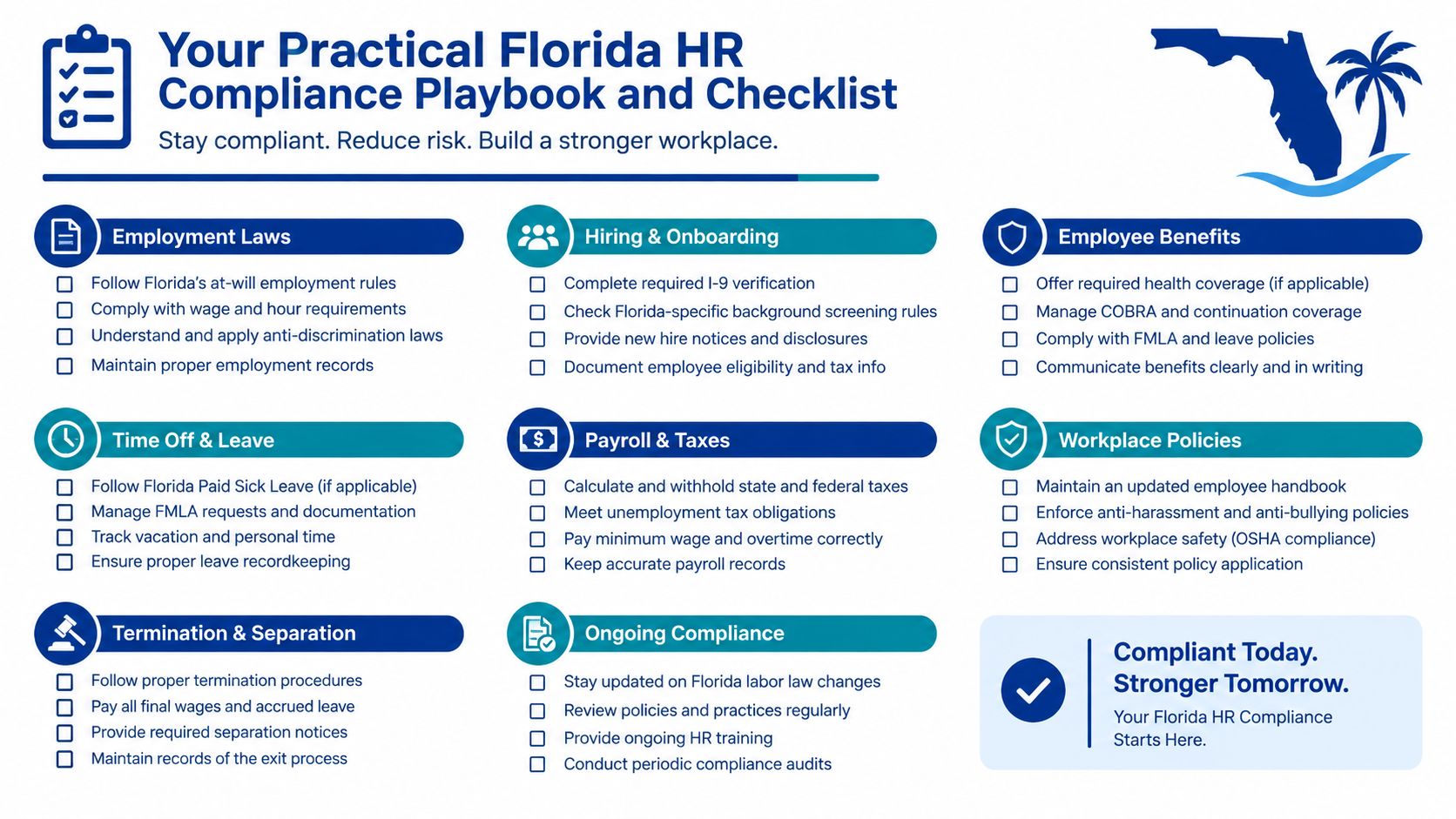
Use policy prompts that force a decision rather than vague language. For example: “Employees must record all time worked using the company's approved system,” “Managers must send accommodation and leave requests to HR promptly,” and “The company reviews separation pay under the employee's work location, policy terms, and applicable law.”
| Decision point | Question to resolve | Required action |
|---|---|---|
| Remote work | Where does the employee physically perform work? | Assign the correct state workflow before hiring or relocation |
| Classification | Do actual duties support the selected status? | Reassess when responsibilities or pay structure changes |
| Separation | Which payment and policy rules apply? | Review location, contract, commissions, bonuses, PTO, and payroll timing |
| Agreement timing | Is a restrictive covenant being issued or changed? | Confirm state requirements before the employee signs |
| Contractor relationship | Is the person a covered service provider? | Review reporting and classification obligations separately |
Defensibility principle: Document the decision path, not just the final answer. A reviewer should be able to see the facts considered, the rule selected, the person who approved it, and the record supporting completion.
Reemployment tax planning belongs in the same review. Florida uses a wage base of the first $7,000 of each employee's wages, and the new-employer tax rate is 2.7%, as summarized in Florida employer cost guidance. Finance and payroll should understand the wage-base threshold so the company can forecast obligations without treating the tax as applying to total annual pay.
Seasonal employers and businesses using foreign labor should also separate employment eligibility from visa-specific obligations. A review of employer H-2B visa compliance can help identify requirements that don't belong in a standard domestic onboarding checklist.
Run an internal review on a set cadence and after material changes, including a new state location, acquisition, payroll-system migration, headcount threshold, wage change, or revised agreement. The review should test actual files and transactions, not just confirm that a policy exists.
Florida compliance becomes difficult when a routine decision carries several overlapping triggers. A termination may involve final pay, commissions, PTO, a complaint, an accommodation request, a restrictive covenant, and a different state's rules for a remote employee. A new hire may involve E-Verify, I-9 coordination, new-hire reporting, tax setup, and record retention at the same time.
Self-management works when the organization has clear ownership, trained managers, reliable systems, and a documented review process. Advisory support becomes important when facts are disputed, the employee has raised a complaint, the company is changing a policy, a workforce is expanding across states, or a decision could affect multiple employees.
Paradigm International Inc. supports owners, COOs, and HR leaders through policy review, document and risk discovery, action planning, and ongoing advisory support. That work can include termination planning, investigations, documentation standards, manager conduct, and multi-state compliance decisions.
The goal isn't to create more paperwork. It's to make the company's decisions consistent, timely, and explainable before a payroll error, complaint, audit, or dispute forces a rushed response.
Paradigm International helps growing employers build practical HR controls for Florida hiring, payroll timing, documentation, investigations, terminations, and multi-state expansion. Visit Paradigm International Inc. to discuss the compliance risks your leadership team needs to resolve next.