Georgia doesn't have a state law requiring meal or rest breaks for adult employees, but federal FLSA rules still control whether break time must be paid. That means a Georgia employer can choose whether to offer breaks, yet still create wage-and-hour exposure if managers handle them poorly.
If you're running a business in Georgia, that gap between "not required" and "still risky" matters. Many owners hear that Georgia has no lunch break mandate and stop there. The critical issue is that once you allow breaks, schedule lunches, auto-deduct meal periods, or expect staff to stay reachable during lunch, federal pay rules step in quickly.
For multi-state SMBs, georgia lunch break laws can feel deceptively simple. In practice, they often become a policy problem, a payroll problem, and a manager training problem at the same time. The goal isn't just knowing the rule. It's building a break process you can defend if someone challenges your time records later.
Georgia follows federal law on breaks for adults. It has no state-mandated meal or rest period requirement for adult employees, and that places Georgia among 22 states without additional break mandates, affecting roughly 60 million workers nationwide beyond state-level protections, according to this state-by-state break law overview.

That sounds simple. It isn't.
In a regulated state, the compliance question is often, "Did we provide the required break?" In Georgia, the more important question is, "If we provided a break, did we pay and document it correctly?"
That's where many employers get exposed. They assume flexibility means low risk, then use informal practices like:
Georgia's lack of a state break mandate reduces one layer of regulation. It doesn't remove federal wage-and-hour exposure.
The FLSA doesn't require employers to give breaks in the first place. But it does regulate when break time counts as paid work time. That distinction matters most in businesses with lean staffing, long shifts, and high interruption rates, especially healthcare, retail, hospitality, and service operations.
For a CEO or practice administrator, the practical takeaway is straightforward. Don't confuse scheduling freedom with compliance freedom.
A workable Georgia break approach usually includes:
Georgia can be easier to administer than stricter states, but only if your system is built well. If your company operates in several states, georgia lunch break laws often become the "easy state" inside a much harder compliance map. That creates a temptation to use broad habits instead of precise rules.
That approach works until a manager asks someone to eat at the desk, keep a phone on, or monitor patients, clients, or equipment during lunch. Then the label "unpaid lunch" may no longer match the legal reality.
A Georgia location manager tells payroll that everyone gets a 30-minute unpaid lunch. Then a supervisor asks the receptionist to keep answering calls while eating, or a technician to stay close in case equipment alarms. That is where wage exposure starts. Under federal law, the question is not what the schedule says. The question is what the employee was free to do during that time.
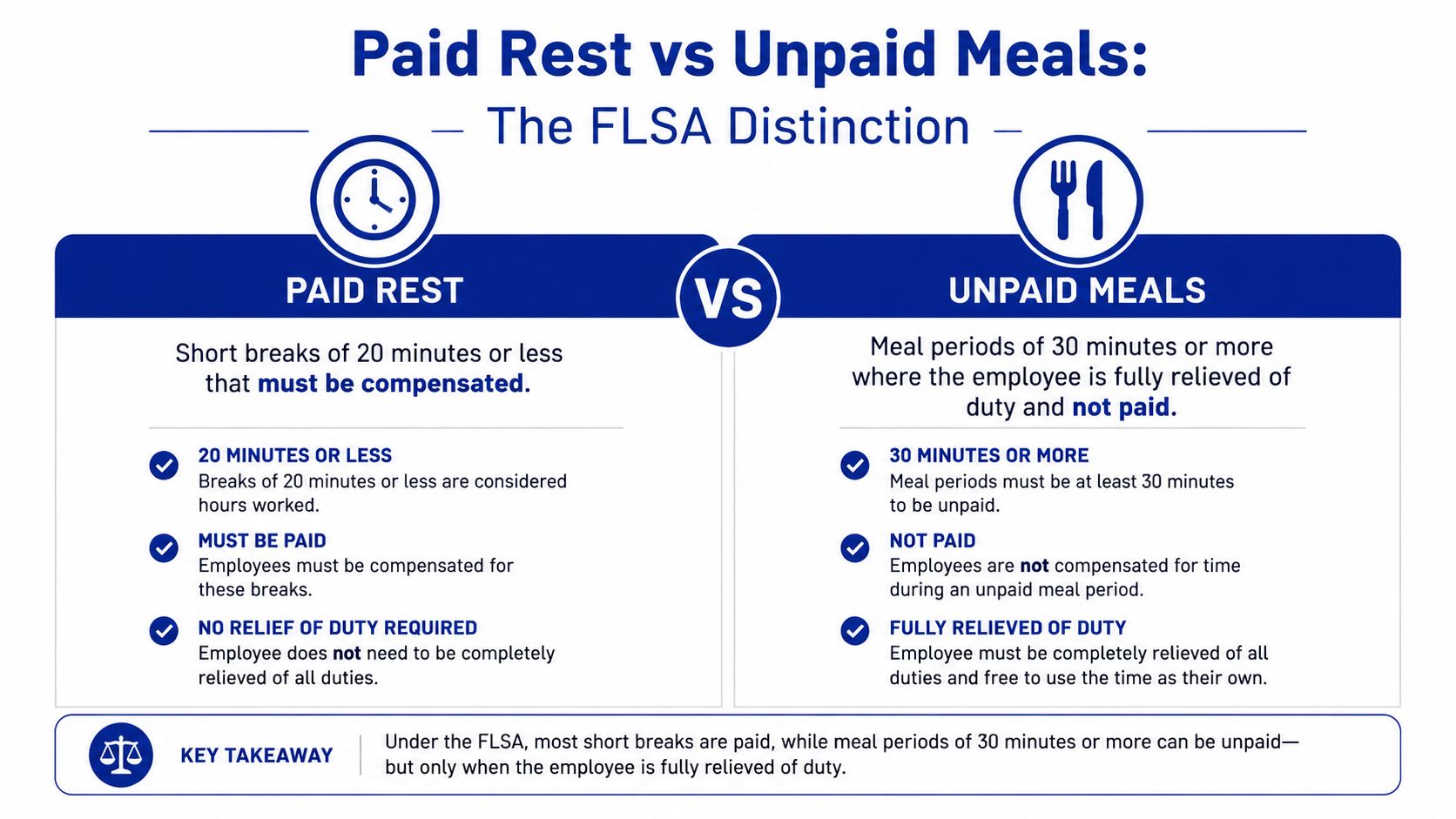
Under the FLSA, short breaks of 5 to 20 minutes are generally paid time. Employers do not get to subtract those minutes because the employee stepped away from the workstation. A quick coffee break, restroom break, or brief recovery pause still counts as hours worked.
This matters most in businesses that run on constant coverage. Front desks, clinics, retail counters, service teams, and small warehouses often create risk without intending to. If your timekeeping setup rounds away short breaks or supervisors tell employees to clock out for them, you can underpay regular wages and overtime in the same pay period.
An unpaid meal period is allowed only when the employee is fully relieved of duty for a bona fide meal period, which is usually at least 30 minutes. The employee must be free to use that time for their own purposes.
That standard is stricter than many managers assume.
If someone has to monitor a radio, watch a patient area, stay at the reception desk, respond to customer issues, or remain on-call for immediate action, the meal period may need to be paid. Titles and payroll codes do not fix that problem. Actual duties control.
The failure point is usually not the written policy. It is the gap between policy and operations.
I see this most often with auto-deduct lunches. Auto-deduct can work, but only if employees have a reliable way to reverse the deduction when lunch is missed or interrupted, and only if managers are trained not to discourage those corrections. Without that safeguard, a clean payroll process on paper can become a backpay claim in practice.
Role design matters too. If your team is still sorting out who should be treated as exempt or hourly, use a clear guide to exempt vs. nonexempt classification. Break-pay errors and classification errors often show up together in the same audit or demand letter.
Use a break policy that managers can apply consistently across locations:
For multi-state SMBs, standardization helps and hurts. A single company-wide lunch rule is easier to administer, but it can fail if local managers improvise or if stricter state rules apply elsewhere. The safer model is one core policy, plus state-specific rules and a payroll correction workflow that records what happened on the shift.
If a dispute is already developing, this overview of guidance for Georgia businesses on wage issues is a useful companion to the HR side of the analysis.
Most Georgia employers focus on the adult rule and miss the exceptions. That's a mistake. Two groups need special attention under georgia lunch break laws and related federal requirements: minors and nursing mothers.

Adult break flexibility doesn't carry over cleanly to younger workers. For minors, limited exceptions apply under federal child labor rules.
These requirements matter most in retail, food service, and seasonal operations where scheduling is often decentralized. If store managers or shift leads build schedules informally, minor break errors can happen without anyone in HR seeing the issue.
The other major exception is lactation accommodation. The federal PUMP for Nursing Mothers Act requires reasonable break time and a private space for nursing employees up to one year post-birth. A 2026 enforcement summary referenced here noted 35% non-compliance in Southern SMBs, and it also noted that 22% of Georgia's female workforce is of childbearing age.
Georgia employers should treat this as an active compliance obligation, not a courtesy item.
A private lactation space can't be a restroom. If your only answer is "use the bathroom," your process is already in trouble.
For nursing mother accommodations, the operational standard should be clear and repeatable:
For minors, the checklist is different:
The common failures are operational, not legal. A manager forgets the employee is under 16. A practice has no suitable private room. A lead says "just tell us when you need a break," but nobody documents what was provided.
Those aren't policy drafting errors. They're execution failures. If your business has younger staff, high turnover, or a mostly manager-run schedule process, these are the exceptions worth tightening first.
A Georgia manager auto-deducts 30 minutes for lunch. The employee ate at the front desk, answered calls, and helped customers the whole time. Payroll still treated it as unpaid. That is how a routine scheduling choice turns into a wage claim.
A defensible break policy closes that gap between what the handbook says, what managers allow, and what payroll pays.
For Georgia employers, the legal rule is simple. The operational risk is not. The businesses that get in trouble usually do not fail because the policy was missing a sentence. They fail because supervisors improvise, auto-deductions run without review, and nobody owns the correction process. If you operate in more than one state, the stakes go up because a loose Georgia practice often gets copied into stricter jurisdictions.
A sentence like "Employees receive a 30-minute unpaid lunch break" does not do much on its own. It does not tell a retail shift lead what to do when coverage falls apart. It does not tell payroll how to handle an interrupted meal. It does not tell employees how to report that they worked through lunch.
Write the policy to match the jobs people perform.
Front desk teams, healthcare staff, field service crews, warehouse leads, and assistant managers often remain available during meal periods unless someone plans coverage in advance. If that is your operating reality, your break policy has to address it directly. Otherwise, your written rule becomes evidence against you.
The policy should be easy for a supervisor to apply during a busy shift, not just easy for HR to publish.
Use plain language and assign responsibility clearly.
Policy alignment matters too. If one rule sits in the handbook, another appears in a scheduling memo, and payroll follows a third practice, you have created avoidable risk. Reviewing your handbook against broader employee handbook requirements by state helps keep those documents consistent.
| Component | Purpose |
|---|---|
| Written break definitions | Separates paid rest breaks from unpaid meal periods |
| Full duty relief requirement | Prevents unpaid meals when employees are still working |
| Timekeeping instructions | Tells employees how to record missed or interrupted lunches |
| Auto-deduction review process | Reduces wage risk when payroll systems deduct meal periods automatically |
| Manager training | Limits off-the-clock work created by supervisor decisions |
| Employee acknowledgement | Confirms staff received and understood the policy |
| Audit routine | Spots repeat issues by manager, role, or location |
| Complaint channel | Gives employees a clear path to report pay problems early |
Auto-deductions are a common problem. They save administrative time, but they also create risk if your managers do not review exceptions consistently. In practice, I see this most often in customer-facing teams where employees are expected to stay nearby "just in case."
Manager shortcuts create a second problem. A supervisor says, "Eat now, but keep an eye on the phones," or "Clock out and finish this first." Those instructions undermine the policy immediately, and they are hard to defend later.
Documentation is the third failure point. If an employee reports an interrupted lunch, your records should show when it was reported, who reviewed it, and whether payroll paid the time. Without that trail, a company is left arguing from memory.
Use your timekeeping system to force exception reporting, train supervisors on what counts as full relief, and review patterns by site and manager. A break policy becomes defensible when operations, payroll, and written rules match each other consistently.
Georgia is one of the simpler states on break mandates. For multi-state employers, that can be an advantage if you handle it strategically. According to a 2026 analysis discussed here, Georgia's alignment with federal law can slash administrative costs by 20-30% for multi-state SMBs compared to heavily regulated states.

The mistake is assuming "simple" means "standardize everything around Georgia." That usually backfires.
There are two common models.
A single nationwide policy is easier to train and easier to administer. The trade-off is that it may be more generous than Georgia requires, which can raise labor cost and scheduling friction.
State-specific policies are more precise. They also create more room for manager error, especially when employees transfer, work remotely, or support multiple locations.
For growing SMBs, a tiered approach is usually more defensible than either extreme:
This lets you use Georgia's flexibility without exporting Georgia standards into stricter states. If your team is building a broader framework, this guide to employment law breaks across jurisdictions is a useful starting point.
Multi-state compliance works best when the policy is centralized, but the state differences are explicit.
Remote work creates another layer. The controlling law often follows the employee's work location, not the headquarters location. If someone reports to a Georgia manager but works in another state, the break rules may not be Georgia's.
That means your HRIS, payroll, and manager instructions need the same location data. If they don't, you can end up applying the wrong break rule even with a decent handbook.
Choosing between copying the strictest state everywhere or implementing a more specific system is the central business decision. Your organization must determine if it has the management discipline to maintain that specialized approach. If not, a more uniform strategy may be worth the added cost because it lowers execution risk.
Georgia gives you room to simplify. Use that room carefully.
No. Georgia doesn't require meal or rest breaks for adult employees. The main compliance issue is whether break time that is provided must be paid under federal rules.
If the employee performs work during what was supposed to be an unpaid meal period, that time may need to be paid. Voluntary work still creates pay risk if the company knows or should know it happened. The better practice is to require reporting and correct the time record promptly.
You can use auto-deductions only if there is a reliable way to reverse them when lunches are missed, shortened, or interrupted. Auto-deduct systems fail when managers don't review exceptions or employees don't have a clear reporting path.
The paid versus unpaid break issue is most often a wage-and-hour concern for nonexempt employees because their pay and overtime depend on hours worked. Exempt employees still benefit from clear scheduling and break expectations, but the pay analysis is different. Classification should be reviewed carefully before assuming someone is exempt.
If the employee works in Georgia, Georgia and federal rules generally frame the break analysis. What matters most is accurate time reporting, especially when remote staff answer messages, monitor systems, or keep working while eating.
Usually not if they are still performing duties or must remain actively available. An unpaid meal period requires full relief from duty. If they are working and eating at the same time, the safer assumption is that the time is compensable.
Make sure your written policy, your timekeeping process, and your managers all follow the same rule. Most break disputes aren't caused by the law being unclear. They're caused by the business saying one thing and operating another way.
If your leadership team needs help turning break rules into a practical, defensible process across locations, Paradigm International Inc. advises SMBs on HR risk, documentation, and multi-state compliance decisions that carry real legal and operational consequences.