


A manager walks into your office, closes the door, and says an employee reported harassment. You now have a business risk, a people risk, and a credibility test all at once. If your harassment complaint procedure is vague, slow, or built around one overextended HR contact, you're exposed before the investigation even starts.
Most business owners still treat complaint handling like an HR formality. That's a mistake. A defensible process protects employees, preserves evidence, reduces retaliation risk, and gives leadership a clear path when emotions are high and facts are still developing.
The first complaint is rarely the first problem. It's usually the first moment someone trusts your organization enough to speak up.
That's why weak reporting systems are dangerous. According to the National Sexual Violence Resource Center, over 85% of people who experience sexual harassment never file a formal legal charge, and approximately 70% of employees never even complain internally to their employer (NSVRC workplace guidance). If people aren't reporting, leadership doesn't have fewer issues. Leadership has fewer visible issues.
A business owner should read that as a risk signal. Silence doesn't prove your workplace is healthy. It often means employees don't trust the channel, don't believe they'll be protected, or assume nothing useful will happen.
Practical rule: If your process depends on employees feeling comfortable reporting only to HR, your process is too narrow.
A good harassment complaint procedure belongs in the same risk conversation as financial controls, safety protocols, and incident response. If you already understand NIST vs. ISO risk frameworks, the logic is familiar. You identify exposure, define accountability, create response steps, document decisions, and improve the system before failure compounds.
The same principle applies here. You need a process that works under stress, not just a policy that reads well in a handbook.
Three realities should drive your thinking:
If your current setup is reactive, start by reviewing your prevention standards alongside your response standards. A useful starting point is this guide on preventing workplace harassment, because prevention and complaint handling have to reinforce each other.
A sound complaint process starts long before anyone files a report. Structure determines whether your response looks fair and credible, or rushed and self-protective.
The foundation is simple. Employees need to know where to report, what will happen next, and why they won't be punished for speaking up. Leadership also needs internal guardrails so one person doesn't control intake, fact-finding, and final judgment.
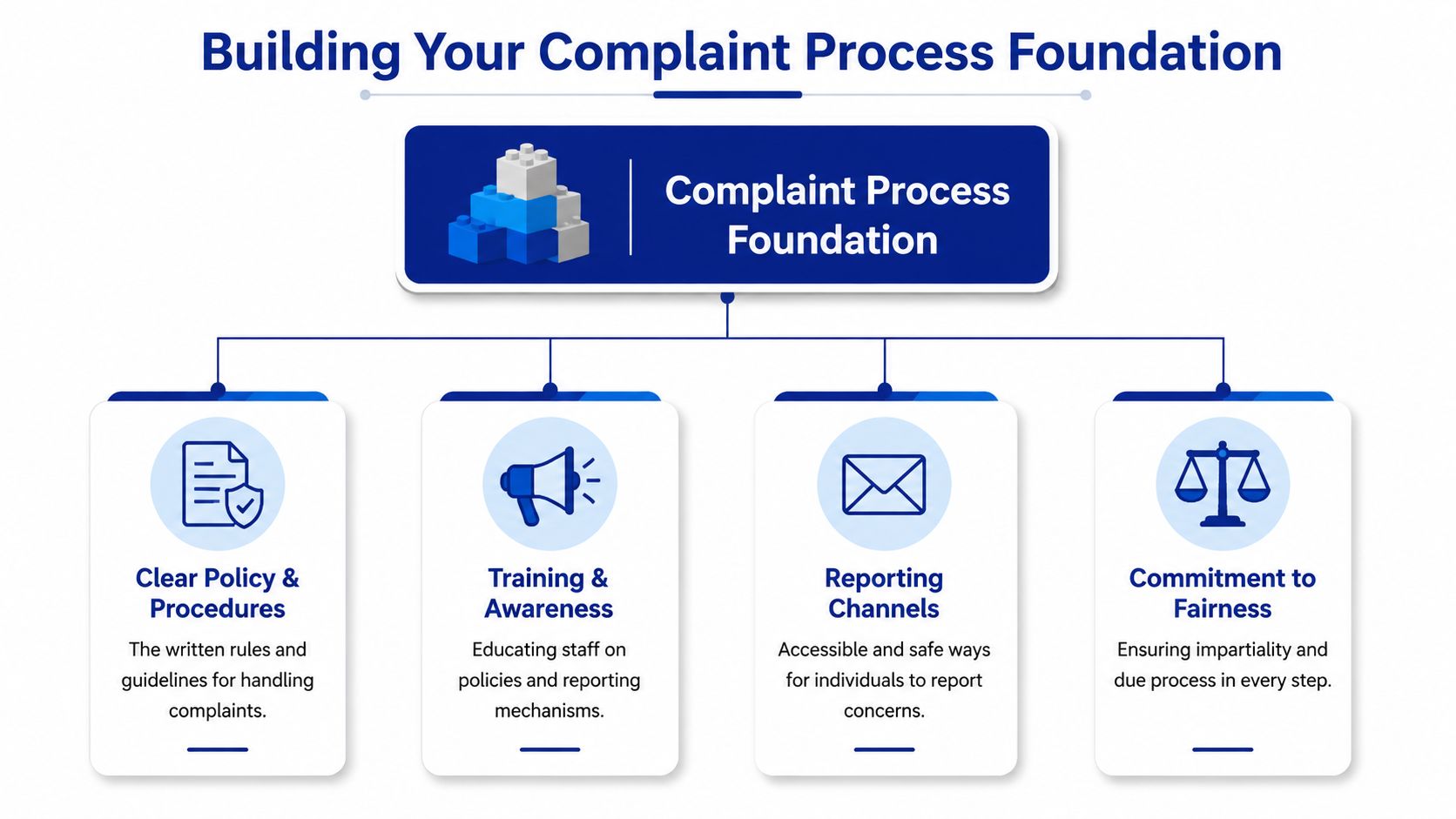
The most important design standard is access. A key success factor is the “trusted and accessible” nature of the reporting channel, and a major legal pitfall is failing to separate responsibilities so that the person receiving the complaint is also investigating or making the final decision (NCBI guidance on workplace harassment response).
That means your system should offer more than one door. Employees should be able to report to a supervisor, a designated HR contact, another member of leadership, or a separate reporting mechanism if internal relationships are compromised.
Use a written process map. If your documentation is messy or trapped in email chains, fix that now. Tools that help teams streamline business process docs can make complaint routing, role assignments, and recordkeeping easier to follow and easier to defend.
Too many smaller businesses collapse the process into one person. That creates bias risk, or at minimum the appearance of bias.
Keep these roles distinct:
If one person must wear multiple hats because your organization is lean, use outside support for at least one stage. The separation matters because neutrality matters.
The moment the same person becomes reporter intake, fact-finder, and judge, your process becomes harder to defend.
An anti-retaliation statement can't be a slogan in the handbook. It needs operational meaning.
Your procedure should clearly state that the company prohibits retaliation against:
Spell out what retaliation can look like in practice. Reassignment, exclusion, schedule manipulation, sudden hostility, or changes in duties can all create exposure if they follow a complaint.
The intake stage sets the tone. If you mishandle the first conversation, you make every later step harder.
Leaders often want to jump straight to conclusions. Don't. Your first job is to receive the report, secure the situation, and preserve your options.

A modern harassment complaint procedure shouldn't rely on direct HR submission alone. While 70% of large organizations now use third-party hotlines for harassment reporting, most public complaint procedure guides still emphasize direct HR submission. This gap matters for SMBs, especially in sectors like healthcare where 48% of staff prefer anonymous third-party reporting over internal channels (third-party reporting trend reference).
That doesn't mean every business needs a complex ethics platform tomorrow. It does mean you should stop assuming employees trust only internal channels.
A practical intake model usually includes:
If you're reviewing your intake design, this overview on handling harassment complaints is a useful companion for operational decisions.
When someone reports harassment, respond in a disciplined sequence.
The U.S. Department of Labor guidance cited in the verified material states that when a complaint is filed, the employer must initiate the investigation immediately, typically within 24 to 48 hours, and document findings, review evidence, and communicate outcomes to both parties (summary reference on immediate investigation timing).
Initial assessment isn't a mini-trial. You're deciding what needs immediate action, not whether the allegation is true.
Use questions like these early:
Short-term measures can include schedule adjustments, reporting-line changes, or limiting contact. Keep them neutral where possible. Don't punish the complainant under the banner of “solving the issue.”
An investigation fails when the outcome looks predetermined. It also fails when leadership treats it like an informal conversation and then tries to defend it later as a formal process.
A proper investigation follows a defined method. The verified guidance is clear: first, acknowledge receipt and conduct an initial assessment; second, gather evidence using open-ended questions; third, provide the accused a full response opportunity; fourth, analyze all evidence and make a credibility assessment; and finally, document findings in a detailed report (HR investigation methodology reference).
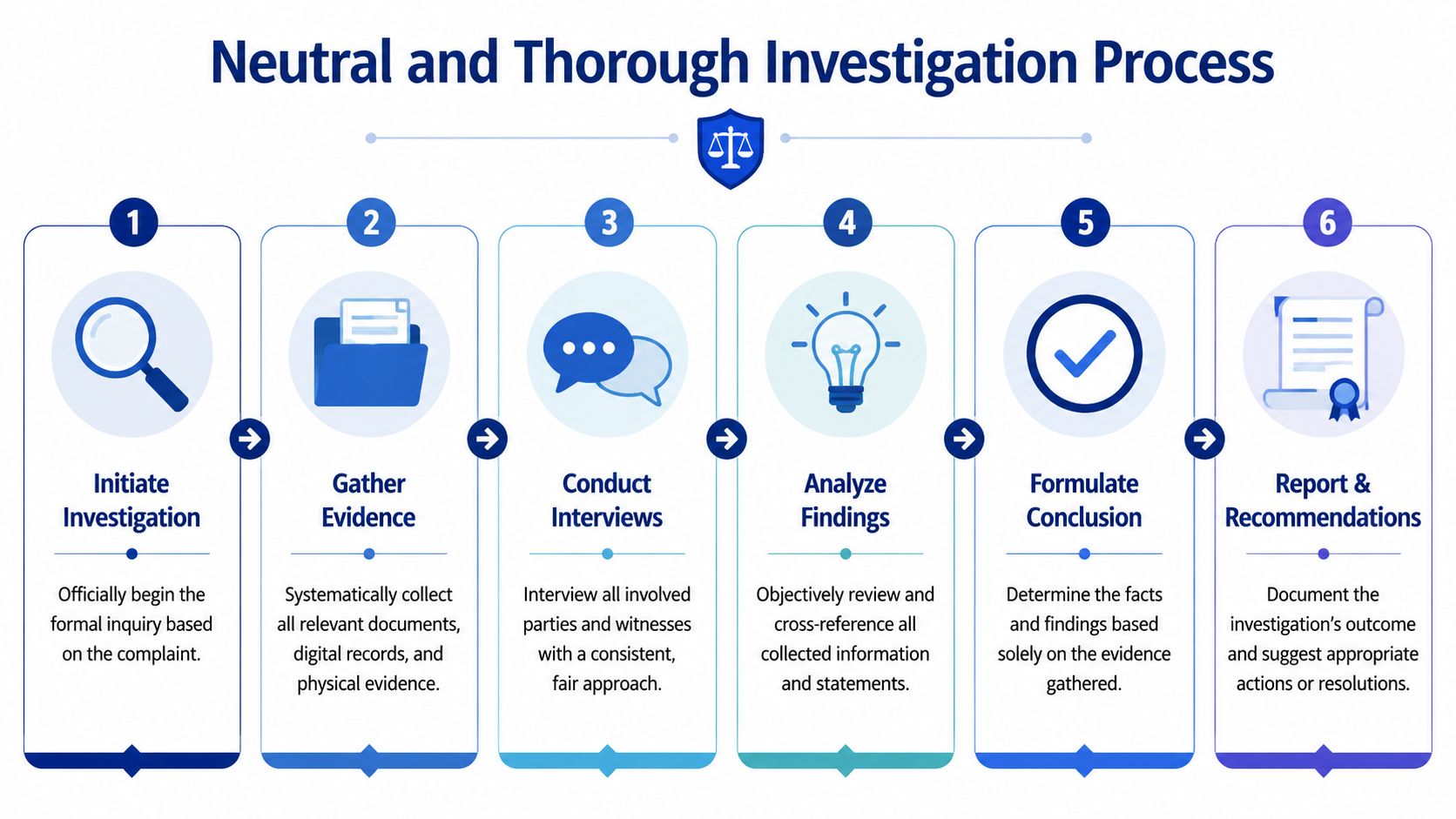
Before interviews begin, define scope. Identify the allegation, the relevant time period, the people involved, and the records you need.
A simple planning table helps:
| Question | What you need to define |
|---|---|
| Allegation | What conduct is being reviewed |
| Parties | Complainant, respondent, witnesses, decision-maker |
| Evidence | Emails, texts, chats, footage, schedules, prior reports |
| Risks | Retaliation, ongoing contact, evidence loss, business disruption |
This step keeps the investigation from drifting. It also helps you avoid the common error of interviewing people before you know what you need from them.
The complainant should get time to tell the story in full. Let them speak without interruption, then return to dates, locations, language used, frequency, witnesses, and supporting records.
Use open-ended questions first. They produce detail and reduce the risk of leading the witness.
Examples include:
The same discipline applies when interviewing the respondent. Give the accused a real chance to address each allegation individually. That isn't courtesy. It's due process.
Ask the same level of detail from every party. Inconsistent questioning creates credibility problems for the investigation itself.
Physical and digital evidence often matters as much as interviews. Pull the records early and preserve them in one secure file.
Look for consistency across:
Don't overvalue a confident witness. Confidence is not proof. Look for corroboration, timing, internal consistency, and whether a witness has any obvious motive to distort events.
Neutrality is not just a mindset. It has to be visible in your conduct and your records.
That means:
For businesses that need a structured outside advisor, an international advisory firm is one option that supports complaint procedures, investigation processes, documentation standards, anonymous reporting channels, and anti-retaliation protocols for SMB leadership teams operating in complex employment settings.
If you want a deeper operational view of the fact-finding stage, this guide on investigating work harassment is worth reviewing alongside your internal protocol.
Most employers lose defensibility on paper before they lose it on the facts. A reasonable investigation can still become hard to defend if your records are thin, disorganized, or inconsistent with your own policy.
Documentation and timing work together. Your file should tell a clean story from intake to closure, and your dates should show that leadership acted without unnecessary delay.
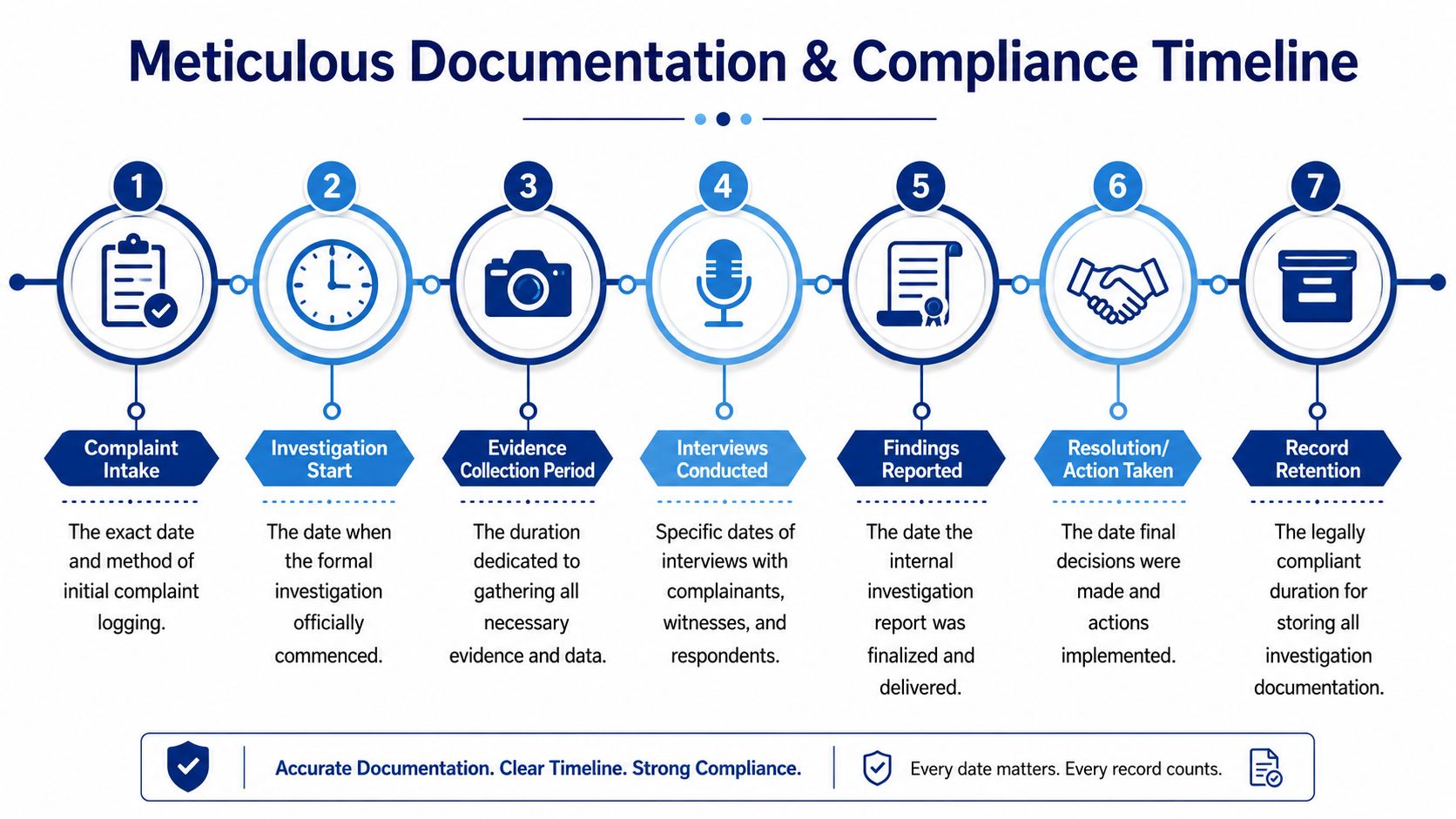
Good documentation is factual, dated, and readable by someone outside the company. Assume a regulator, agency, opposing counsel, or future executive may review it.
Your file should typically include:
If a decision matters, date it. If a conversation matters, summarize it. If an action matters, record who approved it.
According to the EEOC, employees generally have 180 days to file a harassment charge, while federal employees have a shorter 45-day window. Specific state laws add their own requirements, and in New York employers are legally required to provide a written complaint form for employees to report alleged incidents (EEOC harassment guidance).
That matters for two reasons. First, your managers and HR team need to understand the timing context so they don't give bad guidance. Second, your internal process needs to move quickly enough that evidence is still available and workplace disruption doesn't spread.
Federal sector timing is especially unforgiving. Federal employees and applicants must use their agency's internal EEO process within 45 calendar days of the alleged act, and missing that window results in dismissal of the claim (federal complaint timing requirement).
Don't write a separate harassment complaint procedure from scratch for every state unless you enjoy inconsistency. Write one core procedure with local compliance overlays.
A workable model looks like this:
| Layer | What it covers |
|---|---|
| Core policy | Reporting channels, anti-retaliation, role separation, investigation method |
| State addendum | Required forms, notice language, training requirements, local process rules |
| Site practice | Who receives complaints locally and how escalation occurs |
New York deserves special attention. Employers there are legally required to adopt a sexual harassment prevention policy that includes a written complaint form for reporting alleged incidents (New York policy requirement reference). If you operate in New York and your policy lacks that form, fix it.
There's another point many employers miss. Some late-filed complaints may still require exception review. Verified material notes that guidance is often unclear on how procedural exceptions are granted for complaints filed after the standard deadline, and that employer-induced delays can play a meaningful role in approved exceptions (late complaint exception discussion). The practical lesson is simple. Don't dismiss a delayed internal report just because it arrived late. Review the reason for delay before deciding how to proceed.
The hard part isn't only finding facts. It's deciding what those facts mean, what action is justified, and how to communicate the outcome without creating new risk.
Your conclusion should be tied to the evidence, not to the status of the people involved. Don't let seniority, revenue responsibility, or personality distort the analysis.
Most internal investigations end in one of three categories:
Those labels matter less than your reasoning. A good decision memo shows what evidence you relied on, what conflicted, how credibility was assessed, and why the final conclusion follows from the record.
Use consistency checks:
| Decision question | What to ask |
|---|---|
| Policy fit | What exact policy standard applies |
| Evidence quality | What evidence is direct, corroborated, or disputed |
| Credibility | Are accounts consistent, plausible, and supported |
| Prior action | Have similar violations led to similar consequences |
Discipline should be proportionate, documented, and consistent with prior practice. If a manager committed the same conduct that previously led to a warning for someone else, you need a reasoned basis for any different result.
Potential actions can include coaching, written warning, reassignment, final warning, termination, training, reporting-line changes, or other corrective measures. The right response depends on severity, recurrence, power dynamics, and whether trust can be restored.
Don't use “team harmony” as a substitute for discipline. If the conduct is substantiated, act on it.
A weak response to proven misconduct tells the workforce your policy is conditional.
You need to communicate with both parties. Silence creates distrust, and vague internal handling often triggers further complaints.
With the complainant, confirm that the matter was reviewed, that appropriate action was taken based on the findings, and that retaliation is prohibited. With the respondent, communicate the outcome, any expectations going forward, and any disciplinary or corrective action that applies.
Keep these communication rules in place:
The process is not finished when discipline is issued. It's finished when the workplace is stable, the record is complete, and leadership has verified that retaliation isn't taking hold.
If you need a decision partner for a high-stakes harassment complaint procedure, Paradigm International Inc. works with SMB leaders navigating investigations, documentation standards, multi-state compliance, and sensitive people decisions where defensibility matters.


