
TL;DR: Generally, no, properly classified exempt employees do not get overtime pay. Under the FLSA, most employees must receive overtime at 1.5 times their regular rate after 40 hours in a workweek, but qualifying exempt employees are excluded from that requirement. A significant employer risk isn't the answer itself. It's that classification is easy to get wrong, especially for multi-state businesses.
You’re probably dealing with this question in one of two situations. A manager has a salaried employee working long hours and wants to “do something fair,” or your company is expanding and assuming an exempt title in one state will hold up everywhere else. Both situations create risk fast.
My view is simple. If you’re asking “do exempt employees get overtime,” you shouldn’t stop at the pay question. You need to ask whether the employee is exempt, whether the salary structure supports that classification, and whether state law makes your federal answer incomplete.
The default rule is straightforward. Most employees are entitled to overtime pay. Under the FLSA, most employees must receive overtime at 1.5 times their regular rate for hours worked over 40 in a workweek, and only specific categories of employees can be treated as exempt under Section 13(a)(1), as outlined in ADP’s summary of exempt and non-exempt rules.
That means exemption is the exception, not the starting point. Too many employers still treat “salaried” and “exempt” as interchangeable. They aren’t.
A salary is a pay method. Exempt status is a legal classification.
You can pay someone a salary and still owe overtime if the role doesn’t qualify for an exemption. That’s where employers get into trouble. They promote someone, give them a manager title, put them on salary, and assume the overtime issue is closed.
Practical rule: If you can't clearly prove why a role is exempt, treat the role as non-exempt until you've done the analysis.
The burden sits with the employer. If a wage and hour claim lands on your desk, the employee doesn’t have to prove they were non-exempt first. You have to prove the exemption was valid.
The FLSA recognizes specific exempt categories, including executive, administrative, professional, outside sales, and some computer employee roles. But titles don't control. Actual job duties do.
A “director” who spends most of the week performing frontline operational work may not be exempt. A “coordinator” with real administrative authority might be closer, but only if the full test is met.
For practical decision-making, keep these points in view:
If your team needs a clean breakdown of the baseline distinctions, this guide on exempt vs nonexempt classification is a useful companion to your audit process.
This issue isn't academic. It affects payroll cost, scheduling, morale, manager behavior, and litigation exposure.
Once a role is labeled exempt, many companies stop tracking hours, stop checking duties, and stop questioning whether the classification still fits. That’s a mistake. Roles evolve. Growth changes scope. A strong classification at hire can become weak a year later if the employee’s actual work shifts.
The right answer to “do exempt employees get overtime” is usually no. The better executive question is whether you’ve built a defensible reason for calling the role exempt in the first place.
Most classification mistakes happen because employers apply one part of the test and ignore the others. Paying a good salary isn’t enough. A strong title isn’t enough either.
An exempt role has to pass three separate tests. The University of Minnesota summary of FLSA standards states that exemption requires a predetermined fixed salary, a salary that meets the minimum threshold, and job duties that primarily involve executive, administrative, or professional functions. It also makes the key point many employers miss: merely paying a high salary is insufficient if the employee’s primary duties are non-exempt. See this duties-and-classification overview.
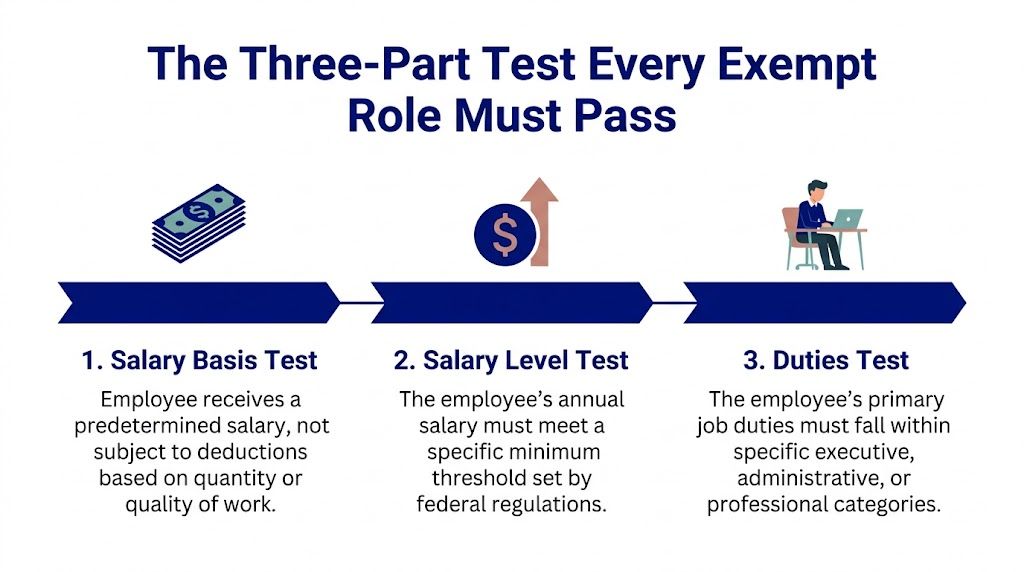
The employee must receive a predetermined salary that isn't reduced based on the quantity or quality of work.
Payroll structure is significant. An exempt employee should receive a fixed salary, not a fluctuating amount tied to hours worked like a non-exempt employee.
If your payroll team docks an exempt employee’s weekly pay because they worked fewer hours, that can undermine the classification. If managers routinely think of exempt employees as “hourly but salaried,” you have a training problem that can turn into a legal problem.
A few signs your salary basis approach needs attention:
The employee must also earn at least the required minimum salary threshold under applicable law. Federal law sets a floor, but that floor is only the start.
For busy executives, the practical rule is this. Always check the higher standard that applies. If federal law says one thing and a state says another, your risk sits with the stricter rule.
Here, multi-state businesses lose control. A compensation model that works in one jurisdiction can fail immediately in another. If your finance team wants one national approach, HR and legal review need to push back when state law requires a different one.
The duties test is usually where employers win or lose. Job titles don't carry the exemption. Actual primary duties do.
This is the most important part of the analysis. A role can pass the salary basis test and the salary level test and still fail because the day-to-day work is not actually exempt.
The standard focuses on what the employee primarily does. If the employee spends most of their compensated time doing routine production, operational support, technical execution, or manual work, the exemption may fail even if the title sounds senior.
Common exempt categories include:
A frequent error in SMBs is labeling strong individual contributors as exempt just because they’re experienced, trusted, or well paid. Expertise alone doesn’t create exemption. If they are producing the work rather than directing, administering, or qualifying under a recognized professional exemption, the role may still be non-exempt.
For a closer look at how to evaluate day-to-day responsibilities instead of titles, review this guide on the duties test for exempt employees.
Borderline roles deserve a stricter review, not a quick assumption. This comes up often with practice managers, team leads, project supervisors, operations coordinators, and technical specialists.
Use a simple internal challenge process:
If your documentation starts with title and works backward, you're doing it wrong. Start with duties. Then test pay. Then confirm the structure supports the result.
Federal law gives you a baseline. It doesn't give you a complete answer if you operate across state lines.
Many SMBs create exposure without realizing it. Leadership approves a single exempt classification model, HR applies it broadly, and payroll assumes consistency equals compliance. It doesn’t. State law often imposes stricter salary thresholds or different overtime rules.
Paycor’s summary of exempt versus non-exempt rules highlights this clearly. States like California and New York impose much higher thresholds than the federal baseline, California requires daily overtime after 8 hours, and a SHRM survey cited there found 42% of employers faced FLSA misclassification lawsuits. Multi-state operations carry more exposure because one classification decision can fail in several different ways at once, as noted in Paycor’s overview of state variation and misclassification risk.
A federal-only mindset is dangerous for companies with remote employees, satellite offices, or recent expansion. The moment an employee works in a stricter state, your old assumptions may stop working.
California is the clearest example. An employee might appear exempt under a federal analysis and still trigger state law issues because California imposes a higher salary threshold and daily overtime rules. New York creates a different challenge by applying a much higher weekly salary threshold for some executive and administrative roles. Colorado adds its own overtime triggers and verification issues.
Here is a simple side-by-side view:
| Jurisdiction | Minimum Weekly Salary (Executive/Admin) | Notable Overtime Rule |
|---|---|---|
| Federal | $684 | Overtime after 40 hours in a workweek |
| California | Higher than federal | Daily overtime after 8 hours, double time after 12 hours |
| Colorado | State-specific salary verification required | Overtime after 12 hours in a day or 40 hours in a week |
| Maine | $871.16 | State threshold exceeds federal baseline |
| New York | $1,199.10 | Higher threshold for some executive/admin roles |
If you operate in more than one state, stop asking whether a role is “exempt” in the abstract. Ask whether the role is exempt in that state, under that employee’s actual duties, salary, and scheduling pattern.
The fastest way to create hidden wage exposure is to standardize exempt classifications across states without checking where the employee actually works.
A better operating model looks like this:
The hard truth is that “we follow federal law” won’t protect a multi-state employer. It only proves you stopped your analysis too early.
Most leaders think of misclassification as a payroll technicality. It isn’t. It’s a business liability that can spread across compensation, documentation, culture, and operations.
The Department of Labor’s 2024 final rule expanded overtime eligibility by making an estimated four million more workers eligible for overtime, according to McAfee & Taft’s analysis of the final DOL rule. When a larger share of the workforce sits near the exemption line, more roles require review, more compensation decisions become risky, and more employers get caught relying on old assumptions.

If an employee was treated as exempt and shouldn’t have been, the company can face claims for unpaid overtime. But the damage rarely stops there.
You also have to account for legal fees, management time, payroll reconstruction, internal investigation work, and the cost of fixing broken practices after the fact. If multiple employees hold similar roles, one challenge can force a wider review.
Here’s where companies usually feel the impact first:
If a role was poorly scoped from the beginning, the problem overlaps with hiring discipline too. The broader operational impact then starts to resemble the cost of a bad hire, because the company isn't just correcting pay. It's cleaning up a decision that was flawed at the design stage.
Misclassification claims don't stay contained to one employee. People talk. Once employees believe the company cut corners on wages, trust drops quickly.
That can show up as skepticism toward HR, resistance to scheduling changes, reluctance to accept promotions, or more scrutiny of pay equity and manager conduct. Even if the legal issue is eventually resolved, the organization still has to repair confidence.
Bad classification decisions don't just create back-pay exposure. They teach employees that leadership may not understand, or may not respect, the rules that govern pay.
For growing employers, that reputational damage matters. You may be trying to hire in competitive markets while dealing with internal questions about whether people were paid correctly.
Scaling increases classification risk because roles drift. A startup operations manager might begin in a clearly non-exempt role, take on more authority over time, and still never be formally re-evaluated. The reverse happens too. A once-exempt leader gets pulled back into frontline production, but the exempt label stays in place because no one revisits it.
This is why periodic audit work matters. A classification decision made in good faith can still become indefensible later.
If you need a practical review of what wage and hour exposure can look like once errors surface, this resource on employee misclassification penalties is worth keeping in your compliance file.
Yes, you can pay exempt employees extra. No, that doesn’t mean every extra-pay structure is safe.
Often, employers create avoidable problems in their efforts to reward hard work. The FLSA allows additional compensation for exempt employees beyond salary, but the structure matters. The Department of Labor explains that extra compensation is permitted so long as the guaranteed salary remains intact, yet payments designed like a time-and-a-half overtime multiplier can be used as evidence to challenge the exemption, as described in the DOL fact sheet on overtime exemptions and extra compensation.
The safer concept is discretionary additional compensation that sits on top of a valid salary arrangement. The risky concept is pay that starts to look like hourly overtime.
That distinction matters because compensation structure tells a story. If your payroll records show an exempt employee receiving classic overtime premiums tied directly to extra hours, you've created facts that can undercut your own classification position.
A clean approach is to separate recognition pay from overtime mechanics. If you want to reward exempt employees for heavy workloads or major project demands, structure it carefully.
Safer examples often include:
The most common mistake is trying to be “fair” by paying exempt employees exactly like non-exempt employees after a certain hour threshold. That may feel practical. It also creates a record that cuts against exempt treatment.
Watch for these red flags:
If you want to reward extra effort, don't mirror non-exempt overtime. Use a compensation method that preserves the guaranteed salary and doesn't redefine the role through payroll practice.
This is also where internal coordination matters. HR, payroll, and operations need to use the same language. A legally acceptable approach can still become risky if managers describe it incorrectly or payroll labels it the wrong way.
My recommendation is blunt. If an exempt role regularly requires extra payments tied to long hours, stop and reassess the role itself. The better fix may be workload redistribution, staffing changes, or reclassification. Repeated premium payments often signal that the underlying job design no longer matches the classification.
If you want a defensible answer to “do exempt employees get overtime,” run an audit before someone else forces one. Don’t wait for a complaint, a demand letter, or a payroll dispute.
This doesn't need to start as a legal overhaul. It needs to start as a disciplined review of how your company classifies work, pays people, and documents the basis for those decisions.

List every role currently treated as exempt
Start with a full inventory. Include remote employees, part-time salaried staff, promoted employees, and roles that changed substantially over the last year.
Compare job descriptions to work performed
Don’t rely on old documents. Ask managers what the employee does each week, then validate that with the employee’s real responsibilities. If the role description sounds exempt but the work looks operational or production-heavy, flag it.
Verify salary structure and threshold compliance
Confirm that each exempt employee is paid on a true salary basis and that the salary level meets the applicable standard in the employee’s work state. Multi-state employers should review this one employee at a time, not by department.
Test the claimed exemption category
Determine whether the role fits executive, administrative, professional, outside sales, computer, or another recognized exemption. If the answer depends on title more than duties, the classification is weak.
Review manager practices and payroll coding
Look for emails, handbook language, manager instructions, and payroll labels that refer to exempt overtime, hourly makeup, or deductions that don't fit a salary basis model. These records often create avoidable evidence.
Check where employees work
Remote and hybrid arrangements change the legal analysis. A strong classification in one state may not hold up in another.
Identify roles with chronic long-hours patterns
If exempt employees regularly work extreme hours and leadership repeatedly wants to “make it right” with extra pay, that role deserves closer review. It may be misclassified, understaffed, or poorly designed.
Document the business rationale for every exempt classification
Write down why the role qualifies, what duties support that answer, and which jurisdiction rules were applied. If you can’t explain it clearly on paper, you probably can’t defend it later.
Some audits can be handled internally. Others shouldn't be.
Bring in counsel or an experienced advisor when you have multi-state operations, regulated environments, disputed duties, inconsistent payroll practices, or planned reclassification decisions. Firms such as outside employment counsel, specialist wage-and-hour auditors, and Paradigm International Inc. can support classification reviews, documentation standards, and risk-based remediation planning for SMB leadership teams.
A good workforce audit doesn't just tell you what's wrong. It gives you a record that leadership took classification seriously before a regulator or plaintiff asked for proof.
Do this review on a schedule, not just after a problem. Exemption is never a set-it-and-forget-it decision.
If you’re reviewing exempt classifications, dealing with multi-state overtime rules, or cleaning up compensation practices that no longer look defensible, contact Paradigm International Inc. for structured HR risk guidance. The goal isn’t more process. It’s clear decisions, stronger documentation, and fewer avoidable wage and hour surprises.