A nurse reports a patient-safety concern, a supervisor documents performance problems, and the COO is asked to approve termination before the next shift. In a Florida healthcare organization, that decision can't be treated like an ordinary personnel file closure. The employment relationship may be at-will, but complaints, clinical reporting, credentialing, payroll, patient continuity, and regulatory screening can turn a routine separation into a high-risk event.
Healthcare employee termination in Florida requires a defensible process. The question isn't only whether the employer can end employment. The question is whether the organization can prove that it acted for a lawful, consistent, independently supported reason while protecting patients and completing every regulatory handoff.
Florida follows an at-will employment model. Major legal references summarize the rule this way: Florida has no statutory provision creating at-will employment, no common-law cause of action for wrongful discharge, and an indefinite employment relationship may generally be ended by either party at any time unless a written agreement or a specific exception applies. The Florida at-will exceptions provide useful context for leaders managing more than one state.
That broad default gives healthcare employers considerable discretion. A hospital, physician group, or care facility can generally terminate an employee without proving cause. But “at-will” doesn't mean “without risk,” and it doesn't eliminate the need to test the decision against discrimination, retaliation, contract terms, public policy, and healthcare-specific obligations.
Florida law contains a specific milestone exception for abortion procedures. Under Florida Statutes section 390.0111(8), no employee of a hospital or physician may be discharged for refusing to participate in an abortion procedure. That protection applies even though the general employment relationship remains at-will.
The practical lesson is narrow but important. A healthcare employer can't rely on a general termination policy to override a specific statutory protection. Before approving a separation, the decision-maker must identify whether the employee's conduct falls within a protected legal, contractual, or policy category.
Florida's default shifts the employer's focus away from proving cause and toward proving lawful reasoning. The organization should be able to show that the stated reason existed before the termination, that managers applied the relevant policy consistently, and that the decision wasn't a response to protected activity.
That standard matters in clinical environments because employees often raise concerns as part of their work. A nurse may report an unsafe staffing condition. A clinician may document a patient-safety event. An administrator may question billing, wage practices, discrimination, or compliance procedures. Those actions can create a retaliation issue if the employer terminates soon afterward without a clear, independent record.
Practical rule: At-will employment gives you discretion. It doesn't give managers permission to skip analysis.
Multi-state healthcare operators should also separate Florida's legal baseline from the rules that apply elsewhere. A policy that works in one jurisdiction may create inconsistency when applied to employees under different statutory protections. Florida's default can support prompt action, but only when HR and clinical leadership verify the employee's status, the relevant agreement, the policy history, and the reason for separation.
The right operating principle is simple: terminate for a lawful reason, document it contemporaneously, and screen the decision for protected activity before anyone communicates it.
The investigation should begin before the termination date is selected. Don't ask a manager to write a justification after the decision has already been made. That creates a post hoc record, and a post hoc record is difficult to defend when the employee can point to an earlier complaint, report, leave request, or wage concern.
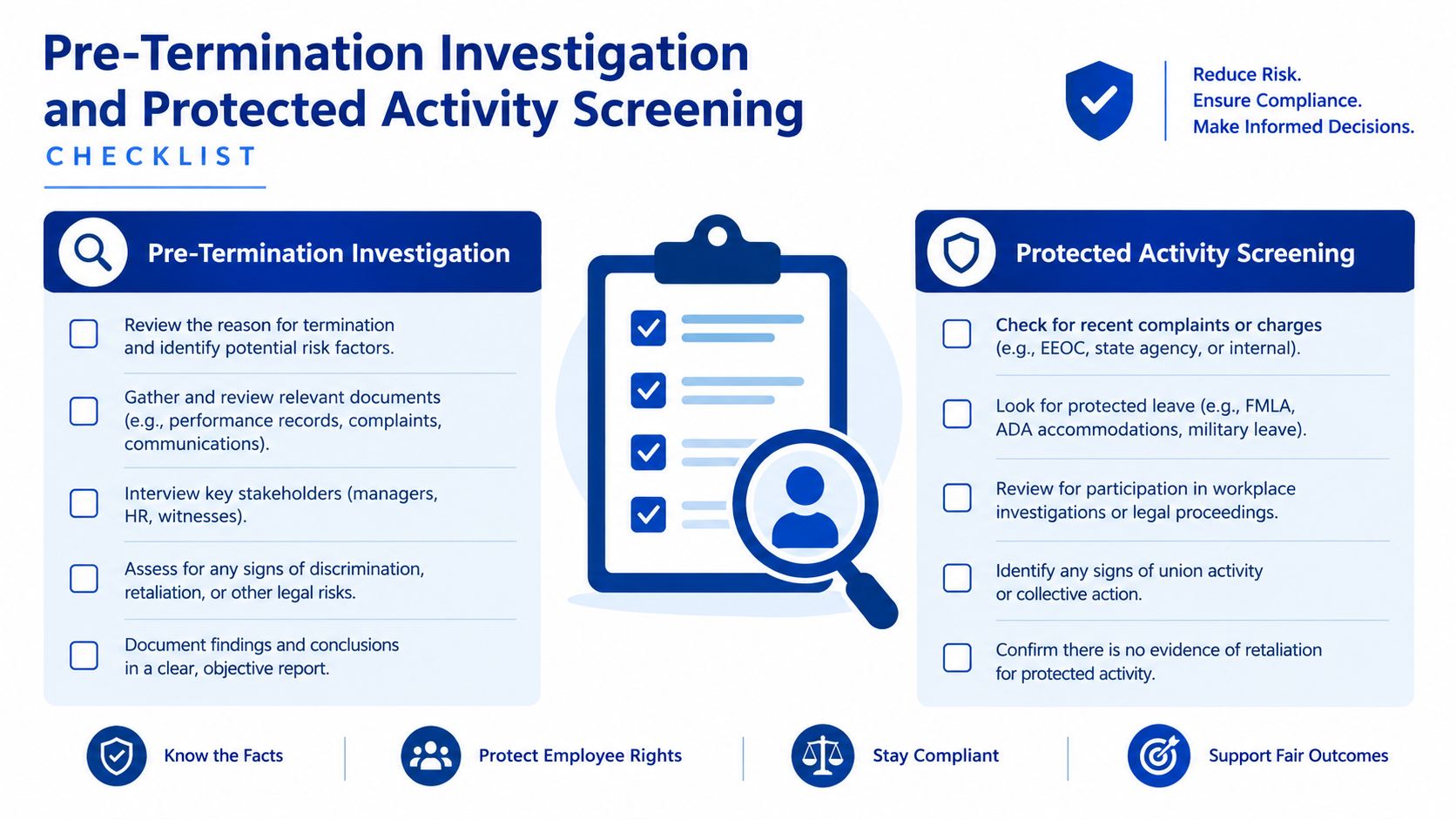
Start with the employment file and build a timeline. Include hiring documents, the at-will disclaimer, performance reviews, attendance records, disciplinary actions, coaching notes, emails, incident reports, and relevant witness statements. Then add the employee's recent communications, including complaints about safety, discrimination, wages, leave, workers' compensation, or other legal and regulatory concerns.
The Paradigm International Inc. investigation guide can help structure the fact-gathering process. Keep the investigation focused on facts, not conclusions. Ask who observed the conduct, when it occurred, what policy applied, whether comparable employees were treated similarly, and whether the employee had a legitimate explanation.
Protected-activity screening should occur immediately before final approval. Check whether the employee recently:
A defensible file doesn't need unnecessary paperwork. It needs the right paperwork, prepared at the right time.
At-will disclaimer. Confirm that the employee received the applicable handbook or agreement language and that no separate promise changes the employment relationship.
Contemporaneous performance documentation. Preserve records created when the conduct occurred. Avoid backdating, rewriting, or replacing earlier notes with a cleaner narrative.
Termination letter with an independent stated reason. Tie the letter to the documented reason. Don't use vague language that conflicts with performance records or suggests the separation followed a complaint.
Final-pay calculation aligned to written PTO policy. Determine what wages and accrued time are owed under the employer's written policy, then retain the calculation and supporting payroll records.
The core operational test is consistency. If the termination letter says attendance caused the decision, but the file contains only recent criticism of a safety report, the employer has created an avoidable contradiction. Florida termination guidance also stresses preserving performance reviews, disciplinary records, communications, timelines, and witness statements, with a signed acknowledgment of receipt where possible.
The decision file should also account for potential filing deadlines. EEOC-style discrimination claims commonly require action within 300 days, while Florida Civil Rights Act claims are often tracked to a 365-day window in practitioner guidance, as summarized by Florida employment termination guidance. These deadlines primarily affect the employee's claim process, but they reinforce an employer's need to preserve records immediately.
Don't let a manager's urgency erase the review. If the evidence is incomplete, pause the decision, place the employee on an appropriate status if necessary, and complete the investigation under controlled conditions.
A practitioner's departure doesn't end the organization's healthcare compliance responsibilities. Termination may change who can access patients, systems, medications, records, and regulated facilities, while the former employee's screening and licensing status may create separate consequences.
The Agency for Health Care Administration states that all persons required to be screened must be screened and determined eligible before they're hired into a position requiring a Level 2 background screening. Florida healthcare screening rules also require criminal background checks with fingerprint screening for all healthcare practitioners effective July 1, 2025, as described by AHCA screening information.
The screening process isn't a document collected at onboarding. AHCA describes a Level 2 fingerprint-based background check initiated through the Clearinghouse, with fingerprints and a photo submitted through an approved Livescan provider, followed by an eligibility determination before employment starts in a regulated facility. HR, credentialing, compliance, and clinical operations should know who owns each step.
For practitioners licensed before July 1, 2025, the updated rule can apply at the next license renewal after that date. Existing licensees who weren't previously screened through a state and federal Level 2 review must comply by their next renewal on or after that date, according to Florida health practitioner screening guidance.
Termination planning should therefore include a controlled access and credentialing checklist:
Certain applicants may be refused a Florida license or exam admission if they were terminated for cause from Florida Medicaid, unless a statutory exception applies. Florida guidance also lists exclusion for people currently on the federal OIG exclusion list, as summarized by healthcare background check information.
That doesn't mean every employment termination should be reported as a Medicaid or licensing event. It means leaders must distinguish ordinary performance separation from conduct that may trigger a separate regulatory obligation. A termination letter should be accurate and restrained. Overstating misconduct can harm the former employee and create unnecessary dispute, while understating a reportable event can expose the organization.
A healthcare termination is complete only when the employment file, access controls, credentialing record, and patient-care handoff are complete.
The termination meeting should be short, coordinated, and controlled. The employee should hear the same independent reason documented in the decision file, not a collection of new criticisms from a manager under pressure.
Schedule the meeting with the right participants. HR should lead the process, the decision-maker should attend when appropriate, and clinical leadership should be ready to manage patient and shift continuity. A second company representative can document what was communicated and how the employee responded.

The message should identify the decision, the effective date, the stated reason, final-pay information, benefits instructions, and return-of-property requirements. Don't invite an argument about every prior coaching conversation. Give the employee a clear channel for questions and document any material response.
A practical sequence looks like this:
In a clinical setting, access removal mustn't create a patient-safety gap. The COO should know who assumes medication management, open charts, patient calls, shift coverage, and escalation responsibilities. HR can manage the meeting, but operations owns continuity.
Florida termination practice emphasizes a written termination letter and a final-pay calculation aligned to the employer's written PTO policy, as outlined in Florida termination and at-will guidance. The organization should verify earned wages, approved time, deductions, commissions or bonuses where applicable under the governing terms, and accrued PTO treatment under the policy.
Don't make a manager promise a payment amount in the meeting. Payroll should prepare the calculation, HR should review it against the policy, and the letter should match the records. Wage disputes can expand the separation issue into a broader claim about withholding, timing, or inconsistent treatment.
Retain a complete closing file:
A healthcare termination plan can't stop at one employee. A service-line closure, payer change, facility restructuring, or credentialing disruption can affect many workers at once. Those events require a workforce-reduction playbook, not a stack of individual termination letters.
Florida healthcare reporting illustrates the issue. Health First announced 214 layoffs with a 60-day paid notice period and support services, while commentators connected the move to the federal WARN threshold for larger reductions in force, as reported by Florida healthcare layoff coverage. The point for a COO isn't to copy another employer's package. It's to recognize that headcount, location, timing, notice, and operational impact can create federal obligations.
A mass-separation notice should be reviewed for accuracy and plain language. It should identify the affected employment status, effective timing, available pay or benefits information, contact channels, and any applicable appeal or transition process. If credentialing, program eligibility, or facility access changes affect the group, the notice should explain what employees need to do and who will answer questions.
Notice quality matters beyond workforce reductions. Federal judges found state termination notices for benefits to be “vague, confusing and often incorrect and misleading” and ordered corrective notice changes, according to the verified legal and reporting summary. That example shows how an unclear notice can become the central problem even when the underlying eligibility decision is lawful.
Large reductions create clinical risks that ordinary HR workflows miss. Before the announcement, leadership should map:
Don't treat a group termination as a series of unrelated meetings. Centralize the legal, HR, payroll, clinical, communications, and credentialing workstreams. The organization needs one source of truth for who is affected, why, when, what they're owed, and how patient care continues.
A strong termination process starts long before a manager asks for approval. Healthcare leaders need policies, training, records, and decision checkpoints that work under pressure. Reactive HR administration won't reliably protect a regulated organization facing complaints, staffing shortages, credentialing changes, and multi-state growth.
Florida's workforce data supports a measured approach. The Florida Hospital Association reported that, since 2022, registered nurse vacancy rates fell by 52% and turnover rates dropped by 47%; a later update said nurse turnover declined from 32% in 2022 to 20% in 2023. An industry summary reported Florida nursing turnover at 17.6% in 2026, down from 32% in 2022, representing a 45% reduction, as summarized in Florida healthcare workforce reporting.
Those improvements don't eliminate termination risk. Staffing volatility still increases pressure on managers to resolve attendance, performance, and conduct problems quickly. A better workforce strategy uses turnover data to identify where supervisors need training, where retention problems create rushed decisions, and where documentation standards break down.
Your operating model should require:
Paradigm International Inc. supports leadership teams with termination guidance, workplace investigations, manager conduct and corrective-action protocols, documentation standards, and multi-state HR risk decisions. The value of an advisory approach is judgment at the moment the facts are incomplete and the operational consequences are immediate.
For a healthcare COO, the standard should be higher than “Florida is at-will.” The defensible standard is a lawful reason, a clean record, a protected-activity screen, accurate pay, secure access, and uninterrupted patient care.
Paradigm International Inc. helps owners, COOs, and HR leaders manage high-stakes terminations, investigations, manager decisions, and multi-state compliance with a structured advisory approach. Visit Paradigm International Inc. to discuss a Florida healthcare separation or build a defensible process before the next one arises.