
If you're hiring across state lines, posting remote roles, or moving people between offices, pay transparency probably stopped being a simple recruiting issue a while ago. It's now a compensation governance issue with compliance consequences attached. The mistake most employers make is treating pay transparency laws by state like a list to check, when the critical work is building a system that holds up across postings, managers, locations, and internal employee questions.
A recruiter opens a remote requisition for a mid-level engineer. The hiring manager wants one pay range. Legal wants state-by-state exceptions. An internal employee sees the posting, compares it to their own pay, and asks for an explanation the same day. That is the 2026 pay transparency situation for multi-state employers.
By 2026, Paycor's pay transparency law summary shows that statewide pay transparency requirements have spread across a large and growing group of jurisdictions, with differences in timing, coverage, and disclosure triggers. Colorado started the modern wave in 2019, and other states followed with their own rules, definitions, and enforcement risk.
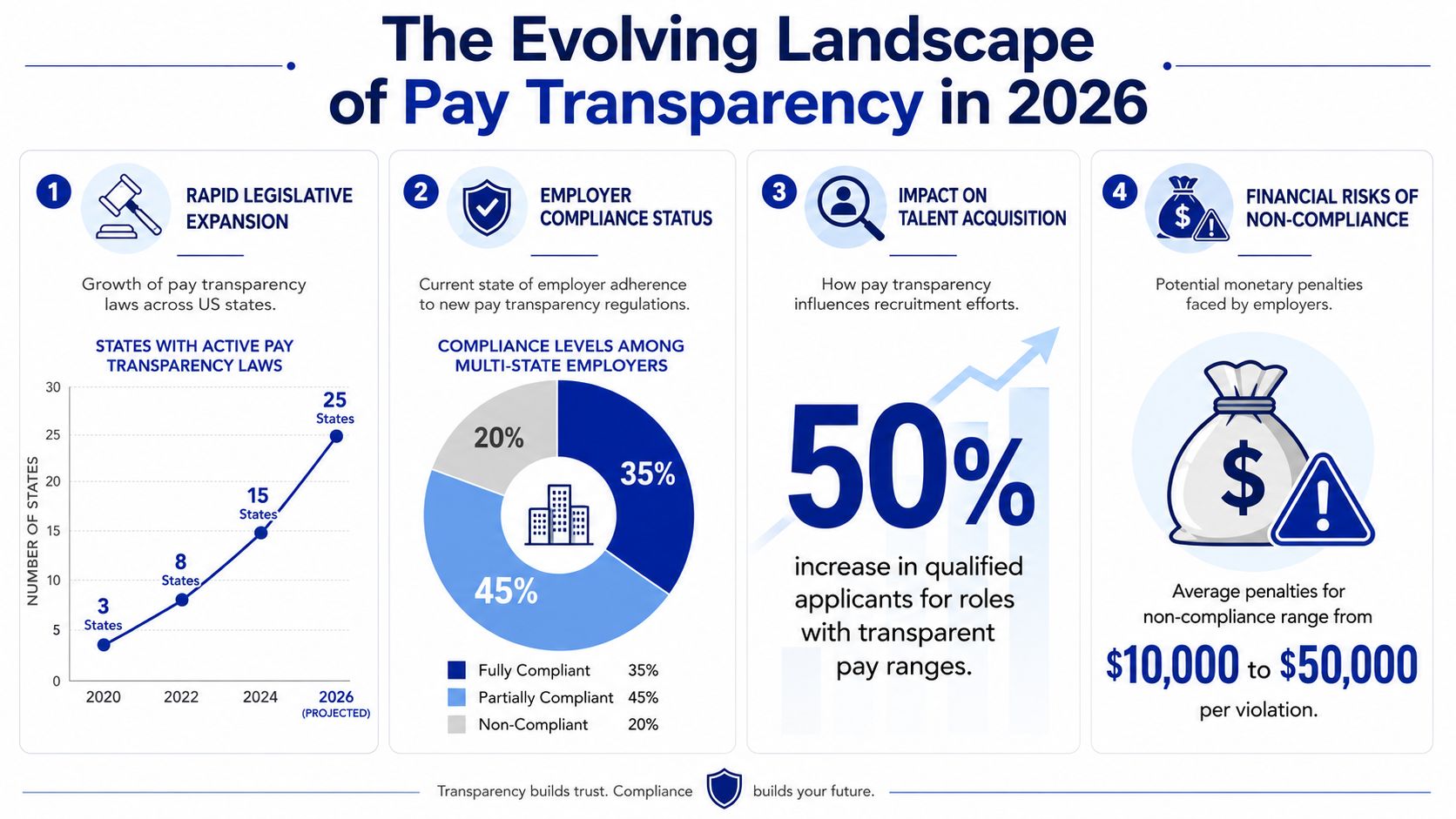
The hard part is not the posting itself. The hard part is running one compensation program across states that ask different questions and expect different answers.
Remote work made that harder. Internal mobility made it harder again. A posting can reach applicants in one state, a current employee seeking promotion in another, and a recruiter sitting somewhere else entirely. If your company treats each posting as a one-off decision, you create inconsistency by design.
Multi-state employers now have to control three things at once. What gets published externally. What gets said internally. What the company can defend if those two versions do not match.
That requires more than recruiter training. It requires compensation governance.
A posted range that is too broad invites scrutiny. A range that does not reflect actual hiring practice creates employee relations problems. A remote job posted nationally can trigger rule conflicts before the first interview is scheduled. Internal transfers and promotions add another layer, because disclosure rights often extend beyond external candidates.
The risk is not abstract. It shows up in routine workflows, including job posting approvals, manager intake calls, transfer requests, and employee questions after a range goes public.
Practical rule: If you hire in more than one state, treat pay transparency as a controlled compensation process with documented decisions.
Set one default approach and document the exceptions. That is the only scalable model.
Start with these actions:
Technical hiring exposes weak pay systems fast. If you need a market reality check on role pricing, resources that help leaders understand software engineering salaries can help pressure-test whether your internal ranges are credible before they become public.
The companies in the strongest position are not the ones chasing each new state rule posting by posting. They build a unified compensation strategy that can hold up across locations, remote hiring, and internal movement. That is how you reduce compliance risk without turning every requisition into a legal fire drill.
A recruiter opens a requisition for a remote role. The hiring manager wants one posting for the whole country. Then legal asks a simple question. Which state's disclosure rule controls if the job can be filled in California, Washington, Illinois, and New York?
That is the actual compliance problem. Multi-state employers do not need a memorized state list. They need a fast screening tool that helps them decide whether a posting needs a range, when disclosure must happen, and whether the rule also reaches transfers, promotions, and remote hiring.
Use this table to triage risk. Then verify your posting workflow, internal mobility rules, and manager scripts before the job goes live. If you are already reviewing employee handbook requirements by state, handle pay transparency the same way. Central policy, state-specific execution.
| State or Locality | Employer Size Threshold | When Range Must Be Disclosed | Applies to Remote Jobs |
|---|---|---|---|
| California | 15 or more employees | In postings, and range disclosure can also be required upon worker request | Yes, can reach employers if only one employee works in California |
| Connecticut | 1 or more employees | During hiring, at the candidate's request or before a job offer if no request is made; employees also have disclosure rights for their own role and in certain transfer or promotion situations | Depends on the role and employee connection to the state |
| Illinois | 15 or more employees | In job postings for openings that could be filled by state residents; notice obligations can also apply to promotional opportunities | Yes, if the opening could be filled by Illinois residents |
| Massachusetts | 25 or more employees for posting disclosure; 100 or more employees for EEO reporting | Good-faith pay range in postings; disclosure rights also apply during the hiring process | Depends on job location and coverage analysis |
| Washington | 15 or more employees | Wage scale or salary range, plus benefits and other compensation, in each posting; internal transfer and promotion disclosures also apply | Yes, including roles that could be filled by Washington-based workers |
| Vermont | 5 or more employees | Range disclosure in postings for roles physically located in Vermont or tied mainly to a Vermont office | Yes, in some circumstances tied to Vermont location or office connection |
| Delaware | 25 or more employees | The pay-range posting law is scheduled to begin September 26, 2027 | Remote-work reach should be evaluated based on the final effective rule and role connection to the state |
Use five screening questions before you approve any posting:
A single posting can be compliant in one state and defective in another with the exact same pay range language.
For multi-state employers, the better question is not "what does this state require?" It is "what rule attaches to this hiring scenario, including remote work and internal movement?" That shift leads to better decisions and fewer preventable compliance failures.
A multi-state employer posts one remote role, opens it to internal applicants, and assumes the same template will work everywhere. That is how compliance failures happen. The legal risk is not the phrase "pay range." The risk sits in coverage thresholds, trigger timing, internal mobility rules, and which state's law attaches to a job that can move across borders.
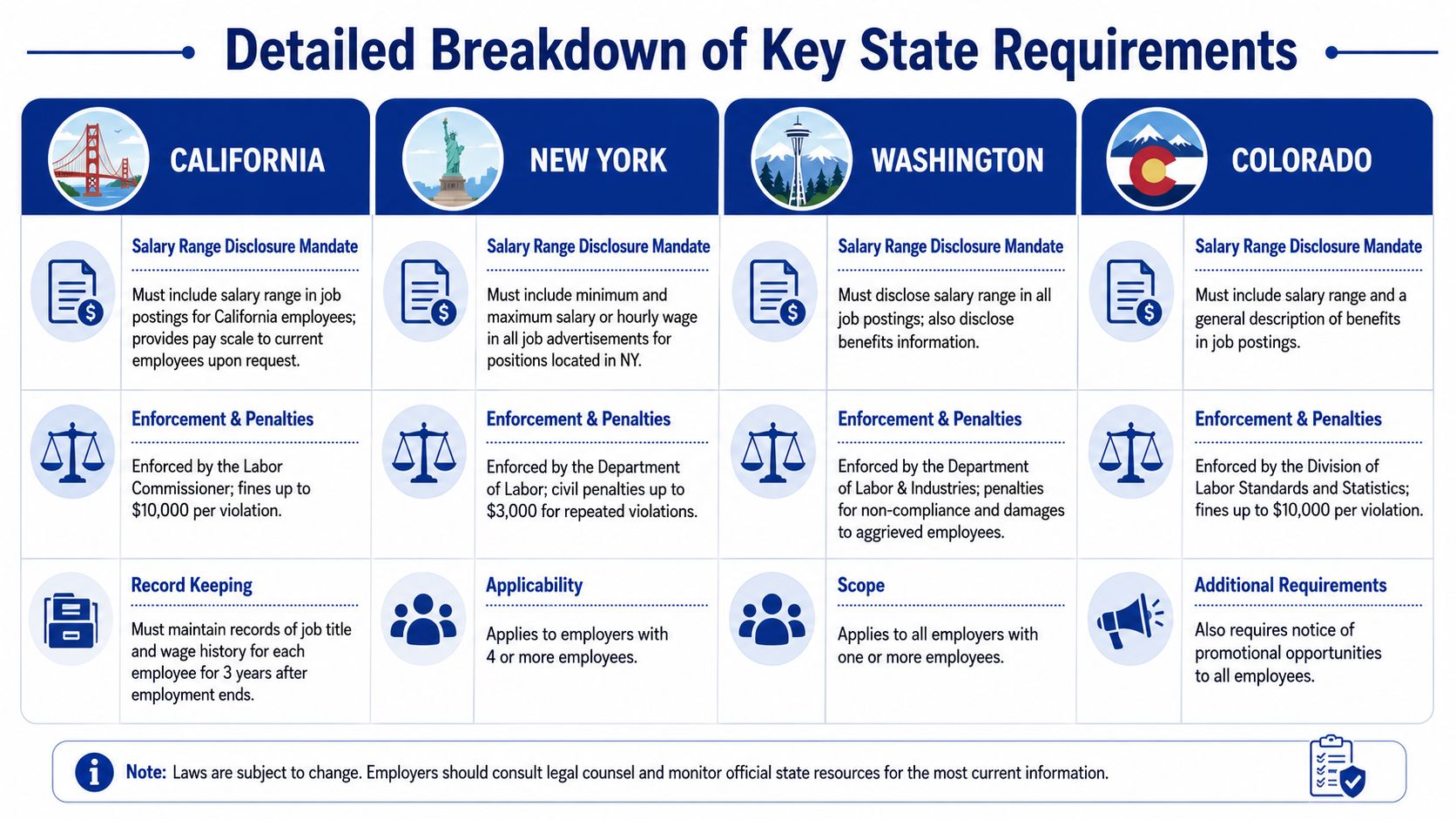
California punishes lazy assumptions. An employer can fall under the law with a small California footprint, and the rule reaches salary-range disclosures in postings and certain employee requests, as outlined in Paycom's overview of pay transparency rules. If you hire nationally, do not treat California as a local issue. Treat it as a posting and recordkeeping issue that can attach to the broader business.
Washington creates a different operational burden. The posting must include more than pay. Employers also need a general description of benefits and other compensation, and the rule can reach remote roles that may be filled by Washington-based workers. That means recruiting cannot publish jobs alone. Compensation, benefits, and legal review need one controlled process.
Connecticut catches employers that rely too heavily on the posting itself. The compliance trigger can arise during the hiring process at the applicant's request or before an offer, and current employees can have disclosure rights in transfer or promotion situations. Train recruiters and managers on the trigger points. A polished template does not solve a broken process.
Illinois forces employers to make a sharper call on geographic reach. The law applies to employers that meet the coverage threshold and to jobs that could be filled by Illinois residents. That standard is broader than the office address. If a role is remote, hybrid, or open to relocation, your posting review should ask who can realistically perform the work, not just where the requisition originated.
Massachusetts deserves attention because it points to the next phase of enforcement. The state combines posting obligations with reporting expectations, which pushes pay transparency out of recruiting and into compensation governance.
That matters for multi-state employers with internal mobility programs. If employees move across business units, states, or job levels, inconsistent job architecture will create inconsistent ranges. Then every transfer, promotion, and remote hiring decision becomes harder to defend.
Your pay ranges will only be as defensible as the underlying role design, approval controls, and documentation. Employers fixing this problem often find gaps in related policies too, including state-specific employee handbook requirements.
The hard question is not whether you can post a range. It is whether you can defend the range, explain the differences between similar roles, and show that your internal movement rules follow the same logic.
Do not run pay transparency through a generic national template. Build a state-impact review tied to the hiring scenario.
Screen every opening for:
A uniform posting format can still create inconsistent legal outcomes. The fix is a unified decision process with state-specific rules built into it.
A compliant job posting does one thing well. It tells the truth about what you reasonably expect to pay, and it does so in a format your recruiters can repeat consistently.
Bad postings usually fail in predictable ways. The range is too broad to be credible. Benefits are omitted where they should be included. The internal and external versions don't match. Or the compensation language says one thing while the recruiter says another.
Start with a standard structure. Don't let each hiring manager write compensation language from scratch.
Use this baseline checklist:
Posting rule: If a recruiter can't explain the range in one sentence, the posting probably isn't ready.
Here is plain language that works better than vague corporate copy:
Sample posted range language: “The anticipated pay range for this position is $X to $Y. Final compensation will depend on role-related factors such as experience, skills, and work location.”
If benefits or other compensation need to be summarized, keep it direct:
“This role is also eligible for company-sponsored benefits and may include additional compensation components based on the position.”
If a role is remote, say where it may be performed. Don't leave legal scope to assumption.
Don't post fantasy ranges. Don't write “competitive pay” when a range is required. Don't tell candidates one range in the ad and a narrower one in the first interview. And don't let recruiters freelance around compensation rules.
Three habits create unnecessary exposure:
If your team is rewriting postings now, tighten the actual role definitions first. This guide on how to write a compliant job description is a useful companion because range compliance gets much easier when the job scope is accurate.
Use one approved posting template for all covered roles, then add state-specific rules through a review step. That's better than trying to maintain a different drafting style for every manager.
The goal isn't elegance. It's consistency, speed, and defensibility.
Your recruiter opens a role to candidates in six states. A manager wants freedom to “go higher for the right person.” Finance wants tighter labor costs. Then a candidate asks how you set the posted range. If your answer depends on who approved the requisition, you do not have a defensible process. You have avoidable risk.
A good-faith pay range is evidence of control. For a multi-state employer, that means the range must reflect actual hiring intent, fit your job architecture, and hold up across remote hiring, internal transfers, and exception requests. If the same role carries one logic for an external candidate, another for a current employee, and a third for a remote worker, your pay practice will break under scrutiny.
The wrong question is, “What number should we publish?”
Ask the questions that matter operationally:
Those answers should exist before the job goes live. Otherwise, your posting is exposing a decision your company has not made.
Start with internal consistency. Market data matters, but it should support your structure, not replace it.
Use a process like this:
Define the job scope
Clarify duties, decision authority, reporting level, and business impact. Vague jobs produce weak ranges.
Slot the role into your job architecture
Assign the level based on established criteria, not manager preference. Deviating from this often results in pay disputes.
Set the range around real hiring intent
Post the pay span you reasonably expect to use. If you would never hire at the bottom or top, fix the range.
Apply location rules the same way every time
If geography changes pay, document how. Multi-state employers need one rule set, not office-by-office improvisation.
Document the exception path
Decide in advance when you will pay above range, below midpoint, or at a premium for scarce skills. Then require written approval.
Keep a short rationale on file
A one-page compensation worksheet is usually enough if it shows the job level, market reference, geography, comparators, and approver.
That record matters. A regulator, plaintiff's lawyer, or internal complainant will ask whether your company followed a repeatable method. “We looked at the market” is not a method.
Keep the file simple and disciplined. It should answer the questions an investigator will ask in the first ten minutes.
Include:
For multi-state employers, add one more control. Keep the compensation rationale separate from the posting copy. The range decision belongs in your compensation records. The job ad is just the output.
Many employers treat pay transparency as a posting problem. It is a compensation governance problem.
If your managers can create titles loosely, price jobs inconsistently, or negotiate outside approved limits, public ranges will expose those weaknesses fast. Remote work makes this worse because one posting can trigger questions from candidates, employees, and regulators in different jurisdictions at the same time.
Fix the operating model, not just the ad. Align job architecture, recruiter scripts, approval authority, and wage-and-hour controls. If your compensation process is loose, your broader wage and hour compliance program is usually loose too.
Use one company-wide range-setting framework for all U.S. roles, then document the state-specific posting requirements separately. That gives you a single compensation logic for external hiring, internal mobility, and remote roles, with less room for manager improvisation.
If your ranges are still built ad hoc, stop posting new roles until you fix the process. Public transparency rewards employers with discipline and exposes employers without it.
The biggest compliance mistake in modern hiring is assuming the law follows your headquarters. It often doesn't.
For remote roles, the question isn't where your company is based. It's where the job can be performed, where the worker may sit, and whether a state law reaches the posting because residents there could fill the role. As of late 2025, Brightmine counted 25 U.S. jurisdictions with enacted pay-transparency laws, and the more useful question for employers is which rule applies to a remote role, especially because Washington reaches jobs that could be filled by Washington-based workers while Vermont applies to roles physically located in Vermont or tied mainly to a Vermont office (Brightmine's pay transparency law tracker).

A traditional HR mindset says, “We're a Texas company, so we follow Texas rules.” That falls apart when you advertise a role nationally and candidates can perform it from covered states.
Remote hiring creates at least four points of analysis:
That's why “remote” is not one category. It's several legal scenarios hiding under one recruiting label.
Scenario one: national remote posting
You post “remote anywhere in the U.S.” without a range. That can trigger disclosure problems if the role could be filled in a state with a posting requirement.
Scenario two: office-based company with one covered-state employee
You think your footprint is too small to matter. It may not be, depending on the state threshold and connection.
Scenario three: internal mobility without separate controls
An employee sees a public range for an opening but gets inconsistent answers about a transfer or promotion path. That can turn a recruiting issue into an employee relations issue quickly.
Remote hiring expands compliance exposure because your applicant market is wider than your office map.
Stop treating remote jobs as standard jobs with a location tweak. They need their own intake process.
Before any remote role posts, require:
Employers that already manage multi-state wage issues usually understand this faster once they connect it to broader wage and hour compliance. The same principle applies. A dispersed workforce demands tighter rules, not looser ones.
If you don't want to analyze state-by-state reach for each remote role, use the broadest compliant posting format your business can support for remote hiring. It won't solve every issue, but it will eliminate a lot of preventable inconsistency.
A multi-state employer posts a range for a remote opening on Monday. By Friday, a manager has promised an internal candidate something different, a recruiter has used an outdated range in another market, and employees are comparing posted pay across teams. That is not a posting problem. It is a governance failure.
Posting ranges makes your compensation system visible. Once that happens, loose job levels, local manager exceptions, and inconsistent transfer practices stop being internal quirks and start becoming legal and employee-relations risk. Multi-state employers need one operating model that holds up across public postings, internal mobility, and remote hiring.
The right question is not whether your business can comply state by state. The right question is whether your pay decisions can be defended the same way across states. If the answer is no, standardize now.
Start with role design. If departments use different titles, levels, and scope definitions for similar work, your posted ranges will expose those gaps immediately.
Set role families and levels centrally. Define what changes a role from one level to the next, who can approve exceptions, and when a local business case justifies a different structure. Multi-state employers should resist creating one-off titles for individual managers or locations. Those shortcuts create comparison problems later.
Pay ranges need a single owner and a clear approval path. Without that, HR drafts one range, finance pushes for another, and managers negotiate around both.
Assign final authority to one accountable function. For many companies, that is the head of HR, a compensation lead, or a small approval group with written authority. Make sure the same group controls posting ranges, internal transfer ranges, and exception approvals. Separate owners create conflicting pay messages.
Managers need boundaries, not freedom to improvise.
Use guardrails that are easy to enforce:
This same discipline matters in other wage decisions. If your managers already struggle to apply pay rules consistently, a practical guide on how to calculate double time is a useful reminder that compensation administration fails when every manager creates their own method.
Public ranges will trigger questions. Internal candidates will compare transfer opportunities to external postings. Employees in one state will ask why a coworker in another market sits in a different range. Remote teams will raise the hardest questions because geography, job scope, and internal equity all collide.
Prepare answers before those conversations happen. Give managers plain-language explanations tied to level, experience, geography, and business rules. Do not hand them vague talking points. If managers cannot explain your system clearly, they will create risk with off-the-cuff answers.
Public ranges do not create pay problems. They expose weak pay decisions and inconsistent controls.
A strategic compensation governance plan should define:
Keep the model disciplined and usable. A good plan is not long. It is clear, enforced, and consistent across states, remote roles, and internal moves. If your company cannot explain why two similar roles have different ranges, fix that before the next posting goes live.
Most companies don't need another memo about the trend. They need an internal audit that reveals where their real exposure sits. The fastest way to do that is to review the full chain from role design to manager communication.
Use this checklist as a working audit tool, not a one-time compliance project.
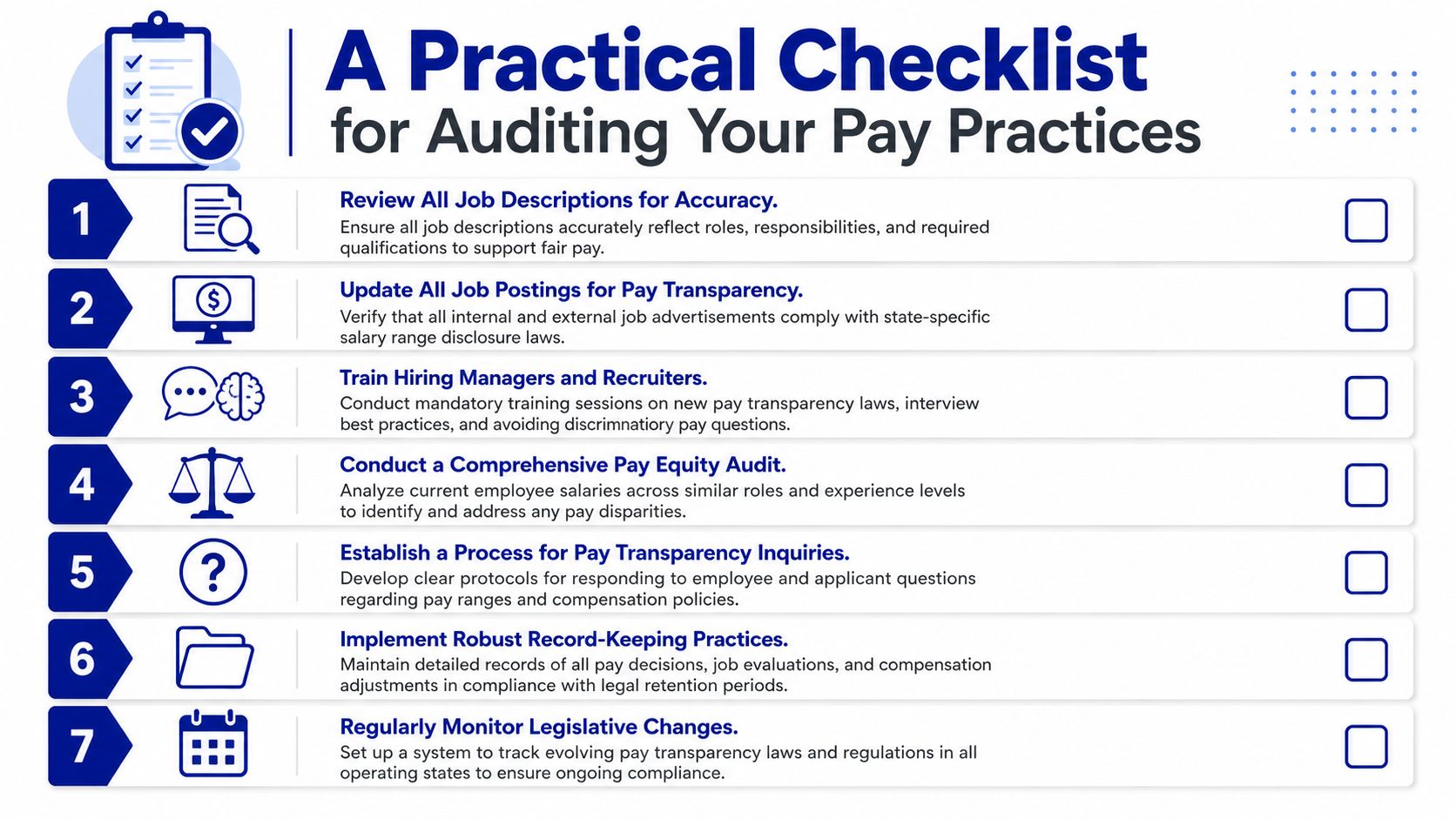
Start where risk becomes visible.
Then move behind the posting.
If your records can't show how a range was set, your company will struggle to prove it acted in good faith.
At this juncture, many employers discover the larger problem.
Ask these questions:
If the answer to any of those is no, the issue isn't just legal compliance. It's governance failure.
The audit only matters if it becomes a recurring discipline.
Build a standing review around:
One final recommendation. Assign a single owner to maintain the company's pay transparency decision log. Not because the law always requires that exact document, but because it gives leadership one place to review what was approved, why it was approved, and where inconsistency is creeping in.
If your leadership team is hiring across states, managing remote roles, or trying to bring compensation practices under tighter control, Paradigm International Inc. can help you pressure-test your current approach, identify exposure points, and build a more defensible pay transparency process.