A Florida healthcare employer can lose control of compliance before the first day of work. A candidate needs to start quickly, the background screening is still pending, a nurse's credential needs verification, and a manager has stored medical paperwork in the employee's general personnel file. At the same time, a rule has changed, payroll has a Medicaid wage attestation to verify, and leadership is preparing for an audit.
That isn't a policy problem. It's a workflow problem. Effective healthcare HR compliance in Florida connects hiring, credentialing, payroll, privacy, investigations, training, and rule monitoring into one operating system that produces reliable evidence when someone asks, “Who approved this, when, and based on what?”
Florida healthcare employers work in a large, fast-moving labor market, and that scale makes process discipline matter. The 2024 statewide workforce report identifies more than 63,000 healthcare establishments employing more than 1 million people, with healthcare employment growing by more than 36,000 jobs from the prior year. Average annual healthcare wages exceeded $78,000, nearly $16,000 above the all-industry average, while the state estimated about 17,000 nursing vacancies annually. These figures are reported in Florida's statewide healthcare workforce information.
That volume changes the risk profile for owners, COOs, and HR leaders. A missing license record is not a small admin miss when the same onboarding path runs across clinics, home health operations, assisted living facilities, and nursing homes. Inconsistent leave handling creates repeated exposure across a workforce already under staffing pressure.
Operational rule: If a compliance control depends on memory, it is not a control. Put the decision, owner, deadline, and evidence into the workflow.
A Florida clinic hiring several direct-care employees while expanding hours faces the same pressure every time. Recruiting wants conditional offers issued quickly. Operations wants people on the schedule. HR has to hold the line on screening requirements, licenses, certifications, onboarding records, and employment eligibility before the hire is treated as cleared. If those steps happen in an improvised order, the organization may have no reliable answer when an auditor, regulator, employee, or attorney asks for the file.
A defensible system has four characteristics:
The risk does not stop at employment claims. Florida healthcare facilities also have to manage licensure obligations, wage conditions tied to public funding, privacy requirements, and reporting duties. Leaders should treat compliance as an operating discipline, not as an annual handbook exercise.
A playbook gives that discipline structure. It ties hiring, credentialing, payroll, privacy, investigations, training, and rule monitoring into one workflow so the organization can produce reliable evidence when questions come up.
A healthcare employer in Florida needs a rule-change workflow, not a shelf of policies. The Agency for Health Care Administration keeps a regulations index for hospitals, ambulatory surgical centers, assisted living facilities, nursing homes, and health care clinics, with effective dates across 2024, 2025, and 2026. Assign one owner to review the index, update local procedures, and push changes into the worksite before staff keep using outdated forms or stale instructions. Use the Florida healthcare regulations index and compliance resources as the starting point, then build the rest of the workflow around it.
The operating model should stay simple and fixed:
That structure matters because Florida healthcare employers also have duties tied to overpayments, wage administration, privacy, and reporting. Facility licensees and practitioners who receive overpayments must refund them within 30 days of determining the overpayment, and administrative fines can reach $500 per violation, as summarized in this Florida healthcare compliance overview. HR may not own the refund process, but it must know where payroll, billing, manager approvals, and employee compensation records intersect.
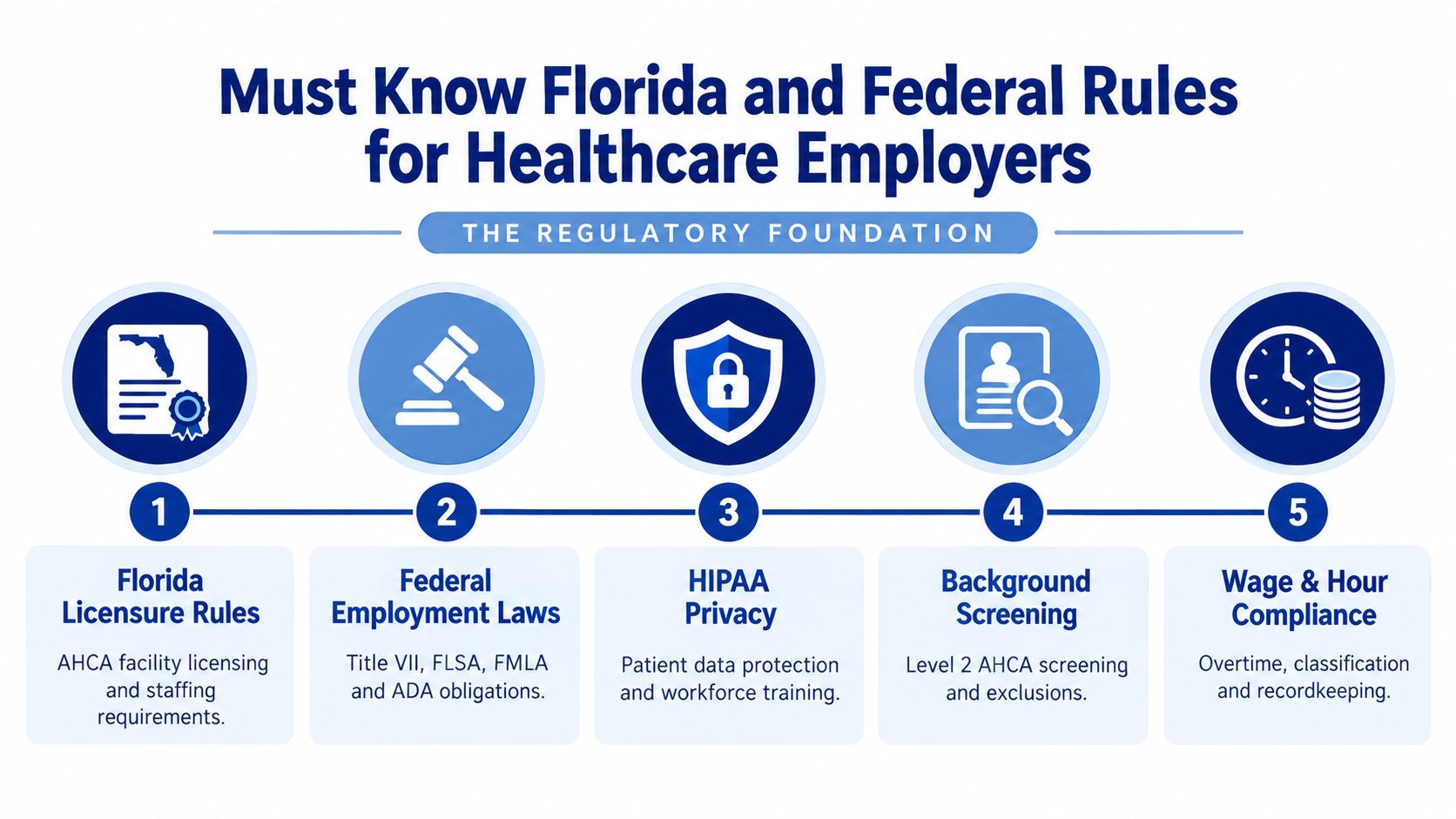
Leadership should review the regulatory calendar on a fixed cadence, then trigger an off-cycle review when AHCA, the Florida Department of Health, payroll, or legal advisors identify a material change. HR teams can also use this overview of essential HR rules for Florida employers to organize broader employment obligations outside the healthcare workflow.
Hiring controls should prevent a common failure: treating a promising candidate as a cleared employee before required checks are complete. Florida healthcare employers should initiate required screening before finalizing start dates, make the offer conditional on screening results, and keep licenses, certifications, and background-check records in the personnel file. The Florida healthcare background screening guidance identifies Level 2 screening as mandatory for many roles, including direct-care, administrative, and volunteer positions.
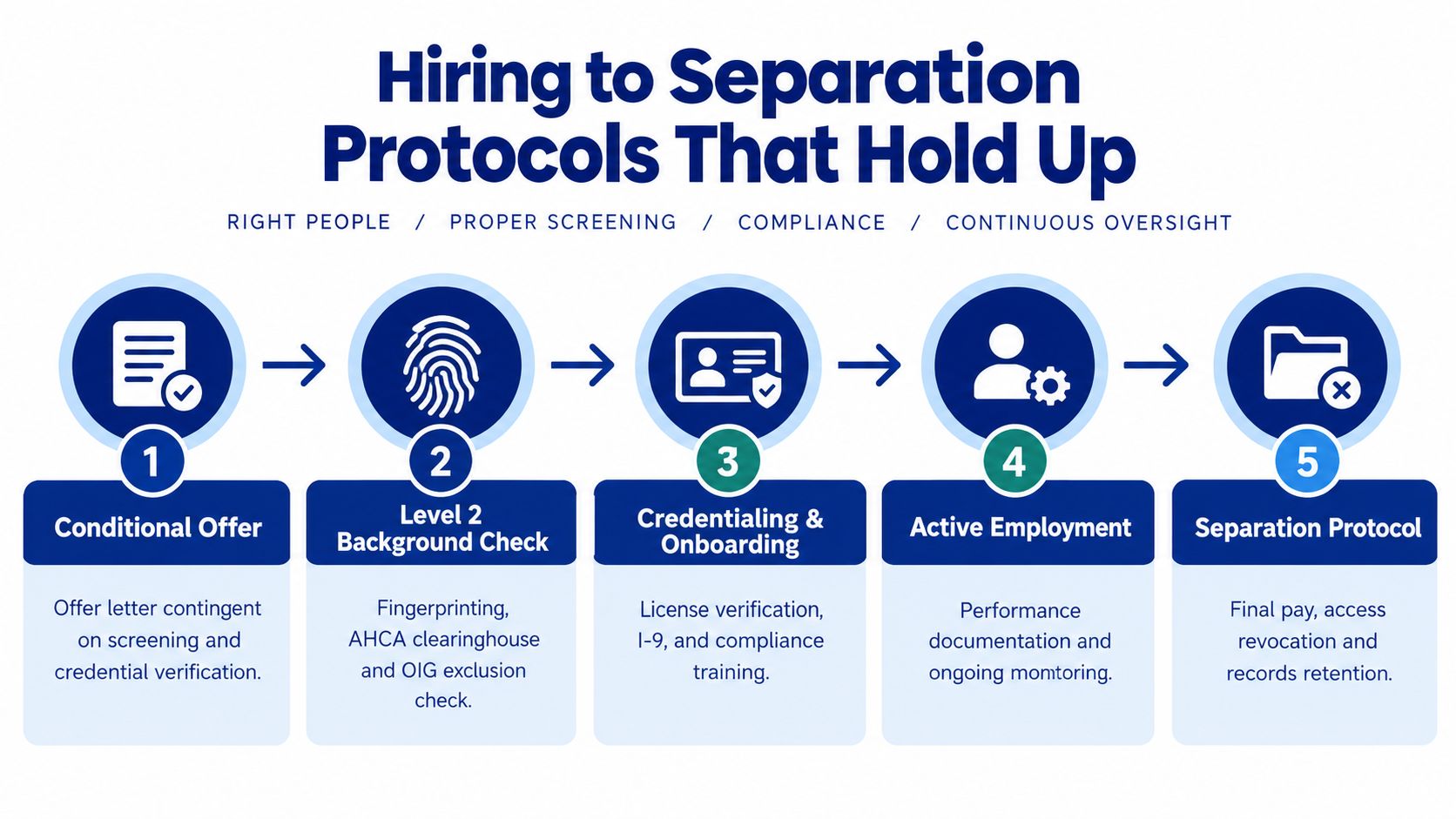
Start with the requisition. The job description should identify required licenses, certifications, screening level, physical or scheduling requirements, and any role-specific compliance training. In 2026, certain Florida organizations using Level 2 screening must include a link to AHCA's background-check education page in job postings. AHCA must update that page annually by October 1, so recruiting templates need an assigned owner and review date. The rule and workflow implications are described in this Florida job-posting background-check update.
Issue a conditional offer. State clearly that employment depends on satisfactory screening, credential verification, and any other stated conditions. Don't promise a start date that assumes clearance. If screening is delayed, document whether the candidate may perform any work, what supervision applies, and who approved the exception.
Complete verification before access. Confirm the license or certification directly through the appropriate source, record the verification date, and set a renewal reminder. Complete Form I-9 and the applicable E-Verify process for covered hires. Florida private employers with at least 25 employees must complete Form I-9 and use E-Verify for employees hired on or after July 1, 2023, according to this Florida employment-law update.
Control onboarding access. Assign required training, confirm acknowledgment of policies, and provide only the system access needed for the role. A person can be scheduled for orientation without receiving access to patient systems or independently providing regulated care.
Manage separation as a control point. Record the reason, decision-maker, final-pay process, return of property, access revocation, and records-retention instructions. Keep the file objective. Avoid speculative labels or emotional commentary that could undermine the organization's position later.
Organizations that need administrative support may consider specialized services such as hire Medical Virtual Assistants for defined nonclinical tasks, but delegation doesn't transfer accountability. The employer still must control access, training, confidentiality, documentation, and supervision. Review the relevant multi-state handbook laws before using one onboarding package across jurisdictions.
A complaint becomes a compliance test the moment it reaches a manager. The organization must capture the concern, assess urgency, preserve relevant evidence, select an impartial investigator, and document the outcome. A shared inbox or informal conversation may be an intake channel, but it shouldn't be the complete case record.
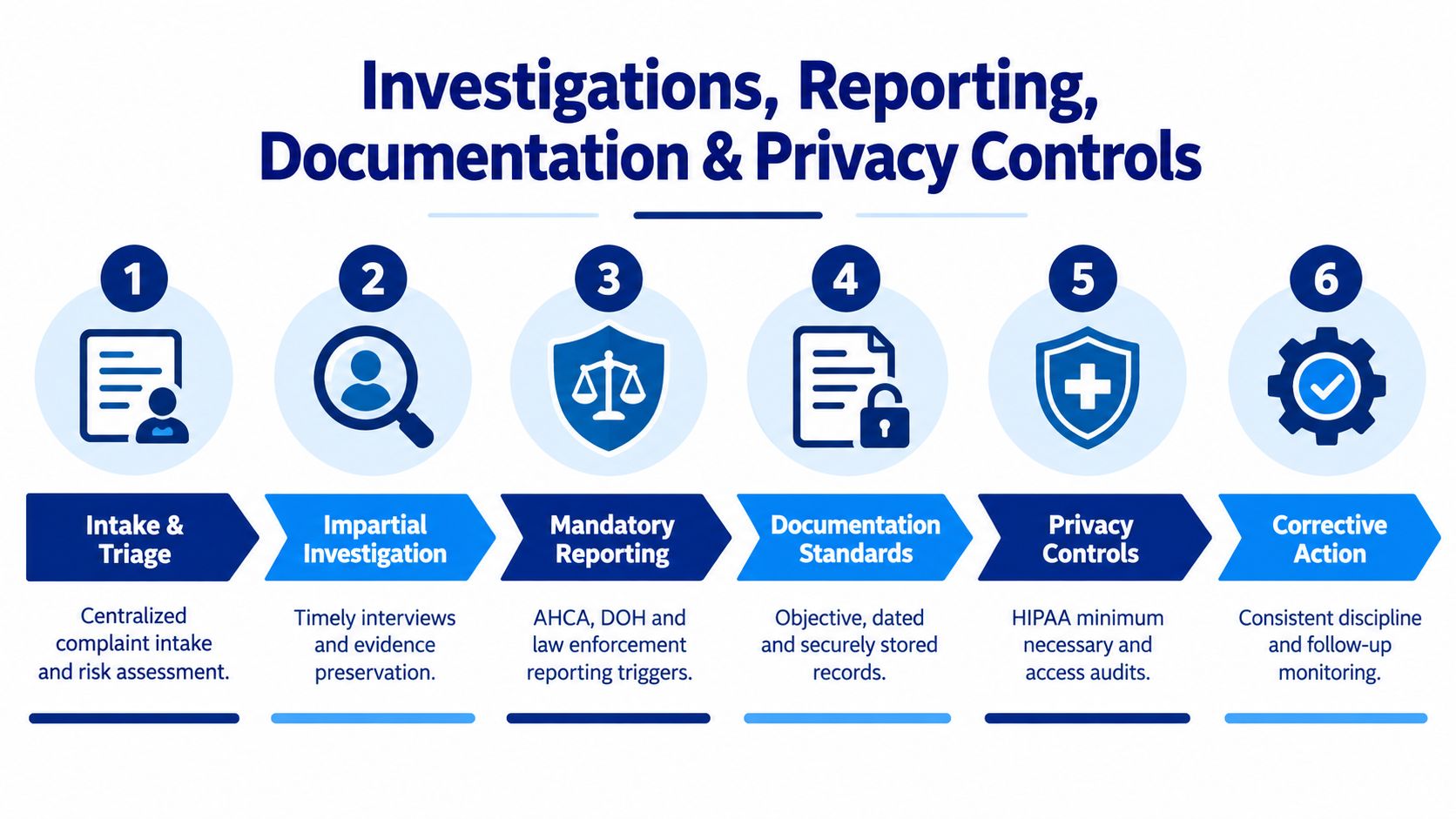
An investigation record should show:
Keep medical and health-plan information separate from the general personnel file. Florida's Information Protection Act treats medical and health insurance data as protected personal information and requires breach notification within 30 days, as explained in this Florida employee-data privacy guidance. In practice, that means HRIS permissions, vendor access, offboarding, file naming, and retention rules need deliberate design.
Privacy control: Store employee medical records, leave certifications, accommodation documents, and health-plan information in restricted locations. Don't let a manager's broad HRIS access become the default.
Use role-based access and audit it after transfers, promotions, and separations. Vendors supporting scheduling, payroll, benefits, or virtual administrative work should receive only the information necessary for their assignment. Teams can use this practical guide to HIPAA virtual assistants when evaluating delegated administrative work, while still documenting the employer's own access and oversight controls.
A disciplined investigation doesn't guarantee that every dispute ends without commotion. It gives leadership a credible record showing that the organization responded promptly, applied a consistent process, protected confidential information, and made a decision based on evidence. The investigation management framework can help leaders formalize that process.
A compliance system fails through drift. Employees forget procedures, managers improvise, credentials approach expiration, and a policy that worked for one location gets copied into another state without checking local requirements. Training and credential management must therefore operate as recurring controls, not as orientation tasks.
Start with a role-based matrix. Separate training required for all employees from training triggered by job duties, facility type, patient population, system access, or supervisory authority. Assign completion owners, preserve acknowledgments, and escalate overdue items before the employee performs work that requires the training.
Credential management needs the same discipline. Track the credential, issuing body, verification date, expiration date, renewal status, and work restrictions. A lapsed credential should trigger an immediate scheduling and access review. Don't rely on an employee to notice the lapse or on a manager to remember an expiration date.
For Florida Medicaid-participating providers, AHCA requires a supplemental wage agreement tying funding to at least $15.00 per hour for employees, with an attestation under penalty of perjury. Employees may sue if the wage floor is missed, and prevailing workers can recover back wages, an equal amount in liquidated damages, plus reasonable attorney's fees and costs. The AHCA Medicaid provider minimum wage requirements make payroll audits and contract-level verification a leadership responsibility.
Florida doesn't generally require employers to sponsor health insurance, but the federal ACA employer mandate applies to businesses with 50 or more full-time equivalent employees. Covered employers must offer minimum essential coverage, with the cited guidance describing a plan that covers at least 60% of allowed medical expenses and employee premium contributions no higher than 9.12% of household income for 2023, subject to annual adjustments. Verify current thresholds and affordability requirements before relying on an old benefits configuration. See this Florida employer health insurance explanation.
Smaller employers also need a continuation-coverage workflow. Florida's Health Insurance Coverage Continuation Act applies to employers with fewer than 20 employees, allowing eligible employees to elect coverage for up to 18 months, or 29 months in disability situations, under the conditions summarized in this Florida employment-law compliance resource.
For multi-state operators, standardize the evidence and localize the legal requirement. Use one core record structure for offers, credential verification, training, investigations, and separation, then maintain state-specific addenda for postings, leave, screening disclosures, wage rules, and benefit notices.
The result should be a single dashboard showing which location owns each control, which rules apply, and which items need review. That structure reduces inconsistency without pretending that one Florida policy can govern every jurisdiction.

Audit readiness is the ability to produce reliable evidence without reconstructing events from memory. Assign one owner for each control, store records in a consistent location, and review exceptions rather than only checking whether a policy exists.
For every hire: Verify the conditional offer, required screening, license or certification, Form I-9, E-Verify where applicable, training assignment, and access approval.
For every employee change: Recheck credentials, permissions, compensation, reporting lines, and required training after a transfer, promotion, leave, or role change.
For every complaint: Record intake, triage, investigator assignment, evidence preservation, interviews, findings, corrective action, and follow-up.
On a recurring operational schedule: Review open screening exceptions, expiring credentials, overdue training, payroll rates, Medicaid wage documentation, leave records, and access reports.
When a rule changes: Identify the effective date, affected locations and roles, revised forms or postings, manager communication, training requirements, and completion evidence.
Your offer letter should state the conditions that must be satisfied before employment begins. Your job-posting template should include any required screening education link and identify who reviews it. Your personnel-file checklist should distinguish general employment records from restricted medical, leave, accommodation, and benefits information.
A useful audit sample asks five questions:
Build the system in a way managers can use. A short checklist with ownership and deadlines is safer than a lengthy policy that no one follows. If your organization needs help translating requirements into hiring, documentation, investigation, payroll, and multi-state controls, contact Paradigm International Inc. for a focused review of the workflows creating the greatest exposure.
Paradigm International Inc. helps owners, COOs, and HR leaders build defensible HR practices for regulated and multi-state organizations, including hiring verification, investigations, documentation, manager conduct, and compliance reviews. Visit Paradigm International Inc. to learn how an advisory-first approach can bring structure and judgment to your Florida healthcare HR compliance program.