A complaint has landed in your inbox, and the pressure to “just talk it through” is already there. That instinct is dangerous. The first hour of investigation management decides whether you end up with a defensible record or a messy file that falls apart when an employee files a charge, a state agency asks for documents, or a witness tells a different story six months later.
The biggest mistake SMB leaders make is treating a complaint like a conversation instead of a governed process. That feels faster in week one, but it creates the exact exposure you're trying to avoid in month six. Once the file has to survive outside scrutiny, informal handling starts to look like indecision, favoritism, or poor control.
Modern investigative workflows are built as a formal lifecycle, with case intake and triage, scope and planning, investigation, report drafting and review, case closing, quality assurance, and audit as described in the corporate investigators handbook. That structure exists because investigation management is a controlled governance process, not ad hoc note-taking. If your team skips the structure, you're not saving time, you're borrowing trouble from the future.
The failure usually starts with ownership. A complaint comes in, someone informally “owns” it, and no one asks whether that person is the right investigator, whether the scope is clear, or whether management has authorized the work. By the time the business realizes the case is sensitive, the record is already fragmented.
The second failure is timing. People remember that they “handled it quickly,” but speed without documentation doesn't help when a witness contradicts the story later. If there's no clear intake trail, no defined scope, and no documented decision-making, the file looks weak even if the underlying response was well intentioned.
Practical rule: If the complaint is serious enough to affect pay, discipline, promotion, or legal exposure, it deserves a governed process from the start.
You should also stop assuming every internal complaint can be managed the same way. The right process is driven by who the complaint involves, where the employees sit, and what could happen if the matter escalates. Multi-state operators feel this pain first because they rarely have one neat chain of command, one policy culture, or one legal environment.
The market is already signaling that this is mainstream business infrastructure, not a specialty compliance add-on. The investigation management software market was valued at USD 14.8 billion in 2024 and is projected to reach USD 33.25 billion by 2031 according to the market study. That growth reflects a simple truth, organizations need a repeatable way to intake, track, and defend cases.
A defensible case moves in stages. If you collapse two stages into one because “we're short on time,” you usually lose clarity, and clarity is what survives scrutiny. The point of the lifecycle is to force the right decision at the right moment, before the file gets contaminated by guesswork.
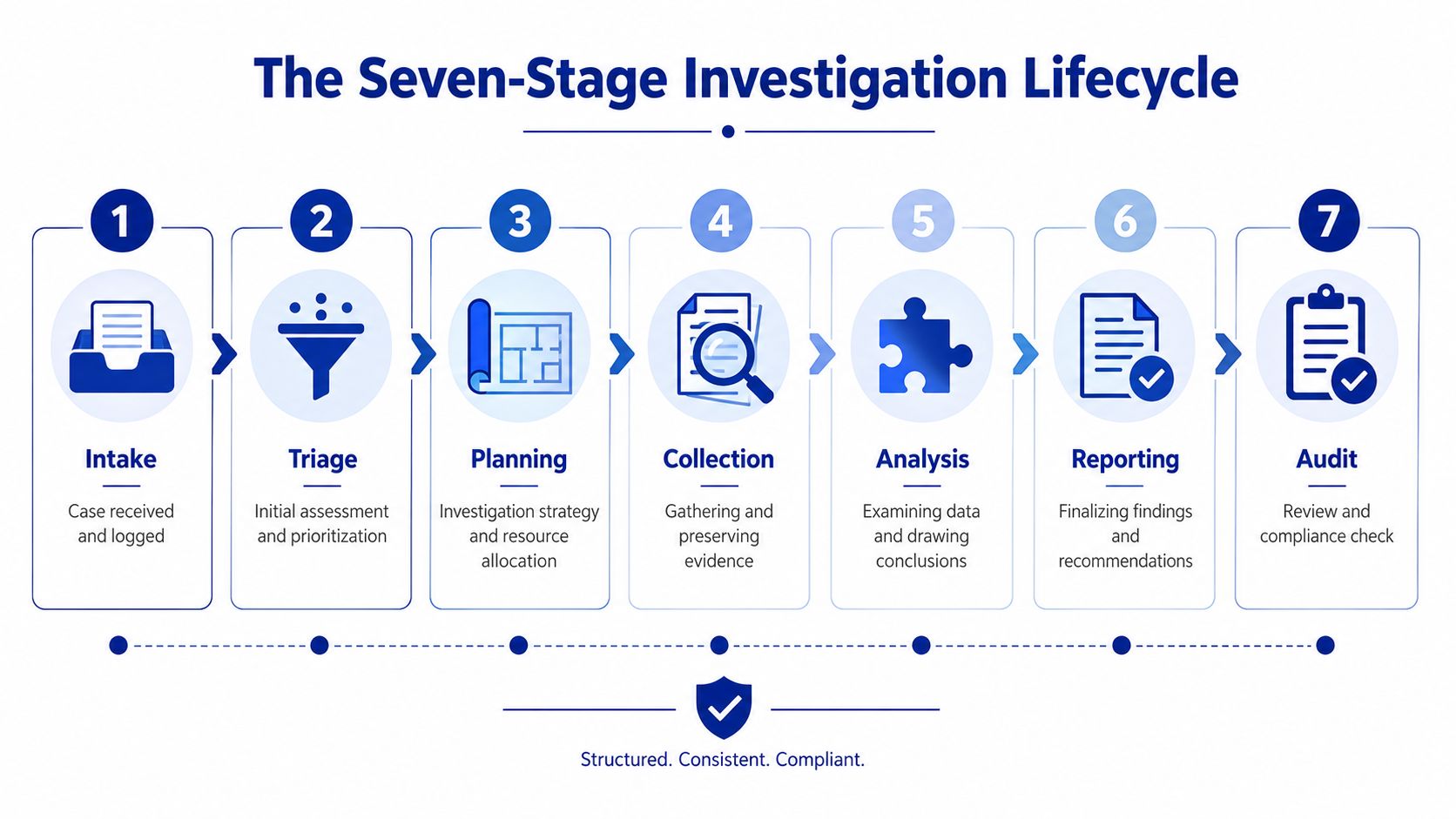
Intake should capture the complaint cleanly and log who reported it, when it was received, and what issue is being raised. Triage decides whether the matter needs a full investigation, who should own it, and whether there's an immediate conflict. Planning sets the authorized scope, the timeline, and the resource level before anyone starts collecting evidence.
Collection is where you preserve records, identify custodians, and gather documents without casually changing the file as you go. Analysis is where the evidence gets weighed, not where opinions are dressed up as findings. Reporting turns the record into a decision memo or final report, and Audit checks whether the process held up and whether the file can still be defended later.
That sequence is not academic. It is the difference between a file that reads as disciplined and a file that looks improvised. If your organization is blending collection, interviews, and conclusions into one loose conversation, the investigation is already vulnerable.
Most SMBs break at the same two points, intake and closure. Intake fails when nobody decides who owns the matter, and closure fails when no one signs off on what happened or what gets retained. Those gaps are exactly where later complaints find oxygen.
A useful way to think about the lifecycle is this, each stage should produce one defensible output:
| Stage | Output |
|---|---|
| Intake | Logged complaint and triage decision |
| Planning | Authorized scope and terms of reference |
| Collection | Preserved evidence record |
| Interviews | Timely interview memos |
| Analysis | Supported findings |
| Reporting | Final written determination |
| Audit | Independent review and sign-off |
The lifecycle works because it forces discipline before emotion takes over. That's the core value of investigation management, and it is also why the process can't be improvised once a complaint becomes serious.
The first question is not “who can start?” It's “who should own this, and what exactly are they being asked to decide?” If you get that wrong, the rest of the file will wobble because the authority behind it was never clean.
The UK ACAS workplace investigation guide is blunt about the sequence, decide whether an investigation is necessary, establish the terms of reference, choose an appropriate investigator, gather evidence, and report the findings as set out in the guide. That order matters. You do not choose your evidence strategy first and then decide what you're investigating.
If the complaint involves the person who normally handles HR, the owner's sibling, or a senior manager, split triage from decision-making. One person should assess urgency and risk, while a separate person, often external, should lead the investigation or at least review the process. Independence is not a luxury when the subject of the complaint sits close to the process owner.
Use a tight terms of reference document before any evidence is touched. It should define the complaint, the scope, the investigator's authority, the timeline, confidentiality boundaries, and what the final output must answer. If that document is vague, the investigation will drift.
A proper intake decision should answer these questions clearly:
That last point matters more than most SMBs realize. If the file could end up in a workplace dispute, the internal rights of the parties matter from day one, not after the fact. A practical overview like this guide to employee rights during an HR investigation helps leadership avoid sloppy assumptions about process fairness.
Don't confuse speed with control. A clean intake decision is faster than a sloppy one once the matter escalates, because the file doesn't need to be rebuilt later.
The evidence phase is where investigations usually fail. People collect files first and only later try to impose order, by then the record has already lost chain of custody, version control, or a clean explanation of who held what and when.
Start with preservation at the outset. Secure documents and electronic files immediately, then restrict access so the record does not get muddied while the matter is active. Interview memos should be drafted within 3 days to preserve recollection and privilege protections as recommended in the internal-investigation guidance. Delay turns useful memory into reconstruction.
Your baseline evidence system does not need to be fancy. It needs to be disciplined. Create one locked location, limit access, and separate originals from working copies.
Use this operating standard:
A manager forwards screenshots into email. HR stores notes in a personal drive. Then the actual record becomes a scavenger hunt. Once that happens, the business cannot explain the file clearly if it is challenged later.
Preservation also means handling items the right way from the moment they are collected. Follow these evidence handling procedures so the record stays usable under pressure. That standard matters because evidence is only as strong as the file around it.
An interview is not a therapy session and it is not a fishing expedition. Ask from a written outline, document responses promptly, and keep the notes factual. If the matter is sensitive or legal exposure is likely, have counsel review the process before you start pulling people into meetings that could affect privilege.
The same discipline shows up in the guide to documenting accident evidence. The setting is different, but the rule is identical, preserve what exists before memory and handling degrade it.
A clear interview record also protects the organization when someone later questions fairness or process. The investigator should know who was asked what, what documents were shown, and which answers were captured in the file. That is how you keep the record defensible.
The memo you write three days later is still part of the evidence. If it is vague, late, or overwritten, you have weakened the case even if the interview itself was solid.
A finding is not a summary of who seemed more credible. It is a reasoned conclusion built from what can be supported. If the file mixes evidence, opinion, and speculation, outside reviewers will spot it immediately.
The cleanest method is to build a timeline first, then separate what is uncontested from what is disputed. Once that's done, weigh the evidence by quality, not by how forcefully someone repeated their version. A written claim is not equal to a contemporaneous document, and a rumor is not equal to a firsthand account.
The strongest rule is simple. Corroborating documentary, physical, or witness evidence is the gold standard, and prior complaint history should be handled with great caution so each matter stands on its own as Q Workplace notes. That does not mean history is irrelevant. It means you do not let old baggage decide a current case.
Use three buckets, and use them effectively.
That classification discipline prevents sloppy conclusions. It also protects you from the most common HR mistake, turning a weak record into a strong-sounding memo that can't survive challenge. If the evidence doesn't support a conclusion, say so.
The file should read like someone expected to be asked hard questions. Every conclusion should tie directly back to evidence already in the file. If the logic chain has gaps, fill them before the report goes out.
A useful reference point for structure is a workplace investigation report template, because the report should force you to show your work. The tone matters too. A blunt, evidence-led report is safer than a polished one that overreaches.
Judgment call: If the finding depends on interpretation, label it as such. Don't bury uncertainty inside confident language.
The file itself has to be defensible, not just the interview notes. That means the record needs structure, access discipline, and a retention approach that still works months later when an outside party asks for it. If you can't retrieve it cleanly, you don't really control it.
The strongest operational benchmark is simple documentation discipline, record activities in real time, include dates, times, and identifiers, preserve chain of custody for critical evidence, use consistent naming conventions, and make sure conclusions are directly supported by evidence as IBM's guidance states. That's not a software issue first. It's a governance issue first.
A defensible file should contain:
That structure matters because investigation data has to be stored so it can be retrieved later and reviewed in context, not reconstructed from memory. Multi-state employers feel this especially hard because the same case can later surface in internal appeals, civil litigation, or a state agency review.
For records that may need secure destruction later, the practical rules around data destruction legal requirements are worth understanding before you decide how to retire old files. Destruction is part of the control system, not an afterthought.
Only people who need the file should touch it. If too many managers can edit, rename, or forward materials, the record becomes unreliable. Role-based access, encryption, and secure archival are not IT ornaments, they are the difference between a clean file and an open loop.
Retention also needs a deliberate owner. If no one is responsible, files linger forever or disappear too early, both of which create risk. The defensible answer is a defined retention horizon tied to the matter type and the company's broader recordkeeping rules.
Defensibility is a property of the file. It is not a personality trait of the investigator.
Not every case belongs inside the organization. Some matters need outside counsel, a specialized investigator, or a split between internal triage and external fact-gathering because independence matters more than convenience. If you wait until the file is already compromised, you've waited too long.
Escalate when the complaint involves an executive, when the internal owner has a conflict, when litigation looks likely, or when the matter crosses jurisdictions in a way your team can't control cleanly. Independent quality assurance is essential, and investigation functions should be included in audit plans, especially in regulated sectors, with management or committee sign-off on final reports and case closure as the handbook guidance states. That sign-off is not ceremonial. It proves the business accepted the result.
Before you shut the file, confirm the following:
If you cannot complete that list, the case is not really closed. It is just paused.
A disciplined close also helps you spot where internal capacity ends. If the matter touched senior leadership, had cross-state exposure, or created a credibility problem for the internal owner, the smart move is to bring in outside help before the next complaint lands. That's the difference between a company that reacts and a company that runs its process.
If your team needs a cleaner way to handle a sensitive complaint, a defensible report structure, or an escalation decision that won't collapse later, Paradigm International Inc. can help you sort the issue before it turns into a larger problem. Visit them if you want advisory support built for multi-state employers that need judgment, structure, and a file that can hold up under scrutiny.