


A key client asks for coverage in another state, a strong candidate lives three states away, and the owner handling HR between operations meetings gets the question. Hiring employees in another state isn't solved by adding a payroll code. It's a sequence of registrations, notices, leave rules, and records that should be settled before an offer goes out.
The request usually sounds simple. A manager wants a remote hire to support a major account, and payroll can run wages in that state. The owner approves the salary, and only then does someone ask about unemployment insurance, workers' compensation, or required wage notices. That order creates the problem.
The employee's physical work location, not headquarters, drives most obligations. Hiring employees in another state can therefore trigger several separate duties even when the company has no office there. Each duty may sit with a different agency, require a different account, and follow a different deadline.
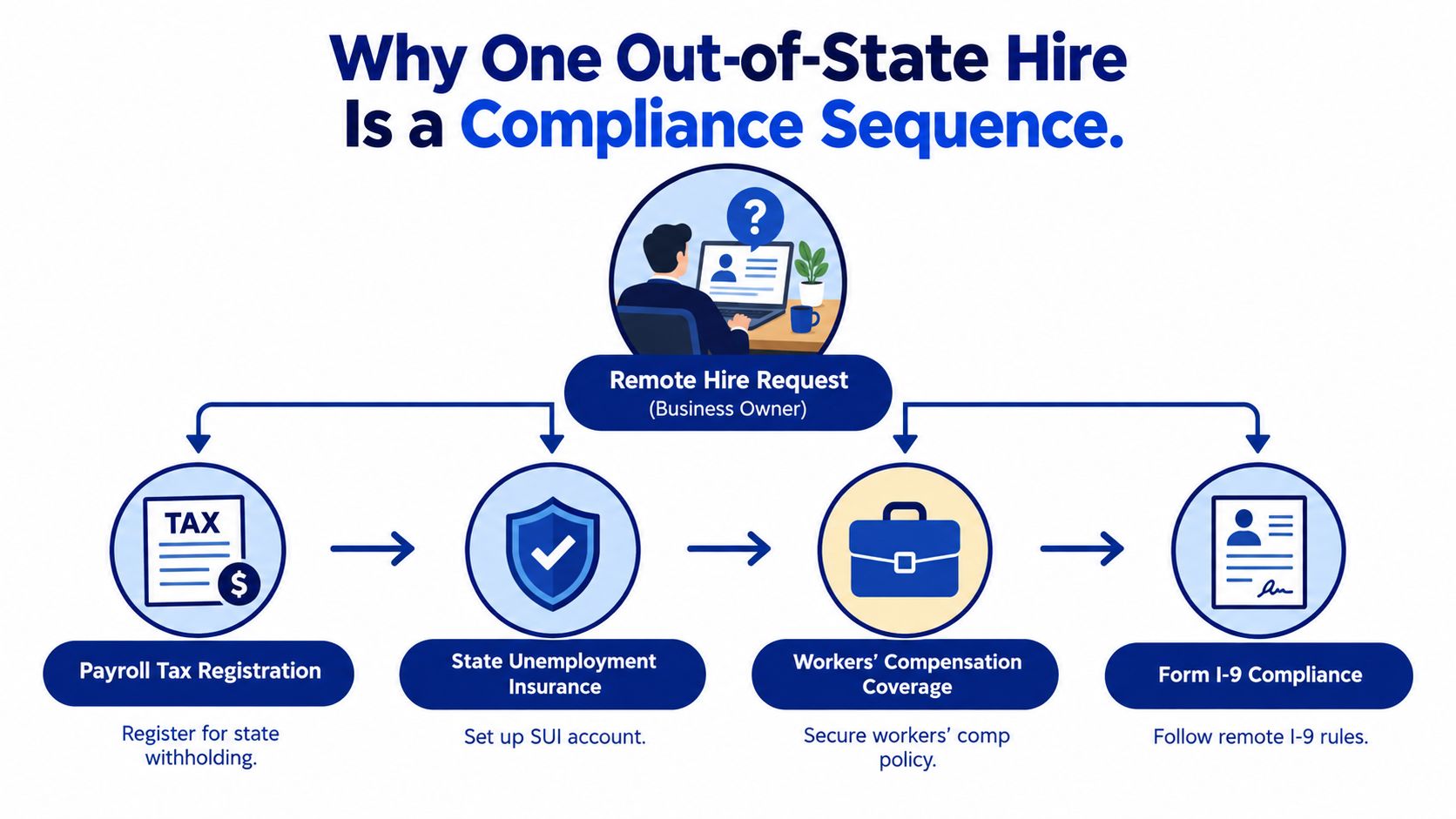
A fifth question sits behind those four. A physical employee presence may create broader business-tax nexus or foreign-qualification issues. That analysis belongs with tax counsel or a qualified tax advisor, and it should happen before the first business activity in the state, not at year end.
A payroll platform can process approved wages. It can't decide where the employee actually works, confirm workers' compensation, or prove that every registration was completed.
The issue isn't rare. The U.S. Bureau of Labor Statistics 2023 state telework table reported an annual average of 155.167 million people at work, including 30.606 million who teleworked or worked from home for pay, or 19.7% of all people at work. State results varied widely, which reinforces why a headquarters-only process no longer fits distributed hiring.
The practical conclusion is direct. Owners should treat work location as a core employment-data field. The offer, payroll setup, handbook addendum, leave process, and personnel file all depend on that field being right.
A defensible workflow assigns an owner to each trigger. One person confirms location and classification. Another confirms tax accounts, insurance, notices, and reporting. Nobody should assume that the ability to issue a paycheck means the state entry is complete.
The checklist should run before the offer letter is signed. Waiting until orientation leaves too little time to obtain accounts, correct classifications, or prepare state-specific documents. For hiring employees in another state, the pre-offer stage is where an owner without a senior HR leader can prevent most avoidable rework.
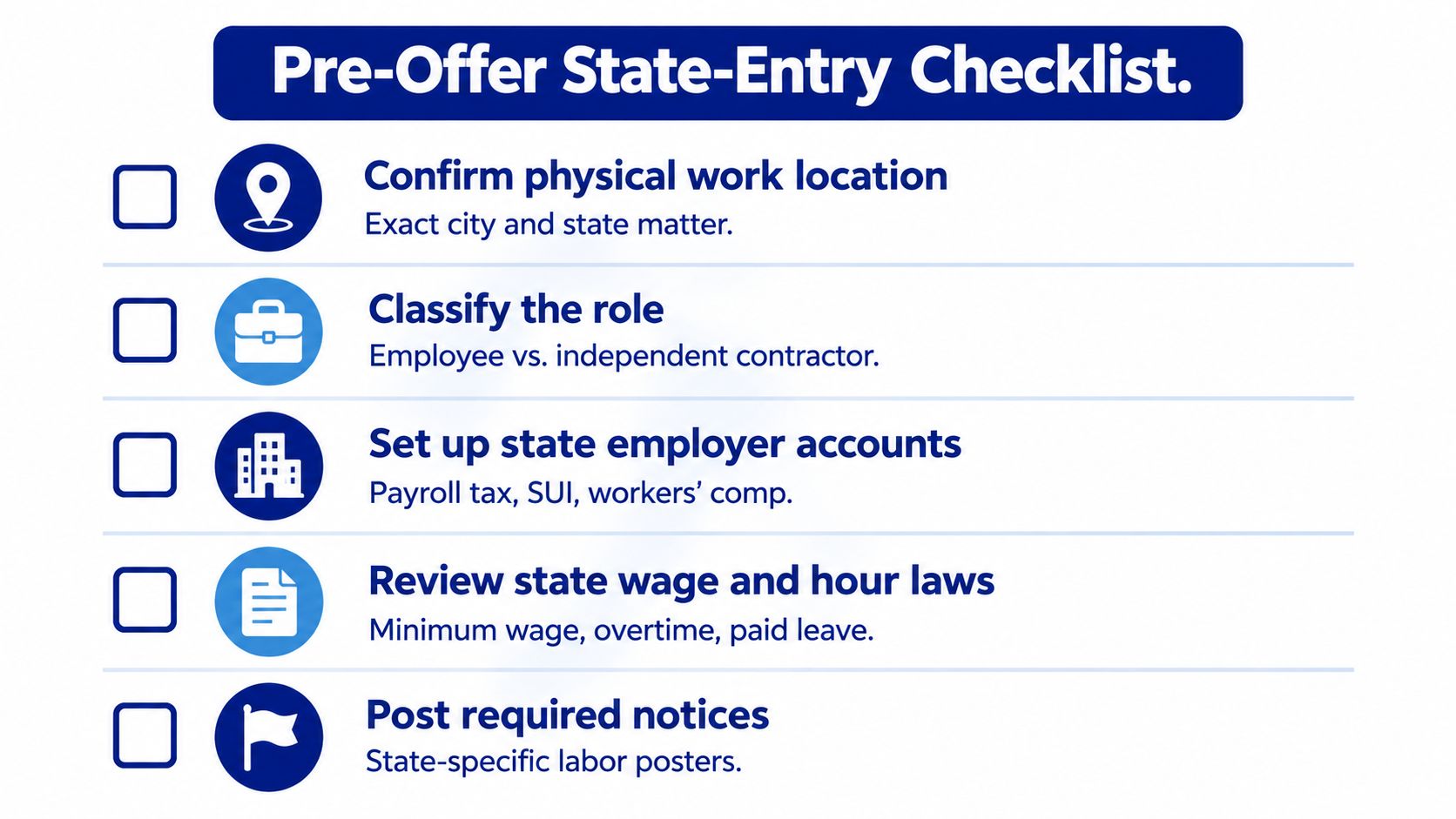
The intake record should capture more than a home mailing address. It needs the city and state where services will be performed, the anticipated start date, expected travel, and whether relocation is planned. The record should also state whether the person is an employee or independent contractor, and whether an employee role is exempt or nonexempt.
Classification shouldn't be copied from a similar headquarters job without review. Duties, supervision, pay method, and state tests can change the answer. When sourcing support is needed, remote hiring services may help with recruiting logistics, but the employer still owns classification and state-registration decisions.
The employer should determine whether registrations are needed for state withholding, unemployment insurance, workers' compensation, business qualification, and new-hire reporting. Those items should appear as separate lines on a registration matrix. Each line needs an agency, account status, responsible person, and completion date.
The Internal Revenue Service Publication 15 guidance on new-hire registries states that all 50 states and most U.S. territories operate a new-hire registry and that employers must report each new employee to the designated registry. That reporting duty doesn't disappear because a payroll vendor transmits wages. Confirmation still belongs in the employer's file.
Practical rule: Payroll readiness and legal registration aren't the same milestone. An owner should ask for account evidence, not accept a verbal assurance that a state has been added.
Pay frequency, wage statements, required hire notices, paid sick leave, expense reimbursement, meal and rest periods, and final-pay deadlines should be reviewed for the work state. The offer letter shouldn't promise a schedule, leave benefit, or restrictive covenant that conflicts with that review. The Paradigm International hiring compliance guide provides a useful structure for organizing those pre-employment checks.
The same checklist should rerun when an employee relocates or shifts from office work to remote work. A completed launch file gives the owner an auditable record. It also makes the next hire in that state faster because the state decisions aren't trapped in email threads.
Federal law sets a floor for many employment rights. It rarely supplies the complete answer for hiring employees in another state. State and local rules can require higher pay, different pay timing, paid leave, added notices, or broader family-leave coverage. Owners should compare the federal baseline with the employee's work state and locality before policies are issued.
The federal Fair Labor Standards Act, administered by the U.S. Department of Labor Wage and Hour Division, establishes federal minimum wage and overtime rules. Many states set a higher minimum wage, and some localities set a higher rate than the state. The rate that controls payroll is the one applicable where the employee performs work.
Pay frequency and final-pay deadlines also vary sharply. A national practice of paying final wages on the next regular payday may be too late in some states. Owners should document the work state's paydays, wage-statement content, permissible deductions, and separation deadlines before the first payroll. Additional structure is available in the guidance on wage compliance for remote workforces.
Meal periods, rest breaks, daily overtime, expense reimbursement, and predictive scheduling also vary. A remote setting doesn't remove those duties. Managers need instructions that match the employee's location, especially when the manager works under different rules at headquarters.
Under the federal Family and Medical Leave Act, 29 U.S.C. § 2601 et seq., and Department of Labor regulations in 29 C.F.R. Part 825, a private employer is covered when it has employed 50 or more employees during 20 or more workweeks in the current or preceding calendar year, as explained in the U.S. Department of Labor FMLA guidance. Employee eligibility also depends on service, hours, and worksite tests.
That worksite analysis matters for remote staff. An eligible employee generally must have worked for the employer for at least 12 months, completed at least 1,250 hours during the preceding 12 months, and worked at a location where the employer has at least 50 employees within 75 miles. A distributed employee's reporting location can change the result, so owners shouldn't decide eligibility by counting only headquarters staff.
State law may go further. California, Connecticut, Colorado, and Massachusetts are examples of states with paid sick leave mandates, and other states operate paid family or medical leave programs with separate eligibility and contribution rules. A state family-leave law may also cover a smaller employer than federal FMLA. The handbook needs state addenda that explain which leave applies, how notice is given, and how leaves run together.
| Topic | Federal baseline | State that goes further |
|---|---|---|
| Paid sick leave | No general federal paid sick leave mandate for private employers | California, Connecticut, Colorado, and Massachusetts have state mandates |
| Family and medical leave | FMLA coverage and eligibility use federal thresholds and worksite tests | Some states cover smaller employers or add paid benefits |
| Wage notices and statements | Federal law sets core wage payment and record duties | Some states require specific hire notices and detailed wage statements |
| Final pay | Federal law doesn't supply one universal final-pay deadline | States set different deadlines based on resignation or discharge |
Required postings and individual notices need the same attention. Remote employees should receive or be able to access applicable federal, state, and local notices through a method the employer can document. Topics can include wage rights, pregnancy accommodation, paid leave, workplace safety, and anti-discrimination protections.
Some moments shouldn't be handled from a checklist alone. Leave and disability overlap, a termination after a complaint or leave request, and a workplace investigation are high-stakes situations. It's worth getting expert help before acting in those cases.
Remote onboarding fails when it's treated as a packet sent by email. The employer still needs identity and work-authorization verification, signed notices, policy acknowledgments, equipment terms, and a clear manager cadence. For hiring employees in another state, the personnel record should show exactly how each step was completed without the employee in the office.
Under the current federal alternative procedure administered by U.S. Citizenship and Immigration Services and the Department of Homeland Security, the employer must participate in E-Verify in good standing, use E-Verify for newly hired employees in the United States, and enroll each hiring site that uses the procedure. The USCIS remote examination guidance requires the employer to examine documents through a live video interaction, retain clear copies, and indicate use of the alternative procedure in Form I-9's Additional Information field.
Collecting photographs by email isn't enough. The employee must present the same documents during the live interaction, and the employer must determine whether the copies reasonably appear genuine and relate to the employee. The retained copies need to be clear and legible.
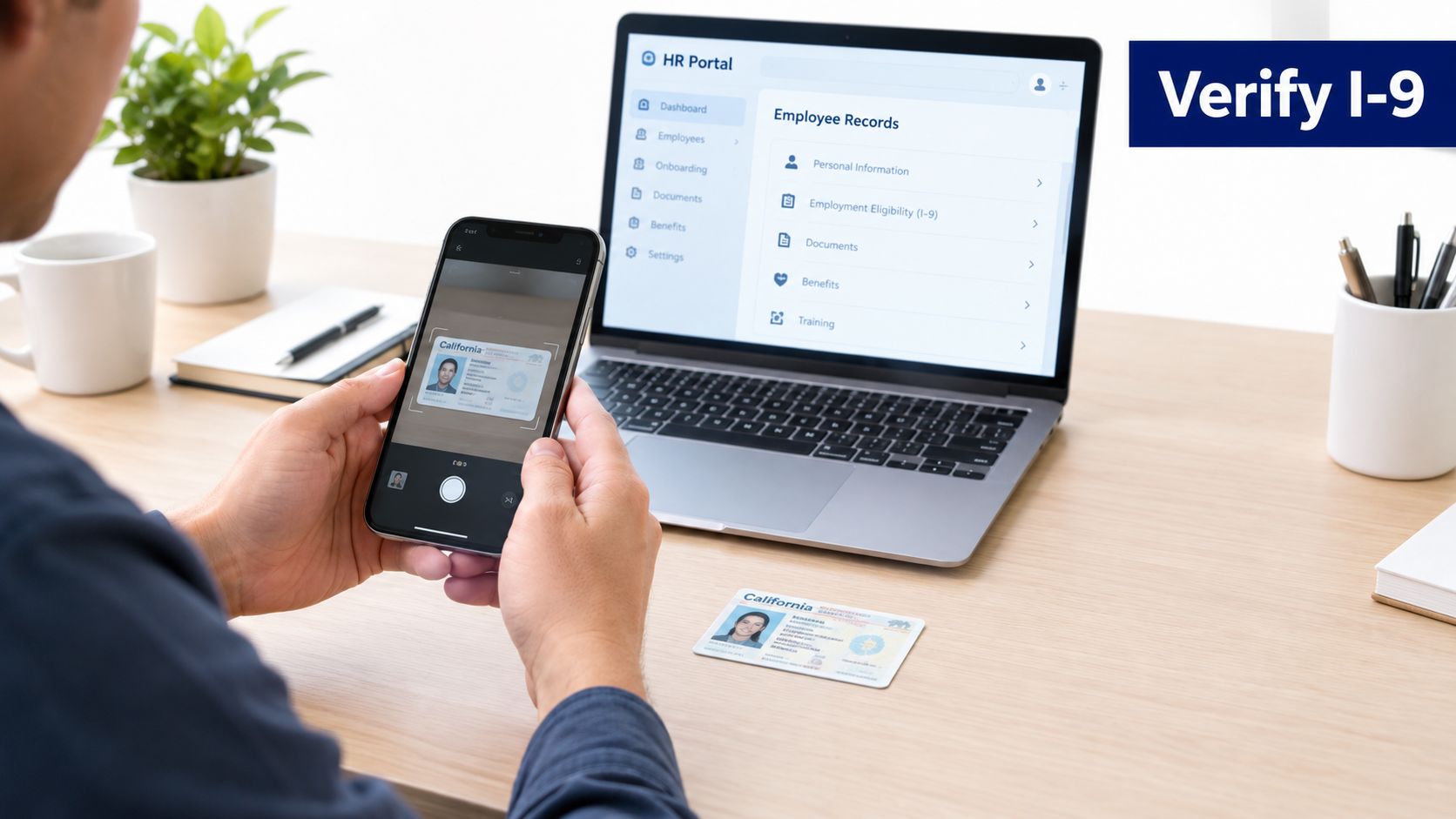
The procedure is chosen by hiring site, not improvised by each manager. A company may limit remote examination to remote hires while using physical examination for onsite or hybrid staff. It must apply the approach consistently and may not use different treatment for discriminatory reasons based on citizenship, immigration status, or national origin. The I-9 verification best practices resource can help owners turn that rule into a repeatable workflow.
A remote hire's file should tell a complete story without a manager explaining it later. If the document, acknowledgment, or approval isn't in the file, the process isn't finished.
Acknowledgments belong with the launch file and payroll records, subject to the employer's retention rules. Form I-9 records should be stored and audited according to the employer's established I-9 process. Separating documents across inboxes makes later audits harder and increases the chance that state notices or policy receipts are lost.
Owners should also verify system access against the approved work state. Payroll, timekeeping, leave balances, tax forms, and the HR record should all point to the same location. A mismatch among systems is often the first sign that onboarding was completed informally.
The static case is manageable. One employee works from one approved home office in one state. The harder case begins when that employee moves, works from a vacation home, visits clients across state lines, or splits weeks between two homes. Remote doesn't mean location-neutral, and flexibility without controls can create obligations the employer never approved.
The default principle is physical work location, yet reciprocity agreements and convenience-of-the-employer rules can change income-tax withholding, while unemployment insurance generally follows where services are performed, as described in Thomson Reuters reporting on multistate payroll compliance risks. Owners shouldn't assume an income-tax reciprocity result settles unemployment insurance. Those systems involve different rules and may involve different agencies.
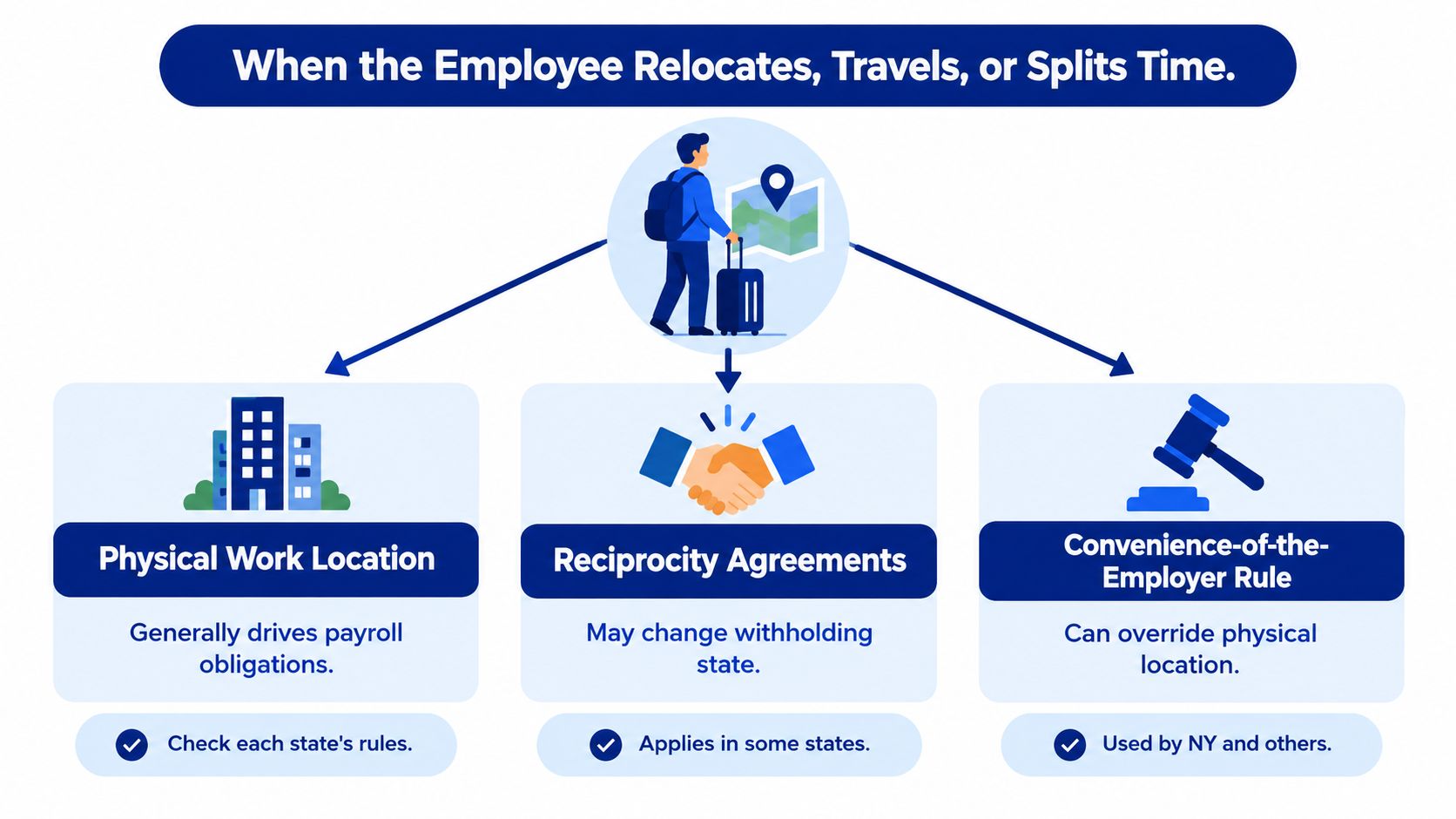
A relocation can affect more than payroll. The review should cover withholding, unemployment insurance, workers' compensation, paid leave, wage-and-hour rules, posting delivery, handbook addenda, benefits eligibility, and business-tax exposure. Client-site travel needs a workday record by state so payroll isn't guessing at year end.
There's no cost-free option. A strict rule can frustrate valued employees, while broad mobility can multiply registrations and policy variations. The weaker choice is silence, because silence lets individual managers create state exposure one approval at a time.
Owner decision: Flexibility should be granted through a policy with reporting duties and a workday record. It shouldn't be granted through informal manager permission.
A PEO or payroll vendor processes the data it's given. It can't reliably detect that an employee moved or began working from another state. The employer needs a written duty to report planned location changes, a named approver, and a quarterly workday-by-state review. The detailed framework in Paradigm International's multi-state compliance advice is a practical starting point for that governance model.
Temporary work deserves a clear approval threshold. The policy should define when advance notice is required, when tax or HR review is triggered, and when the request must be denied because setup can't be completed in time. That candor protects operations better than promising work-from-anywhere freedom without limits.
State entry isn't a one-time build. Laws change, employees move, duties evolve, and managers develop informal habits. Owners need a steady review rhythm that catches those changes before a payroll correction, leave dispute, or agency notice forces the issue.
The U.S. Department of Labor position summarized in the Department of Labor guidance on tracking remote work hours is that employers must pay for all hours worked remotely, including unscheduled work at home when the employer knows or has reason to know the work occurred. A policy prohibiting off-the-clock work doesn't permit the employer to withhold pay for time worked.
Managers need four habits. They should define scheduled hours, require all added time to be reported, pay unauthorized time while addressing the policy violation separately, and watch for recurring after-hours logins or messages. A casual instruction to finish work that night can become evidence that the employer had reason to know extra hours were worked.
A quarterly exception review should compare reported hours with schedule deviations, access patterns, and manager approvals. Repeated early logins, skipped meal periods, or constant weekend activity shouldn't be normalized. The review should produce corrections, coaching, or workload changes, with records retained in the payroll file.
Owners should pause before high-risk decisions. A termination after a complaint or leave request, a contested investigation, or overlapping leave and disability duties can turn a routine remote-management issue into a documented dispute. Those moments are worth expert help before action is taken.
The goal after day 30 is consistency. Payroll, timekeeping, leave administration, and the handbook should describe the same work location and the same rules. When those systems drift apart, the employer loses the benefit of the careful setup completed before the offer.
Owners who want a second set of eyes on a current multi-state setup can start with a focused review of registrations, handbook addenda, I-9 practice, and location controls.
This article is general information, not legal advice. Employment laws change and vary by state; consult qualified employment counsel about your situation.
Paradigm International Inc. supports multi-state employers with HR risk reviews, handbook state addenda, I-9 and personnel-file audits, and decision support for complex hiring, leave, and separation matters. Owners preparing for hiring employees in another state can visit Paradigm International Inc. and Book a Free HR Risk Review to discuss the next state-entry decision before an offer is issued.

