A payroll audit starts with a routine question: why did holiday-week salaries change, and why were some employees paid differently from others? The answer often exposes a deeper problem, such as an improper deduction from an exempt employee, holiday hours omitted from overtime calculations, or variable earnings excluded from holiday pay. Leaders who treat holiday pay as a simple benefit can create liability without realizing it.
How Does Holiday Pay Work (mechanics + salaried) depends on worker classification, jurisdiction, pay structure, and the reason the employee is away from work. The safest approach is to separate the legal rule from the payroll mechanism, then document how each employee population is handled.
A growing business may have a written holiday policy, an established payroll provider, and managers who believe the process is settled. Then an employee asks why holiday pay was calculated from base salary when regular commission and overtime were part of their normal earnings. A later audit reveals that the payroll system treated every salaried employee as exempt and deducted pay during a holiday closure.
That sequence is common because holiday pay sits at the intersection of employment law, payroll configuration, classification decisions, and policy wording. A policy can promise paid holidays while the payroll system fails to count holiday work toward overtime. A salary can look fixed while the employee remains non-exempt. A calculation can appear reasonable while omitting regular commission, overtime, or allowances that form part of normal remuneration.
The legal exposure usually comes from a mismatch between what the policy says, what the employee's classification requires, and what the payroll system does. Leaders should ask four questions before approving a holiday framework:
Leadership rule: If payroll cannot show why a worker received a particular holiday payment, the business has a documentation problem even when the amount happens to be correct.
The United States and the UK provide a useful warning against assumptions. U.S. federal law generally leaves holiday pay to employer policy, contract, or state law, while the UK establishes a statutory paid-leave baseline. A company expanding across jurisdictions therefore needs a controlled framework, not one universal holiday code.
The practical objective is defensibility. Leaders should be able to explain how the business classified the worker, which rule applied, how the amount was calculated, and why the same rule was applied consistently to comparable employees.
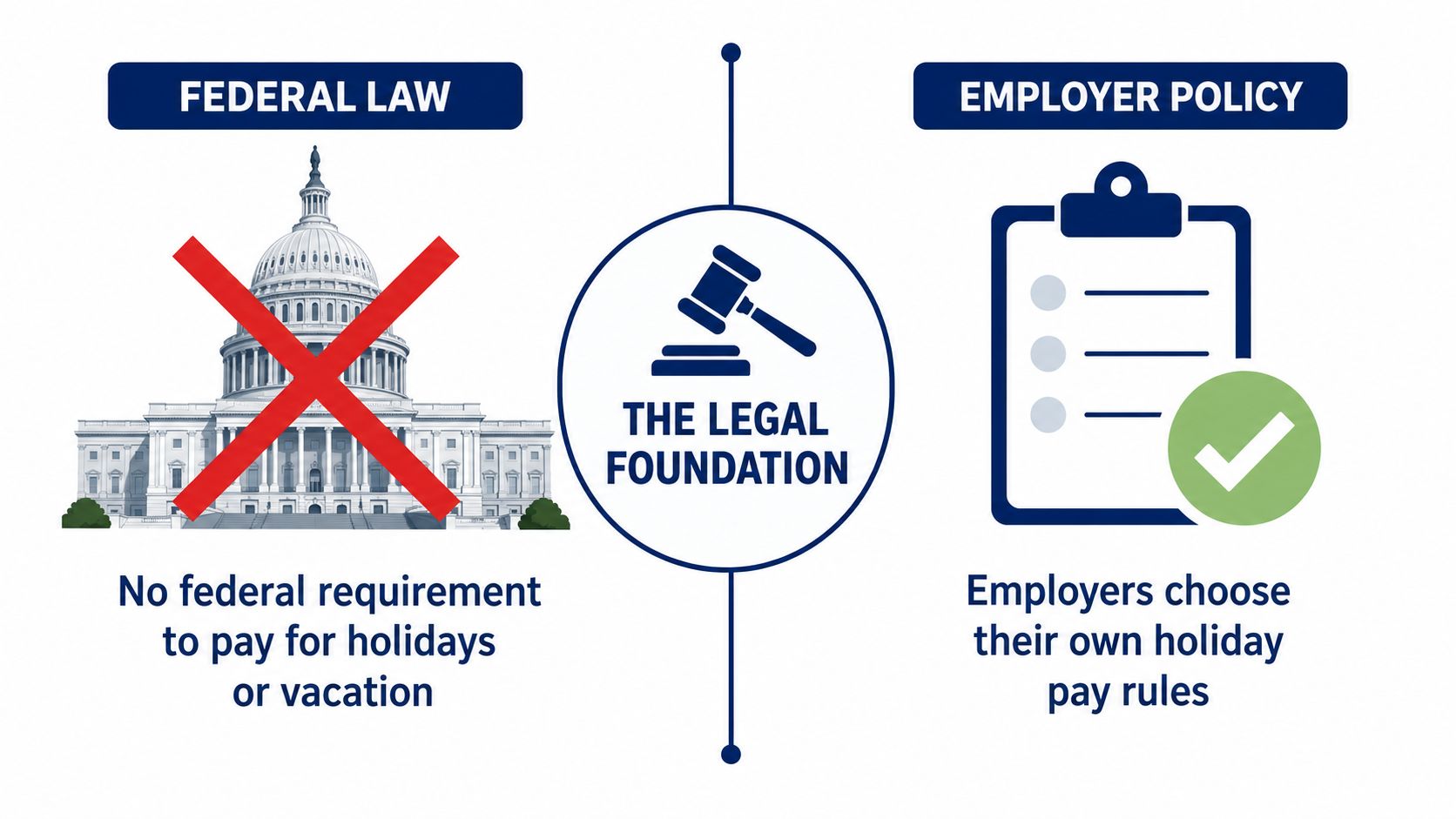
A holiday policy can be lawful on paper and still fail in payroll. In the United States, federal law does not require employers to pay for vacation or holidays. The U.S. Department of Labor's holiday guidance explains that the Fair Labor Standards Act does not require payment for time not worked, including vacations and holidays. The entitlement therefore usually comes from employer policy, an employment contract, or applicable state law, not from a universal federal rule.
Salary status does not change that baseline. A salary generally pays for work during the pay period, but it does not automatically create a separate statutory right to paid holidays. An employer may offer the benefit, but the written policy then controls eligibility, treatment, and administration. Payroll must also apply the policy without creating an unlawful salary deduction or misclassifying holiday hours as overtime.
The UK statutory baseline is 5.6 weeks of paid annual leave, equal to 28 days for a worker on a five-day schedule, under the Working Time Regulations 1998. The UK government's holiday entitlement guidance states that leave accrues from the first day of employment, with no minimum tenure requirement before accrual begins.
For fixed schedules, employers prorate entitlement by days worked per week multiplied by 5.6. A four-day worker receives 22.4 days, and a three-day worker receives 16.8 days, using the same statutory method.
UK holiday pay replaces earnings during leave. It is not a discretionary bonus. For most workers, four weeks must be paid at the normal rate, while the remaining 1.6 weeks may be paid at basic rate under current reforms, as explained in the UK holiday pay rules. Variable pay requires a defined reference-period method, not an improvised payroll estimate.
A U.S. policy should define eligibility, any waiting rules, carry-forward treatment, work performed on the holiday, and the interaction with overtime. It should state how non-exempt salaried employees are paid for holiday hours not worked and whether holiday pay enters the regular-rate calculation when overtime is due.
Vague drafting creates exposure. A policy promising paid holidays without defining the covered population leaves managers and payroll to make inconsistent decisions, producing disputes even when the original benefit was voluntary.
The first payroll question isn't “Is this employee salaried?” It's “Is this employee exempt or non-exempt?” Salary status describes how the employee is paid. Exemption status determines whether overtime protections and salary-basis rules apply.
For an exempt salaried employee, the salary-basis rule is the critical mechanic. If the employee performs any work during a workweek, they generally must receive the full predetermined weekly salary, even if the business closes for a holiday or the employee works only part of the week, as described in the U.S. Department of Labor holiday-hours guidance.
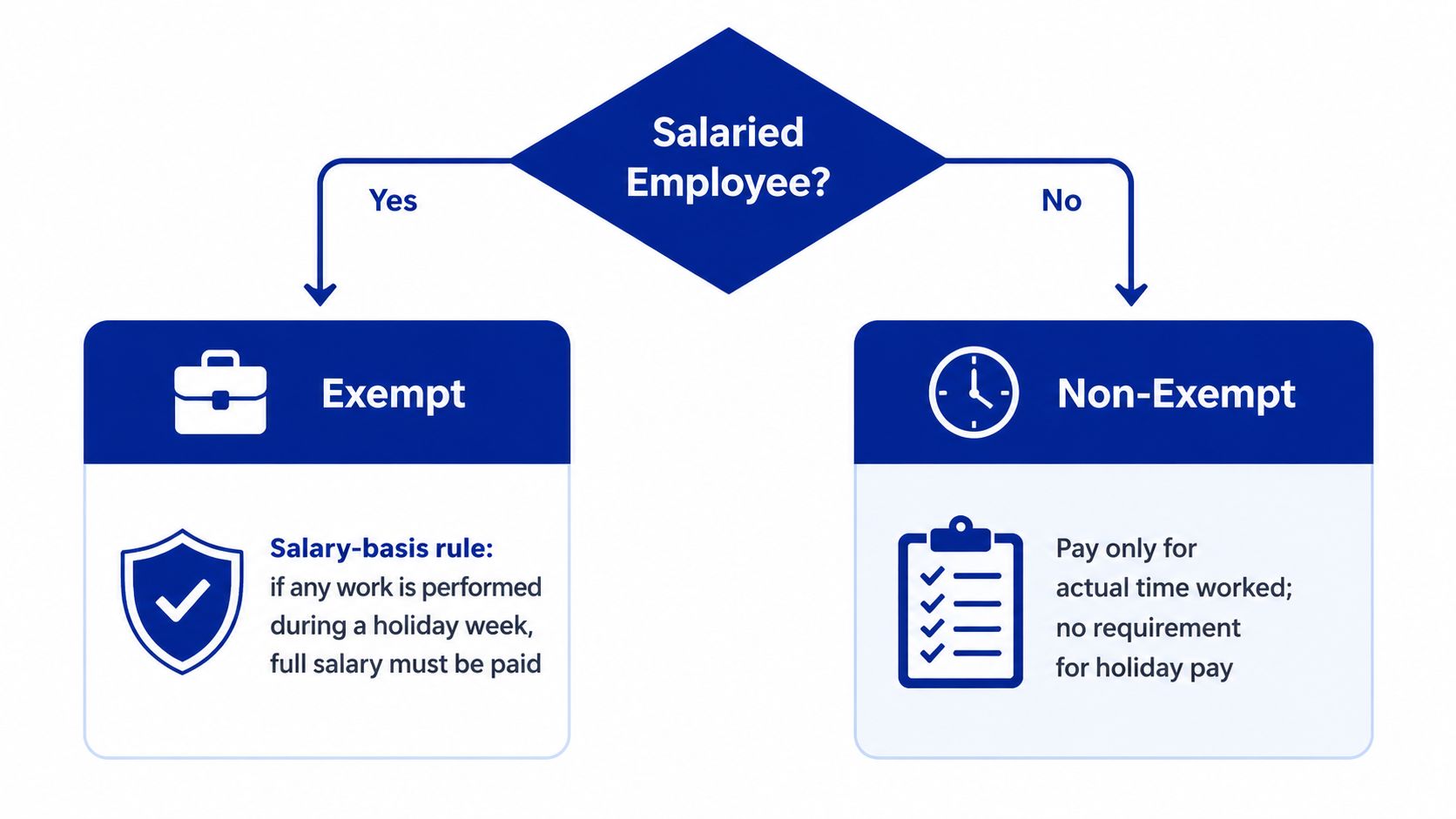
Consider an exempt manager who works on Monday, the business closes on Tuesday for a company holiday, and the manager performs no further work that week. The closure typically doesn't permit the employer to reduce the predetermined salary. A full-day absence for the holiday also doesn't justify a salary deduction when the exempt employee has performed work during that week.
The same principle applies when an exempt employee takes a full day away from work for the holiday. The company may track the absence against an available leave bank under its policy, but it generally cannot reduce the salary because the business closed or because the employee was absent for that holiday day.
Payroll safeguard: Configure holiday closures and exempt salary deductions as separate events. A closure may affect scheduling, but it shouldn't automatically create a salary deduction.
A non-exempt employee can receive a salary and still qualify for overtime. Holiday hours that aren't worked may be unpaid unless a company policy, contract, or state law provides payment. Hours worked on the holiday must be recorded and included in the workweek's overtime aggregation.
The most frequent system failure is treating a salaried employee as exempt without reviewing actual duties and classification criteria. The second is recording holiday work as a premium category that payroll excludes from weekly overtime calculations. The solution is simple in principle: maintain the classification decision, capture actual hours, and calculate overtime using the applicable workweek rules.
A practical review should test:
For a fuller review of the classification decision, use this employee classification guide alongside payroll testing.
Holiday pay should be calculated by worker population, not by one company-wide shortcut. Fixed salary, variable remuneration, and irregular hours create different calculation requirements. The right method depends on whether the employee's ordinary pay is stable, contains recurring extras, or must be reconstructed from historical earnings.
For a fixed-salary employee, holiday pay is usually a replacement for normal salary during approved time off. That doesn't mean every salaried employee receives the same treatment. The payroll team must first confirm whether the worker is exempt, non-exempt, covered by a company holiday policy, or subject to a jurisdiction with statutory paid leave.
Variable-pay workers require closer analysis. UK guidance states that normal pay can include regular overtime, commission, and allowances, rather than base salary alone, and the official holiday pay rules warn against reducing holiday pay to salary where variable earnings are part of ordinary compensation. A salary-only calculation can therefore underpay an employee even when the base salary is processed correctly.
| Worker Type | Calculation Method | Key Compliance Risk |
|---|---|---|
| Fixed-salary employee | Use the applicable normal salary treatment for paid leave or a company holiday, after confirming classification and policy coverage. | Treating salary as proof of exemption or applying a deduction during a holiday closure. |
| Variable-pay employee | Include normal remuneration where the applicable rule requires it, including regular overtime, commission, and allowances. | Using base salary alone and underpaying ordinary earnings. |
| Irregular-hours or variable-pay UK worker | Use the previous 52 paid weeks, ignoring weeks with no pay, to calculate the holiday pay reference average under the UK government calculation method. | Using an incomplete history or treating unpaid weeks as zero earnings. |
| Part-year worker | Apply the relevant statutory accrual and payment method for the jurisdiction and contract pattern. | Assuming a full-year formula applies without checking the worker's hours pattern. |
For leaders reviewing payroll software, the system should preserve the underlying earning categories. It should distinguish base salary, regular overtime, commission, allowances, paid leave, and holiday work rather than combining them into a single “holiday” code.
A PTO calculator can help employees or managers estimate available time off, but it shouldn't replace the employer's statutory calculation logic, policy review, or payroll audit. The calculator answers an administrative question. Compliance requires evidence that the correct pay components and reference period were used.
A distributed workforce can't operate safely under a single holiday-pay assumption. U.S. federal law doesn't require holiday pay, but state laws, local requirements, employment contracts, and employer policies may impose additional obligations. The payroll team must identify the governing rule for each work location before configuring holiday codes.
International markets add different mechanisms. Singapore requires at least an extra day's salary at the basic rate when an employee works on a public holiday, with time off in lieu available by agreement in certain scenarios, according to the Singapore Ministry of Manpower guidance. Australia requires at least the base pay rate for public-holiday hours, with penalty rates depending on the applicable award or agreement. South Africa requires at least double the ordinary wage when a public holiday falls on a day the employee would ordinarily work and the employee works that day, subject to the statutory formula described in the same verified market guidance.
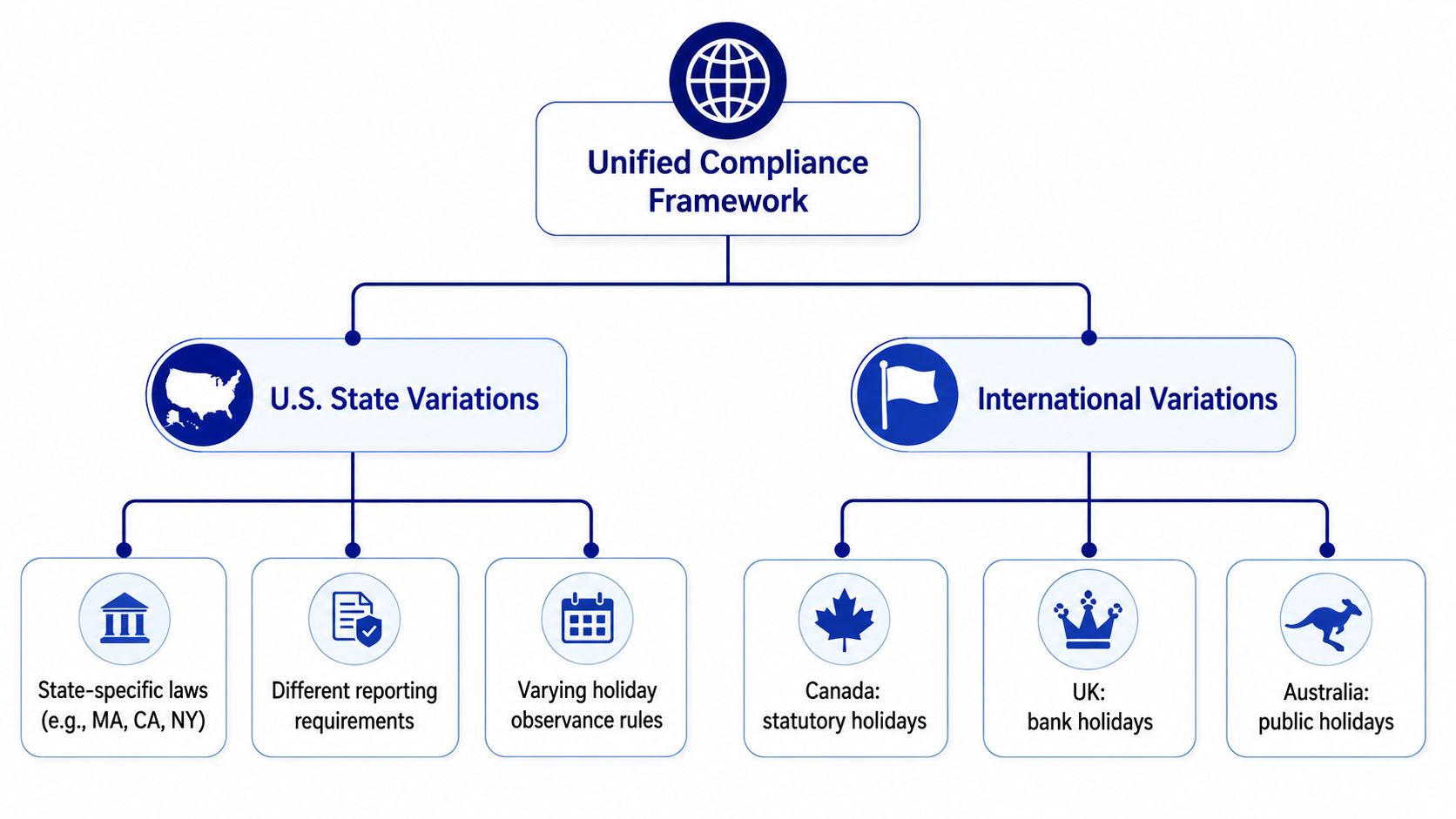
Across jurisdictions, holiday pay generally turns on three questions:
This structure prevents a common design error, treating all holiday hours as standard salary. Payroll should separate:
The framework also supports expansion. Before entering a new state or country, HR should map the worker's location, classification, contract, applicable collective or award rules, holiday calendar, premium trigger, and recordkeeping requirement.
For U.S. operations, leaders should pair holiday review with broader wage and hour compliance for your team. That review should test whether payroll is applying the correct state or local rule rather than relying on the federal baseline alone.
The dangerous assumption is that a holiday is just another payroll label. It isn't. The legal result changes depending on whether the employee worked, whether the employee is exempt, whether the day was ordinarily scheduled, and whether variable earnings form part of normal pay.
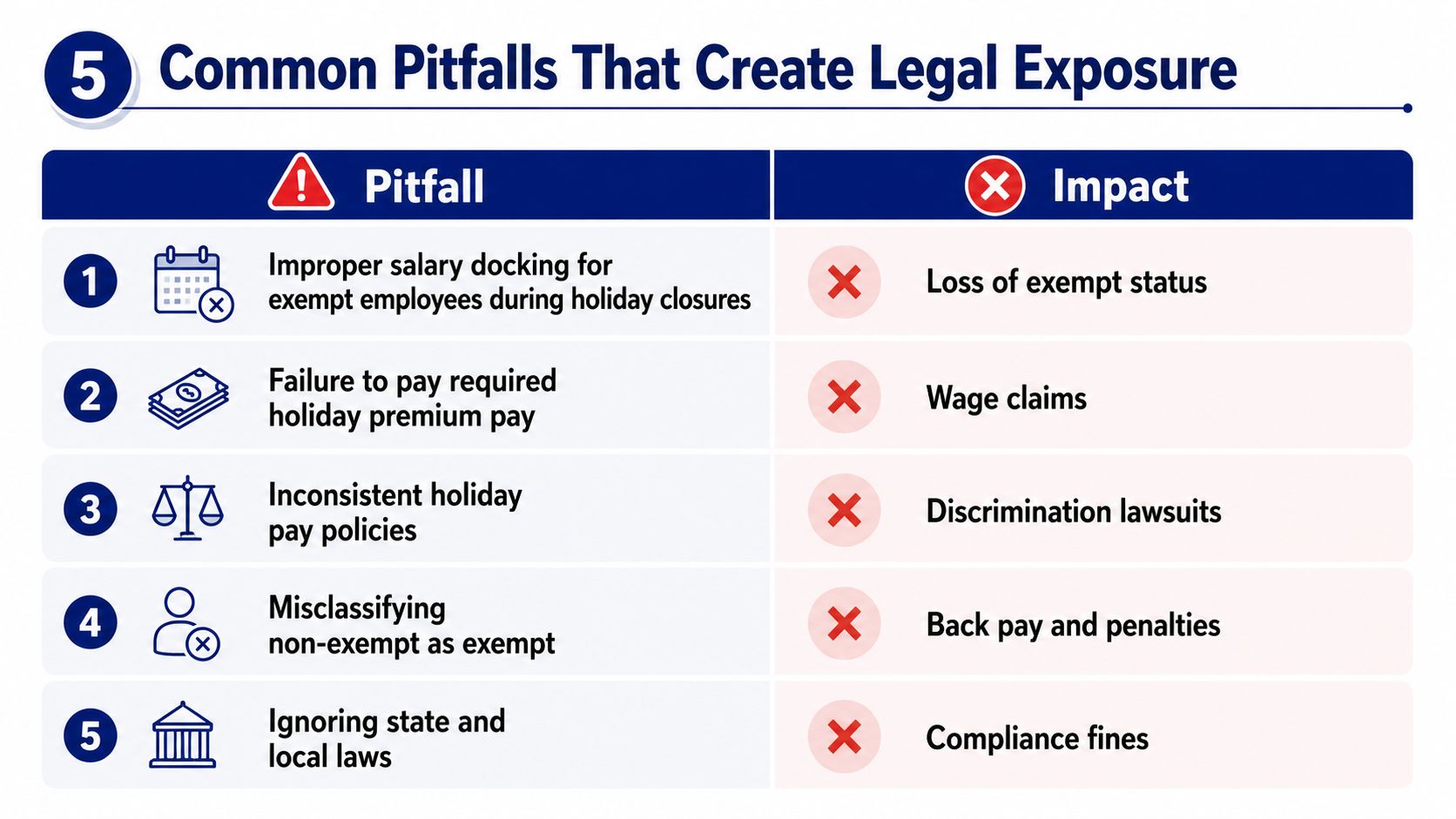
Improper salary docking: Reducing an exempt employee's salary because the business closed for a holiday can violate the salary-basis rule when the employee performed work during that week. Preserve the full predetermined salary and review whether the deduction was permitted.
Holiday work omitted from overtime aggregation: A non-exempt employee's holiday hours are still hours worked. Payroll should feed those hours into the applicable workweek overtime calculation instead of isolating them in a holiday category that the overtime engine ignores.
Base salary used for variable-pay workers: Regular overtime, commission, and allowances may form part of normal remuneration in the UK. Recalculate the applicable holiday pay using the required earnings history and document which components were included.
One policy applied to unlike populations: Exempt employees, non-exempt salaried employees, hourly workers, and irregular-hours workers don't necessarily share the same legal treatment. Use a policy matrix that identifies eligibility and calculation rules by population.
No evidence behind the formula: A correct payment without an audit trail is difficult to defend. Keep the source earnings, reference period, classification, approval, calculation, and final payment record together.
UK guidance and industry reporting now emphasize defining normal remuneration, keeping auditable records for six years, and preparing for new enforcement exposure from 2026 onward, as described in current UK holiday-pay compliance reporting. The operational message is clear: employers need more than a formula. They need a defensible record of how the formula was selected and applied.
New Zealand has also approved a move toward hours-based leave accrual with a 24-month implementation period, according to recent statutory holiday-pay change coverage. That direction reinforces the need to segment salaried, variable-hours, irregular-hours, and mixed-pay populations in payroll systems.
Audit test: Select a holiday payment and work backward from the payslip to the policy, classification, time record, earning history, and jurisdictional rule. Any unexplained gap deserves correction.
A defensible holiday-pay program begins with written rules and ends with an audit trail. Leaders should not rely on payroll vendor defaults or manager memory. The business needs a controlled record showing who qualifies, what event triggered payment, which earnings counted, and how the final amount was approved.
Start with a written policy that defines eligibility, accrual, paid holidays, holiday work, premium treatment, substitute leave, carryover, termination treatment, and interaction with overtime. For UK operations, remember that statutory leave generally can't be cashed out except when employment ends, when untaken statutory leave must be paid.
Use a compliance checklist that includes:
Record retention must match the applicable jurisdiction and policy. UK guidance and industry reporting specifically identify six-year auditable records as an important control, while U.S. requirements can differ by record type and governing law.
Managers also need practical training. They should know that approving holiday work, changing a time record, or directing an exempt employee to work during a closure can affect payroll treatment. For policy drafting and state-by-state employee handbook controls, review these multi-state handbook compliance tips.
Paradigm International Inc. advises owners, COOs, and HR leaders on classification, documentation, investigations, and multi-state employment risk, including holiday-pay controls that need to remain defensible as the workforce grows.
If your payroll rules haven't been tested against classification, variable earnings, holiday work, and each operating jurisdiction, Paradigm International Inc. can help you review the mechanics and documentation. Visit the firm to discuss a practical HR risk assessment before an employee complaint or payroll audit exposes the gap.