
Navigating the world of hiring means promoting fairness and equal opportunity. But what happens when a job seems to require a specific personal characteristic, like gender or religion? While it feels like a legal gray area, U.S. law provides a very narrow, strictly defined exception for these situations: the Bona Fide Occupational Qualification, or BFOQ. Understanding this concept is crucial for business owners and HR leaders to make defensible hiring decisions and avoid costly legal missteps.
A bona fide occupational qualification (BFOQ) is a rare legal exception that allows an employer to hire someone based on a protected trait like sex, religion, or national origin. This is only permissible when that characteristic is absolutely essential to performing the job. The standard is incredibly high and difficult to meet.

A BFOQ is not about preference, convenience, or stereotypes; it is about provable business necessity. For example, customer preference is never a valid reason for a BFOQ. A restaurant cannot legally justify hiring only female servers because they believe patrons prefer them. The law is clear that stereotypes and customer comfort do not meet the high bar of business necessity.
The legal basis for BFOQs comes directly from federal anti-discrimination laws, including Title VII of the Civil Rights Act of 1964 and the Age Discrimination in Employment Act (ADEA). These laws broadly prohibit employment discrimination but include this very limited exception. The burden of proof is always on the employer to demonstrate that a discriminatory requirement is "reasonably necessary to the normal operation of that particular business."
For a qualification to be a legitimate BFOQ, it generally must relate to one of these core principles:
It is critical to remember that race and color can never be a BFOQ. Your primary focus should always be on reducing hiring bias to ensure fair recruitment. If you are even considering whether a role might need a BFOQ, that is a sign you are in high-stakes legal territory. Expert guidance is essential to navigate these complex decisions.
Navigating these decisions can be complex. If you need support in analyzing your specific situation, feel free to contact us for support.
The legal defense for a bona fide occupational qualification originates in Title VII, but it is far from a loophole. The law only permits a BFOQ when a specific trait is "reasonably necessary to the normal operation of that particular business." Courts examine this phrase with extreme skepticism, and understanding this strict standard is the first step in avoiding a costly compliance disaster.

When a BFOQ is challenged in court, judges typically apply one of two tough tests. As an employer, you must be ready to prove that your discriminatory requirement is absolutely essential, not just a matter of convenience. These tests force a business to show that the very essence of its operations would be undermined without the specific qualification.
It's crucial to remember that race and color can never be justified as a BFOQ. Federal law is non-negotiable on this point.
One of the most common mistakes employers make is thinking that customer preference can justify a BFOQ. Courts and the Equal Employment Opportunity Commission (EEOC) have repeatedly rejected this argument. For instance, a company cannot legally defend hiring only female flight attendants because they believe customers prefer it. Your business needs cannot be built on the biases of your customers.
To understand how this works in practice, consider the mandatory retirement age for commercial airline pilots. This rule was upheld using the "safety" test. The reasoning was that the risk of a sudden, incapacitating health event increases with age, and there is no reliable way to test individual older pilots to determine who might be at risk. Therefore, the age limit is considered "reasonably necessary" to ensure public safety.
This case shows that an employer must prove not only a business necessity but also that there are no reasonable alternatives to the discriminatory practice. The BFOQ is truly a last resort. In fact, the bar is so high that the defense is successful in less than 5% of cases. You can explore additional BFOQ data to better understand these risks.
If you are facing a complex hiring decision, our team can provide expert guidance. You can contact us to discuss your situation.
Knowing the legal definition of a BFOQ is one thing, but seeing it applied in real-world scenarios makes the concept clearer. These examples highlight the critical line between business necessity and what is merely business convenience. Getting this right is key to spotting red flags in your hiring process before they become legal risks.
A lawful BFOQ is always tied directly to the core duties of a job, not stereotypes or assumptions. The following scenarios show where a BFOQ might be legally defensible because the requirement is essential to business operations.
Many hiring restrictions that seem logical at first glance are actually illegal. These examples are based on stereotypes, customer preferences, or convenience—all of which fail the strict legal test for a BFOQ. A common error is mistaking customer comfort for business necessity. Federal law is clear: a business cannot use the biases of its clientele to justify discrimination.
Here are some common yet unlawful attempts at applying a BFOQ:
Making this distinction correctly is a high-stakes decision. For guidance on your specific hiring practices, we encourage you to get in touch with our team.
If you are considering using a BFOQ, you are stepping into a risky area of employment law. To proceed with confidence, you must stress-test your logic using three foundational pillars. Building your case around these ideas helps you challenge your own assumptions before a regulator does.
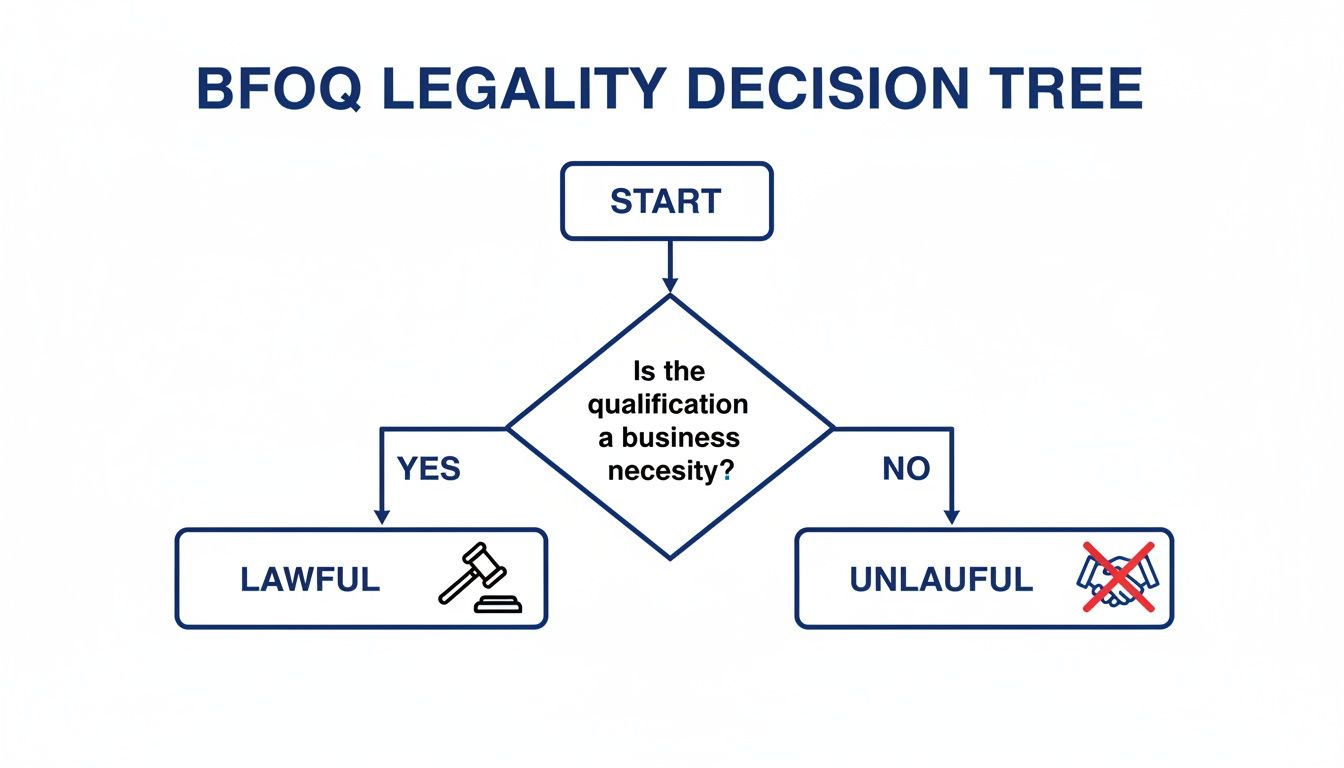
The first and most critical pillar is absolute business necessity. You must prove that the specific trait, like gender or religion, is so fundamental that the job cannot be done without it. The qualification has to be tied to the "essence of the business operation." For example, a Catholic church can require a priest to be a Catholic man because that requirement is the substance of the job itself.
Even if you clear the business necessity hurdle, you must also prove there are no reasonable alternatives to your discriminatory requirement. A court will want to see that you have genuinely considered other solutions. Could you adjust job duties, change schedules, or assess candidates individually instead of applying a blanket rule? The burden is on you to prove that no other practical, non-discriminatory option exists. For more on this, see our guide on what is reasonable accommodation under the ADA.
The final pillar is universal application. If you claim a trait is essential for a role, it must be essential for 100% of the people in that role, with no exceptions. You cannot have a "mostly male" or "mostly female" position based on a BFOQ. For instance, if an airline sets a mandatory retirement age for pilots based on safety, that rule must apply to every single pilot. Any inconsistency undermines the argument that the trait is a business necessity.
Successfully navigating these pillars requires meticulous documentation. If your reasoning feels weak on even one, it is a clear sign to seek expert legal advice. For support with high-stakes HR decisions, our team is here to help.
Claiming a BFOQ is a high-risk move. Without solid documentation, a BFOQ is just an opinion that is almost guaranteed to fail in court. To turn this decision into a defensible strategy, you need to build a detailed evidence file proving your choice was an absolute necessity, not a preference.

Your documentation must be created before you implement the BFOQ. A well-organized file proves your process was deliberate, which is what a regulatory agency wants to see. Your evidence file must include these core documents:
Once you have gathered your evidence, you need to formalize the decision and establish a process for ongoing review. A BFOQ is a living policy, not a permanent one. Business needs change, and a qualification that is defensible today might not be tomorrow.
To properly formalize and maintain your BFOQ, complete these two final steps:
This structured process transforms a high-risk legal maneuver into a calculated, defensible decision. If you need assistance building your evidence file or reviewing a potential BFOQ, please contact our team.
Exploring a BFOQ is one of the highest-risk employment decisions you can make. Getting this wrong can lead to expensive discrimination claims and serious damage to your company’s reputation. Engaging an employment law expert is a strategic move to ensure your decision is grounded in legal reality, not just operational convenience.
While any BFOQ consideration should involve a legal review, some situations make it non-negotiable. If your business is facing one of these scenarios, your immediate next step should be to call legal counsel.
Viewing legal counsel as a preventative investment rather than a reactive cost is essential. An expert legal review before you act is significantly less expensive than defending a lawsuit. If you are facing one of these critical moments, we are ready to help. Please reach out to our team to discuss your situation.
Even with a solid grasp of the BFOQ concept, specific "what if" scenarios often arise. This section tackles some of the most common questions from business leaders and HR professionals, providing clear answers to help you navigate these high-stakes decisions.
No. An employer can never use cost or administrative hassle to justify a BFOQ. You cannot legally restrict a job to a specific group simply because it would be cheaper or easier to hire them. The legal standard is business necessity, not business convenience or budget.
Absolutely not. This is one of the most common—and consistently rejected—arguments for a BFOQ. Federal law and decades of court rulings have made it clear: you cannot use the biases of your customers to justify a discriminatory hiring practice. Your hiring decisions must be based on an individual's ability to do the job.
While they sound similar, these are two very different legal concepts.
A Bona Fide Occupational Qualification (BFOQ) is a narrow defense for intentional discrimination based on sex, religion, national origin, or age when that trait is essential to the job. It is a direct and explicit, though very limited, exception to anti-discrimination laws.
A business necessity is a defense used in disparate impact cases. This is where a seemingly neutral policy, like a diploma requirement, unintentionally screens out a protected group at a higher rate. The employer must then prove the policy is job-related and crucial for business operations.
Navigating the legal intricacies of BFOQs and other employment decisions requires expert judgment. If you need guidance on a complex people decision and want to learn more about how to reduce employment risk, you can contact us for a discussion.