
An employee raised a concern, participated in an investigation, or asked for an accommodation. Two months later, their performance still isn't where it needs to be. The manager wants to issue a warning or make a change. Leadership freezes because nobody wants to trigger a retaliation claim.
That hesitation is understandable, but it becomes dangerous when it turns into inaction, inconsistency, or sloppy process. If you don't understand how retaliation is proven, you'll either overcorrect and tolerate real performance problems, or move too fast and create avoidable exposure.
The better approach is simple. Learn the framework used to evaluate retaliation claims, then run your people decisions through that lens before you act. Retaliation isn't proven by anxiety, assumptions, or office politics. It's proven through specific elements, specific evidence, and specific failures in management process.
Business owners and HR leaders usually face retaliation risk at the worst possible moment. A complaint has already happened. Emotions are high. Managers feel watched. Every corrective action suddenly feels radioactive.
That's exactly why you need a disciplined view of how to prove retaliation in the workplace. If you understand what an employee would need to show, you can manage performance, investigate complaints, and make decisions with far more confidence.
Retaliation is not a niche issue. According to the EEOC, 47.8% of all EEOC charges in FY 2024 included a retaliation component, and retaliation remains the most common issue alleged in federal sector cases and by federal employees over a period of more than a decade, as noted in the EEOC's retaliation guidance. That means employers shouldn't treat retaliation as a rare legal technicality. They should treat it as a core management risk.
Many leaders assume a retaliation claim exists whenever an employee complains and then experiences any negative outcome. That's not the standard.
A retaliation claim generally turns on three questions:
If one of those breaks, the claim weakens. If your records are inconsistent, your decision-makers are careless, or your process changes after a complaint, the claim gets stronger.
Practical rule: After protected activity happens, your burden isn't to stop managing. Your burden is to manage cleanly, consistently, and with records that hold up under scrutiny.
You don't need perfect managers. You need managers who document facts, follow policy, and stop improvising.
You also need HR or executive review before significant action is taken against someone who recently engaged in protected activity. That review should test timing, consistency, policy adherence, and whether the record would make sense to an outside investigator who knows nothing about your workplace history.
The retaliation analysis is built on three legal pillars. Strip away the legal language, and the structure is straightforward. Someone did something the law protects. The employer did something harmful in response. There's evidence linking the two.
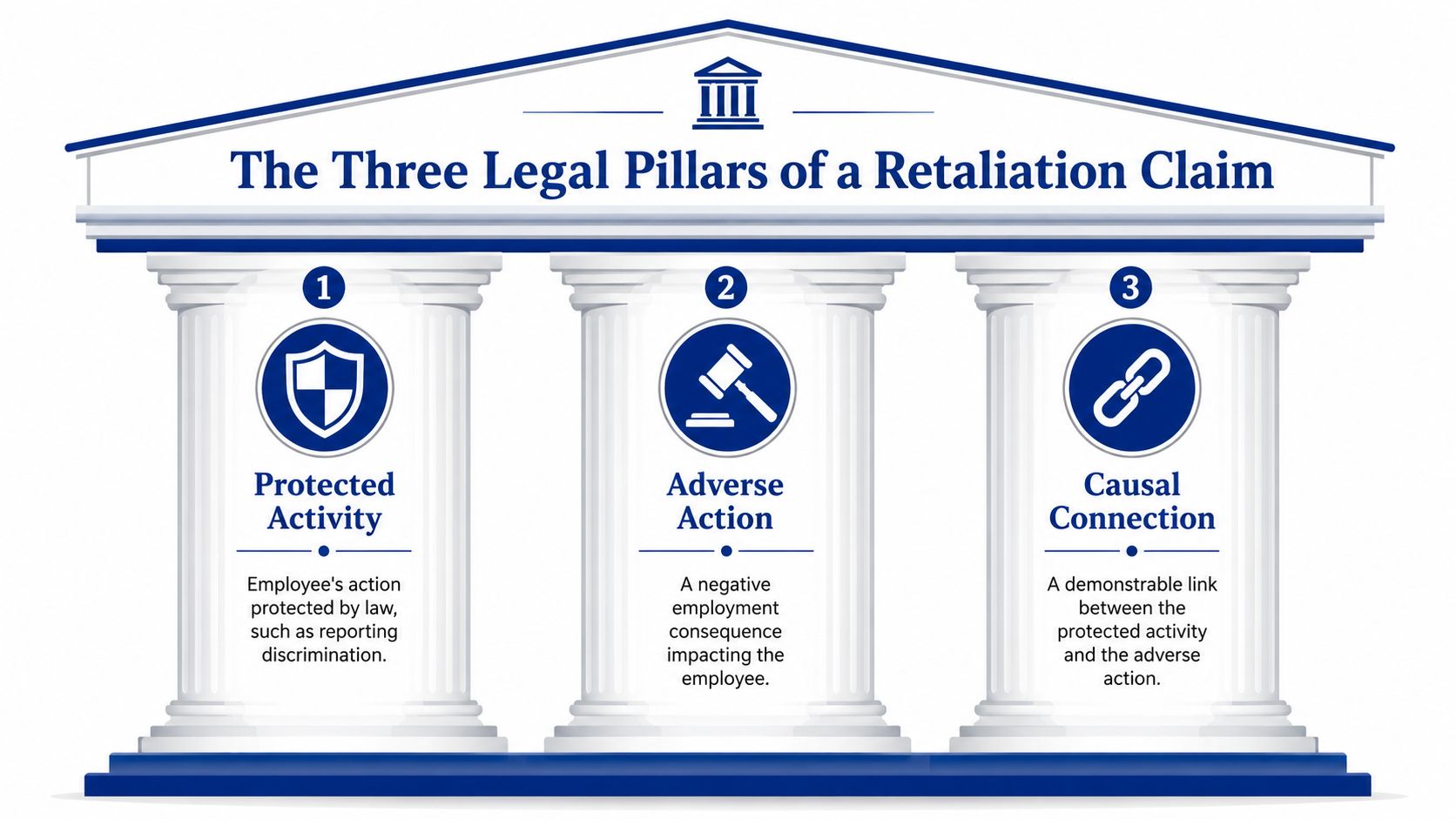
The Department of Justice framework is clear. Proving retaliation requires establishing three core components: (1) the individual engaged in protected activity, (2) the employer took a materially adverse action, and (3) a causal connection exists between the two. Courts have also held that adverse actions must be more than trivial harms, minor annoyances, or petty slights, as explained in the Department of Justice retaliation manual.
Protected activity is where many managers make their first mistake. They think only a formal legal complaint counts. That's too narrow.
Protected activity can include an internal complaint about discrimination or harassment, participation in an internal investigation, supporting another employee's complaint, or requesting an accommodation where the law protects that conduct. The key risk point for employers is knowledge. If a supervisor knows about that activity and then acts against the employee, scrutiny follows.
Here's the practical test. Ask whether the employee did something that a law or policy likely protects, and whether the decision-maker knew about it.
Some actions are obvious. Termination, demotion, suspension, significant pay reduction, and denied promotion are classic examples.
But don't stop there. Retaliation cases often turn on less dramatic decisions. A schedule change that disrupts childcare, removal from important projects, sudden written warnings, exclusion from meetings, or an abrupt increase in scrutiny can become part of the story if they materially affect the employee's work situation.
This is the link between the first two pillars. It asks whether the action happened because of the protected activity.
In real workplace disputes, cases are won or lost depending on what is demonstrated. The employee will try to show timing, changed treatment, inconsistent explanations, or different treatment compared with others. The employer must show a legitimate reason supported by records that existed for business reasons, not as an after-the-fact defense.
| Pillar | What it asks | Employer risk point |
|---|---|---|
| Protected activity | Did the employee do something legally protected? | Managers ignore informal complaints |
| Adverse action | Did the employer take action that caused real workplace harm? | Leaders focus only on termination and miss subtler actions |
| Causal connection | Is there evidence linking the activity to the action? | Weak documentation and shifting explanations |
Most retaliation exposure comes from ordinary management decisions handled badly. The risk usually doesn't start with a dramatic firing. It starts when a manager treats an employee differently after a complaint and assumes nobody will notice.
Protected activity often appears in routine channels, not formal legal filings. An employee tells HR they believe they were treated differently because of race, sex, disability, religion, age, or another protected category. Another employee participates as a witness in an internal investigation. A worker asks for an accommodation. A supervisor receives an email objecting to harassing conduct.
Those moments should trigger discipline in your process. They should also trigger communication control. Managers don't need editorial freedom after protected activity. They need guidance, consistency, and documented next steps.
A useful way to think about it is this:
Many employers still use an outdated standard. They assume an action isn't risky unless it involves termination or demotion. That's a mistake.
The Supreme Court in Muldrow v. City of Saint Louis clarified that proving adverse action requires showing the employer's conduct brought about some harm with respect to an identifiable term or condition of employment. That means unwarranted shift changes or exclusion from meetings can qualify, as discussed in this analysis of adverse employment action standards.
If a manager changes duties, access, schedule, review patterns, or visibility after a complaint, don't call it harmless until someone has tested the business reason and the record behind it.
Use this screen before approving action involving an employee who engaged in protected activity:
If your managers can't explain why the action would have happened anyway, using records that predate the complaint or align with consistent practice, you have a problem. Not every uncomfortable decision is retaliation. But every post-complaint decision should be treated as evidence-sensitive.
Causation is where retaliation claims become dangerous. Most employers understand protected activity. Most can identify a disciplinary action. They get in trouble when they underestimate how a pattern of small facts can be assembled into a persuasive story.
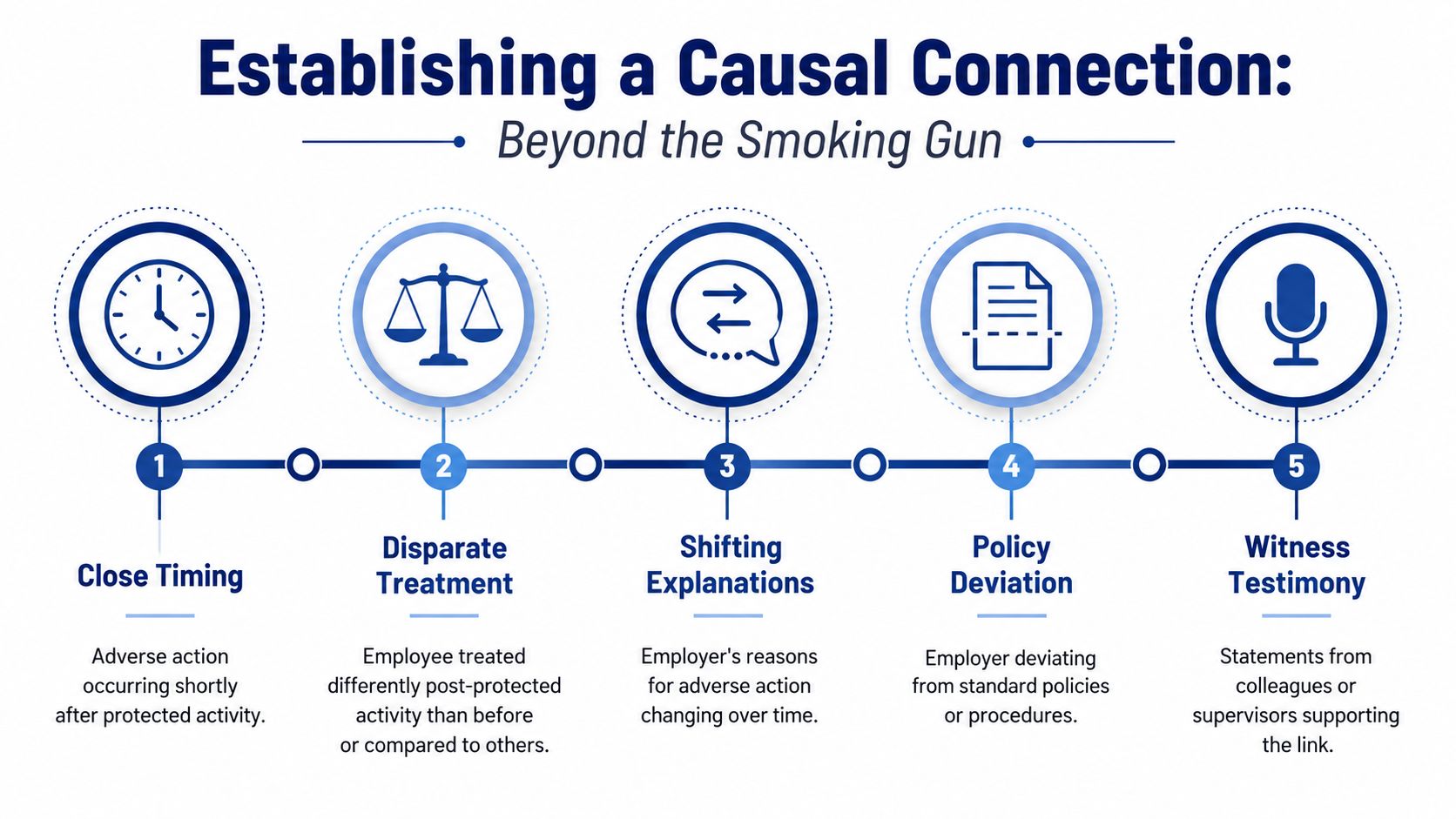
One point matters immediately. Temporal proximity is powerful. According to this discussion of how workplace retaliation is proven in court, adverse action occurring days or weeks after protected activity can create a presumption of causation that shifts the burden to the employer to show by clear and convincing evidence that the same action would have happened regardless.
Close timing is compelling because it's easy to understand. Complaint on Monday. Discipline on Friday. That sequence invites suspicion.
But timing alone usually isn't the whole case. The stronger retaliation claims combine timing with one or more of the following:
Agencies and courts often decide these cases by evaluating credibility. Does the employer's story hold together? Was the performance issue documented before the complaint? Did the manager follow the same standards used for others? Did anyone overstate, backfill, or rewrite history after the fact?
That's why a reactive approach fails. If your file only becomes organized after counsel gets involved, the record already looks defensive. Good employers build the record in real time, for operational reasons, before any claim exists.
A clean timeline beats a passionate explanation. If the documents don't line up, the employer usually loses credibility first and the legal argument second.
Before issuing significant discipline, changing terms of employment, or ending employment after protected activity, require a causation review. That review should ask:
This isn't bureaucracy. It's damage control before damage happens.
Most employers don't lose retaliation disputes because they had no business reason. They lose because they can't prove it cleanly. Their records are incomplete. Their managers are inconsistent. Their investigation notes are thin, delayed, or biased.
The EEOC guidance described in the ADA legal brief identifies several forms of causation evidence, including suspicious timing, verbal or written statements, comparative evidence, and proof that the employer's stated reason is false. That's exactly why a disciplined record matters, as outlined in this retaliation protection legal brief. If your file can't rebut those points, your business reason may not survive review.
Documentation should never start at the moment of discipline. It should begin when the issue begins.
That means managers need to record performance gaps, coaching discussions, missed expectations, and policy concerns as they happen. Not emotionally. Not editorially. Factually.
Strong documentation usually includes:
If your managers write only when they're angry, your records will look retaliatory even when they aren't.
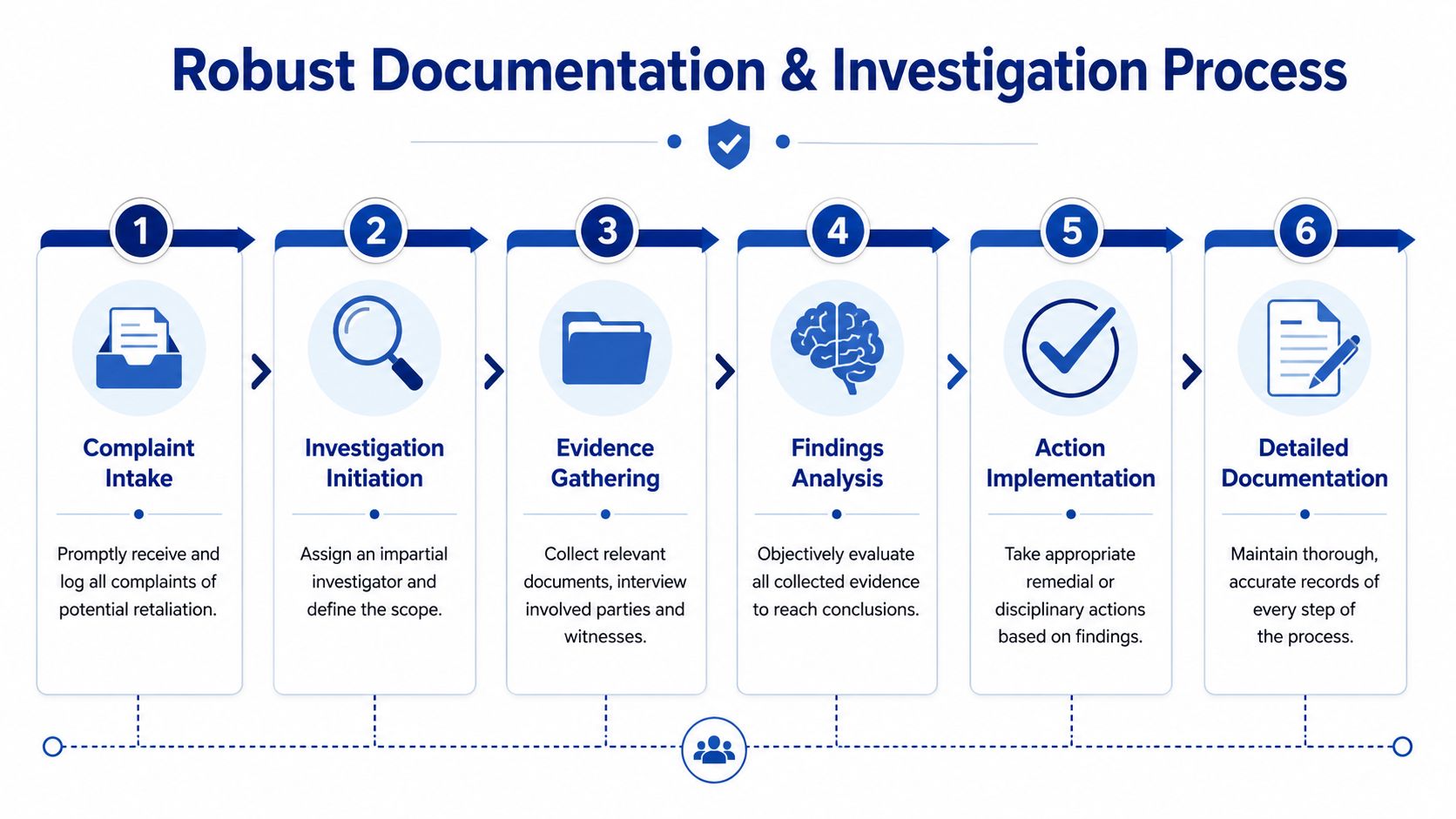
When retaliation is alleged, or when an adverse action is being considered after protected activity, use a formal investigation process. If your organization doesn't have one, create one immediately and train to it. A helpful reference point is this guide on how to conduct workplace investigations.
Keep your investigation disciplined:
A chain-of-custody mindset also helps when preserving sensitive records, screenshots, exported messages, or digital files. If your team needs a simple starting point for handling evidence carefully, AI Video Detector's template is a useful example of how to maintain a clear possession and handling record.
Key takeaway: Your investigation file should allow an outside reviewer to answer three questions quickly. What happened, who knew what, and why the employer acted.
Use this checklist whenever protected activity and discipline intersect:
If you can't explain the decision plainly and back it with records made in the ordinary course of business, wait and fix the process first.
Retaliation risk drops when leaders stop treating it as a legal problem and start treating it as a management control issue. The strongest employers build safeguards before a complaint ever happens.
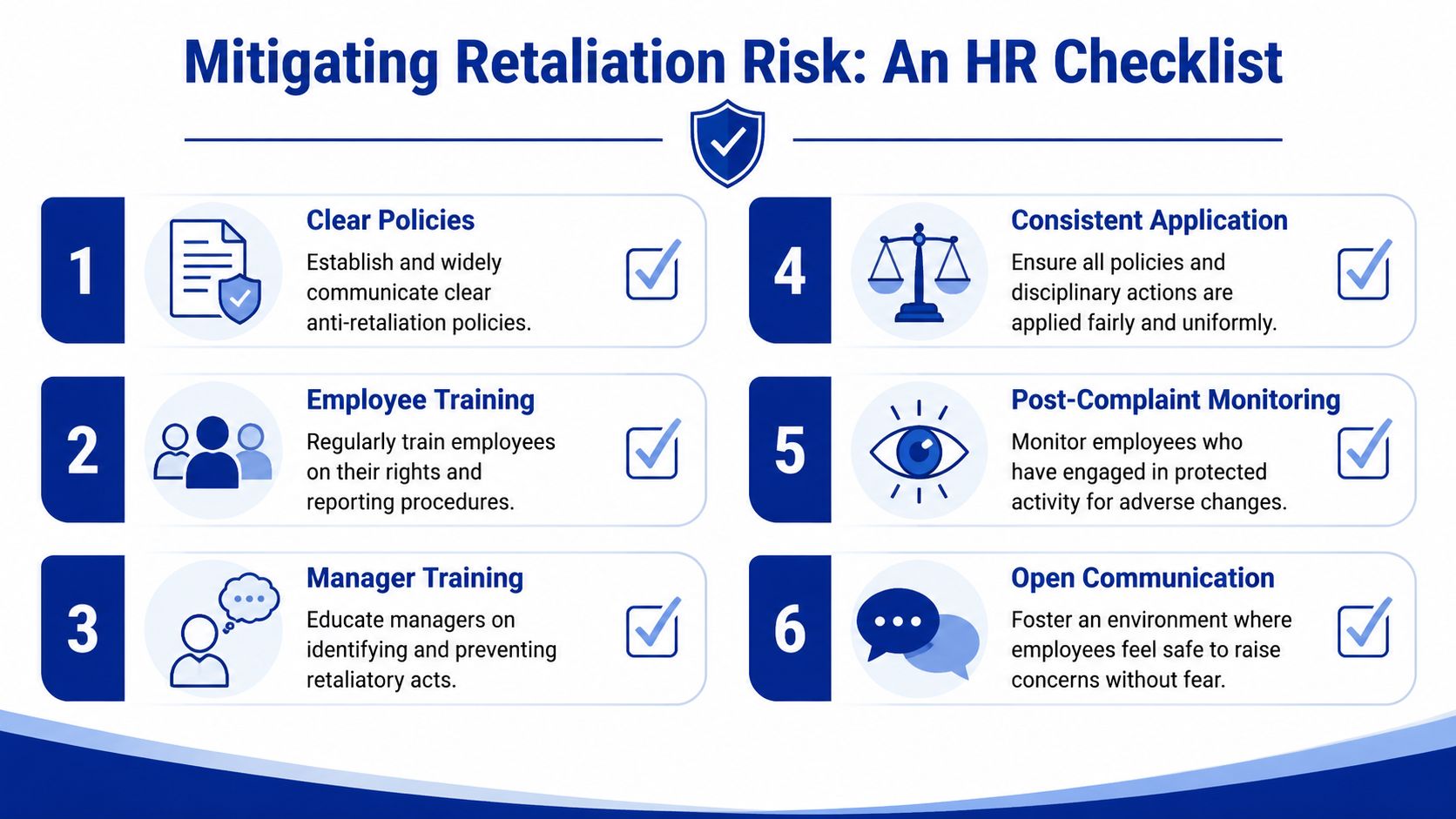
Start with manager behavior. Most retaliation problems are created by frontline supervisors who feel challenged, embarrassed, or bypassed after a complaint. Training has to address that directly.
Focus your operating controls on these areas:
A mature process doesn't block accountability. It validates it.
If an employee complained and is also underperforming, you can still act. But you need records that predate the complaint when possible, objective support for current concerns, and a decision path that follows policy. You also need leaders who understand that “everyone knows this person is a problem” is not evidence.
Here's a simple operating model:
| Risk area | Weak practice | Defensible practice |
|---|---|---|
| Manager response | Emotional reaction | Structured coaching and escalation |
| Documentation | Late, vague, inconsistent | Timely, specific, fact-based |
| Decision review | Local manager acts alone | HR or executive review before action |
| Post-complaint environment | No monitoring | Active check for changed treatment |
Train managers to ask, “Would I take this same action, in the same way, with the same record, if no complaint had happened?” If the answer is unclear, the action isn't ready.
If you want to know how to prove retaliation in the workplace from the employer side, the answer is blunt. Employees typically prove it through timing, inconsistency, comparative treatment, and weak employer credibility. You reduce risk by shutting down those openings before they form.
That requires discipline, not fear. Keep performance management alive. Keep investigations neutral. Keep decision-making centralized when risk is high. Most of all, keep records that reflect reality as it unfolded, not as leadership wishes it had unfolded later.
Businesses operating across states, regulated environments, or high-scrutiny industries often need a tighter decision framework than internal teams can build on their own. If you want help pressure-testing your documentation standards, investigation process, or retaliation risk controls, connect with Paradigm International Inc..