
Letting an employee go is one of the most difficult responsibilities a leader faces. Knowing exactly how to write a termination letter is what separates a smooth, professional offboarding from a potential legal challenge. This letter must be a clear, factual, and defensible record of the separation. It provides the departing employee with necessary clarity while protecting your business from wrongful termination claims.
Beyond the difficult conversation, the termination letter stands as your company's official, final word on the separation. This is not just a formality; it is a crucial risk management tool that helps you maintain a consistent and professional offboarding process every single time. Many businesses stumble by using vague language, getting details wrong, or leaving out key information entirely. These small mistakes can quickly escalate a straightforward separation into a costly legal battle.
It helps to think about this letter differently. Instead of viewing it as another unpleasant task, recognize its dual purpose. For the employee, it is a clear, unambiguous summary of the decision. For the company, it is a critical piece of evidence that shows you handled the process fairly and lawfully.
A well-crafted termination letter isn’t an emotional document; it's a business record. Its primary job is to communicate a final decision clearly and to minimize legal risk by creating an official account of the separation terms.
A clean, professionally written letter accomplishes several key things to protect your organization. It establishes an official timeline and confirms that the decision is final, leaving no room for misinterpretation. Most importantly, it creates a paper trail that aligns with your internal documentation and offboarding procedures. This document lets you control the narrative by ensuring the reasons and terms of the separation are stated accurately.
If you need a hand creating defensible HR practices for your business, our team can help you build the right foundation. You can learn more by contacting us.
Writing a termination letter is the starting point for a legally defensible offboarding. Every component in the letter has a specific job, working together to create a clear and unambiguous record. When you understand why each element is there, you can move beyond generic templates and better protect your business while giving the departing employee the clarity they need.
The entire process boils down to three core pillars:
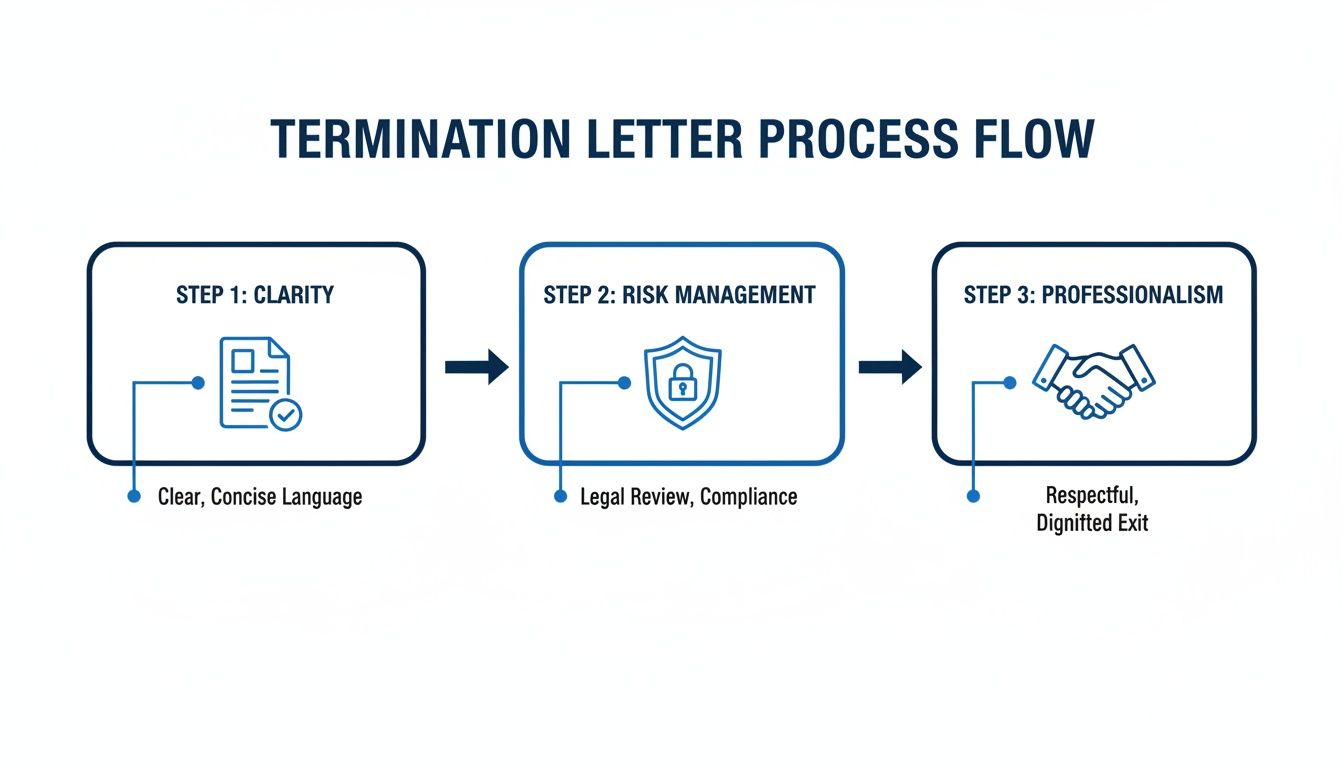
A successful termination letter strikes a careful balance between absolute clarity and solid risk management, all while maintaining a high standard of professionalism. To help you achieve this, let's break down the essential components that should be in every letter. This table summarizes the must-haves for ensuring clarity, compliance, and defensibility.
| Essential Elements of a Termination Letter |
| :--- | :--- |
| Component | Purpose and Key Details |
| Employee & Company Details | Establishes the official record. Includes the employee's full legal name, job title, and the company's legal name. |
| Issue & Effective Dates | Creates a clear timeline. The issue date is when the letter is written; the effective date of termination is the final day of employment. |
| Clear Statement of Termination | Leaves no room for misinterpretation. The opening sentence should state the decision directly and professionally. |
| Factual Reason for Separation | Manages legal risk. Provides a neutral, fact-based reason consistent with prior documentation (e.g., performance reviews, policy violations). |
| Final Paycheck Details | Ensures wage and hour compliance. Specifies the amount of the final paycheck and when and how it will be delivered. |
| Benefits Information | Fulfills legal notification duties. Outlines the status of health insurance (COBRA), retirement plans, and other benefits. |
| Return of Company Property | Secures company assets. Lists items to be returned (laptop, keys, etc.) and provides clear instructions for doing so. |
| Confidentiality & Non-Disclosure | Reinforces ongoing obligations. Reminds the employee of any confidentiality or non-disclosure agreements they signed. |
| Contact Information | Provides a clear channel for questions. Designates a specific HR contact for any follow-up inquiries. |
Getting these elements right is about building a document that stands up to scrutiny while treating the departing employee with respect.
Every termination letter must begin with the basics, laid out clearly at the top. This section leaves no room for confusion about who the letter is for or when the termination is official. Think of it as the factual foundation for everything that follows.
These non-negotiable details include:
The effective termination date is arguably the most critical piece of information here. It officially marks the end of the employment relationship and starts the timelines for final pay, benefits continuation, and other legal obligations. Make sure this date is clear and unmistakable.
Right after the introductory details, your first paragraph must state the decision to end the employment relationship. Do not try to soften the blow with a gentle lead-in; directness is a key part of professional communication in this situation. Use straightforward language that conveys the finality of the decision.
For example, a clear opening statement would be:
This letter confirms our decision to end your employment with [Company Name], effective [Date of Termination].
This approach immediately sets a professional tone and prevents any misunderstanding. Vague phrasing like "we're moving in a different direction" creates confusion and can open your company up to legal risks. The goal here is to be decisive, not apologetic.
This is where you manage your legal exposure. The key is to be factual, neutral, and completely consistent with all previous documentation, like performance improvement plans or written warnings. Avoid emotional language, subjective opinions, or overly detailed descriptions.
For instance, if the termination is for cause, you might state:
If the termination is without cause, such as a layoff, the language should reflect that:
Getting this section right is paramount. A well-written letter with a neutral, factual statement of separation can significantly reduce your litigation odds. For more on this, check out these termination letter requirements on paradigmie.com. If you need a second pair of eyes on your offboarding documents, our team can help ensure they meet compliance standards. Feel free to reach out to our experts.
Once you have stated the termination decision, the letter must pivot to the practical details of final pay and benefits. This is the part of the letter that will get the most scrutiny from the departing employee. Getting the numbers and timelines right is not just good practice; it is a critical compliance step. Navigating the rules around final pay, accrued leave, and benefits can be a minefield for any business.

A simple misstep here can quickly escalate into a costly wage and hour claim. Your goal is to provide a clear, straightforward summary that answers the employee's immediate financial questions while fulfilling all legal obligations.
The rules for when an employee receives their final paycheck vary drastically from one state to the next. Some states demand payment on the employee's last day, while others give you until the next scheduled payday. You cannot afford to guess on this detail. Before drafting the letter, you must confirm your state's specific final pay laws. For instance, California requires immediate payment for an involuntary termination, while Texas allows six calendar days.
Your letter needs to spell out:
This proactive communication demonstrates good faith and can head off potential disputes before they start.
A common mistake is assuming your normal payroll schedule applies to terminated employees. Always double-check state-specific final pay requirements. They often override your standard process and come with steep penalties for non-compliance.
Beyond regular wages, the final check might include payouts for unused paid time off (PTO) or vacation time. Just like final pay laws, the regulations for PTO payouts are state-dependent. Some states require you to pay out all accrued, unused vacation, while others do not. The termination letter should be explicit about the status of any accrued leave.
You should also address any outstanding expense reimbursements. Provide simple instructions for how the employee can submit their final expense report and a timeline for when they can expect reimbursement. This small detail helps tie up all financial loose ends.
Losing health benefits is a major concern for any departing employee. Your letter needs to provide clear information about their benefits status without offering legal or financial advice. Your main responsibility is to meet notification duties under the Consolidated Omnibus Budget Reconciliation Act (COBRA).
The letter should state that their health insurance coverage will end on a specific date, typically the last day of the month of their termination. Then, inform them that a separate COBRA election notice will be sent by mail. That official notice will contain all the details they need about continuing their health coverage. For a more thorough look at your obligations, you can explore detailed COBRA continuation rules on paradigmie.com.
Finally, briefly mention other benefits like a 401(k) or life insurance. Provide contact information for the plan administrators so the former employee can ask about rollovers or conversions directly. This empowers them to take control of their benefits while keeping your communication focused and compliant.
Offering a severance package is almost always a strategic business decision, not a legal requirement. It is a powerful tool for creating a cleaner separation while significantly reducing your legal risk. How you introduce that offer in the termination letter is critical. The concept behind severance is a straightforward exchange: you offer something of value in return for the employee signing a release of all potential legal claims.
Your termination letter is not the place for the full severance agreement. Think of the letter as an introduction to the offer, not the entire conversation. It should briefly mention the offer and clearly state that a separate, more detailed document will be provided. This keeps the termination letter focused while pointing the employee toward the comprehensive legal agreement.
Your language must be direct and unambiguous. Frame the severance as a voluntary offer that is contingent upon the employee signing a separation agreement and release of claims. This wording makes it clear that the payment is not an entitlement but is tied to them waiving their right to sue.
For instance, you could include a sentence like this:
"In connection with your separation, [Company Name] is offering you a severance package. The details of this offer, including its terms and conditions, are outlined in the enclosed Separation Agreement and Release of Claims."
This phrasing establishes the critical link between the offer and the liability waiver without getting bogged down in legal jargon.
A crucial piece of any severance offer is giving the employee enough time to review the agreement. This is not just a professional courtesy; in many cases, it is a legal necessity. The Older Workers Benefit Protection Act (OWBPA) mandates specific review periods to protect against age discrimination claims for employees aged 40 or over.
The OWBPA requirements are non-negotiable:
Even if the OWBPA does not apply, providing a reasonable review period is a smart best practice. It demonstrates fairness and makes it much harder for an employee to later claim they were pressured into signing. For more insights like this, you can find our complete employee termination checklist on paradigmie.com.
Always include a line in the letter encouraging the employee to consult with an attorney to review the severance agreement. This simple statement reinforces that you're handling the process transparently and fairly, which goes a long way in strengthening the defensibility of the signed waiver.
If you need help structuring your severance agreements or making sure your entire offboarding process is compliant, our team provides expert advisory support. Please contact us to learn how we can help.
A smooth offboarding process depends on nailing the final logistics, especially when it comes to recovering company assets. Your termination letter is the perfect place to make these expectations clear, serving as an official guide for the departing employee. This section must eliminate any guesswork to help you sidestep security risks and arguments over unreturned equipment.
The best way to handle this is with a straightforward list of all company property that needs to be returned. Being specific is the only way to prevent misunderstandings. Your goal is to create an inventory that the employee can physically check off as they gather everything.
Your checklist should explicitly name every asset issued to the employee.
By being meticulous, you create an undeniable record of expectations.
Listing the items is only half the job. You must also provide clear, actionable instructions on how, when, and where the employee should return everything. Leaving these details unclear is a common mistake that leads to delays and frustration on both sides.
Your instructions should be so clear that there are no follow-up questions. State the exact location for drop-off, the contact person, and a firm deadline. This clarity not only secures your assets but also demonstrates professionalism and respect for the departing employee's time.
Think through the logistics from the employee's perspective. If the employee is local, you might ask them to bring everything to the office by a certain date. For a remote employee, you will need to provide instructions for shipping the equipment back, including whether you are sending a prepaid shipping label.
Beyond physical items, the letter should briefly touch on the deactivation of system access. This reinforces the security measures you are taking and sets a clear, final boundary. A simple, professional statement is all you need.
For example:
"Please be advised that your access to all company systems, including email, internal networks, and software accounts, will be deactivated at the end of your final workday on [Termination Date]."
This sentence formally documents a critical offboarding step. It confirms that the separation is complete from a digital perspective, protecting sensitive company and client data. If you need guidance on creating a complete and defensible offboarding process, our experts are here to help. Contact us today to learn more.
How you deliver the termination letter is just as important as what is inside it. This is not just a logistical step; it is a moment that reflects your company's respect and professionalism. A well-managed delivery protects the employee's dignity and creates a clear, verifiable record that the notice was officially received.
This final part of the process requires careful thought. Deciding between a face-to-face meeting or using certified mail depends on the unique circumstances of the termination. Each approach has its own benefits for maintaining professionalism and building a defensible record.

Whenever possible, delivering the termination letter in a private, in-person meeting is the best approach. It is the most respectful method and gives you a chance to control the narrative and answer immediate logistical questions. A face-to-face conversation provides a sense of closure that an email or mailed letter cannot match.
To keep the meeting professional and on track, stick to a few key practices:
The point of the termination meeting isn’t to rehash old performance issues or justify the decision. It's to clearly state the outcome, provide the official letter, and explain what happens next for a smooth exit.
While an in-person delivery is ideal, it is not always realistic. For remote employees, or in situations where a face-to-face meeting might pose a security risk, you need another plan. The most important thing is to choose a method that provides proof of delivery.
Certified mail with a return receipt is a reliable option, as it creates a legally recognized paper trail. Secure document delivery platforms can provide a time-stamped digital receipt when the employee opens the file. Avoid standard email, as it offers no guarantee the message was received or read. Understanding both sides of the separation process is a hallmark of great HR management. You can learn about the employee's perspective on how to write a resignation letter.
Managing these final steps with care is crucial. Our complete employee termination checklist on paradigmie.com provides a structured framework to guide you through every stage. If you need expert guidance on navigating high-stakes terminations, our advisory team is here to help. Contact us to learn how we can support your leadership team.
Even with a well-structured letter, the complexities of an employee separation bring up difficult questions. Answering common queries ahead of time helps build confidence and ensures your offboarding process is consistently fair and defensible. While some employers explore tools like AI for termination and relieving letters, the underlying strategy still requires human judgment. Let's walk through some of the most frequent questions.
In most at-will employment states, you are not legally required to provide a reason for termination. However, giving a brief, factual, and neutral reason often adds necessary clarity and can prevent speculation. For instance, stating the cause is a "position elimination due to company restructuring" is clear and difficult to dispute. If the termination is for cause, the reason you provide must align perfectly with your previous documentation. Consistency is your best defense.
Think of a termination letter as a legal document. Every word matters. It is critical to steer clear of any language that is subjective, emotional, or could be misinterpreted later.
Here are specific phrases and words to remove:
Stick to objective facts. The goal is to be direct and professional, not to soften the message with ambiguous language that could create legal exposure. This becomes even more critical when terminating an employee on leave, which demands exceptionally precise wording.
The most defensible termination letter is boring. It should be a straightforward, factual account of a business decision, free of any personal commentary or emotional subtext that could be used to build a wrongful termination claim.
An employee cannot be forced to sign a termination letter. It is important to clarify that their signature is only an acknowledgment of receipt—it does not mean they agree with the termination. If they still refuse, the witness in the room should make a brief note directly on the company’s copy of the letter, such as: "[Employee Name] received this letter but declined to sign on [Date]." You then give the employee their unsigned copy and securely file your annotated original. This simple notation serves as your record that the letter was delivered.
Navigating these high-stakes scenarios requires sound judgment and defensible practices. We can act as a decision partner for leadership teams, providing the expert guidance needed to handle complex terminations correctly and reduce employment risk. To learn how we can help you build more consistent and defensible HR processes, please contact us.