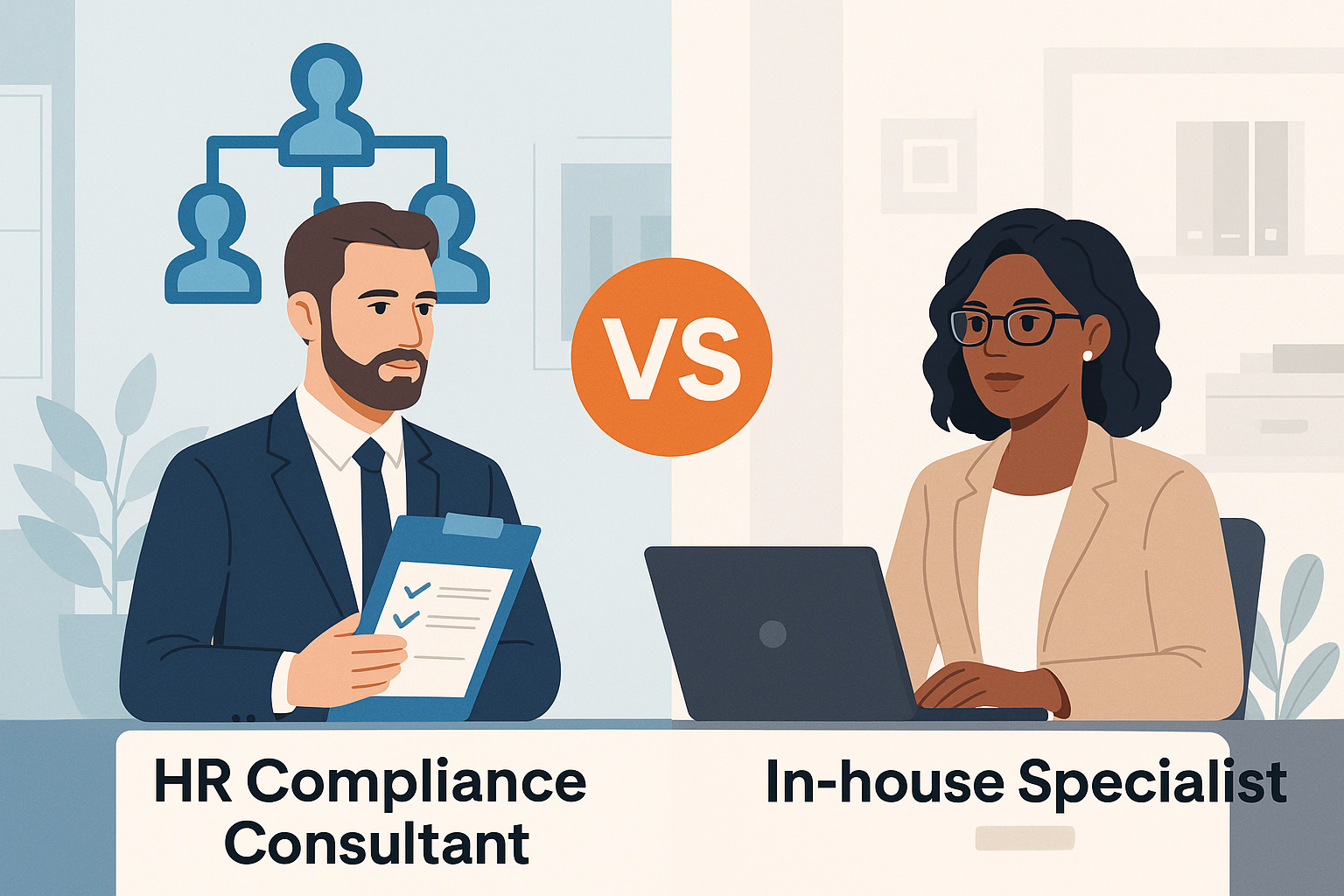
If you're staring at an HR proposal after a messy termination, a multi-state complaint, or a handbook issue that suddenly feels bigger than your team, the price probably looks higher than you expected. That's because you're not buying “HR time,” you're buying judgment, documentation, and a cleaner path through employment risk. In 2026, the smartest buyers stop comparing consultants like interchangeable vendors and start asking what level of exposure the fee is covering.
Owners and COOs who price HR consulting like general admin support usually get the wrong proposal. A policy cleanup is one job. A termination that crosses state lines, touches pay rules, and leaves gaps in documentation is another. The fee should follow the risk, not the title on the invoice. If you want a quick primer on why advisory spend rises with growth, see HR support costs for growth.
For independent HR consulting in the U.S., about $75 to $350 per hour is the common bracket. Early-career consultants usually sit around $75 to $130, mid-level consultants around $130 to $200, and senior specialists or fractional CHROs around $200 to $350 per hour. Highly specialized compliance or legal-adjacent advisory work can reach $375+ per hour (ConsultFees). That spread tracks the level of employment risk you are asking someone to manage.
Project pricing follows the same logic. Common engagements include HR compliance audits at $8,000 to $30,000, compensation design at $15,000 to $60,000, and organizational development projects at $25,000 to $100,000+ (ConsultFees). If a quote comes in far below those ranges on a complex engagement, assume something is missing from the scope until proven otherwise.
A lower fee is not a bargain if it leaves out the work that protects you.
Start with the person doing the work. A senior advisor selling the engagement and a junior consultant delivering it are not the same product, and the risk profile changes fast.
Then ask what the fee excludes. The cheapest proposals often leave out investigations, manager coaching, documentation cleanup, or follow-through after the first memo. Ask what closes the engagement, and ask what triggers a price change before anyone starts reviewing employee files.
The broader market also explains why pricing stays firm for higher-stakes work. One 2026 estimate puts the global human resource consulting market at $84.58 billion in 2026, rising to $118.76 billion by 2031 at 7.02% CAGR, while another places it at $88.81 billion in 2026 with 7.37% CAGR through 2035 (Research and Markets). In other words, this is a mature advisory market where buyers pay for risk reduction, not just availability.
HR buyers get burned when they choose a pricing model that doesn't match the work. Hourly fees can be perfect for a one-off investigation, but they're clumsy for ongoing multi-state compliance support. A retainer can be ideal for a company with recurring employee-relations issues, but it's a poor fit if you only need a handbook refresh. The model matters because it decides who carries uncertainty.
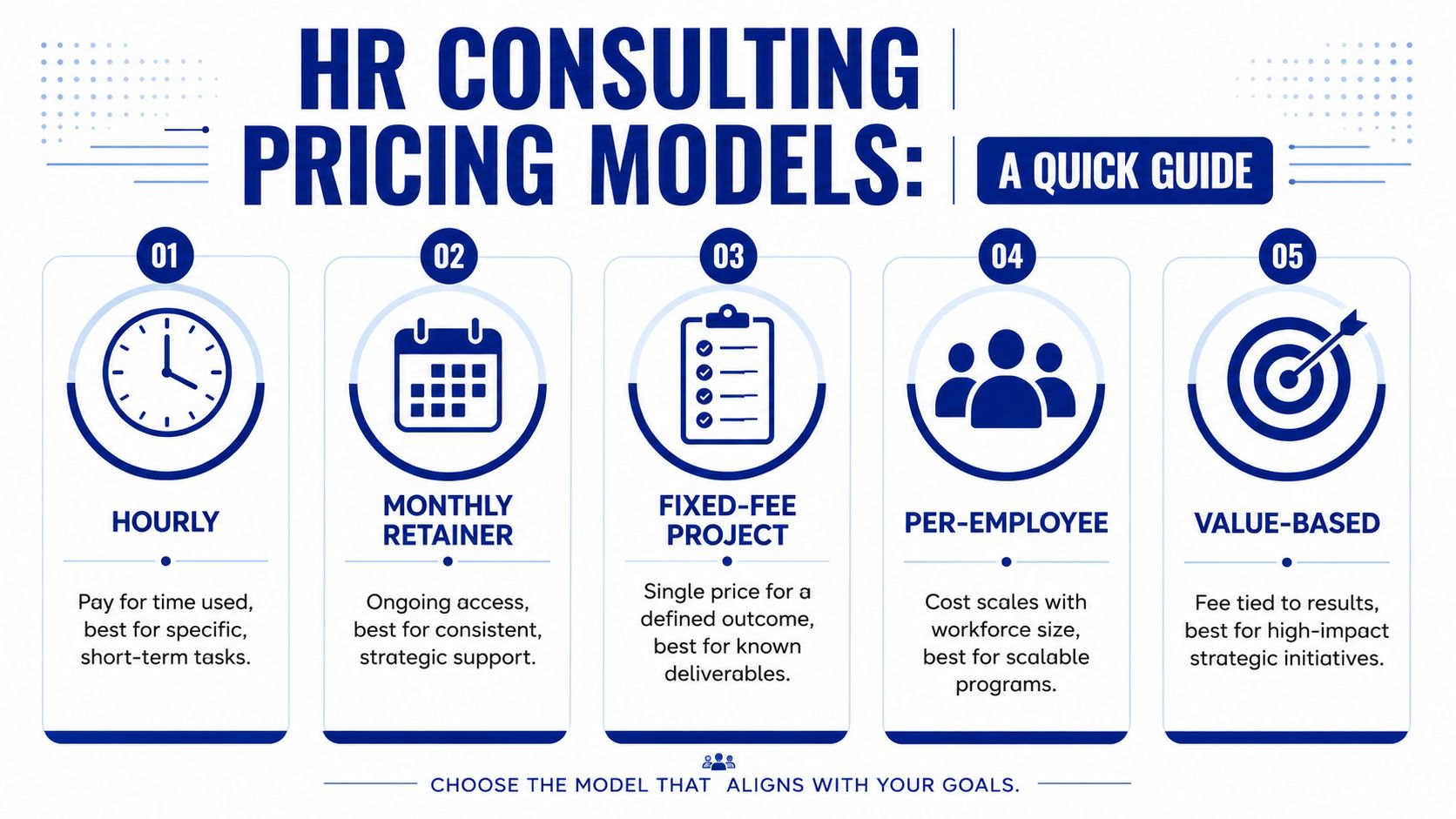
Hourly pricing is the cleanest fit for unpredictable work. Investigations, employee complaints, terminations, and call-in advice are often billed this way because the consultant can't know the time burden up front. The downside is obvious, the bill moves with every follow-up question, redraft, or extra meeting.
Monthly retainers work when the company has ongoing exposure. If you're operating across state lines, adjusting policies repeatedly, or handling recurring manager issues, a retainer buys availability and continuity. You're paying for readiness, not just hours. That makes it better for firms that need steady judgment, not isolated tasks.
Fixed-fee projects fit work with a clear finish line, like a handbook refresh, compensation structure, or an HR audit. You know the deliverable, so you can buy the outcome rather than the stopwatch. This is usually the most comfortable model for owners who want cost certainty.
Per-employee pricing is common when the consultant is effectively scaling HR support with headcount. It works best when the service package repeats across employees, like access to guidance, policies, or managed support. It can misalign if the business has a small headcount but unusually high complexity, because the risk doesn't always track neatly with staff size.
Value-based pricing is used when the consultant ties the fee to business impact rather than time. In HR, that usually means higher-stakes advisory where a mistake could be costly, and the advisor is pricing the judgment, not the minutes. It's a better fit for strategic work than routine admin support.
A simple way to judge the model, if the problem is episodic, fixed-fee usually wins. If the problem is recurring, retainer or per-employee pricing usually makes more sense.
The biggest mistake in HR buying is assuming the rate card tells the whole story. It doesn't. A consultant who handles a straightforward policy update and a consultant who manages a multi-state termination with defensible documentation are not doing the same kind of work, even if both call themselves HR advisors. The fee rises because the exposure rises.
Multi-state coverage adds friction fast. Different wage-hour expectations, policy standards, and documentation practices create more places to make a mistake. Regulated industries add another layer because the advisor has to think about defensibility, not just internal consistency.
Investigations and terminations also cost more because they interrupt everything else. The consultant has to move quickly, gather facts, preserve documents, and reduce the odds of later disputes. Senior roles and high-compensation employees raise the stakes again, because the legal, financial, and reputational fallout from a bad decision is harder to unwind.
The consulting market has already recognized this pattern. Recent 2026 rate guides show a wide gap between general HR advisory and compliance or HR legal-style work, with senior specialists frequently quoted around $200 to $450+ per hour and compliance or audit projects commonly priced from $8,000 to $30,000+ (InvoiceBloom HR consulting rates guide). If a proposal ignores that gap, it's probably under-scoping the actual problem.
A documented, advisor-led termination process may feel expensive at the front end. But if the consultant helps you clean up the facts, the file, and the messaging before the decision lands, that fee is usually a fraction of the cost of a wage-and-hour claim, agency complaint, or drawn-out employee dispute. The point isn't that every issue becomes litigation, it's that weak process gives the other side more power.
Here's the right lens:
If your quote jumps when the issue spans states, involves an executive, or requires investigation work, that's not always markup. Sometimes it's the correct price for avoiding preventable exposure.
The best way to read HR pricing in 2026 is by scope first, geography second. Regional cost of living can raise the floor, but complexity raises the ceiling in every market. A consultant in a lower-cost city can still charge a premium if they're handling regulated, multi-state, or litigation-sensitive work.
| Engagement Type | Tier 1 General Advisory | Tier 2 Compliance and Investigations | Tier 3 Senior Specialist |
|---|---|---|---|
| Hourly | $75 to $130 | $130 to $200 | $200 to $350+ |
| Project | Lower-complexity projects tend to sit below the audit and design ranges. | HR compliance audits often run $8,000 to $30,000 | Compensation design can reach $15,000 to $60,000, and organizational development can reach $25,000 to $100,000+ |
| Monthly retainer | Lower-touch support is usually the cheapest tier. | Ongoing compliance coverage usually costs more than admin-only access. | Fractional CHRO-style support usually commands the highest monthly fee |
This table is meant as a sanity check, not a shopping list. If a proposal for a complicated, multi-state matter sits below the general advisory range, the scope is likely too thin. If you want a parallel benchmark for broader U.S. consulting pricing, use 2026 HR consultant hourly rates as your internal comparison point.
A useful outside reference is LATAM salary benchmarks from Virtustant, because it reminds buyers that labor markets vary, but risk pricing still follows complexity. That distinction matters when a cheaper regional rate tempts you to ignore the expertise gap.
Bottom line: geography may influence the starting point, but employment-risk complexity sets the real price.
Two HR proposals can look similar on paper and still be miles apart in real value. One is scoped for a real decision partner. The other is just a light admin wrapper with a nice logo. If you compare them only on hourly rate, you'll miss the difference between a defensible engagement and a cheap surprise.
Start by asking who does the work. A senior partner may sell the deal, but if the delivery sits with a junior generalist, the quote should be lower. You also need to know what deliverable ends the engagement, because “ongoing support” without a finish line is how budgets drift.
Then check the control points. Ask how change orders work, who owns the documentation, and whether the consultant carries E&O insurance. That last point is not a formality, it tells you whether the provider treats the work like a professional service or a casual side project.
Use this short checklist when reviewing bids:
If a proposal is dramatically cheaper than the others, look for omissions before you congratulate yourself. Low bids often leave out investigation time, manager coaching, implementation support, or documentation cleanup. That can make the initial fee look efficient and the final cost look foolish.
For a useful contrast on how legal-style consultants frame scope and risk, review founder advice on legal consultants from HireParalegals. The lesson translates directly to HR consulting, clear scope protects both sides.
The lowest bid is rarely the lowest total cost when employment risk is involved.
HR advice is only cheap if the answer survives contact with reality. That's the standard that matters. A consultant who gives you a quick opinion but can't defend it later is not saving money, they're deferring cost until the problem gets louder.
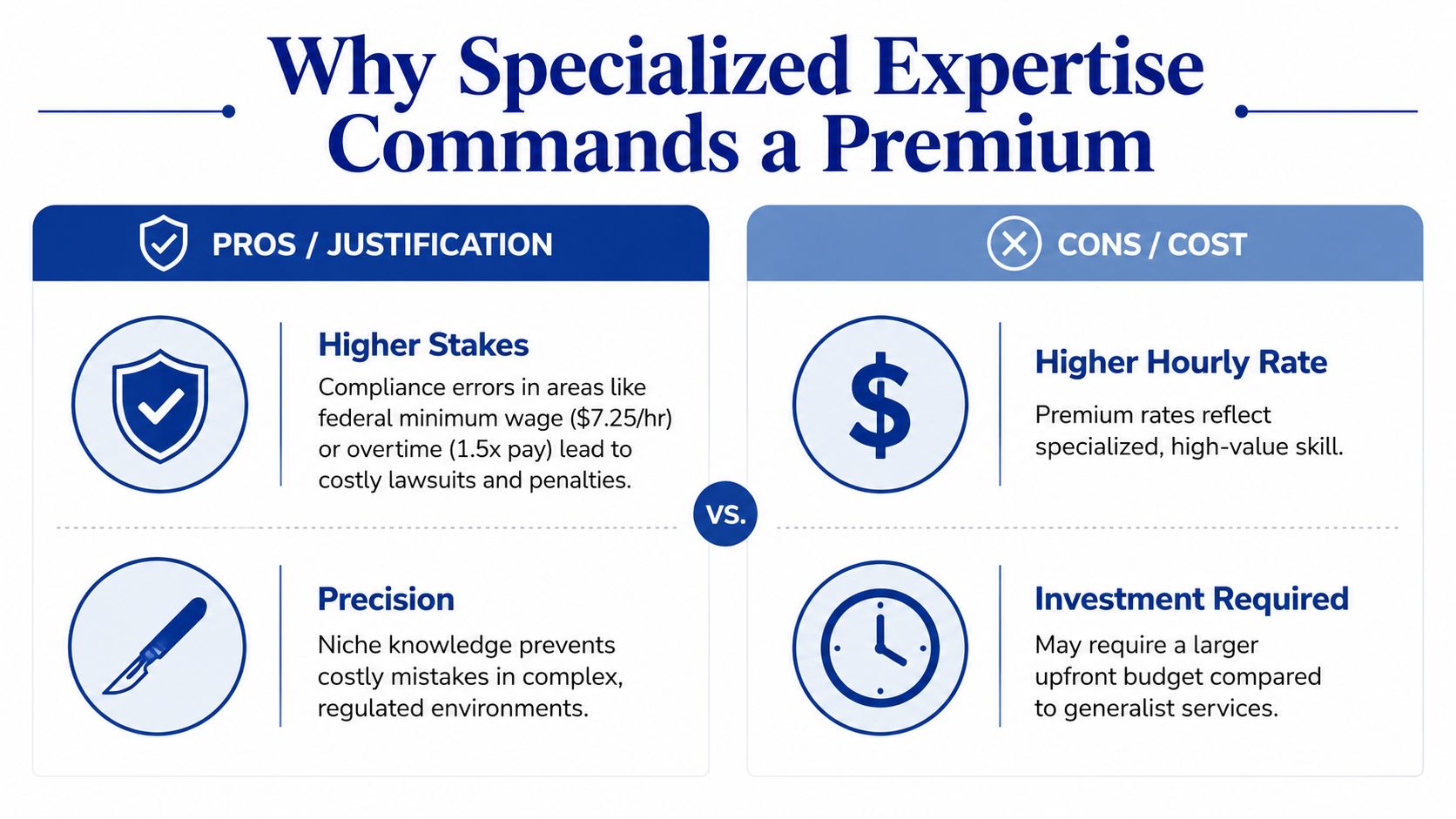
The federal baseline is not complicated. Under the Fair Labor Standards Act, the federal minimum wage is $7.25 per hour, and nonexempt employees generally must receive one-and-one-half times the regular rate for hours worked over 40 in a workweek (ConsultingDemand). A small classification mistake around those rules can become very expensive very fast.
That's why senior HR advisors charge more. They're not just answering questions, they're reducing the odds that your pay practices, classification decisions, or policy language create avoidable exposure. The value isn't in sounding confident, it's in being right in a way that holds up later.
Defensible HR work has three traits. First, the advisor understands the business context, including state variation and operational pressure. Second, the documentation is built so an outsider can follow the logic later. Third, the recommendation is practical enough for managers to use without watering it down.
This is why generalist HR help can be cheaper but still more expensive in the long run. If the consultant gives you a soft answer on a hard issue, you may end up reworking the entire process after the fact. Paying for judgment up front is usually less painful than paying for cleanup, revisions, and reputational damage later.
If you're evaluating a higher fee, ask whether the advisor is producing something that would hold up under audit, deposition, or agency review. If the answer is yes, the premium is usually earned.
You do not need to accept every quote as written. Good buyers negotiate the scope, the controls, and the accountability. Bad buyers only ask for a discount and then act surprised when the engagement gets thin.
Bring these items into the discussion before you sign:
Unlimited scope is the most common trap. So is a deliverable that sounds helpful but never defines what “done” means. Another problem is no documentation ownership, which leaves you dependent on the consultant for records you may need later.
Push back directly. If the proposal is vague, ask for a narrower statement of work. If the consultant refuses to clarify basic accountability, that's not a negotiation problem, it's a signal about how the relationship will work later.
For leaders who want a useful lens on budgeting and owner discipline, payroll tax deposit tips for founders from HireAccountants is a good adjacent read, because the same principle applies. Clear process beats reactive cleanup.
The negotiation conversation is also the relationship test. The way a consultant handles fair pushback tells you a lot about how they'll handle a difficult call six months from now.
A defensible advisor earns the fee by reducing employment risk where SMBs are most exposed, especially in multi-state work, investigations, and terminations. Use three filters. Do they understand multi-state exposure and how it changes HR decisions. Do they produce documentation that can stand up later. Do they show judgment under pressure, not just speed.
If you want a broader overview of service fit and delivery models, your guide to HR consulting is worth reading before you sign. The goal is not the lowest quote. The goal is support that holds when the issue gets serious.
When the work touches terminations, investigations, compensation, or multi-state compliance, price matters less than whether the advisor can defend the outcome.
For a useful adjacent read on owner discipline and clean process, payroll tax deposit tips for founders makes the same point from a different angle. Clear process beats cleanup after the fact.
If your current HR support feels too light for the risk you're carrying, talk to a partner who can pressure-test the scope before the next issue lands. Start a conversation with Paradigm International if you want a factual review of your team's exposure.