
Your company is growing, managers are making people decisions across state lines, and the hard questions keep landing on your desk. A termination in one state, a leave issue in another, a manager complaint that could turn into something bigger. You don't need more HR activity. You need senior judgment in the room before someone makes an expensive mistake.
That's where many SMB leaders get this wrong. They assume fractional HR is mainly a cheaper substitute for a full-time hire. Cost matters, but if that's your only lens, you'll likely buy the wrong kind of support. The fundamental value of fractional HR leadership is risk control, decision quality, and stability when the employment environment gets complicated.
Fractional HR leadership is part-time executive HR leadership embedded into your business. Think of it the same way many companies use a fractional CFO. You're not hiring someone to process transactions. You're bringing in senior leadership to help guide decisions, set priorities, and protect the business while it grows.
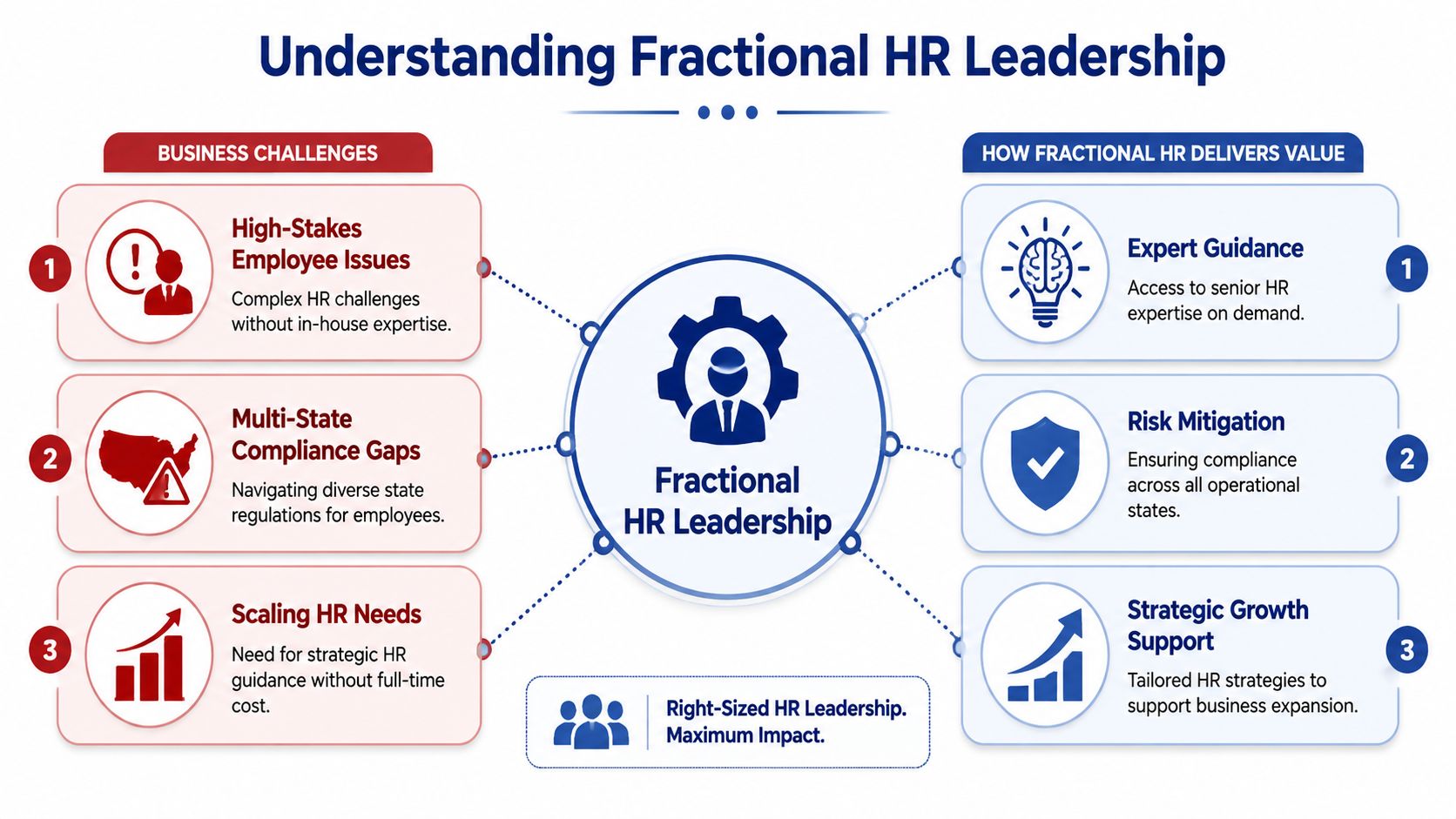
A lot of providers blur the line between strategic HR and administrative HR. That confusion creates problems. A true fractional leader doesn't just clean up policies, answer routine questions, or manage vendors. They help your leadership team make better calls on structure, accountability, workforce planning, manager conduct, investigations, and compliance-sensitive decisions.
The distinction matters because the stakes are different. If your problem is paperwork, transactional HR support may be enough. If your problem is judgment, inconsistency, or exposure, you need leadership.
Practical rule: If the issue could create legal, financial, or reputational consequences, it belongs with a leader, not a task vendor.
This model isn't niche anymore. In 2024, the number of professionals identifying as “fractional leaders” on LinkedIn reached 110,000, up 5,500% from 2,000 in 2022, according to data cited in Lattice's overview of fractional HR. That growth tells you something important. Companies aren't experimenting with this model at the margins. They're adopting it because they need executive capability without carrying permanent executive overhead.
The strongest fractional HR leaders operate as part of the leadership team. They help define how decisions get made, who owns what, and what standards managers have to follow.
That often includes work like:
Fractional HR leadership should feel like access to an experienced operating partner, not a help desk with a nicer title.
If you're a CEO or COO, that's the point. You don't need another person forwarding handbook templates. You need someone who can look at a messy people issue, understand the business context, and help you move in a way that's sound, consistent, and defensible.
Most companies don't wake up one morning and casually decide they need senior HR leadership. The need usually shows up under pressure. A growth push creates inconsistent hiring. A new state expansion exposes policy gaps. A merger leaves managers operating under different rules and assumptions.
One common trigger is multi-state expansion. A company that operated fine in one state suddenly has employees in two or three. Now wage and hour rules, leave obligations, documentation standards, and manager practices can't stay informal. What worked before won't hold up when your employment footprint gets broader.
Another trigger is rapid headcount growth without leadership infrastructure. Teams scale faster than management discipline. Job responsibilities blur, employee complaints get routed inconsistently, and supervisors start making case-by-case decisions without any reliable framework. That's how preventable risk builds.
A third trigger is organizational change. Mergers, leadership transitions, restructures, and culture resets all create HR exposure. Employees test boundaries, managers get nervous, and routine issues become charged. In those moments, senior HR judgment is not a luxury.
If your managers are handling sensitive employee matters based on instinct, you're overdue for stronger HR leadership.
For many SMBs, the business is too complex to go without senior HR guidance but not ready to justify a full-time CHRO. That's exactly where the model fits. According to BPM's explanation of fractional HR, fractional HR leadership typically costs 40% to 60% less than hiring a full-time HR leader with comparable qualifications, and a full-time CHRO often commands a salary exceeding $250,000 plus benefits.
That doesn't mean the right decision is always fractional. It means you can buy executive-level judgment without locking yourself into full-time executive overhead before the role requires it.
Here's when I'd recommend serious consideration:
A good fractional HR leader enters at this point and creates order. Not just more process. Better judgment, clearer ownership, and steadier execution.
Leaders often compare these models as if they're interchangeable. They're not. If you choose the wrong one, you'll spend money and still have the original problem.
A fractional HR leader provides ongoing strategic guidance on a part-time basis. An interim HR leader fills a temporary leadership vacancy and usually carries the function more directly. Outsourced HR providers, including PEO and ASO arrangements, usually handle administration, systems, and recurring HR processes.
If you're weighing operating models more broadly, these strategic contract-to-hire insights are useful because they show the same core principle. Match the model to the problem, not just the budget.
| Attribute | Fractional HR Leadership | Interim HR Leader | Outsourced HR (PEO/ASO) |
|---|---|---|---|
| Primary purpose | Strategic guidance and executive decision support | Temporary full-time leadership coverage | Administrative execution and HR operations support |
| Typical use case | Growing company needs senior judgment without a full-time hire | HR leader exits, goes on leave, or business enters active instability | Company wants help with payroll, benefits, onboarding, and routine processes |
| Role in leadership team | Embedded advisor with ongoing executive involvement | Acting leader with direct operational ownership | External service provider |
| Time commitment | Part-time, structured cadence | Higher presence, often close to full-time | Service-based, task-driven |
| Best for | Multi-state growth, risk management, organizational design, leadership coaching | Coverage during vacancies, crises, or acute transitions | Efficiency in repeatable HR administration |
| Main deliverables | Decision frameworks, policy alignment, manager guidance, risk controls | Day-to-day leadership continuity and direct management | Processing, systems support, compliance administration |
| Biggest limitation | Not ideal if you need constant on-site leadership presence | Higher cost and less flexibility for ongoing advisory needs | Weak fit for high-stakes judgment calls |
Companies often lose time. They hire outsourced HR support because it sounds extensive. Then a manager mishandles a complaint, a termination gets rushed, or an employee issue crosses state lines and nobody can give a confident answer.
That's not a criticism of outsourced providers. It's a scope issue. If you need help choosing between delivery models, this comparison of outsourced HR vs in-house is a practical companion to the decision.
Outsourced HR can keep the machine running. Fractional leadership helps you decide where the machine should go, and how to keep it from breaking under pressure.
Interim leadership has its place too. If your company is in active disruption and needs daily oversight, interim is often the better fit. Fractional works best when the company needs senior expertise, structure, and disciplined decision-making, but not full-time executive presence every day.
Choosing a fractional HR partner is not a staffing decision. It's a risk decision. You are selecting the person who may influence terminations, investigations, manager conduct, compliance posture, and documentation standards. Credentials matter, but judgment matters more.
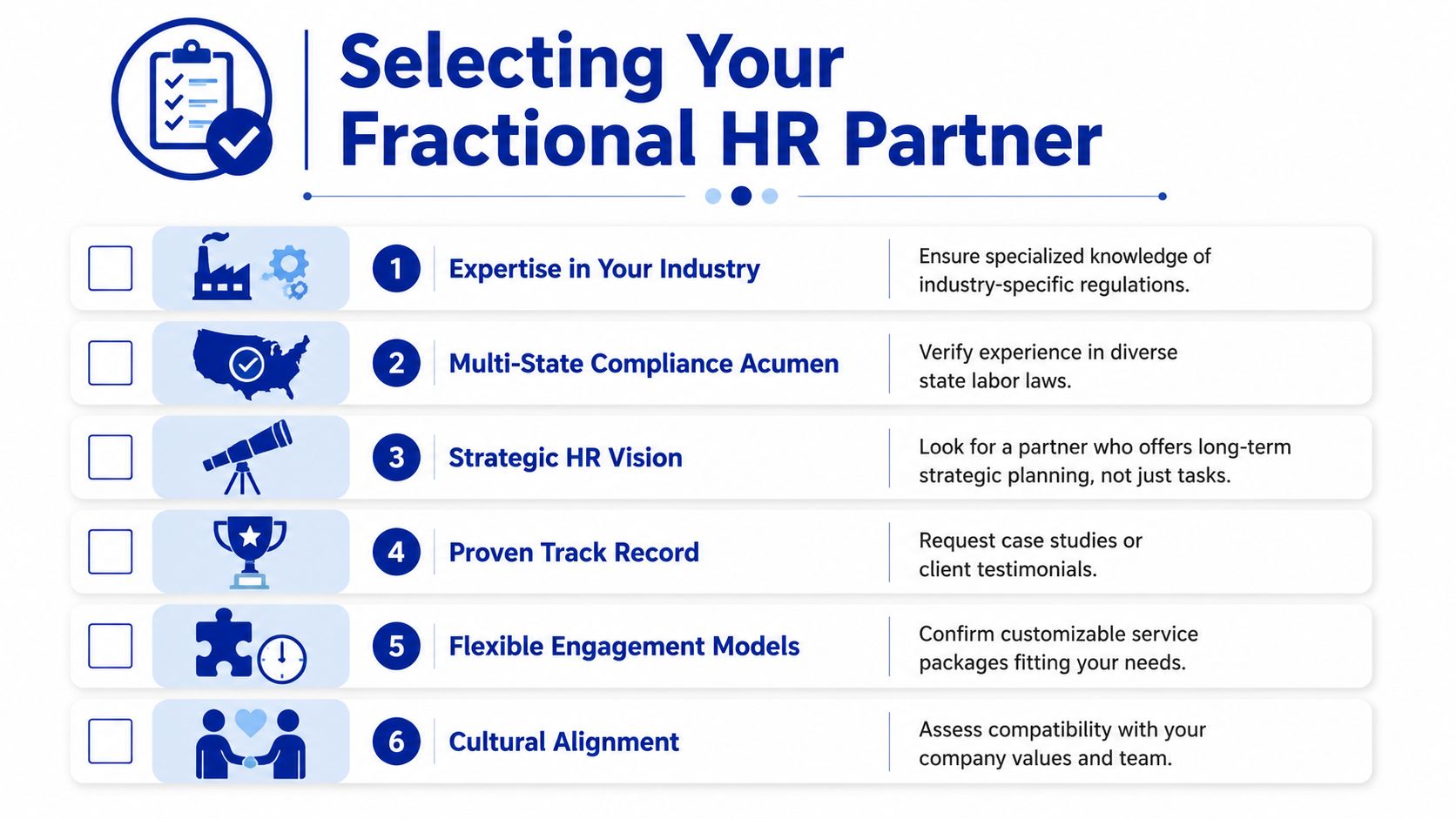
Start by asking where this person has operated and what kinds of environments they've handled. If your business spans states, deals with regulated work, or has a manager population that needs stronger discipline, broad generalist experience isn't enough. You need someone who's comfortable guiding leaders through high-stakes calls.
Look for evidence that they can do more than advise from a distance. Effective fractional HR leadership includes setting clear KPIs, decision rights, and communication cadences upfront, with measurable risk reduction often taking shape within 30 to 90 days, as described in Soteria HR's discussion of fractional HR leadership. That should tell you what good looks like. Not vague support. Defined operating discipline.
A strong evaluation process should include:
Selection test: If the provider can describe deliverables but can't explain decision rights, escalation paths, and how they'll influence manager behavior, keep looking.
A good scope of work should be specific. Spell out leadership access, recurring forums, priority areas, response expectations, and which categories of issues require direct involvement. If you leave the scope broad, you'll get broad results.
You should also expect a transition plan. What happens in the first month? What gets reviewed first? Which managers need coaching right away? How will policy, practice, and documentation be assessed?
If you need a sharper framework for evaluating providers, this guide on how to select an HR partner is worth reviewing before you sign anything.
The best fractional partner doesn't try to do everything. They establish control in the areas where bad decisions create outsized consequences.
Multi-state growth exposes weak HR infrastructure fast. What felt manageable in one location becomes fragile when different states apply different rules to wage and hour issues, leave administration, documentation, and termination practices. Generic HR support won't protect you here. In many cases, it creates false confidence.

A multi-state business needs more than policy templates and reactive answers. It needs consistent judgment across managers, locations, and employee situations. If one supervisor handles performance issues informally and another documents every step, you don't have a culture difference. You have a defensibility problem.
That's why I separate standard fractional HR from embedded risk leadership. The first can be useful. The second is what complex SMBs need when the employment environment gets serious.
According to Ampleo's article on fractional HR services for small businesses, 76% of SMBs face at least one employment lawsuit within five years, and the most important value for multi-state SMBs is proactive employment risk mitigation. That's the right frame. If your support model doesn't reduce preventable exposure, it's incomplete.
This approach is practical, not theoretical. It focuses on how leaders and managers behave in real situations.
Key elements include:
A multi-state company doesn't need more HR noise. It needs tighter decision-making and cleaner execution.
For leadership teams using technology in parallel, tools can help review agreements and surface issues faster, but they don't replace human judgment. This overview of employment contract AI tools from LegesGPT is useful as part of a broader control strategy.
If wage and hour exposure is one of your pressure points, this resource on wage and hour compliance is worth keeping close. Those issues rarely stay isolated. They usually connect back to manager habits, inconsistent classifications, and weak oversight.
Fractional HR leadership works best when the engagement matches the business problem. Not every company needs the same level of depth. Some need a stronger compliance foundation. Others need a strategic operating partner who can help shape the next stage of growth.
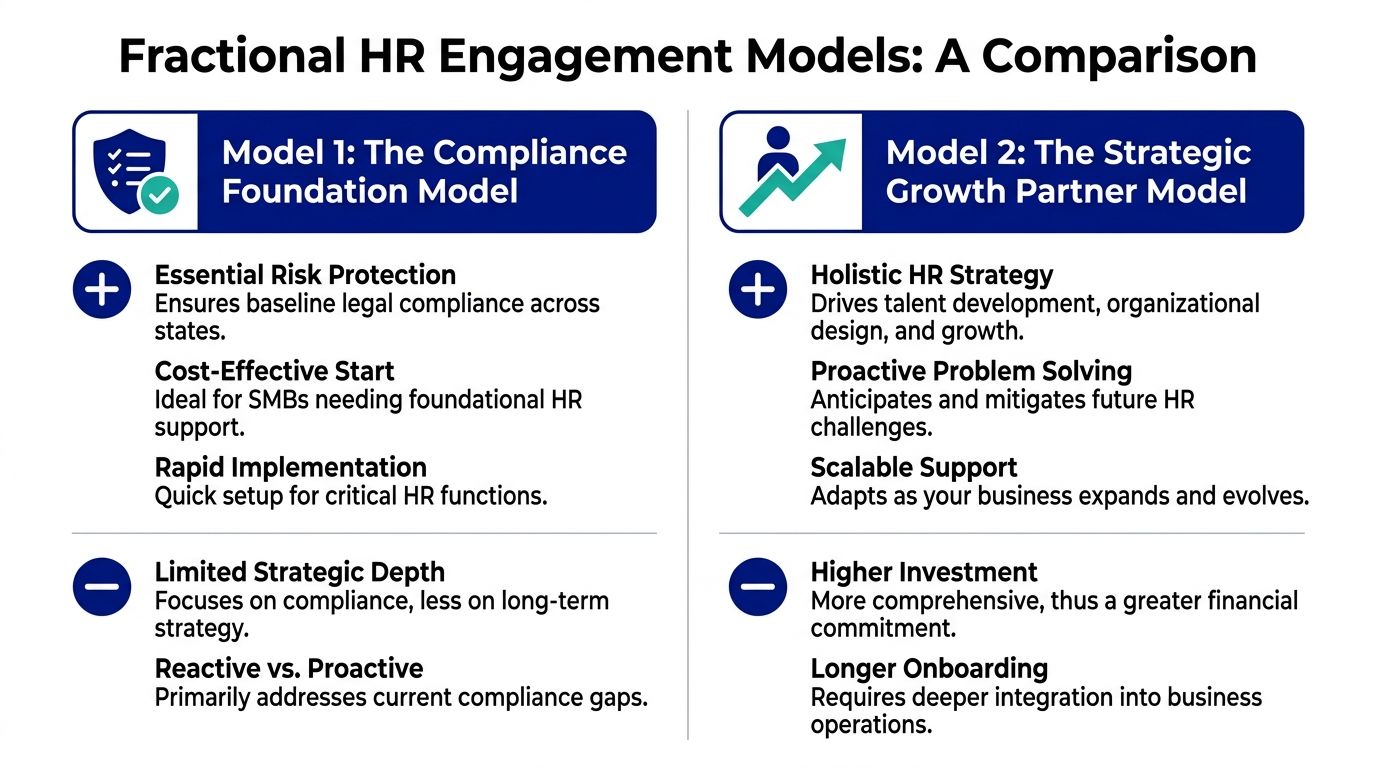
This model fits a business that's expanding, formalizing, or cleaning up avoidable risk. The focus is on building control where inconsistency is creating exposure.
A typical scope may include manager guidance, policy review, documentation standards, escalation rules, and leadership support for sensitive employee decisions. The aim is to create order quickly and establish a repeatable way to handle people issues.
This model works well when:
The tradeoff is simple. This model builds protection first. It is less focused on long-range talent architecture.
This model goes deeper. It suits businesses that need not only risk control but also stronger organizational design and leadership development as they scale.
The role of a Fractional CHRO is especially relevant here. As explained by MEA's overview of fractional HR leadership, the work centers on workforce planning, succession, culture development, and long-term HR architecture, not daily administration or vendor checking. That's the right structure for an executive team preparing for sustained growth.
A strategic growth partner often helps with:
The right model depends on your primary need. If your immediate issue is exposure, start with control. If your foundation is stable and growth is the pressure point, move upstream into architecture and leadership planning.
Both models are valid. The mistake is trying to force one engagement to do both jobs at once without clear priorities.
If your business is navigating growth, complexity, or multi-state exposure, fractional HR leadership can be the right move. But only if you treat it as a leadership decision, not a budget shortcut. The goal isn't to buy part-time HR help. The goal is to add seasoned judgment where poor people decisions create real risk.
The strongest fractional leaders bring structure to moments that often feel messy. They help executives slow down when needed, move decisively when appropriate, and create consistency across managers before inconsistency becomes liability. That's what makes the model valuable.
For SMBs in complex employment environments, the right question isn't whether you can afford this kind of support. It's whether you can keep operating without it when the stakes keep rising.
If these challenges sound familiar, Paradigm International Inc. offers an advisory-first approach for leadership teams that need defensible HR practices, stronger decision support, and more stability in complex employment environments.