A regional manager receives a wrongful termination claim and opens a folder of six-month-old notes. The entries are incomplete, the warning is missing, and the manager can't remember whether the incident was discussed privately or in a team meeting. The company now has to defend a decision using memory instead of a reliable record.
That situation isn't caused by a lack of software. It reflects weak documentation discipline. Effective HR documentation best practices connect four controls: record taxonomy, contemporaneous entries, retention mapping, and manager coaching. When those controls work together, documentation becomes a defensibility strategy rather than a filing task.
In a deposition, a plaintiff's attorney doesn't need to prove that every manager acted in bad faith. The attorney may only need to expose an unreliable timeline. A manager who wrote a performance summary months after the relevant conversation may struggle to explain what happened, who attended, what expectations were set, or whether the employee had an opportunity to respond.
The contrast is clear. One employer keeps scattered notes, delayed summaries, and informal emails that aren't tied to specific events. Another has managers record observations promptly, attach dated correspondence to the relevant incident, and preserve corrective conversations in the same controlled system as routine performance notes.
Practical rule: A late, reconstructed record usually creates more questions than it answers.
The stronger employer doesn't necessarily have a more advanced platform. It has a shared standard for what managers must record, when they must record it, and where the official record belongs. The system supports the habit, but it can't create the habit by itself.
Federal rules reinforce why this structure matters. The EEOC recordkeeping requirements establish a baseline for retaining personnel records and extending preservation when a charge or agency matter exists. That baseline doesn't replace sound judgment, but it does make ad hoc filekeeping indefensible.
Leadership teams should treat documentation as evidence of how decisions were made. A practical defensible HR practices guide can help connect documentation standards to broader governance, decision rights, and escalation practices.
Start with classification, not software selection. A taxonomy tells the organization what a record is, who should see it, where it belongs, and which retention rule applies. Without that structure, even a secure platform becomes a well-organized way to store confusion.
Use record classes that reflect different legal, operational, and privacy needs:
The lifecycle should also be visible. Each category needs a status such as active, on hold, archived, or scheduled for destruction. A legal hold overrides ordinary deletion, so the system must identify records connected to a charge, audit, dispute, or anticipated claim.
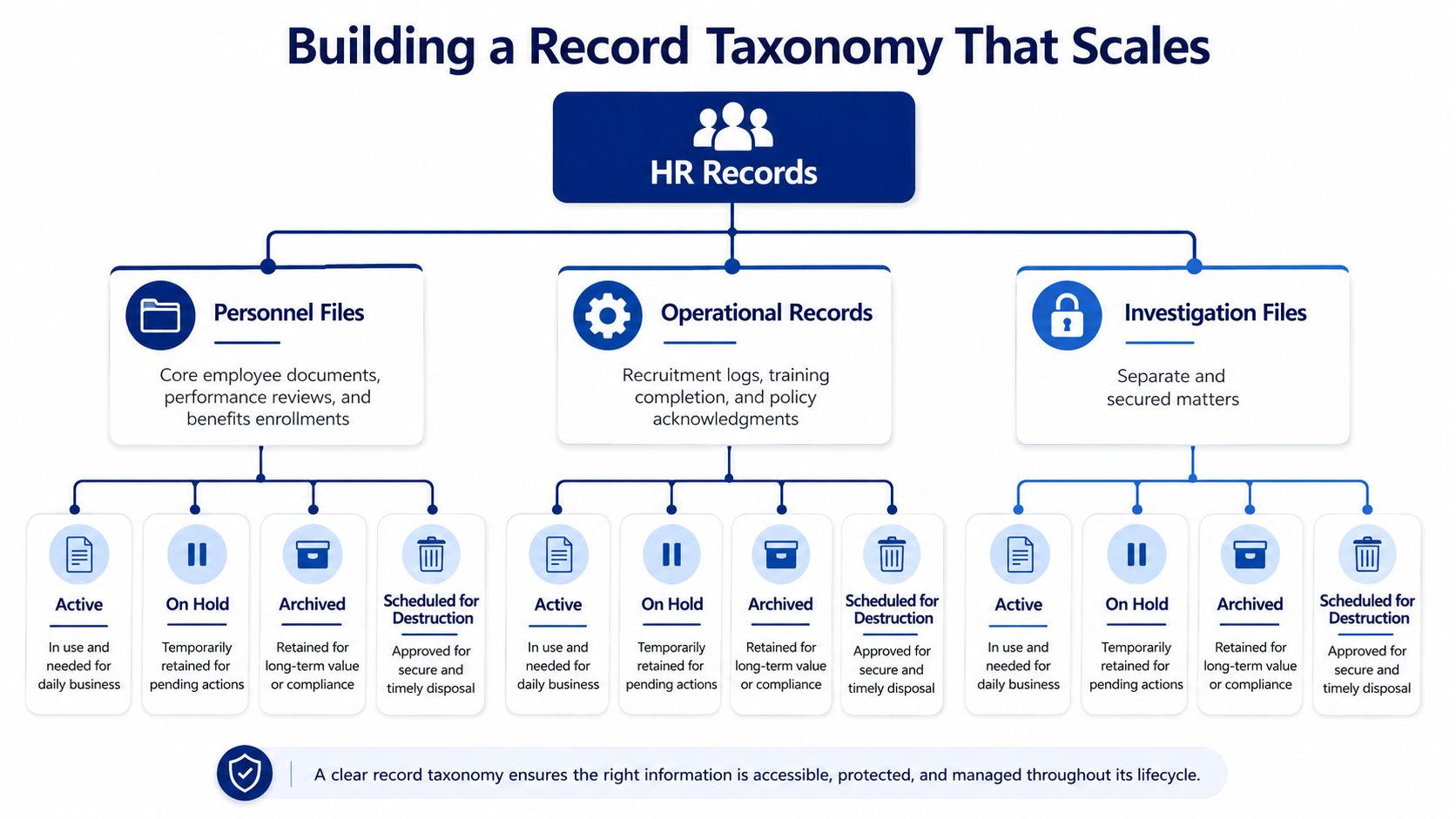
Tagging everything by employee seems convenient, but it hides different retention clocks and access requirements. A single employee folder may contain a payroll record, a leave document, a medical certification, and an investigation file. Those records shouldn't have identical permissions or deletion dates.
Use a naming convention that includes employee identifier, record class, event type, and date. A SharePoint library can support this structure when administrators define permissions, metadata, version history, and document ownership. Teams that need a practical starting point can review how to use SharePoint for documents before configuring their HR libraries.
A promotion illustrates the value of classification. The event may create a personnel record reflecting the role change, a payroll record reflecting the new wage rate, and an operational record showing updated approvals or training. One event, three record classes, three access rules, and potentially different retention treatment.
A manager's note can strengthen a decision or expose the company to risk. Write what the manager observed, not a judgment about the employee's character. “Poor attitude” and “not a team player” fail because they omit the conduct, context, expectation, and business effect.
Use four fields in every performance or disciplinary entry:
Write the note while the timeline is clear. Contemporaneous documentation preserves facts before recollections shift. The guidance in How to Document Disciplinary and Performance Problems emphasizes immediate entries, dates, specific facts, and the employee's response.
A coaching note captures an informal discussion and the expectation communicated. A written warning should identify the deficiency, applicable policy or standard, required correction, and consequences of continued failure. A performance improvement plan should set measurable expectations, support, review points, and consequences. A final warning should explain the escalation and state what another failure may mean. Use a structured guide to writing a performance improvement plan before issuing a formal plan.
Managers should not maintain unofficial “shadow files” outside HR's controlled process. A private working note can prepare a manager for a conversation, but HR must determine whether the material is a temporary coaching record, belongs in the personnel file, or requires formal escalation. That classification controls access, retention, and later review.
| Scenario | Weak Entry | Strong Entry |
|---|---|---|
| Missed deadline | “Jordan has a poor work ethic.” | “The client report was due on Tuesday. Jordan submitted it on Thursday after two reminders, which delayed the scheduled client review.” |
| Meeting conduct | “Taylor was disruptive.” | “During the operations meeting, Taylor interrupted the presenter repeatedly and continued after being asked to hold questions until the discussion ended.” |
| Quality issue | “Morgan is careless.” | “The submitted payroll report contained missing employee entries and required correction before processing could proceed.” |
Never backdate a note or edit it without version history. Preserve the original, keep the content job-related, and record the employee's explanation fairly. Consistent templates and manager coaching help distributed teams apply the same standard across locations without turning documentation into a filing exercise.
A retention schedule should begin with federal floors and then account for stricter state requirements, business practice, legal holds, and the nature of the record. The mistake I see most often is treating one retention period as if it applies to every document connected to an employee.
For employers covered by EEOC rules, most personnel or employment records must be retained for one year from the date the record was made or the personnel action occurred, whichever is later. Involuntary-termination records must be kept for one year from termination, and relevant records must remain available until a charge or agency matter is finally resolved. These requirements appear in the EEOC recordkeeping requirements.
Payroll records generally require three years under ADEA and FLSA-related requirements, while records explaining wage-rate differences between men and women must be retained for at least two years, as summarized in the EEOC payroll recordkeeping materials. FMLA records must be kept for at least three years, including leave dates and hours, notices, policies, benefit-premium records, and eligibility disputes, according to the Department of Labor FMLA recordkeeping guidance.
State overlays may impose longer requirements for personnel and payroll records. California, New York, Illinois, and Massachusetts should not be treated as interchangeable with the federal baseline. Before an employer selects a destruction date, HR should identify the employee's work locations, applicable state rules, record category, and any open matter.
| Record Type | Federal Minimum | Longest State Requirement | Practical Recommendation |
|---|---|---|---|
| Personnel and employment records | One year under EEOC rules | Varies by jurisdiction | Retain at least one year after separation, then apply the strictest applicable state rule |
| Involuntary-termination records | One year from termination | Varies by jurisdiction | Preserve through the applicable state period and any charge or hold |
| Payroll records | Three years under ADEA and FLSA-related rules | Varies by jurisdiction | Retain for at least three years, then apply the longer state requirement |
| Pay-difference records | At least two years | Varies by jurisdiction | Maintain separately so the correct clock can be applied |
| FMLA records | At least three years | Varies by jurisdiction | Keep leave and supporting administrative records together, with medical information separately secured |
| Investigation files | Category-dependent | Varies by jurisdiction and matter | Retain through the related personnel requirement and any active hold |
Minimums aren't maximums. A pending charge, audit, lawsuit, threatened claim, or legal hold stops ordinary deletion. Train managers and administrators on the schedule, and use resources on how to launch internal compliance training so the policy reaches the people who create records.
A practical retention schedule for HR teams should identify the record owner, access group, trigger date, destruction authority, and hold procedure. Review the schedule whenever the organization enters a new jurisdiction or changes its HR systems.
An investigation file is a standalone matter record, not an attachment to the personnel file. Open it when the matter begins and assign a unique identifier. The file should contain the complaint, defined scope, interview notes, evidence log, witness statements, communications, analysis, final determination, and corrective action.
Use a restricted digital or physical folder with access limited to the investigator, designated HR leaders, and legal counsel when appropriate. Maintain an access log. The personnel record can state the outcome and resulting action, while investigative details remain in the matter file.
Investigations may involve email, Slack, Teams, social media, surveillance video, and badge access logs. Preserve each original source, identify the collector, record the collection time, and avoid editing the underlying file. A screenshot without context can carry less weight than the original message export with its timestamp and surrounding conversation.
Investigation standard: Preserve evidence first, analyze it second, and write conclusions only after the factual record is complete.
Apply consistent file names that include the matter identifier, evidence type, source, and date. Store interview notes separately from the final determination memo. The memo should identify the allegation, evidence reviewed, findings, rationale, and corrective action in neutral language. Remove inflammatory descriptions and unnecessary medical information.
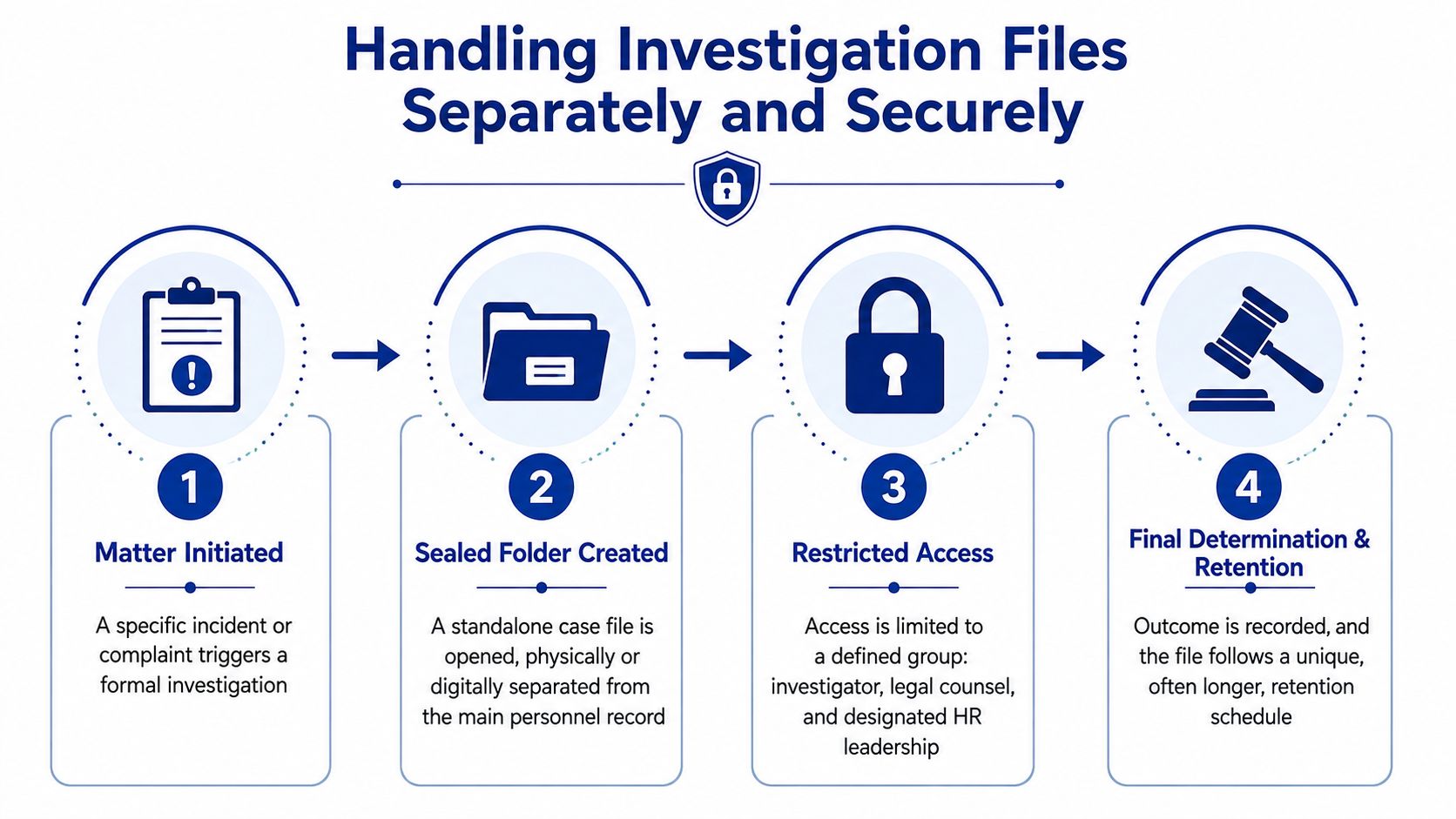
Retain the investigation file for at least the period required for the related personnel record. Extend preservation while a legal hold or connected matter remains active. Closing the investigation does not authorize deletion.
Document the closure decision with the retention category, hold status, responsible owner, and approved destruction process. Tie these fields to the organization's record taxonomy and retention schedule so distributed HR teams classify and preserve files consistently across jurisdictions.
Separate files reduce unnecessary exposure during discovery and help prevent confidential witness information or preliminary analysis from being mistaken for the final employment decision. They also give HR a reliable audit trail when leaders later ask why the organization acted.
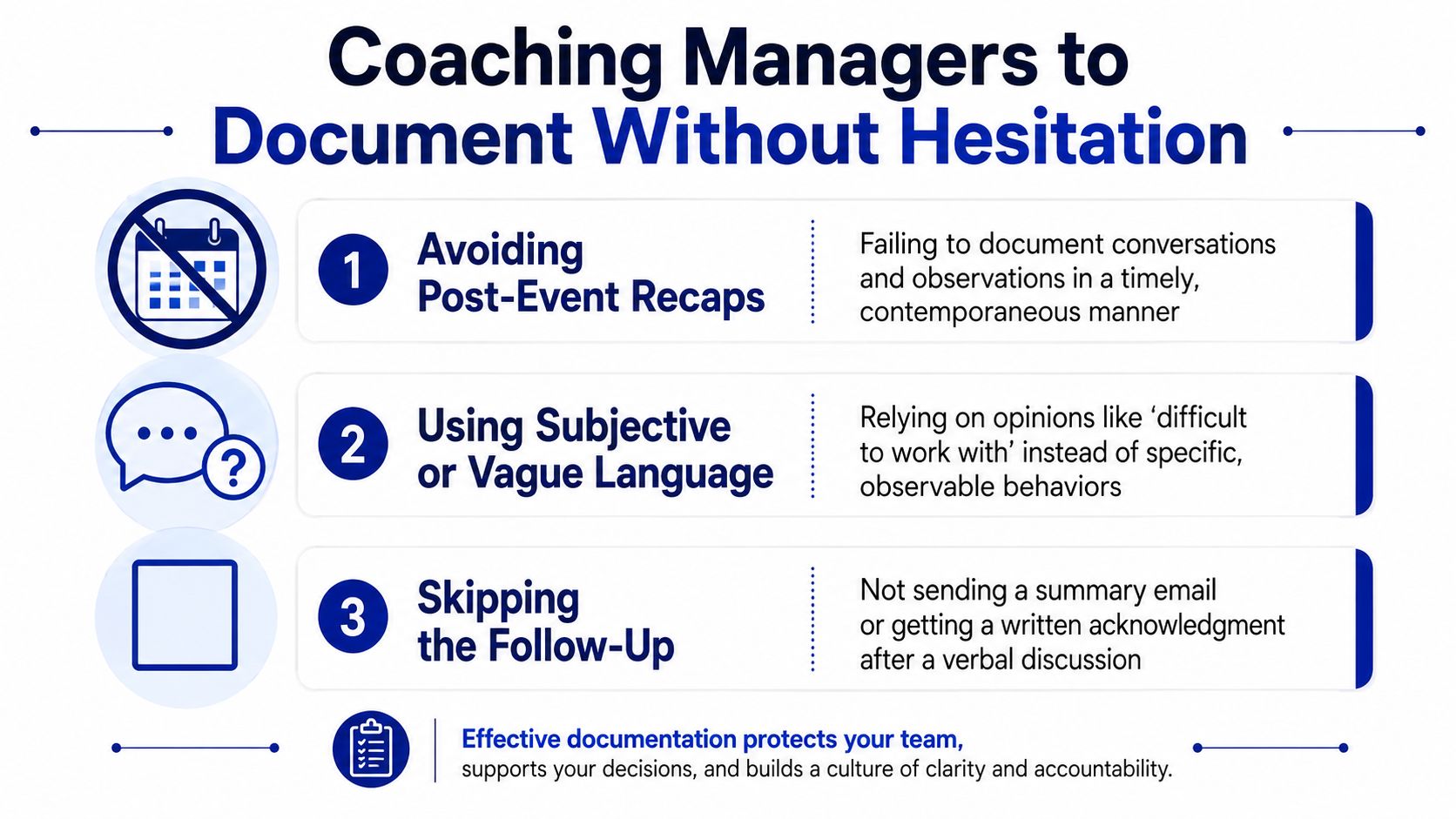
Manager coaching has the greatest effect on documentation quality. A policy fails when a people leader treats documentation as optional, and an HR platform cannot repair a record that was never created. In litigation, the missing entry often matters as much as the flawed one.
Three habits create avoidable deposition problems:
Set a 48-hour entry standard for significant conversations and observations. Managers should write sooner whenever practical. The deadline creates consistency across distributed teams, while prompt documentation preserves the event accurately. Each entry must distinguish observation from interpretation and connect the conduct to a clear job expectation.
After a significant performance conversation, require the manager to answer five questions:
HR should sample manager records monthly for delayed entries, vague language, missing employee responses, inconsistent treatment, and sensitive information placed in the wrong record category. Correct drift early. A short review with the manager is more effective than discovering a pattern during litigation.
Documentation shows that the manager gave the employee clear expectations and a fair chance to respond. It should also capture positive feedback, support offered, standards clarified, and follow-up completed. Managers document more consistently when the practice reflects responsible management throughout the employee relationship, rather than appearing only when termination is being considered. Consistent coaching also helps HR apply the organization's record taxonomy and retention schedule correctly across jurisdictions.
Defensibility comes from the interaction of four controls. Classification puts each record in the right place. Contemporaneous writing creates a credible timeline. Retention scheduling prevents premature destruction. Secure file separation protects sensitive investigative and medical information.
A manager's day-one checklist should be short enough to use and specific enough to prevent improvisation:
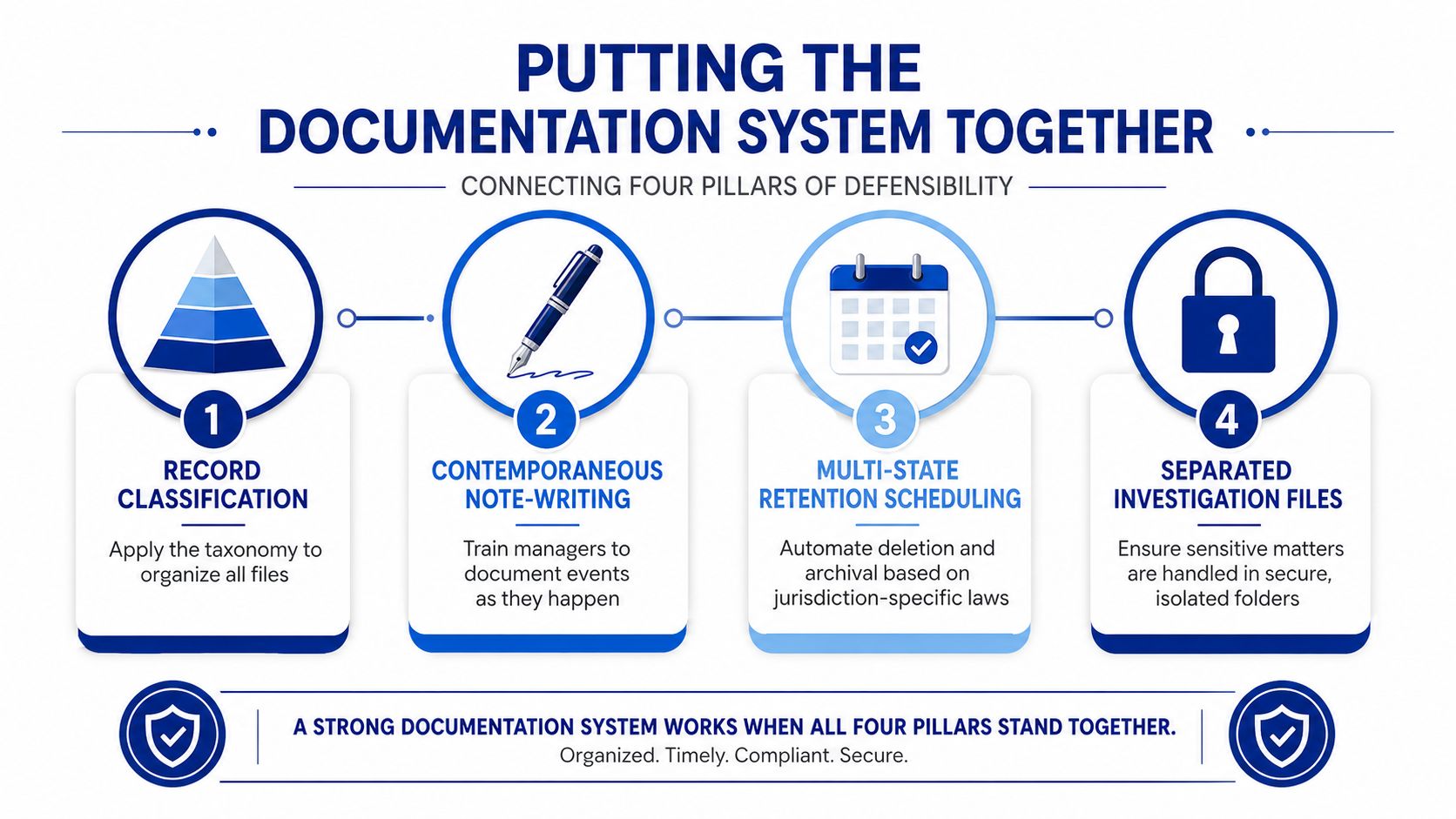
A team at the first level relies on email, memory, and manager-specific habits. The next level has templates but inconsistent filing and unclear permissions. A more reliable operation has a taxonomy, documented ownership, category-based retention, controlled investigations, and recurring manager reviews.
The mature system produces the right record by default. Managers know where to file a correction, HR knows when to escalate, administrators know which clock applies, and leadership can trace a decision without reconstructing it from scattered inboxes.
The system should be tested before a high-risk termination, EEOC charge, or state labor audit. Review a sample of personnel, payroll, leave, medical, investigatory, and separation records. Confirm that each record is complete, accessible to the right people, protected from alteration, and subject to an enforceable retention rule.
Paradigm International Inc. supports SMB leadership teams with advisory guidance on terminations, investigations, manager conduct, documentation standards, and multi-state compliance decisions. To strengthen your documentation controls before a difficult employee decision arises, visit Paradigm International Inc. and discuss the structure your leadership team needs.