You're probably dealing with this right now. Payroll is running, a manager wants to hire a high school student, one location just added seasonal staff, and someone on your team is still assuming “small business” means lower compliance risk. In Maryland, that assumption causes problems fast.
The main issue with labor laws in Maryland isn't finding a list of statutes. It's understanding where ordinary operating decisions create legal exposure. Headcount changes, county lines, tipped roles, youth hiring, inconsistent documentation, and poorly handled separations are where small and mid-sized employers get burned. If you want a useful approach, stop treating compliance as a poster on the breakroom wall and start treating it like a control system tied to payroll, scheduling, and manager behavior.
Most Maryland wage problems don't start with bad intent. They start with bad setup.
A business owner approves a pay rate that seems compliant, payroll codes a tipped role loosely, or a location manager doesn't realize that headcount changes affect the minimum wage path for the business. That's how wage claims begin. The safest approach is to build pay practices around the most demanding rule that applies to the worker, then audit those rules every time your staffing model changes.
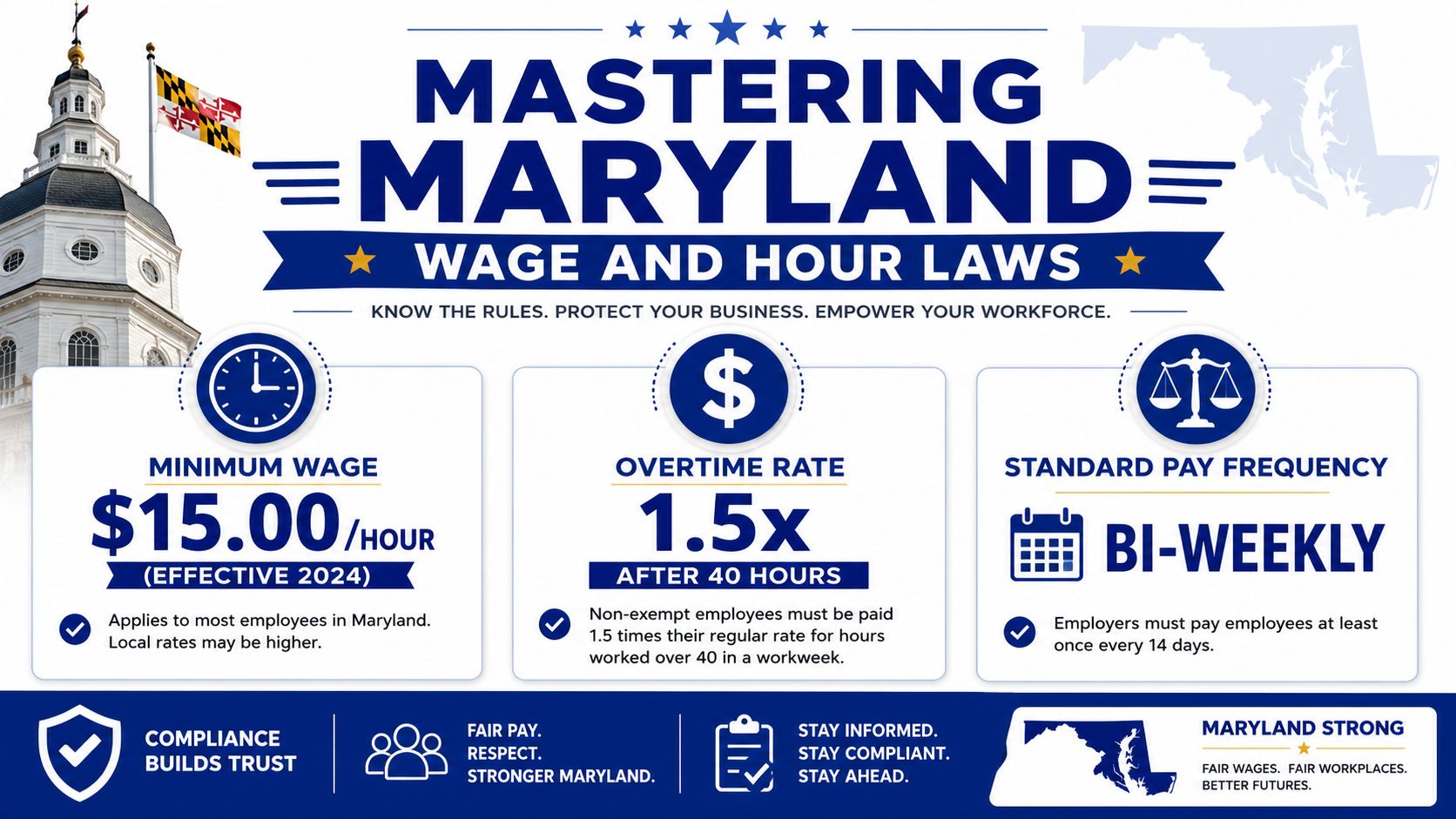
Maryland's wage framework is not one flat number. Under the Fair Wage Act of 2023, the state minimum wage rose to $15 per hour effective January 1, 2024, while employers with fewer than 15 employees followed a phased path of $13.40 on January 1, 2024, $14.00 on January 1, 2025, and a scheduled increase to $14.60 on January 1, 2026, before reaching $15.00 on July 1, 2026. Maryland also sets a tipped wage floor of $3.63 per hour, and minors under 18 may be paid 85% of the state minimum wage, as summarized in this Maryland wage law guide.
That means your payroll team needs answers to three questions before each pay cycle:
Practical rule: If your payroll system can't flag wage differences by employee type, worksite, and employer size, it isn't protecting you.
Many employers focus on the hourly rate and forget the downstream issue. If the base rate is wrong, overtime calculations are wrong too. That compounds risk because underpayment doesn't stay limited to straight time.
Use a simple operating standard:
A practical payroll review should answer whether employees are being paid on the correct base rate, whether tipped employees reach the required minimum when tips are included, and whether youth-rate decisions are documented and lawful. If you can't answer those questions cleanly from records, you have an exposure issue, not just an administrative inconvenience.
The best Maryland employers don't memorize statutes. They build guardrails.
A strong setup usually includes:
Maryland wage compliance is operational work. Treat it that way and you'll avoid most of the problems that lead to expensive cleanup later.
Leave compliance in Maryland trips up businesses that think coverage is obvious. It often isn't.
The biggest mistake is assuming only full-time staff count when determining whether the business is covered. That's wrong, and it creates preventable risk. Once your Maryland headcount crosses the applicable threshold, leave and break obligations can attach whether leadership noticed the trigger or not.
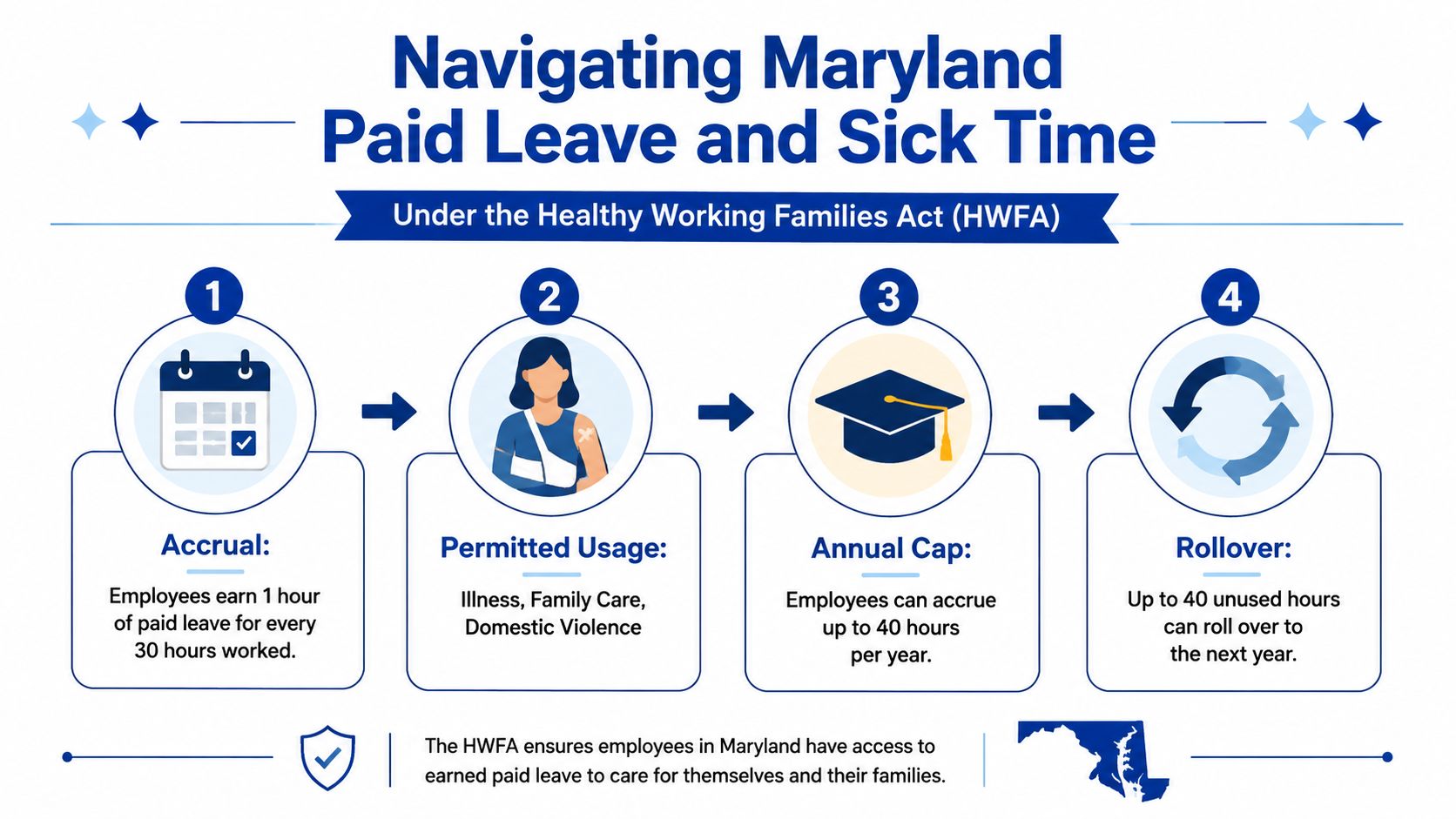
Maryland's Healthy Working Families Act applies once an employer has 15 employees in Maryland, and the state counts full-time, part-time, temporary, and seasonal workers for that threshold. The retail shift-break law applies to employers with 50 Maryland employees, again counting Maryland workers rather than only full-time staff, as outlined in the Maryland paid leave FAQs.
That matters because many businesses scale unevenly. One location may look small on its own, while the overall Maryland operation is large enough to trigger legal obligations. Franchise groups, seasonal operations, and multi-site employers miss this all the time.
Leave compliance falls apart when managers handle it casually. A supervisor says, “Just use PTO,” another asks for a doctor's note too early, and payroll applies a different rule than operations. That inconsistency creates the claim, not just the underlying leave request.
Use a standard workflow:
If your leave process still lives in text messages and supervisor memory, it isn't defensible.
Businesses usually don't fail leave compliance because the law is unreadable. They fail because nobody owns the process from request to documentation.
A lot of employers treat every absence under one generic PTO bucket. That's convenient, but it can create legal confusion. Different leave categories can trigger different rights, notice rules, and documentation expectations.
If you need a practical starting point for leave administration, this overview on managing a leave of absence from work is a useful operational reference. The key is to separate policy language, manager training, and payroll handling so each group knows its role.
The safest move is simple. Review your Maryland headcount quarterly, not annually. Waiting until open enrollment or year-end policy review is too late for a law that can be triggered by how you staff during the year.
Most discrimination claims don't begin with a dramatic event. They begin with inconsistency.
One candidate gets a structured interview. Another gets a casual conversation. One manager asks only job-related questions. Another wanders into medical history, family obligations, or assumptions about availability. If your hiring process changes depending on who is interviewing, your legal risk rises with every requisition.
Business owners often believe fairness is enough. It isn't. You need repeatable process.
A defensible hiring system includes:
This also applies after hire. Harassment and discrimination claims often gain traction because managers respond differently to similar behavior. One employee receives coaching. Another receives discipline. A third gets ignored. That uneven treatment is hard to defend.
Instinct-led hiring creates avoidable bias. Managers tend to favor candidates who feel familiar, communicate like they do, or seem easier to work with. None of that proves job fit.
Use a simple comparison model during hiring:
| Hiring step | High-risk approach | Better approach |
|---|---|---|
| Job posting | Broad, vague language | Role-specific duties and expectations |
| Interviewing | Free-form conversation | Consistent questions by role |
| Evaluation | “Best culture fit” | Written criteria tied to performance needs |
| Selection notes | Sparse or subjective | Clear business-based reasons |
That same discipline should show up in everyday management. If you want to reduce discrimination risk, don't wait for a complaint. Audit who gets opportunities, who gets corrected, and who gets excluded from communication.
A respectful workplace doesn't happen because leadership values respect. It happens because managers are trained, decisions are documented, and policy enforcement is consistent.
Three habits create recurring problems:
The strongest anti-discrimination strategy is operational discipline. Tight hiring workflows, trained supervisors, and documented decision-making do more to reduce risk than polished policy language alone.
Terminations are where weak HR habits become expensive. A sloppy exit can turn a performance issue into a wage claim, retaliation claim, or credibility problem.
Most businesses don't need a more aggressive termination process. They need a cleaner one. If the employee's file is thin, the manager is emotional, and payroll is guessing about deductions or timing, stop and reset before you act.
A defensible separation process should feel almost mechanical. Emotion is the enemy here.
Before any termination, confirm:
Managers often want to “just move on.” That impulse causes preventable mistakes. A rushed termination meeting, especially after a complaint or protected leave issue, can undo months of otherwise reasonable management.
Many employers create unnecessary conflict by trying to settle unrelated problems through the final paycheck. Missing property, damaged equipment, uniform issues, or disputed advances should never be handled casually. If you don't have clear legal footing and clear written support, don't improvise.
A safer operating model is:
The employee doesn't have to agree with the termination. They do need to receive accurate pay and a professionally managed exit.
How you terminate matters almost as much as why. The meeting should be short, factual, and controlled. Don't debate. Don't over-explain. Don't let an untrained manager freelance legal language.
Use this structure:
If the employee challenges the decision, repeat the decision and move to logistics. The goal is not persuasion. The goal is a clean, documented separation with minimal additional risk.
A termination process should protect the business and preserve dignity. If yours does neither, it needs work.
Maryland takes youth employment seriously, and employers should too. This is not an area for casual scheduling or manager guesswork.
If your business hires students for retail, food service, hospitality, recreation, or front-desk work, you need close control over both scheduling and records. Minor labor compliance is detailed enough that one well-meaning supervisor can create a problem by extending a shift or skipping a break.
Maryland requires work permits for all minors under 18. Workers aged 14 and 15 generally cannot work more than 3 hours on a school day, 18 hours in a school week, or more than 5 consecutive hours without a 30-minute nonworking break. For 16- and 17-year-olds, combined school-and-work time is capped at 12 hours per day, and they must receive 8 consecutive hours of non-school, non-work time in each 24-hour period, according to this summary of Maryland child labor rules.
Those rules are specific enough that managers shouldn't be expected to remember them from memory. Build them into scheduling practice.
Use controls like these:
Even when the underlying pay practice is lawful, weak records make employers look unreliable. In a dispute, the business that can produce clean records usually stands on firmer ground than the business relying on memory.
Your recordkeeping framework should include:
Manager warning: If a supervisor can change a minor's shift informally, you don't have compliance control. You have hope.
The broader lesson is simple. Child labor compliance and payroll documentation belong together. The same discipline that protects you on youth scheduling also protects you in wage disputes, leave conflicts, and termination reviews.
The hardest part of labor laws in Maryland isn't the state rule by itself. It's the overlap.
A company can satisfy a statewide wage requirement and still be wrong at the county level. That's where many growing employers get exposed. They centralize payroll, assume one Maryland standard applies everywhere, and miss the local ordinance that changes the actual rate they should have used.
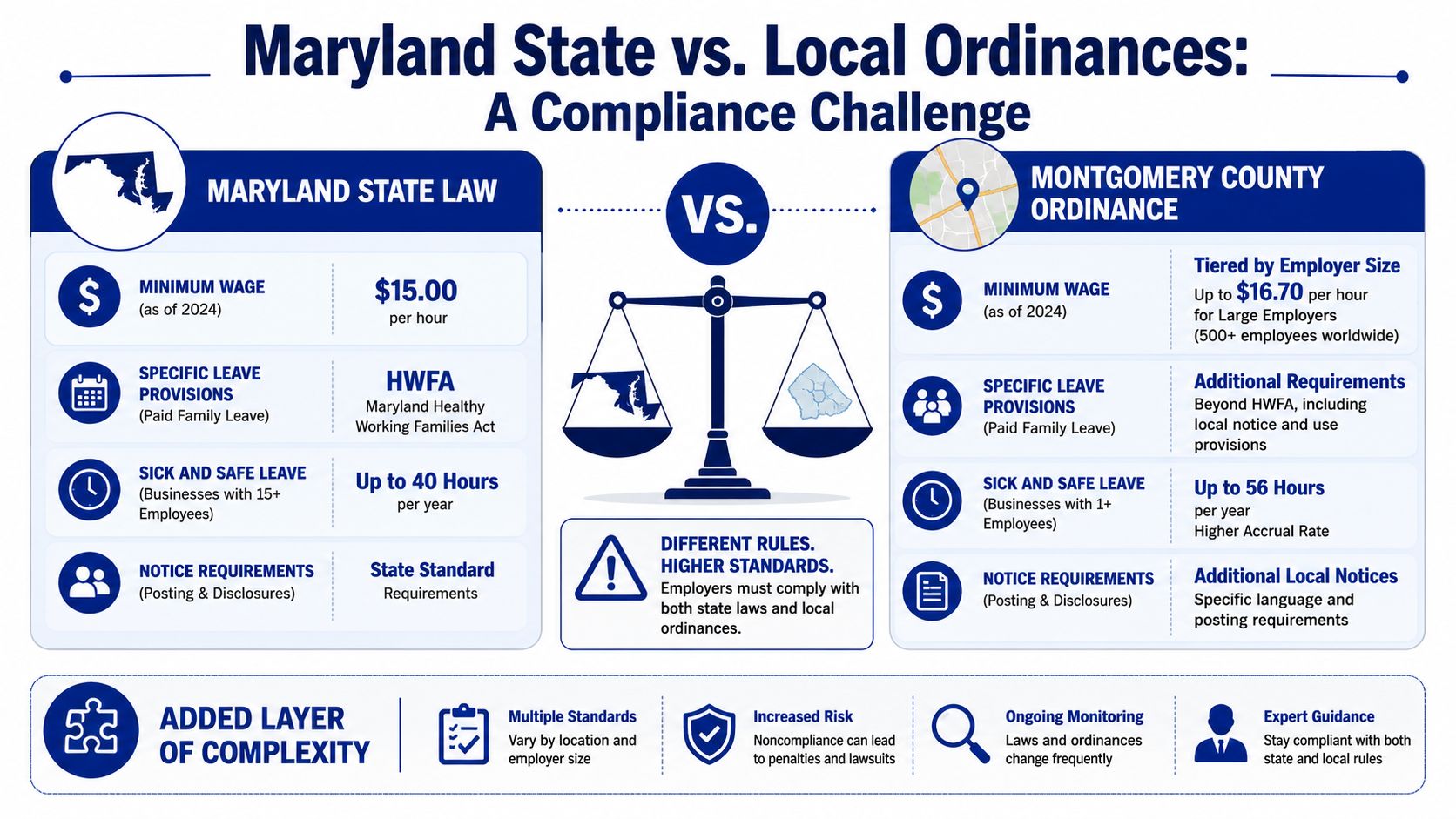
Maryland's wage floor becomes a layered compliance issue when local law imposes a higher standard. The statewide minimum wage is $15.00 per hour, but Montgomery County sets $15.50 per hour for employers with 11 to 50 employees and $17.15 per hour for employers with 51 or more employees, as described by the Maryland People's Law Library wage overview.
That's not a technical footnote. It affects payroll setup, job offers, and overtime calculations. If your payroll team uses the wrong base rate for a Montgomery County employee, the error can flow through multiple pay categories.
If your business operates in more than one jurisdiction, you need a written hierarchy for deciding which law controls. Without that, local managers create workarounds and payroll applies broad assumptions.
A practical hierarchy looks like this:
| Compliance question | First check | Second check | Final action |
|---|---|---|---|
| Wage rate | Work location | Employer size | Apply highest valid requirement |
| Leave rule | State coverage | Local overlay | Route to centralized review |
| Scheduling practice | State restrictions | Site-specific realities | Document approved exception process |
This same mindset matters outside Maryland. If you're comparing how different states handle employee risk obligations, resources like these workers' comp details for Alabama show how quickly compliance expectations can shift across borders. The point isn't Alabama specifically. The point is that multi-state employers need systems, not assumptions.
For a broader operational view, this guide to wage and hour compliance across employers is useful when building cross-jurisdiction payroll controls.
If you operate in Maryland with multiple sites, start here:
The businesses that handle this well don't necessarily have larger HR teams. They just treat location data as a legal input, not a mailing address.
Documentation is where compliance becomes real. Policies alone don't protect an employer. Records do.
When a claim hits, nobody asks whether leadership cared about fairness in the abstract. They ask what the handbook said, what the manager documented, what payroll recorded, what the investigation file shows, and whether the business handled similar situations the same way. If those records are incomplete or inconsistent, your position weakens quickly.
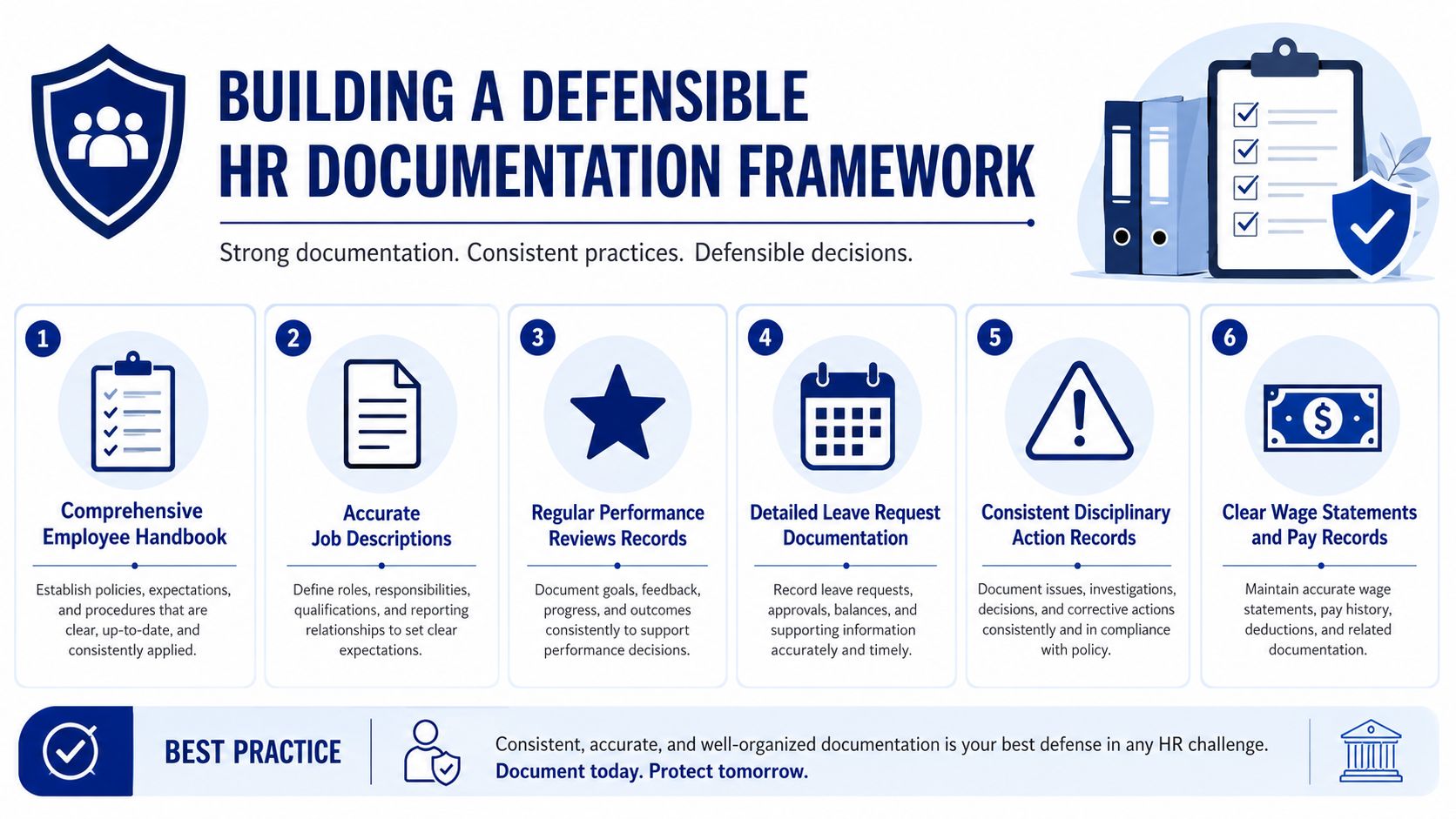
Every Maryland employer should have a core documentation set that is current, centralized, and actively used. Not stored. Used.
Focus on these records first:
Weak documentation usually reveals a deeper management problem. The business tolerates informal decisions, managers aren't trained to write objective notes, and HR steps in only after the issue has escalated.
Most legal exposure doesn't come from no documentation. It comes from bad documentation.
Managers need a simple standard:
Here's the difference. “Employee was disrespectful and impossible” is weak. “Employee interrupted the supervisor twice during the team meeting, refused the assigned task, and left the work area after being instructed to remain” is useful.
“If a manager can't explain an employment decision in plain, factual language, the file probably won't support the decision later.”
Not every interaction needs a memo. High-risk employment moments do.
Prioritize documentation in these situations:
Structure matters more than software. A simple, disciplined folder system beats a complex platform used inconsistently. That said, if your current files are scattered across inboxes, shared drives, and manager desktops, it may help to review a practical guide to open source DMS solutions before choosing how to centralize records.
For retention planning, this resource on employment records retention requirements is a useful operational reference point. The bigger issue is not just how long you keep documents. It's whether you can retrieve the right record quickly, in complete form, with consistent naming and access control.
A defensible HR documentation framework should answer a few blunt questions:
If the answer is no, fix the system now. Don't wait for a complaint, agency inquiry, or attorney letter to expose the gaps.
The strongest employers in Maryland usually do three things well. They centralize key records, train managers to document facts, and review files before making high-risk decisions. That combination is what turns HR from reactive administration into real risk control.
Maryland employers don't need more generic HR advice. They need disciplined systems that hold up when pay practices, leave decisions, hiring choices, and terminations are challenged. If your team needs a clearer structure for managing labor laws in Maryland and reducing preventable exposure, Paradigm International Inc. can help you build a more defensible approach.