
A manager has just recommended termination after a performance concern. The employee disputes the facts, another manager remembers the situation differently, and someone reaches for a generic disciplinary form. The form captures a few dates and signatures, but it doesn't explain what was investigated, which evidence was reviewed, who had decision authority, or whether the same standard applied in another state.
The right HR documentation template should organize facts, preserve chronology, clarify accountability, and reveal missing information. It should not replace judgment, a fair process, or legal review. This list evaluates ten resources by the high-stakes decision each one helps document, the evidence it preserves, its multi-state limitations, and the point at which an SMB should seek advisory support.
The resources appear in a practical order. The list begins with specialized compliance workflows, then moves through handbook systems, employment documents, everyday forms, paper-based records, and HRIS platforms. Multi-state employers should customize fields, approval steps, retention practices, access controls, and escalation triggers before putting any template into use.
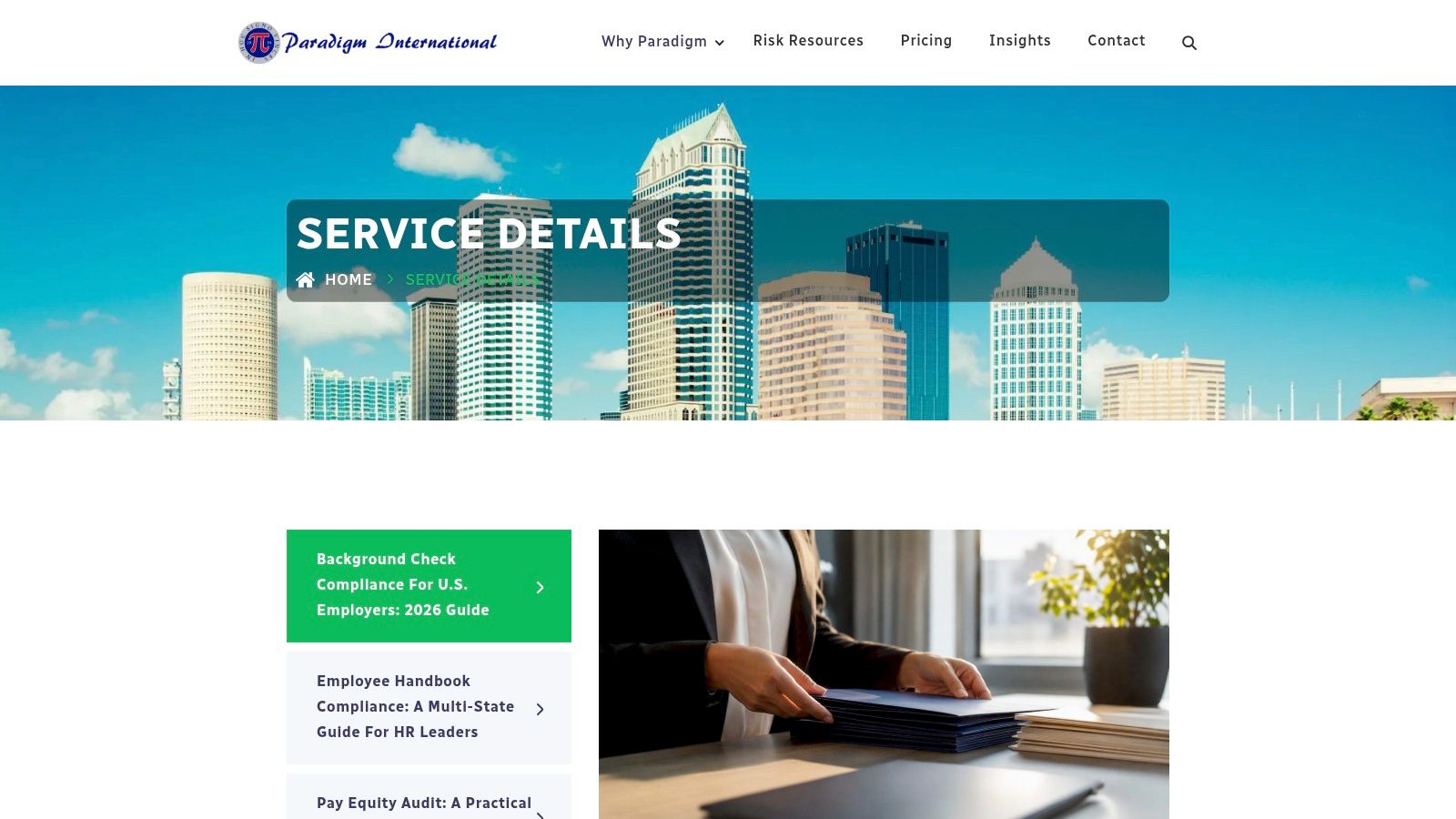
For a hiring decision involving a criminal record or other background-check information, Background Check Compliance for U.S. Employers 2026 Guide is the strongest specialized resource on this list. The Paradigm International background-check compliance guide combines a standalone disclosure, written authorization, pre-adverse action notice, final adverse-action notice, individualized-assessment guidance, and a multi-state compliance checklist.
That sequence matters because the defensible record isn't just the final hiring decision. It includes what the applicant was told, what authorization was obtained, what information was considered, whether the applicant had an opportunity to respond, and who made the final decision. The guide helps an SMB create a consistent workflow instead of asking each manager to improvise after receiving a report.
The resource is particularly useful when an employer needs to show that it separated the existence of a record from the individualized decision about employment. Its documentation can preserve the relevant facts, the assessment process, communications with the applicant, and the timing of adverse-action steps.
Its multi-state checklist also helps identify where a single national process may be inadequate. State and local rules can affect disclosures, assessments, notices, and timing, so a generic form isn't enough for an employer hiring across jurisdictions.
Practical rule: Use the template to standardize the process, then escalate when the facts, role, jurisdiction, or proposed decision falls outside the documented workflow.
The guide isn't a substitute for legal advice specific to your situation. Complex cases, regulated roles, novel state requirements, inconsistent records, or a decision that could create discrimination concerns require experienced review. The documents also need periodic maintenance because employment requirements change.
It suits SMB owners, HR leaders, and executive teams that need deployable documents with an advisory-first approach. For a broader view of how documentation fits into compliance and risk governance, review this compliance and risk governance overview. Employers should also document who approved the decision and where the final records are stored, rather than treating completed notices as the entire file.
SHRM is the best broad reference for an HR team that needs templates across the employment lifecycle. Its member library includes sample policies, toolkits, checklists, and how-to resources for hiring, leave, pay practices, discipline, investigations, and related HR work.
The high-stakes decision SHRM supports depends on the resource selected. A performance template can help a manager document expectations and feedback. An investigation toolkit can help HR identify interviews, evidence, findings, and follow-up actions. A policy template can help establish a consistent baseline before an employee issue arises.
SHRM's main advantage is breadth. It gives teams a common vocabulary and a starting point for routine documentation, especially when an internal HR function needs guidance across several topics. Its US-centric compliance explainers can also help leaders identify questions that need deeper review.
Full access requires membership, and pricing isn't always displayed up front. Quality and specificity vary by topic, so a template that works for a routine policy acknowledgment may be insufficient for a contested termination or investigation.
The resource preserves structure more reliably than it preserves case-specific judgment. Managers still need to record observable facts, dates, witnesses, employee responses, and the decision-maker's reasoning without turning conclusions into supposed facts.
Use SHRM as a broad reference library and training aid. Don't assume that a downloadable form automatically reflects every state or local requirement affecting the employee.
A broad library is valuable at the start of a process. It becomes risky when the team treats a general template as a final answer for a disputed, multi-state decision.
Seek advisory support when the template doesn't explain which facts must be collected, who should approve the outcome, or how the process changes by jurisdiction. Those omissions matter more than the appearance of a polished form.
XpertHR, part of LexisNexis Risk Solutions, is designed for organizations that need policy and handbook content with deeper state and local coverage. Its 50-state handbook builder applies federal, state, and municipal logic, while its policy templates and legal update alerts support ongoing maintenance.
The central decision it helps document is whether the employer's written rules accurately reflect the locations where employees work. That makes it useful for handbook adoption, policy updates, and changes that affect multiple business units. It also helps preserve the connection between a policy version, the jurisdiction it addresses, and the point at which the employer updated or published it.
XpertHR is a strong choice for regulated or growing organizations with a substantial multi-state footprint. Content developed with major employment law firms and editorial guidance tied to evolving US laws give HR teams a more structured way to monitor change than a static document saved to a shared drive.
Its limitation is fit and procurement. Pricing is quote-based and not publicly listed, and the platform is generally better suited to mid-market or enterprise teams than to an SMB that needs a few forms. A small employer may pay for breadth it doesn't use.
A handbook platform can show what policy the employer issued and when it changed. It won't, by itself, prove that managers applied the policy consistently, investigated an exception, or made a fair decision in a particular case. Those records require separate investigation, performance, discipline, and approval documentation.
Use XpertHR when handbook accuracy and update workflows are the central risk. Seek advisory support when a policy conflict, employee complaint, or inconsistent manager practice requires interpretation rather than publication.
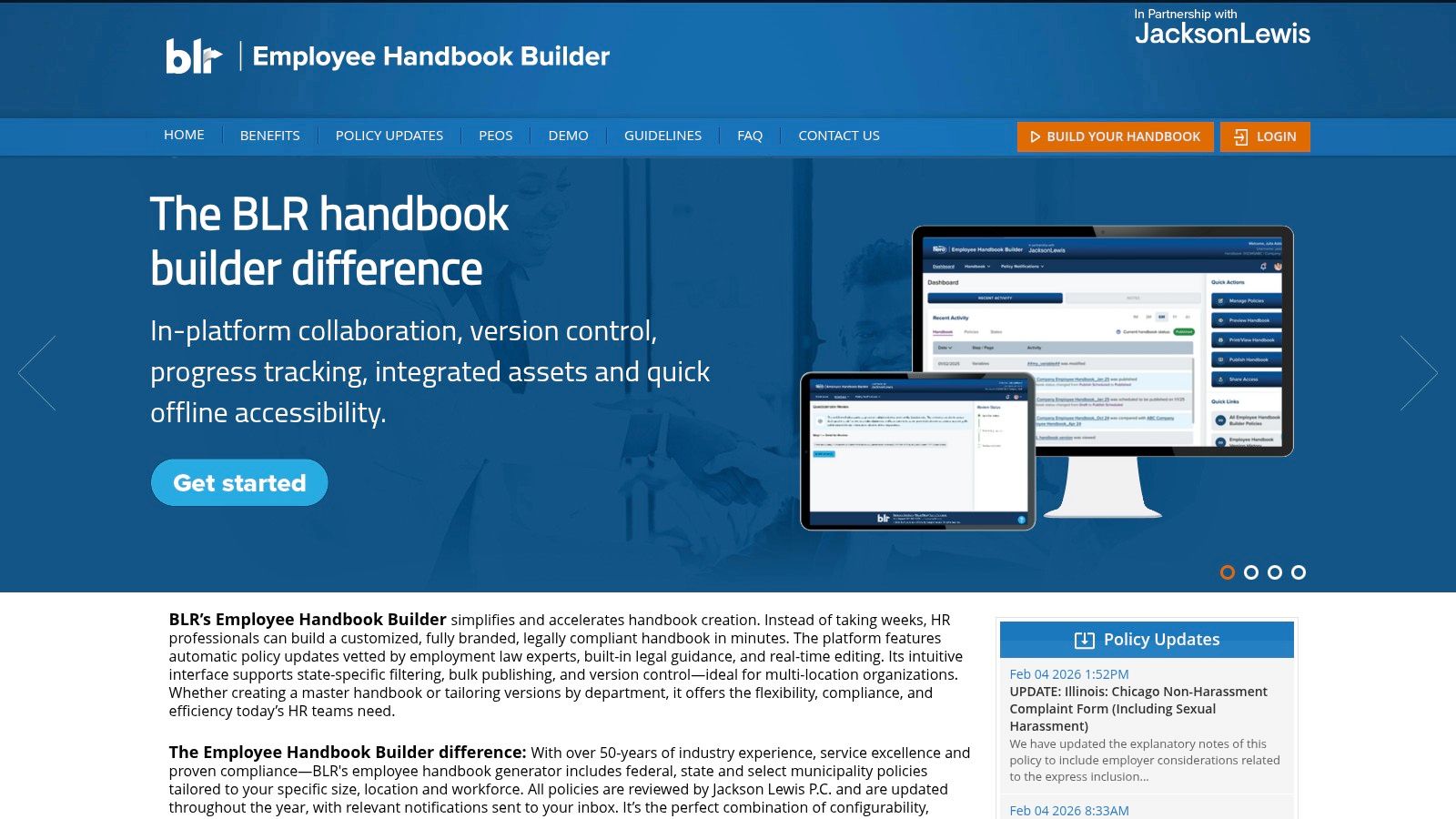
The BLR Employee Handbook Builder is a practical choice for an SMB that needs a guided handbook without commissioning a custom build. It uses policy logic to address federal, state, and selected municipal requirements, with update alerts, version history, and hosted or PDF distribution.
The decision it helps document is the employer's adoption and communication of workplace rules. That includes which policies were included, which version was published, how the handbook was distributed, and whether employees acknowledged receipt. A dated version history is useful when leadership needs to establish which rules applied at the time of an incident.
BLR's published SMB pricing makes evaluation more straightforward than a sales-led platform with no public pricing. The product also benefits from credible legal backing and a content partnership with Jackson Lewis. Those attributes make it useful for leadership teams that need a repeatable handbook process but don't have the resources to build state addenda manually.
The limitation is scope. The builder is primarily a handbook product, not a complete system for investigations, discipline, accommodations, performance records, or employee-file architecture. A signed handbook acknowledgment won't document whether a manager followed the policy.
For a broader explanation of jurisdiction-specific handbook issues, use the Paradigm International handbook guide. Employers should compare the builder's coverage with their actual workforce locations and business structure before publishing.
Use BLR for policy consolidation, version control, and employee acknowledgment. Add separate workflows for complaints, investigations, discipline, and legal holds. The base price has a single-user limit, and additional users cost extra, so define who owns drafting, approval, publication, and archival responsibilities before implementation.
Mineral, formerly ThinkHR and now part of Mitratech, is a strong option for employers that already receive it through a PEO, payroll provider, benefits broker, or another partner. Its dynamic Smart Employee Handbook builder, HR law library, forms, training modules, change alerts, and access to credentialed HR advisors support ongoing compliance maintenance.
The high-stakes decision here is whether the employer's handbook and routine HR practices remain aligned as laws and policies change. Mineral can preserve the policy version, the update process, training activity, and related employee acknowledgments. That creates a stronger record than a handbook that sits unchanged in a shared folder.
Mineral's partner distribution can make it accessible without a separate direct procurement process. Its multi-state handbook maintenance is particularly useful for employers that need recurring updates but don't have an internal employment-law monitoring function.
The tradeoff is that direct pricing is rarely public, and the platform may exceed the needs of an employer seeking only a few forms. Access to HR experts can also depend on the plan or partner arrangement, so leaders should confirm what support is included.
A compliance library won't decide whether a particular termination is supported by consistent evidence. It won't interview witnesses, resolve disputed facts, or determine whether a manager's explanation is credible. Those decisions require a documented process with defined roles and escalation points.
Use Mineral for maintaining the policy environment around everyday HR decisions. Escalate when a complaint, accommodation, investigation, or termination requires case-specific judgment. The tool is most valuable when the employer treats its alerts and templates as inputs to a controlled review process, not as automatic approval.
SixFifty Employment Docs is built for employers that want a focused system for multi-state employment documents. It provides handbook generation and state addenda, employment documents such as offer letters, agreements, and policies, version history, update workflows, and a free HR form library with an employment subscription.
The high-stakes decision it supports is whether the employer used the correct document for the employee's location, role, and employment event. A state addendum can be linked to the core handbook, while an offer letter or agreement can preserve the terms presented to the employee. Version history helps show what changed and which version was in circulation.
SixFifty is a better fit than a single universal form for a multi-state SMB. The employer can organize documentation by document type and jurisdiction rather than forcing every employee into identical language. That approach matters because a core file, a state addendum, and a role-specific agreement may serve different purposes.
The platform's scope is narrower than a full HRIS. It focuses on documents and compliance rather than employee administration, payroll, or broad people operations. Pricing tiers are shown, but final pricing often involves sales, so leadership should assess total fit rather than comparing only the form library.
For a related termination document, this contractor termination letter sample can help illustrate why worker classification and the relationship being ended should be reflected in the record.
Use SixFifty for repeatable document generation and update control. Seek advisory support when the agreement doesn't match the actual arrangement, the worker's status is disputed, a termination follows protected activity, or a state addendum doesn't clearly resolve the issue. A technically current document can't cure a flawed decision process.
Workable HR Templates is the most accessible starting point for routine HR documentation. Its library includes policies, letters, job descriptions, emails, and other downloadable resources. The templates are useful when a small employer needs baseline language quickly and doesn't yet have a centralized document system.
The decision it helps document is usually operational rather than highly adversarial. A manager can use a job description to clarify expectations, an onboarding document to collect information, or a communication template to create a consistent message. These records can support later decisions when the employer adapts them to the actual employee and stores the final version.
Downloaded copies don't provide automated legal tracking or update control. Once a template is saved locally, the employer owns the responsibility for checking jurisdictional requirements, reviewing changes, controlling versions, and removing outdated copies from circulation.
That limitation matters for multi-state employers. A general performance or policy template may omit a state-specific notice, approval step, or required distinction. It may also use language that sounds definitive without identifying which facts a manager should record.
Workable is appropriate for low-risk, repeatable documents that will receive internal review. It isn't the right sole resource for a contested investigation, termination, accommodation, or multi-state policy conflict.
Use a free template to create a first draft. Don't use it to bypass the review that makes a high-stakes record defensible.
Before adoption, assign an owner, add the employee's location and role, define the approval path, and record the review date. For higher-risk matters, have an HR advisor or counsel assess both the language and the process behind it.
Rocket Lawyer gives small teams a broad catalog of employment forms and agreements, including offer letters, employment contracts, nondisclosure agreements, handbooks, and policy documents. Its interactive builders, e-signature capabilities, document management features, and attorney support add-ons make it useful for self-service work with optional assistance.
The high-stakes decision it helps document is the creation and execution of an employment agreement or related business document. The record can preserve the terms presented, the completed document, signatures, and the date of execution. That evidence is valuable when the dispute concerns what the parties agreed to.
Rocket Lawyer is convenient when a business needs several types of documents in one place. On-call attorneys can also provide Q&A or consultation support with membership, which may help a small employer identify issues before finalizing a routine document.
The language remains generic, and complex multi-state policies still need counsel or qualified HR review. A form that works for a straightforward offer may not address a state-specific wage notice, a regulated role, a restrictive covenant issue, or a termination following a complaint.
Its value is strongest with ongoing membership rather than one-off use. That can make sense for a business with recurring document needs, but leadership should be clear about what attorney support includes and what it doesn't.
Use Rocket Lawyer for routine agreements and structured execution. Escalate when the facts are disputed, the document will govern a sensitive relationship, or the employer needs a coordinated investigation, discipline, or termination record. E-signature proves execution. It doesn't prove that the underlying decision was fair or consistently applied.
ComplyRight HR Forms is designed for employers that need a tangible paper trail for routine HR events. Its ready-to-use warning, appraisal, application, time, pay, and labor-law poster materials support consistent paper-based filekeeping. Multi-part carbonless sets can create copies for the employee, manager, and records file.
The high-stakes decision it helps document is the occurrence of a routine performance or discipline event. A completed warning form can preserve the conduct at issue, the expected correction, the employee's response, and the signatures associated with the conversation. That structure is better than an informal note that exists only in a manager's inbox.
ComplyRight doesn't provide the same digital automation, searchability, version control, or access management as a document platform or HRIS. Paper forms can be misplaced, copied inconsistently, or stored alongside records that should have restricted access. They also require a clear process for scanning, indexing, securing, and retaining the final record.
For multi-state employers, standardized paper forms should be treated as a base layer, not a complete compliance system. A form may need state-specific fields, additional notices, or different approval steps. Managers need instructions on what belongs in the record and what should be escalated.
For practical guidance on a difficult separation question, see this Paradigm International rehiring advice. Use ComplyRight when physical documentation is part of the operating environment. Move beyond paper when the business needs audit trails, controlled access, reliable retrieval, or coordinated records across locations.
BambooHR is the strongest fit for an organization that wants HR documentation embedded in its employee system of record. Its platform includes policy, form, and agreement templates, offer-letter and email workflows, e-signatures, compliance resources, and update notifications.
The decision it helps document is the completion and approval of recurring employee workflows. An offer letter can move through a defined signature process. A policy acknowledgment can be linked to the employee record. A form can be stored where authorized HR users already manage employment data, reducing the risk that the final version remains in a manager's personal folder.
Embedding templates in an HRIS can improve consistency because the employer controls where documents are created, routed, signed, and stored. It can also make it easier to identify missing acknowledgments or incomplete steps.
BambooHR's access and features vary by plan tier, and it may be excessive for an employer that only needs a few documents. It also isn't a replacement for case-specific judgment. A workflow can show who completed an action, but it won't independently assess whether the decision was supported by facts or whether a manager applied the same standard elsewhere.
Use BambooHR when the business needs broader HRIS capabilities alongside document workflows. Confirm access permissions for sensitive records and establish separate handling for medical, investigation, and legal materials. Escalate a high-risk matter before routing it through a routine workflow, especially when the form doesn't capture disputed facts, protected activity, or the rationale for the decision.
| Product | Target audience | Core features | Compliance & defensibility | Pricing / access |
|---|---|---|---|---|
| Background Check Compliance for U.S. Employers: 2026 Guide (Paradigm) | SMBs & multi‑state leadership teams; decision partners | FCRA & state-aware templates (disclosure, auth, pre-/final adverse); individualized assessment guidance; multi‑state checklist | High, audit-ready templates + advisory-informed guidance; not a substitute for tailored legal advice | Productized toolkit (purchase); one‑off or package; requires periodic review |
| SHRM (Society for Human Resource Management) | HR pros seeking broad coverage and learning resources | Large member library of templates, policies, toolkits, explainers, community resources | Good US‑centric compliance guidance; quality varies by topic; membership adds updates | Membership required for full access; pricing/membership details not always public |
| XpertHR (LexisNexis) | HR teams in regulated, multi‑state organizations | 50‑state handbook builder; curated policy templates; legal update alerts | Strong legal pedigree and deep state/local logic; suited for complex compliance | Quote‑based, sales‑led pricing; mid‑market/enterprise focus |
| BLR Employee Handbook Builder (BLR/HR Hero) | SMBs needing guided handbook generation | Guided policy logic; multi‑state/municipal coverage; version control and hosting | Attorney‑vetted content (partnered with Jackson Lewis); frequent updates | Published SMB pricing; base tier limits users (additional cost for extras) |
| Mineral (formerly ThinkHR / Mitratech) | Organizations buying via PEOs, brokers, payroll partners | Dynamic handbook builder; law library; templates/forms; advisor access (plan‑dependent) | Good for ongoing multi‑state handbook upkeep and alerts | Sold via partners; pricing often bundled or partner‑discounted |
| SixFifty Employment Docs | Multi‑state SMBs prioritizing defensible documents | Unlimited document generation; handbook + state addenda; version history; automated updates | High, document automation with update workflows and auditability | Annual subscription model; tiered pricing (sales engagement common) |
| Workable HR Templates (HR Toolkit) | Small teams needing free starting templates | 1,000+ downloadable templates (policies, letters, job descriptions) | Generic baseline language; requires jurisdictional tailoring; no auto‑updates for downloads | Free access to templates; optional Workable platform trial |
| Rocket Lawyer | Small teams seeking self‑serve legal docs with on‑demand help | Interactive document builders; e‑signature; attorney Q&A/consults (add‑on) | Broad employment forms; useful ad‑hoc legal support but templates are generic | Membership recommended for best value; attorney consults often extra |
| ComplyRight HR Forms | Employers needing tangible, consistent paper records | Pre‑printed, multi‑part HR forms (warnings, appraisals), posters, kits | Simple defensible paper trail for HR events; limited digital automation | Per‑item / kit purchases; widely available via retailers |
| BambooHR (Compliance Intelligence & templates) | Organizations wanting templates inside their HRIS | Embedded templates, offer letter/email workflows, e‑signature, compliance library | Templates live in system of record; update notifications vary by plan | HRIS pricing by tier; template/features availability depends on plan |
The best HR documentation template is the one that matches the decision, not the one with the most attractive layout. For background-check decisions, the Paradigm International guide provides the most focused sequence of disclosures, authorizations, notices, and individualized assessment guidance. For handbooks and state addenda, XpertHR, BLR, Mineral, and SixFifty offer stronger multi-state structures than general download libraries.
SHRM is the broadest reference for teams building an HR resource base. Workable is a practical free starting point for routine documents. Rocket Lawyer fits self-service agreements with optional attorney support. ComplyRight remains useful when a business needs a physical paper trail. BambooHR is the better choice when templates should live inside a broader HRIS workflow.
The comparison should start with the HR event:
Retention requires particular care. The EEOC recordkeeping requirements state that private employers must retain personnel records for one year from the date the record was made or the personnel action occurred, whichever is later. For an involuntary termination, the personnel or employment records must be retained for one year from the termination date. Employers should treat that as a federal baseline and check for stricter applicable rules.
The rule differs for educational institutions and state and local governments. The EEOC summary of selected recordkeeping obligations states that relevant personnel records generally must be retained for two years for those employer categories, with a two-year period also applying after involuntary termination. A template system that doesn't identify employer type, retention trigger, and applicable jurisdiction is incomplete.
A useful records policy should also define its purpose and scope, record categories, roles, retention schedule, storage requirements, disposal procedures, legal holds, and compliance requirements. The record retention policy template from Lattice illustrates why a schedule should name specific classes such as personnel files, payroll records, I-9 forms, applications, tax documents, contracts, and safety incident reports. It should also identify the responsible owner, storage location, and hold status.
Escalate to advisory support when the matter involves a termination, investigation, accommodation, disputed facts, protected activity, regulated role, or multiple states that the template doesn't clearly address. The same applies when managers disagree about what happened, the record contains emotional or speculative language, or the proposed action departs from past practice.
A generic form can collect information. It can't determine whether the information is complete, whether the process was fair, or whether the final decision is defensible. Leadership teams should use templates to create structure, then apply judgment and obtain review when the consequences justify it.
For organizations that still manage records manually, the operational risk is substantial. One HR technology summary reported that 82% of organizations use electronic recordkeeping for at least some HR files, while a separate compliance metric cited a 25% failure rate on at least one recordkeeping requirement in Department of Labor audits in 2023 (HR employee records summary). Digital storage alone won't solve the problem, but structured records, clear ownership, and controlled access can make missing evidence easier to detect.
Manual handling remains common. One independent survey reported that 84% of respondents managed employee files by hand and/or with paper, while 11% used a dedicated document-management system. The same survey reported that 66.4% expected document-compliance burden to increase over the next three years, and 41.9% of HR teams spent 10% to 25% of weekly time on document management (HR document-management survey). Those findings reinforce a practical point: the system around the template matters as much as the form itself.
Paradigm International's advisory approach is suited to SMB leadership teams that need deliberate decisions rather than reactive administration. Learn more about its support for terminations, investigations, manager conduct, documentation standards, and multi-state compliance through Paradigm International's advisory contact page.
Paradigm International Inc. helps owners, COOs, executive teams, and HR leaders document high-stakes employee decisions with structured, defensible processes. If your organization needs help with investigations, terminations, manager documentation, or multi-state HR risk, visit Paradigm International Inc. to learn more.